Chinese Hamster Ovary Cell Market Size, Share & Industry Analysis, By Offering (Products [CHO Cell Lines, Cell Culture Media, Expression Systems, Feeds, and Vectors & Selection Systems] and Services), By Workflow (Transient Expression, Stable Cell Line Development, Process Development & Scale-up, and Commercial Bioproduction Support), By Application (MAb Production, Recombinant Protein Production, Biosimilar Development, and Toxicology & Basic Research), By End User (Pharmaceutical & Biotechnology Companies, CROs/CDMOs, and Academic & Research Institutes), and Regional Forecast, 2026-2034
 Download Free Sample
Chinese Hamster Ovary Cell Market Size and Future Outlook
 Listen to Audio Version
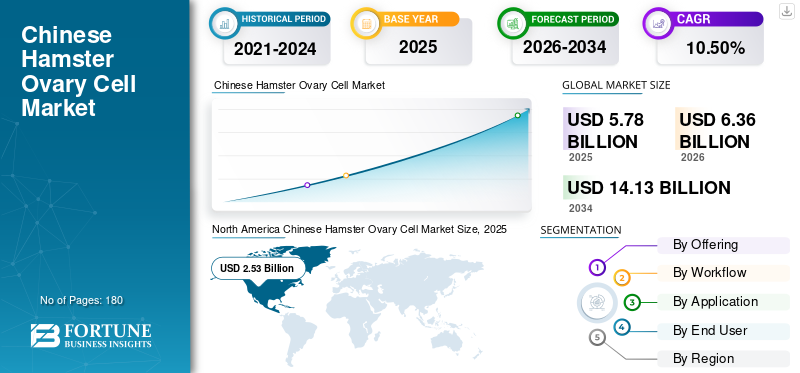
The global Chinese hamster ovary cell market size was valued at USD 5.78 billion in 2025. The market is projected to grow from USD 6.36 billion in 2026 to USD 14.13 billion by 2034, exhibiting a CAGR of 10.50% during the forecast period. North America dominated the global market with a market share of 43.77% in 2025.
Chinese Hamster Ovary (CHO) cells are the backbone of modern biopharmaceutical manufacturing, especially in the production of monoclonal antibodies (mAbs) and other therapeutic proteins. The market comprises products and services used for CHO-based biologics development and production. The market is growing due to the increasing biologics pipeline, rising monoclonal antibody and biosimilar development, growing outsourcing to CROs/CDMOs, and recurring demand for CHO media, feeds, supplements, and process optimization tools.
Key players in the global market include Thermo Fisher Scientific Inc., Merck KGaA, Danaher Corporation, Sartorius AG, and Lonza, among others. Robust portfolios of CHO products, extensive geographic reach, and a focus on innovation are several factors underpinning the leadership of these companies in the worldwide market.
Download Free sample to learn more about this report.
CHINESE HAMSTER OVARY CELL MARKET TRENDS
Shift Toward Integrated CHO Expression Platforms is a Remarkable Market Trend
The CHO cells market is experiencing a distinct transition from individual products to comprehensive expression platforms that merge CHO host cells, vectors, selection systems, optimized media, feeds, and process development assistance. This trend is influenced by the desire to minimize clone screening duration, enhance expression stability, boost protein yields, and speed up timelines for biologics development. Integrated platforms hold significant importance for monoclonal antibodies, bispecific antibodies, Fc-fusion proteins, and other intricate recombinant proteins, as stable and scalable CHO cell lines are essential. Suppliers and CDMOs are thus promoting CHO platforms as comprehensive productivity solutions instead of separate consumables. These factors are supporting the global Chinese hamster ovary cell market growth.
- For instance, in September 2025, WuXi Biologics launched TrueSite TI, the fourth-generation WuXia targeted-integration CHO cell line platform. The company stated that the platform achieved average mAb titers above 8.0 g/L, maintained stable expression in over 99% of clonal cell lines after 60 generations, and enabled a 6-month IND timeline.
MARKET DYNAMICS
MARKET DRIVERS
Download Free sample to learn more about this report.
Increasing Monoclonal Antibody Pipeline to Propel Market Growth
The growing monoclonal antibody pipeline significantly boosts the market as CHO platforms are extensively utilized for mAb expression, stable cell line creation, media/feed enhancement, and clinical-scale manufacturing assistance. With the progression of antibody candidates through discovery, clinical trials , and regulatory evaluation, the need for CHO cell lines, expression systems, vectors, selection systems, and cell banking services rises. This directly enhances continuous product sales along with outsourced CHO cell line creation and testing services.
- For instance, in the June 2025 “Antibodies to Watch” publication, the antibody therapeutics pipeline was reported to include over 200 marketed antibody therapeutics and nearly 1,400 investigational antibody candidates in clinical studies, highlighting a large addressable demand base for CHO-based mAb development and production workflows.
|
Rank |
Market Drivers |
Overall Impact Rank |
CAGR Contribution (2026-2034) |
Impact 2026-2028 |
Impact 2029-2031 |
Impact 2032-2034 |
|
1 |
Rising monoclonal antibody and recombinant biologics pipeline |
High |
+3.50% |
High |
High |
High |
|
2 |
Growing biosimilar development and biologic patent expiries |
High |
+2.90% |
Medium |
High |
High |
|
3 |
Rising outsourcing to CROs/CDMOs for CHO cell line development and bioproduction support |
Medium-High |
+2.60% |
High |
High |
High |
|
4 |
Advancements in high-productivity CHO platforms, media, feeds, and targeted-integration systems |
Medium-High |
+2.20% |
Medium |
High |
High |
|
5 |
Expansion of clinical and commercial bioproduction support for late-stage and marketed biologics |
Medium |
+1.90% |
Medium |
High |
High |
|
6 |
Others |
Low |
+1.50% |
Low |
Low |
Low |
|
|
Total Positive Growth Contribution |
|
+14.6% |
|
|
|
MARKET RESTRAINTS
High Cost of CHO Cell Line Development and Process Optimization to Hamper Market Growth
High cost remains a key restraint in the CHO cell market as stable CHO cell line development requires clone screening, productivity testing, media/feed optimization, stability studies, and scale-up validation before clinical use. These steps increase project timelines and make CHO-based biologics development expensive for small biotech firms, academic users, and early-stage biosimilar developers. The need for advanced platforms shows that companies are actively trying to reduce development cost and complexity rather than relying on conventional lengthy workflows.
- For example, in April 2025, Thermo Fisher Scientific announced an enhanced CHO K-1-based platform designed to reduce IND filing timelines from 13 months to 9 months, highlighting the industry’s need to overcome logistical complexity and high development burden in CHO-based biologics development.
|
Rank |
Market Restraints |
Overall Impact Rank |
Negative CAGR Contribution (2026-2034) |
Impact 2026-2028 |
Impact 2029-2031 |
Impact 2032-2034 |
|
1 |
High cost and long timelines for CHO cell line development, clone screening, optimization, and scale-up |
High |
-1.50% |
High |
Medium |
Medium |
|
2 |
Complex regulatory and product-quality requirements for CHO-derived biologics |
High |
-1.20% |
High |
High |
High |
|
3 |
Competition from alternative expression systems such as HEK293, microbial, yeast, and insect-cell platforms |
Medium |
-0.90% |
Medium |
Medium |
High |
|
4 |
Others |
Low |
-0.50% |
Low |
Low |
Low |
|
|
Total Negative Growth Impact |
|
-4.10% |
|
|
|
MARKET OPPORTUNITIES
CDMO Partnerships and Outsourced CLD Services to Offer Market Growth Opportunities
The increasing demand for quicker biologics development is presenting a significant opportunity for CDMOs and providers of CHO cell line development services. Numerous small and mid-sized biotech firms do not possess in-house CHO platform capabilities, prompting them to depend on external partners for stable cell line development, clone screening, GMP scale-up, cell banking, and IND-enabling assistance. There is a rising need for comprehensive CHO service models that link early cell line development to clinical and commercial production. All these factors would drive the market growth in the coming years.
- For instance, in March 2025, LOTTE BIOLOGICS and Asimov announced a strategic partnership to accelerate cell line development and scale-up to GMP manufacturing using Asimov’s CHO Edge system at LOTTE’s Syracuse Bio Campus.
MARKET CHALLENGES
Competition from Alternative Expression Systems Poses a Prominent Challenge
Competition from alternative expression systems poses a significant challenge for the CHO cells market, as certain complex proteins, viral vectors, plasmid DNA, and low-yield targets might exhibit superior performance in HEK293, microbial, yeast, or insect-cell platforms. This restricts CHO's obtainable share in specific biologics and research fields, despite CHO still being the leader for numerous mAbs and recombinant proteins. Other platforms may provide quicker transient expression, reduced production costs, or improved compatibility for certain challenging-to-express molecules.
Segmentation Analysis
By Offering
Products Segment Dominated Market Due to Recurring Use of CHO Media, Feeds, and Expression Systems
In terms of offering, the market is divided into products and services. The products segment is further segmented into CHO cell lines, cell culture media, expression systems & cell line development kits, vectors & selection systems, feeds & supplements, and others.
Products captured the largest global Chinese hamster ovary cell market share in 2025, as they are required continuously in CHO-based biologics development. Moreover, media and feeds are consumed in every batch, while expression systems and development kits are used across mAb, recombinant protein, and biosimilar workflows. Additionally, strong demand from pharma companies, CDMOs, and research institutes helped products maintain their leading share.
- For instance, in September 2025, Thermo Fisher Scientific Inc. launched Gibco Efficient-Pro Medium (+) Insulin, an addition to its Efficient-Pro medium and feed system for insulin-dependent CHO cell lines, aimed at improving growth, productivity, and workflow handling in bioprocessing.
The services segment is anticipated to rise at a CAGR of 11.83% over the forecast period.
To know how our report can help streamline your business, Speak to Analyst
By Workflow
Rising Demand from Large-scale Biologics Production Led to Commercial/Clinical Bioproduction Support Segment’s Dominance
On the basis of workflow, the market is divided into transient expression, stable cell line development, process development & scale-up, commercial/clinical bioproduction support, and others.
The commercial/clinical bioproduction support segment accounted for the largest global market share in 2025. CHO-based biologics require continuous support during clinical and commercial production, including GMP-compatible media, feeds, cell bank maintenance, characterization, testing, and process consistency. This workflow generates recurring demand as approved and late-stage biologics need reliable CHO systems to maintain productivity, product quality, and batch-to-batch consistency. Moreover, strong use of CHO cells in antibody and recombinant protein manufacturing helped the segment maintain its leading share. Furthermore, the segment is set to hold a 29.5% share in 2026.
- For instance, in December 2025, CHITOSE and FUJIFILM Biosciences formed a strategic alliance combining CHITOSE’s high-performing CHO-MK cells with FUJIFILM Biosciences’ GMP-manufactured culture media to accelerate biopharmaceutical manufacturing and improve productivity, scalability, and product quality.
The process development & scale-up segment is poised to grow at a CAGR of 11.73% over the forecast period.
By Application
Strong Use of CHO Cells in Antibody Manufacturing Supported MAb Production Segment’s Growth
In terms of application, the market is segmented into MAb production, recombinant protein production, biosimilar development, toxicology & basic research, and others.
The MAb production segment dominated the market in 2025. The segmental dominance is supported by the wide usage of CHO cell lines for the development and manufacturing of monoclonal antibodies due to their ability to support complex protein folding, stable expression, and scalable production. In addition, strong demand from innovator biologics, oncology antibodies, immunology drugs, and infectious disease antibody programs helped the segment maintain its leading position. Furthermore, the segment is set to hold a 46.5% share in 2026.
- For instance, in August 2025, CHO Plus entered into a BARDA BioMaP Consortium project agreement valued at up to USD 10.4 million to develop high-productivity CHO cell lines for manufacturing filovirus monoclonal antibodies, with Avid Bioservices supporting scale-up for industrial production.
The biosimilar development segment is anticipated to rise at a CAGR of 15.50% over the forecast period.
By End User
Pharmaceutical & Biotechnology Companies Led Market as They are Key Developers of Monoclonal Antibodies
On the basis of end user, the market is segmented into pharmaceutical & biotechnology companies, CROs/CDMOs, research & academic institutes, and others.
The pharmaceutical & biotechnology companies segment dominated the global market in 2025, as these companies remained the primary developers of monoclonal antibodies, recombinant proteins, fusion proteins, and biosimilars. These firms require CHO cell lines, media, feeds, vectors, expression systems, cell banking, and process-development support from early discovery through clinical and commercial production. Additionally, strong in-house biologics pipelines and rising investment in advanced antibody manufacturing helped the segment maintain its leading share. Furthermore, the segment is set to hold a 52.9% share in 2026.
- For instance, in September 2025, Eli Lilly announced plans to build a USD 5.0 billion manufacturing facility in Virginia for its emerging bioconjugate platform and monoclonal antibody portfolio, highlighting continued large-scale investment by pharmaceutical companies in biologics manufacturing capabilities.
The CROs/CDMOs segment is anticipated to rise at a CAGR of 13.35% over the forecast period.
Chinese Hamster Ovary Cell Market Regional Outlook
By geography, the market is separated into North America, Europe, Asia Pacific, Latin America, and the Middle East & Africa.
North America
North America Chinese Hamster Ovary Cell Market Size, 2025 (USD Billion)
To get more information on the regional analysis of this market, Download Free sample
North America accounted for the largest market share and was valued at USD 2.32 billion in 2024. In 2025, the region maintained its dominance, with USD 2.53 billion. A strong biologics and monoclonal antibody pipeline, large presence of pharma/biotech companies, and high adoption of advanced CHO expression systems, media, feeds, and cell line development services across the region drive the regional market growth. The region also benefits from rising biosimilar approvals and continued investment in domestic biologics manufacturing capacity.
U.S. Chinese Hamster Ovary Cell Market
The U.S. dominated the North American market and can be analytically approximated at around USD 2.49 billion for 2026, accounting for roughly 39.2% of global revenues.
Europe
The European market size is anticipated to grow at a CAGR of 9.72% during the forecast period. A mature biosimilar ecosystem, strong biologics manufacturing base, and presence of major CHO-related suppliers and service providers in the region support market growth. The region’s growth is also supported by its established regulatory pathway for biosimilars, which encourages demand for CHO cell line development, comparability support, cell banking, and product characterization.
U.K. Chinese Hamster Ovary Cell Market
The U.K. market is estimated to touch around USD 0.30 billion in 2026, representing roughly 4.8% of global revenues.
Germany Chinese Hamster Ovary Cell Market
Germany is projected to reach approximately USD 0.38 billion in 2026, equivalent to around 6.0% of global sales.
Asia Pacific
The Asia Pacific market is expected to reach a valuation of USD 1.40 billion in 2026. Asia Pacific is expected to be the fastest-growing region due to rapid expansion of biologics CDMO capacity, rising biosimilar development, and increasing adoption of CHO-based platforms in China, South Korea, India, and Japan.
Japan Chinese Hamster Ovary Cell Market
Japan is estimated to touch a value of around USD 0.36 billion in 2026, accounting for roughly 5.6% of global revenues.
China Chinese Hamster Ovary Cell Market
China is projected to reach revenues of around USD 0.53 billion in 2026, representing roughly 8.4% of global sales.
India Chinese Hamster Ovary Cell Market
The Indian market is estimated to reach around USD 0.19 billion in 2026, accounting for roughly 2.9% of global revenues.
Latin America and Middle East & Africa
The Middle East & Africa and Latin America regions are likely to witness slower growth over the forecast period. The market in Latin America is projected to hit a valuation of USD 0.29 billion in 2026. Latin America’s growth is mainly supported by increasing biosimilar adoption, gradual expansion of local biologics manufacturing, and higher demand for affordable recombinant biologics and monoclonal antibodies.
In the Middle East & Africa region, the GCC market is projected to reach approximately USD 0.08 billion in 2026, representing about 1.3% of global revenues. The regional growth is driven by rising healthcare investment, increasing demand for biologics, and gradual localization of pharmaceutical and biotechnology manufacturing, especially in GCC countries and South Africa.
COMPETITIVE LANDSCAPE
Key Industry Players
Focus on Integrated CHO Platforms, Media/Feed Systems, and Cell Line Development Services by Key Players Strengthen Market Position
The global Chinese hamster ovary cell market is moderately consolidated, with companies such as Thermo Fisher Scientific Inc., Merck KGaA, Danaher Corporation, Sartorius AG, and Lonza holding notable market shares. Strategic focus on biosimilar development coupled with emphasis on offering innovative products and services is helping companies strengthen their market presence.
- For instance, in March 2024, Sartorius & LFB BIOMANUFACTURING announced a partnership under which LFB BIOMANUFACTURING outsourced CLD services to Sartorius, creating an end-to-end solution from CHO cell line development to clinical manufacturing for therapeutic proteins.
Other key players include American Type Culture Collection, FUJIFILM Corporation, WuXi Biologics, AGC Biologics, and Charles River Laboratories. These companies are focusing on high-productivity CHO expression technologies and faster and more stable CHO biologics development platforms to improve competitiveness during the forecast period.
LIST OF KEY CHINESE HAMSTER OVARY CELL COMPANIES PROFILED
- Thermo Fisher Scientific Inc. (U.S.)
- Merck KGaA (Germany)
- Danaher Corporation (U.S.)
- Sartorius AG (Germany)
- Lonza (Switzerland)
- American Type Culture Collection (U.S.)
- FUJIFILM Corporation (Japan)
- WuXi Biologics (China)
- AGC Biologics (U.S.)
- Charles River Laboratories (U.S.)
KEY INDUSTRY DEVELOPMENTS
- April 2026: Thermo Fisher Scientific Inc. launched the Gibco CHOvantage GS Cell Line Development Kit, a next-generation integrated CHO CLD platform that supports titers of ≥7 g/L in fed-batch cultures, stable pools in around four weeks, and stable clone selection within 14 weeks.
- April 2026: OneCyte & Kemp Proteins signed a strategic partnership to offer high-performance cell line development services using OneCyte’s single-cell platform and Kemp’s protein engineering capabilities.
- March 2026: Sartorius AG launched a genetically engineered CHO host cell line developed through proteomic profiling and targeted genome editing.
- February 2026: NorthX Biologics and Demeetra announced a strategic collaboration combining Demeetra’s high-titer GS (-/-) CHO cell line and CLD technologies with NorthX’s process development, MCB banking, and GMP manufacturing services to reduce tech-transfer risk from gene to GMP.
- April 2025: Cytiva & Asimov collaborated to provide an integrated biologics production solution combining Asimov’s CHO Edge CLD platform, Cytiva HyClone media and feed, and Cytiva Fast Trak process development services.
REPORT COVERAGE
The global Chinese hamster ovary cell market analysis provides an extensive examination of market size and projections for all market segments covered in the report. It provides information on the market dynamics and trends that are anticipated to propel the market during the forecast period. It offers insights into crucial factors, such product innovations, the regulatory landscape, pipeline analysis, and the introduction of new products. Furthermore, the global market report outlines collaborations, mergers & acquisitions, along with significant advancements in the industry within the market. The global market forecast report additionally offers a comprehensive competitive landscape with details on market share and profiles of major active participants.
Request for Customization to gain extensive market insights.
Report Scope & Segmentation
| ATTRIBUTE | DETAILS |
| Study Period | 2021-2034 |
| Base Year | 2025 |
| Estimated Year | 2026 |
| Forecast Period | 2026-2034 |
| Historical Period | 2021-2024 |
| Growth Rate | CAGR of 10.50% from 2026 to 2034 |
| Unit | Value (USD Billion) |
| Segmentation | By Offering, Workflow, Application, End User, and Region |
| By Offering |
|
| By Workflow |
|
| By Application |
|
| By End User |
|
| By Region |
|
Frequently Asked Questions
According to Fortune Business Insights, the global market value stood at USD 5.78 billion in 2025 and is projected to reach USD 14.13 billion by 2034.
In 2025, North America’s market value stood at USD 2.53 billion.
The market is expected to exhibit a CAGR of 10.50% during the forecast period of 2026-2034.
By offering, the products segment led the market.
The increasing monoclonal antibody pipeline is driving market growth.
Thermo Fisher Scientific Inc., Merck KGaA, Danaher Corporation, Sartorius AG, and Lonza are some of the leading players in the global market.
North America dominated the market in 2025.



- 2021-2034
- 2025
- 2021-2024
- 180
Get 30-60 hrs Free Customization
Expand Regional and Country Coverage, Segments Analysis, Company Profiles, Competitive Benchmarking, and End-user Insights.













.webp)






Related Reports
-
US +1 833 909 2966 ( Toll Free )
-
Get In Touch With Us