Citrus Fiber Market Size, Share & Industry Analysis, By Source (Orange, Lemon, Lime, Grapefruit, and Others), By Nature (Conventional and Organic), By Application (Food & Beverages, Animal Feed, Nutraceuticals, Cosmetics & Personal Care, and Others), and Regional Forecast, 2026-2034
 Download Free Sample
(Offer valid till 31st Oct 2026)

Citrus Fiber Market Size and Future Outlook
 Listen to Audio Version
The global citrus fiber market size was valued at USD 167.19 million in 2025. The market is projected to grow from USD 174.18 million in 2026 to USD 243.58 million by 2034, exhibiting a CAGR of 4.28% during the forecast period.Europe dominated the citrus fiber market with a market share of 34.3% in 2025.
Citrus fiber is a plant-centric, natural component extracted from the peels of citrus fruits (lime, oranges, and lemons). It is typically off-white to light yellow in color and has a porous/fibrous structure. Moreover, it is rich in dietary fiber, specifically hemicellulose, pectin, and cellulose, and is widely utilized for its texturizing, water-binding, emulsifying, and stabilizing properties. Moreover, it has low moisture content and a slightly acidic to neutral pH. Regarding applications, the product is used in functional foods, nutraceuticals, beverages, dressings, and numerous industrial applications.
Companies such as Cargill, Incorporated, Tate & Lyle, and Fiberstar, Inc., are prominent players in the market. New product launches remain a pivotal strategy adopted by key players to improve their position.
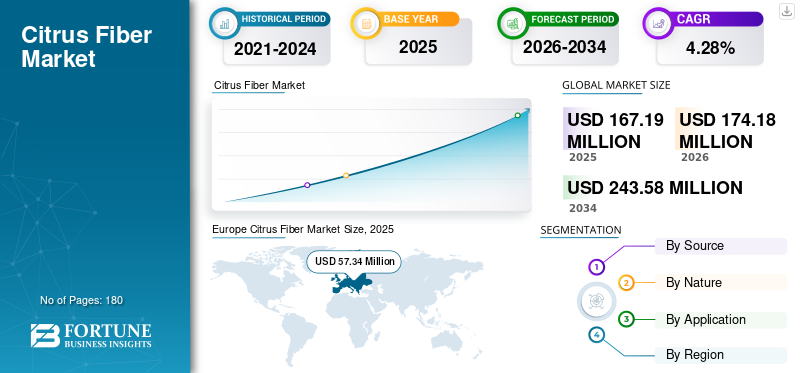
Download Free sample to learn more about this report.
CITRUS FIBER MARKET KEY TAKEAWAYS
 Market Size & Forecast
- 2025 Market Size: USD 167.19 Million
- 2026 Market Size: USD 174.18 Million
- 2034 Forecast Market Size: USD 243.58 Million
- CAGR: 4.28% from 2026–2034
 Market Share
- Europe dominated the citrus fiber market with a 34.3% share in 2025.
- The conventional segment held the largest market share in 2025.
- The organic segment is projected to grow at a CAGR of 6.44% from 2026–2034.
 Key Regional Highlights
North America
North America was valued at USD 44.75 million in 2025, ranking second globally.
Europe
Europe reached USD 57.34 million in 2025 and is expected to grow at a CAGR of 4.13%.
Asia Pacific
Asia Pacific reached USD 41.21 million in 2025, supported by food and pharmaceutical demand.
U.S.
The market stood at USD 36.45 million in 2025, accounting for 21.80% of global sales.
Japan
The market reached USD 8.34 million in 2025, representing 4.99% of global revenue.
Read More

CITRUS FIBER MARKET TRENDS
Increasing Use of Fiber in Functional Cosmetics is a Key Trend
The global industry is observing an emerging trend toward the use of clean ingredients in functional cosmetics. In this modern era, consumers are increasingly inclined toward functional skincare items that provide both therapeutic and aesthetic advantages. This inclination is influencing beauty product manufacturers to move from synthetic ingredients to bio-based components such as citrus fiber. When used in cosmetics the product enhances the texture of creams and lotions. Its water-binding capacity enhances skin hydration by retaining moisture. Additionally, it maintains structural integrity and viscosity under low-pH conditions, thereby bolstering the global citrus fiber market growth.
MARKET DYNAMICS
MARKET DRIVERS
Download Free sample to learn more about this report.
Expanding Alternative Protein/Plant-Based Sector Fuels Industry Expansion
The growing plant-based/alternative protein sector is a pivotal driver boosting the demand for fiber. In vegan meat items, attaining attributes such as firmness and juiciness is difficult due to the absence of connective tissue and animal fat. Citrus fiber is widely used as it helps improve water retention and strengthen the binding between plant-based proteins to overcome such challenges. In dairy substitutes such as plant-based cheese, yogurt, and milk, this fiber enhances creaminess and stabilizes emulsions. Moreover, it improves texture and mouthfeel and offers thaw/freeze stability, specifically in frozen desserts. These advantages are driving greater awareness and acceptance of fiber in food applications.
MARKET RESTRAINTS
High Processing/Production Costs and Restricted Awareness Hinder the Industry's Momentum
One of the main challenges in the market is the high cost of production and processing. In comparison to regular fibers, which use simpler milling/drying processes, the production of citrus fiber requires numerous controlled operations, including removal of soluble solids/sugars, precise drying techniques to retain emulsification properties, and peel stabilization. In order to complete these steps, the producers need specialized equipment such as low-temperature dryers, decanters, and homogenizers. Along with this, high water and energy consumption further add to the expenses. As a result, such high prices restrict its adoption, especially in emerging markets. Another obstacle in the industry is limited awareness of citrus-based fiber. Despite rising traction in Europe and North America, fiber's awareness is relatively low in several developing regions.
MARKET OPPORTUNITY
Technological Advancements in the Fiber Sector Open Lucrative Growth Opportunities
The use of modern technologies in the fiber industry builds several growth opportunities. Producers are adopting energy-efficient methods such as optimized spray drying and low-temperature air drying to retain the functional properties of fiber. Mechanical fibrillation is another method gaining popularity worldwide. This technique aids in breaking down fibers, substantially improving their functional performance and surface area. Moreover, in order to minimize waste production, manufacturers utilize modern fractionation and zero-waste processing technologies. Besides this, most of the businesses are aiming to adopt digital tools to streamline their production process and enhance yield.
Segmentation Analysis
By Source
Orange Segment Dominated the Market Owing to Its Cost Efficiency
On the basis of source, the market is distributed into orange, lemon, lime, grapefruit, and others.
The orange segment dominated the market in 2025. In comparison to other fruits, oranges hold a substantial share of citrus fruit production. Moreover, it's economical to produce orange-based fiber on a large scale, further bolstering the segment's growth. Additionally, compared to other fruits, which offer stronger notes, orange-based fiber imparts a milder taste, making it ideal for culinary applications.
The lemon segment is projected to grow at a high CAGR of 6.14% over the forecast period.
To know how our report can help streamline your business, Speak to Analyst
By Nature
Conventional Segment Led the Market Due to Raw Material Availability For Fiber Producers
Depending on nature, the market is segmented into conventional and organic.
In 2025, the conventional segment captured the key citrus fiber market share. Conventional fruit farming accounts for a higher share of production, which helps in ensuring consistent raw material availability for fiber producers. Compared to organic variants, traditional citrus fruits are cost-effective as they don't require organic certification before marketing. Moreover, large-scale firms primarily prioritize functional performance, making these fruits an ideal choice.
The organic segment is projected to grow at the highest CAGR of 6.44% over the forecast period.
By Application
Food & Beverages Segment Led the Market Due to its Fat-Replacement Capabilities
Based on application, the market is distributed into food & beverages, animal feed, nutraceuticals, cosmetics & personal care, and others.
Food & beverages led the global industry in 2025. In the beverages and food sector, this component is widely used for its effective fat-replacement capabilities and improved functional versatility. Moreover, it enhances moisture retention and reduces the risk of phase separation. Additionally, the product further improves the creaminess, texture, and juiciness of finished items, further bolstering its acceptance rate.
The cosmetics & personal care segment is projected to grow at the highest CAGR of 7.78% over the forecast period.
Citrus Fiber Market Regional Outlook
By geography, the market is categorized into Europe, North America, Asia Pacific, South America, and the Middle East & Africa.
Europe
Europe Citrus Fiber Market Size, 2025 (USD Million)
To get more information on the regional analysis of this market, Download Free sample
Europe dominated the market in 2025, with a valuation of USD 57.34 million. The region is expected to record a growth rate of 4.13% in the coming years. The increasing inclination toward plant-based foods & beverages and the rising number of citrus fiber product developers are driving the regional potential.
Germany Citrus Fiber Market
The German market in 2025 reached around USD 14.44 million, representing roughly 8.64% of the global market revenues.
U.K. Citrus Fiber Market
The U.K. market reached approximately USD 10.41 million in 2025, equivalent to around 6.23% of the global market sales.
North America
North America reached a valuation of USD 44.75 million in 2025 and secured the second-largest position. The market in the region is expected to grow due to the surging use of citrus peel in cosmetics and the growing reliance on long shelf life ingredients. Moreover, the expanding baked goods sector and the increased use of the product in sauces and dressings are driving the market's growth.
U.S. Citrus Fiber Market
Based on North America's strong contribution and the U.S. dominance within the region, the U.S. market stood at around USD 36.45 million in 2025, accounting for roughly 21.80% of global sales.
Asia Pacific
The Asia Pacific region reached USD 41.21 million in 2025 and held the third-largest position. The increasing demand for citrus fiber-based food products and the flourishing pharmaceutical industry are key factors boosting the region's potential. In the region, India and China reached USD 6.32 million and USD 17.04 million, respectively, in 2025.
India Citrus Fiber Market
The India market in 2025 reached around USD 6.32 million, accounting for roughly 3.78% of the global market revenues. The high demand for functional cosmetics and the rising use of orange fiber in animal feed are driving factors in the market.
China Citrus Fiber Market
China's market is projected to be one of the largest worldwide, with revenues standing at around USD 17.04 million in 2025, accounting for roughly 10.19% of global market sales.
Japan Citrus Fiber Market
The Japanese market in 2025 stood at around USD 8.34 million, accounting for approximately 4.99% of the global market revenues.
South America and the Middle East & Africa
The South America and Middle East & Africa regions are expected to witness moderate growth in this market during the forecast period. The South American market is set to reach a valuation of USD 17.15 million in 2025. The robust distribution network and the growing number of local players in citrus fiber products are expected to drive demand. The Middle East and Africa market reached USD 6.74 million in 2025.
South Africa Citrus Fiber Market
The South African market is projected to reach around USD 3.13 million in 2025, representing roughly 1.87% of global revenues.
COMPETITIVE LANDSCAPE
Key Industry Players
Product Innovation Helps Businesses to Improve Their Brand Position
The citrus fiber market comprises a mix of large food ingredient firms and specialized raw material producers competing on clean-label positioning and the product's functionality. Most key players in the market are focusing on new product launches that captivate consumers’ attention to enhance their position in the global industry.
LIST OF KEY CITRUS FIBER COMPANIES PROFILED
- Fiberstar, Inc. (U.S.)
- Tate & Lyle (U.K.)
- Ceamsa (Spain)
- Cargill, Incorporated (U.S.)
- Herbafood Ingredients GmbH (Germany)
- International Flavors & Fragrances Inc. (U.S.)
- Quadra Chemicals Ltd. (Canada)
- FGF Trapani S.p.A. (Italy)
- Florida Food Products, LLC (U.S.)
- Zhengzhou Lemont Sci-Tech Co., Ltd. (China)
KEY INDUSTRY DEVELOPMENTS
- January 2026: CEAMSA, a Spanish raw materials firm, announced the news of expanding its product line by acquiring a fiber range from Peel Pioneers, a Dutch company.
- July 2024: Ingredion Incorporated, a clean-label ingredients supplier based in the U.S., released new citrus fiber, "FIBERTEX CF 500" & "FIBERTEX CF 100" across the EMEA.
- April 2024: CP Kelco, a raw ingredients producer acquired by Tate & Lyle, a British firm, revealed the news of the completion of a USD 60 million citrus fiber plant project.
- January 2023: Fiberstar, Inc., an American plant-centric ingredients enterprise, introduced Citri-Fi 400 series, an organic citrus fiber for the U.S. food industry.
- September 2021: CP Kelco, a subsidiary of Tate & Lyle, a U.K.-based beverage and food solutions company, invested USD 50 million to construct a citrus fiber plant in Brazil.
REPORT COVERAGE
The global citrus fiber market provides an in-depth study of the market size & forecast by all the market segments included in the market reports. The global market forecast analysis includes details on the market dynamics and global market trends expected to drive the market during the forecast period. The global market analysis offers information on the technological advancements, new product launches, key industry developments, and details on partnerships, mergers & acquisitions. The industry forecast also encompasses a detailed competitive landscape with information on the market segmentation, market share, and profiles of key operating players.
Request for Customization to gain extensive market insights.
Report Scope & Segmentation
| ATTRIBUTE | DETAILS |
| Study Period | 2021-2034 |
| Base Year | 2025 |
| Estimated Year | 2026 |
| Forecast Period | 2026-2034 |
| Historical Period | 2021-2024 |
| Growth Rate | CAGR of 4.28% from 2026 to 2034 |
| Unit | Value (USD Million) |
| Segmentation | By Source, Nature, Application, and Region |
| By Source |
|
| By Nature |
|
| By Application |
|
| By Geography |
|
Frequently Asked Questions
Fortune Business Insights says that the global market value stood at USD 167.19 million in 2025 and is projected to reach USD 243.58 million by 2034.
In 2025, the market value stood at USD 57.34 million.
The market is expected to exhibit a CAGR of 4.28% during the forecast period.
By nature, the conventional segment led the global market in 2025.
Expanding alternative protein/plant-based sector is the key factor driving the market.
Cargill, Incorporated, Tate & Lyle, and Fiberstar, Inc., are among the key players in the market.
Europe held the largest market share in 2025.
Increasing use of fiber in functional cosmetics is a key market trend.



- 2021-2034
- 2025
- 2021-2024
- 180
-
(Offer valid till 31st Oct 2026)
Get 30-60 hrs Free Customization
Expand Regional and Country Coverage, Segments Analysis, Company Profiles, Competitive Benchmarking, and End-user Insights.




















Related Reports
-
US +1 833 909 2966 ( Toll Free )
-
Get In Touch With Us