Clinical Microbiology Market Size, Share & Industry Analysis, By Product & Services (Instruments {Microbial Detection & Identification Systems, Laboratory Automation Systems, Microscopes & Imaging Systems, and Others}, Reagents & Consumables, and Software & Services), By Technology (Culture-Based Techniques, Molecular Diagnostics, Immunoassays, and Others), By Application (Infectious Disease Diagnostics, Antimicrobial Susceptibility Testing (AST), Disease Surveillance & Epidemiology, and Others), By End-user (Hospitals, Specialty Clinics, and Others), and Regional Forecast, 2026-2034
 Download Free Sample
KEY MARKET INSIGHTS
 Listen to Audio Version
The global clinical microbiology market size was valued at USD 7.21 billion in 2025 and is projected to grow from USD 7.64 billion in 2026 to USD 12.58 billion by 2034, exhibiting a CAGR of 6.4% during the forecast period. North America dominated the global clinical microbiology market with a market share of 34.26% in 2025.
Clinical microbiology deals with testing patient samples to find out which bacteria, viruses, or fungi are responsible for causing infections. Hospitals and labs use culture plates, identification systems, molecular kits, and many daily-use reagents to diagnose illnesses quickly and guide the right treatment. The market growth is attributed to rising incidence of infections, complexities amongst infections, and need for rapid diagnostics. More countries are building infection-control programs, and labs are upgrading from manual processes to automated systems. Moreover, companies are also launching better tools, which are further expected to propel market growth during the forecast period.
Furthermore, the market is dominated by major players, including bioMérieux SA, BD, Thermo Fisher Scientific Inc., Danaher Corporation, and others. These players are involved in innovations and strategic initiatives to expand their market reach.
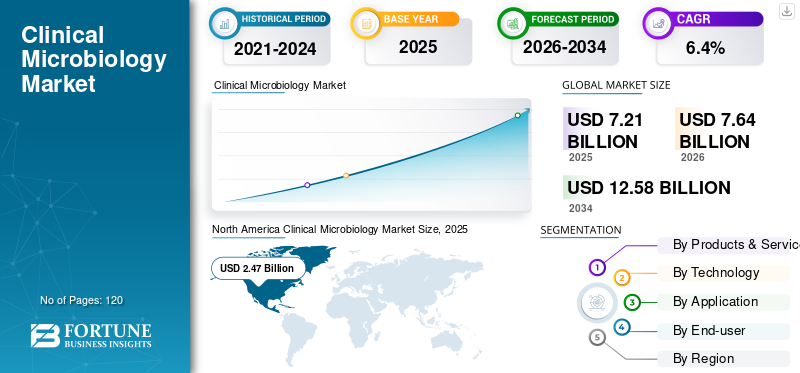
Download Free sample to learn more about this report.
CLINICAL MICROBIOLOGY MARKET KEY TAKEAWAYS
 Market Size & Forecast
- 2025 Market Size: USD 7.21 billion
- 2026 Market Size: USD 7.64 billion
- 2034 Forecast Market Size: USD 12.58 billion
- CAGR: 6.4% from 2026–2034
 Market Share
- North America dominated the clinical microbiology market with a 34.26% share in 2025.
- The reagents & consumables segment accounted for the largest market share in 2026.
- The culture-based techniques segment is projected to hold a 43.8% share in 2026.
 Key Regional Highlights
North America
North America reached USD 2.47 billion in 2025, supported by rising chronic disease prevalence and advanced healthcare technologies.
Europe
The market is projected to reach USD 1.38 billion by 2026, driven by the presence of major industry players.
Asia Pacific
The market is projected to reach USD 2.25 billion by 2026, driven by increasing healthcare investments and advanced diagnostic technologies.
U.S.
The market is projected to reach USD 2.23 billion by 2026, fueled by increasing adoption of advanced diagnostic systems.
Japan
The Japan market is expected to witness steady growth, driven by rising adoption of advanced healthcare technologies.
Read More

MARKET DYNAMICS
MARKET DRIVERS
Rising Incidence of Complex Infections and Testing Demand to Boost Market Growth
Extensively growing prevalence of infectious conditions coupled with rising demand for advanced testing to boost the global clinical microbiology market growth. In addition, there is substantial rise in the complexity within infections which is further expected to boost market growth. Hospitals need microbiology platforms that support broad testing menus, from routine urine cultures to specialized assays for fungal, mycobacterial, and parasitic organisms. This diversification has led to increased adoption of standardized, modular systems that support rapid turnaround.
- For instance, in January 2023, Howard Hughes Medical Institute announced the launch of its new Emerging Pathogens Initiative. The program aims to support basic research into mechanisms, origins and evolution of pathogens that could pose significant threats to human health.
MARKET RESTRAINTS
Fragmented Infrastructure and Uneven Adoption of Advanced Systems to Deter Market Growth
The uneven distribution of diagnostic infrastructure across regions is the prominent factor hampering the market growth. Many hospitals, especially in middle income markets, still rely heavily on manual plate reading, outdated incubators, and limited molecular menus. Also, even when advanced systems are available, integration with existing LIS, workforce limitations, and inconsistent quality-control practices hinder full adoption.
MARKET OPPORTUNITIES
Expansion of Decentralized and Near-Patient Microbiology Testing to Provide Thriving Growth Opportunities
The expansion of near-patient and decentralized microbiology testing is projected to offer significant opportunity for market growth during the forecast period. Clinics, urgent care centers, and small hospitals increasingly require rapid infectious disease diagnostics without relying entirely on centralized labs. This is creating demand for compact, cartridge-based platforms, portable PCR devices, and rapid culture-independent ID tests. Moreover, market players are also introducing lighter, modular instruments that function with minimal training along with partnerships and collaborations.
- For instance, In February 2025, Tasso Inc. and ARUP Laboratories entered into a strategic partnership to develop and operationalize high-quality, at-home, blood testing services.
CLINICAL MICROBIOLOGY MARKET TRENDS
Shift toward Integrated Diagnostic Ecosystems and Multi-platform Connectivity is One of Key Market Trend
The evolution of microbiology from standalone instruments to integrated diagnostic ecosystems is a key trend driving the market. Laboratories increasingly expect unified software dashboards, automated QC systems, shared data repositories, and harmonized workflows across culture, ID/AST, and molecular platforms. Vendors are building ecosystems that link incubators, imagers, MALDI-TOF, rapid AST, and PCR platforms into coordinated pathways with auto-routing and real-time analytics. Connectivity upgrades from companies such as Roche, Qiagen, and bioMérieux demonstrate this transition, enabling microbiologists to monitor incubation progress remotely, trigger confirmatory tests automatically, and generate consolidated pathogen reports that support stewardship teams and infection control units.
MARKET CHALLENGES
Data Burdens, Surveillance Requirements, And Quality Compliance Pressures to Pose Challenge for Market Growth
As microbiology volumes grow, laboratories face challenges around data management, mandatory reporting, and maintaining quality across large specimen loads. National programs for AMR surveillance, sepsis reporting, and hospital-acquired infection monitoring require strict documentation, traceability, and standardized interpretation. Many labs struggle with manual data entry, inconsistent antibiograms, and limited bioinformatics support. While automation reduces labor, it also introduces complex validation cycles, continuous instrument monitoring, and cybersecurity requirements for interconnected systems.
Download Free sample to learn more about this report.
Segmentation Analysis
By Products & Services
High Diagnostic Procedures to Boost Reagents & Consumables Segment Growth
Based on the products & services segmentation, the market is classified into instruments, reagents & consumables, and software & services.
The reagents & consumables systems segment accounted for the largest global clinical microbiology market share in 2025. The segment growth is majorly attributed to the substantial volume of diagnostic procedures. In addition, continual product approval and introductions by market players for analysis of emerging pathogens, and resistant organisms is also expected to accelerate segment growth.
- For instance, in June 2022, SGS announced the launch of a new microbiology laboratory in the U.S.
Additionally, the software & services segment is projected to grow at a CAGR of 7.2% during the forecast period.
To know how our report can help streamline your business, Speak to Analyst
By Technology
Superior Results Offered by Culture-Based Techniques to Propel Segment Growth
Based on technology, the market is segmented into culture-based techniques, molecular diagnostics, immunoassays, and others.
The culture-based techniques segment accounted for the largest share in 2025. The segment growth is majorly attributed to its utilization in a substantial number of diagnostic procedures due to better outcome. Moreover, despite the growth of PCR and syndromic panels, clinicians still depend on cultured isolates for antimicrobial stewardship decisions, outbreak investigation, and confirmatory testing. Also, the segment is set to hold 43.8% share in 2026.
- For instance, in January 2025, Rapid Infection Diagnostics Inc. announced the launch of its new one-button technology which provides microbiology testing and antibiotic sensitivity results in just 5 hours.
In addition, the molecular diagnostics segment is projected to grow at a CAGR of 6.9% during the forecast period.
By Application
Considerable Prevalence of Infectious Diseases to Drive Segment Growth
Based on application, the market is segmented into infectious disease diagnostics, antimicrobial susceptibility testing, disease surveillance & epidemiology, and others.
In 2025, the global market was dominated by infectious disease diagnostics in terms of application. The segment growth is directly associated with the utilization of clinical microbiology for diagnosis and assessment of infectious conditions. In addition, rising incidence of bacterial sepsis, respiratory infections, UTIs, diarrheal diseases, and hospital-acquired infections are also projected to offer substantial opportunity for market growth. Furthermore, the segment is set to hold 63.7% share in 2026.
In addition, the disease surveillance & epidemiology segment is projected to grow at a CAGR of 7.9% during the forecast period.
By End-user
Availability of Cutting-Edge Technologies and Substantial Diagnostic Procedural Volumes in Hospitals Drive Segment Growth
Based on end-user, the market is classified into hospitals, specialty clinics, and others.
In 2025, the global market was dominated by hospitals in terms of end-user. Hospitals lead the market as most diagnostic procedures take place in these settings. In addition, these facilities are equipped with intelligent and advanced instruments, which enables streamlining of diagnostic procedures along with research. Furthermore, the segment is set to hold 58.6% share in 2026.
In addition, the others segment is projected to grow at a CAGR of 7.5% during the forecast period.
Clinical Microbiology Market Regional Outlook
By region, the market is divided into North America, Europe, Asia Pacific, Latin America, and the Middle East & Africa.
North America
North America Clinical Microbiology Market Size, 2025 (USD Billion) To get more information on the regional analysis of this market, Download Free sample
North America held the dominant share in 2024, valuing at USD 2.34 billion, and also maintained the leading share in 2025, with USD 2.47 billion. The growth is attributed to rising prevalence of chronic conditions, substantial investments, and introduction of advanced technologies. In 2026, the U.S. market is estimated to reach USD 2.23 billion.
- For instance, in May 2022, Abbott announced the launch of its new Alinity m system, which enables detection of four different infections simultaneously.
Europe and Asia Pacific
Europe and Asia Pacific are projected to experience notable growth during the forecast period. Europe is projected to record a growth rate of 5.6%, and reach a valuation of USD 1.38 billion by 2026. This growth is attributed to the presence of major players in countries such as Germany, the U.K., and France. Due to these factors, the U.K. is expected to record a valuation of USD 0.31 billion, Germany USD 0.43 billion, and France USD 0.26 billion in 2026. The market in Asia Pacific is estimated to reach USD 2.25 billion in 2026 and managed to hold the third-largest position in the market. In the region, India and China are both estimated to reach USD 0.50 billion and USD 0.75 billion, respectively, in 2026.
Latin America and Middle East & Africa
Latin America and the Middle East & Africa regions are expected to showcase moderate growth in the market over the forecast period. Latin America market in 2026 is anticipated to reach a valuation of USD 0.46 billion. The growth is attributed to increasing awareness of surgical care in the region. In the Middle East & Africa, the GCC is set to reach a value of USD 0.14 billion by 2026.
COMPETITIVE LANDSCAPE
Key Industry Players
Focus on Product Launches and Approval to Strengthen Position of Key Players
In 2025, major players such as bioMérieux SA, BD, Thermo Fisher Scientific Inc., Danaher Corporation, and others accounted for the largest global market share. The share is attributed to the focus of these players on innovations and other strategic initiatives, including partnerships, acquisitions, and collaborations.
Other prominent companies, such Bruker Corporation, QIAGEN N.V., F. Hoffmann-La Roche Ltd., Siemens Healthineers AG are focused on increasing product supply to emerging countries, which is expected to help them gain a significant market share.
LIST OF KEY CLINICAL MICROBIOLOGY COMPANIES PROFILED
- bioMérieux SA (France)
- BD (U.S.)
- Thermo Fisher Scientific Inc. (U.S.)
- Danaher Corporation (U.S.)
- Bruker Corporation (U.S.)
- QIAGEN N.V. (Netherlands)
- Hoffmann-La Roche Ltd (Switzerland)
- Siemens Healthineers AG (Germany)
- Copan Italia S.p.A. (Italy)
- Liofilchem S.r.l. (Italy)
KEY INDUSTRY DEVELOPMENTS
- April 2025: BD received FDA approval for its new microbiology solutions, BD Phoenix M50 and BDXpert.
- February 2025: bioMérieux received FDA approval for its BIOFIRE FILMARRAY gastrointestinal (GI) panel.
- January 2024: Seegene Inc. and Microsoft entered into a strategic collaboration for development of automated diagnostic reagent development system.
- February 2023: Mylab Discovery Solutions announced launch of its new diagnostics tests for detection of sexually transmitted diseases.
- October 2021: QIAGEN announced the launch of its QIAreach QuantiFERON-TB tuberculosis test.
REPORT COVERAGE
Request for Customization to gain extensive market insights.
Report Scope & Segmentation
|
ATTRIBUTE |
DETAILS |
|
Study Period |
2021-2034 |
|
Base Year |
2025 |
|
Estimated Year |
2026 |
|
Forecast Period |
2026-2034 |
|
Historical Period |
2021-2024 |
|
Growth Rate |
CAGR of 6.4% from 2026-2034 |
|
Unit |
Value (USD Billion) |
|
Segmentation |
By Products & Services, Technology, Application, Application, End-user, and Region |
|
By Products & Services |
· Instruments o Microbial Detection & Identification Systems o Laboratory Automation Systems o Microscopes & Imaging Systems o Others · Reagents & Consumables · Software & Services |
|
By Technology |
· Culture-Based Techniques · Molecular Diagnostics · Immunoassays · Others |
|
By Application |
· Infectious Disease Diagnostics · Antimicrobial Susceptibility Testing (AST) · Disease Surveillance & Epidemiology · Others |
|
By End-user |
· Hospitals · Specialty Clinics · Others |
|
By Region |
· North America (By Products & Services, Technology, Application, End-user, and Country) o U.S. (By Products & Services) o Canada (By Products & Services) · Europe (By Products & Services, Technology, Application, End-user, and Country/Sub-region) o Germany (By Products & Services) o U.K. (By Products & Services) o France (By Products & Services) o Spain (By Products & Services) o Italy (By Products & Services) o Scandinavia (By Products & Services) o Rest of Europe (By Products & Services) · Asia Pacific (By Products & Services, Technology, Application, End-user, and Country/Sub-region) o China (By Products & Services) o Japan (By Products & Services) o India (By Products & Services) o Australia (By Products & Services) o Southeast Asia (By Products & Services) o Rest of Asia Pacific (By Products & Services) · Latin America (By Size, Procedure, End-user, and Country/Sub-region) o Brazil (By Products & Services) o Mexico (By Products & Services) o Rest of Latin America (By Products & Services) · Middle East & Africa (By Products & Services, Technology, Application, End-user, and Country/Sub-region) o GCC (By Products & Services) o South Africa (By Products & Services) o Rest of the Middle East & Africa (By Products & Services) |
Frequently Asked Questions
Fortune Business Insights says that the global market value stood at USD 7.21 billion in 2025 and is projected to reach USD 12.58 billion by 2034.
In 2025, the market value stood at USD 2.47 billion.
The market is expected to exhibit a CAGR of 6.4% during the forecast period.
The reagents & consumables systems segment led the market by products & services.
The key factors driving the market are the increasing number of diagnostic procedures and technological advancements.
bioMerieux SA, BD, Thermo Fisher Scientific Inc., and Danaher Corporation are some of the prominent players in the market.
North America dominated the market in 2025.



- 2021-2034
- 2025
- 2021-2024
- 120
Get 30-60 hrs Free Customization
Expand Regional and Country Coverage, Segments Analysis, Company Profiles, Competitive Benchmarking, and End-user Insights.













.webp)






Related Reports
-
US +1 833 909 2966 ( Toll Free )
-
Get In Touch With Us