Cocoa-free Chocolates Market Size, Share & Industry Analysis, By Ingredient Type (Carob-based, Grain-based, Legume-based, Seed-based, Fruit-based, and Others), By Product Type (Bars, Chips & Chunks, Slabs, Coatings & Fillings, and Others), By Application (Bakery Products, Confectionery, Dairy & Dairy Alternatives, Beverages, Snacks & Cereals, Ice Cream & Frozen Desserts, and Others), and Regional Forecast, 2026-2034
 Download Free Sample
(Offer valid till 15th Oct 2026)

Cocoa-free Chocolates Market Size and Future Outlook
 Listen to Audio Version
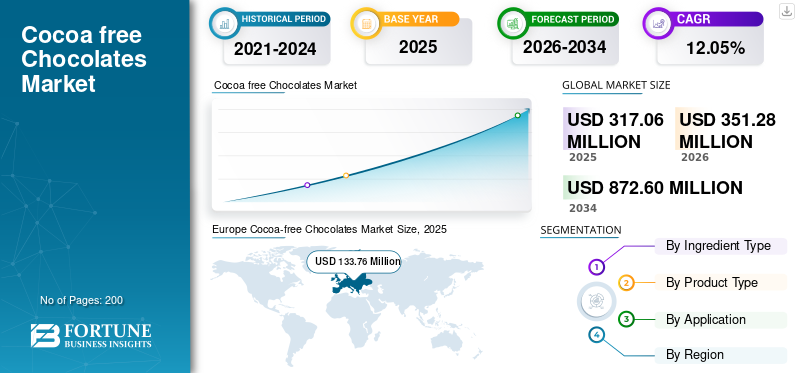
The global cocoa-free chocolates market size was valued at USD 317.06 million in 2025. The market is projected to grow from USD 351.28 million in 2026 to USD 872.60 million by 2034, exhibiting a CAGR of 12.05% during the forecast period. Europe dominated the cocoa free chocolates market with a market share of 42.18% in 2025.
Cocoa-free chocolates are designed to replicate the sensory experience of traditional chocolate without the use of cocoa beans or cocoa-derived ingredients. These products are generally formulated using carob, grains, legumes such as fava beans, seeds, fruits, specialty fats, fermentation-derived flavor systems, roasted plant ingredients, and natural flavor compounds to deliver chocolate-like taste, color, melt, aroma, and texture. The market covers cocoa-free bars, chips, chunks, slabs, coatings, fillings, bakery inclusions, ice cream coatings, confectionery applications, dairy alternatives, beverages, snacks, and frozen dessert formats.
The global market growth is supported by rising cocoa price volatility, climate-related cocoa supply risks, sustainability concerns, clean-label reformulation, vegan product development, allergen-conscious product positioning, and the increasing interest of confectionery and bakery manufacturers in cost-stable chocolate alternatives. Cocoa supply stress has strengthened the commercial case for cocoa-free formulations, especially among food manufacturers that require predictable ingredient availability, scalable supply, and lower exposure to cocoa bean price fluctuations.
The global product demand is supported by leading companies and innovators such as Planet A Foods, Voyage Foods, Cargill, Barry Callebaut, Win-Win Food Labs, Nukoko, Foreverland, and others. These companies are active across cocoa-free chocolate ingredients, cocoa-free coatings, sustainable confectionery solutions, chocolate-like inclusions, bakery applications, frozen dessert applications, and B2B ingredient partnerships.
Download Free sample to learn more about this report.
Cocoa free Chocolates Market KEY TAKEAWAYS
 Global Market Size & Forecast
- 2025 Market Size: USD 317.06 million
- 2026 Market Size: USD 351.28 million
- 2034 Forecast Market Size: USD 872.60 million
- CAGR: 12.05% from 2026–2034
 Market Share
- Europe dominated the cocoa-free chocolates market with a 42.18% share in 2025.
- The legume-based segment is projected to grow at the fastest CAGR of 15.14% during the forecast period.
- The chips & chunks segment is projected to grow at the fastest CAGR of 13.40% during 2026–2034.
 Key Regional Highlights
Asia Pacific
Asia Pacific reached USD 56.52 million in 2025, driven by rising bakery and confectionery demand.
North America
North America reached USD 101.46 million in 2025, supported by growing demand for plant-based confectionery.
Europe
Europe reached USD 133.76 million in 2025, driven by strong sustainability awareness and premium chocolate demand.
U.S.
U.S. reached USD 80.81 million in 2025, fueled by demand for vegan confectionery and sustainable alternatives.
Japan
Japan is driven by growing demand for plant-based confectionery and sustainable chocolate alternatives.
Read More

Cocoa-free Chocolates Market Trends
Expansion of Cocoa-free and Sustainable Chocolate Alternatives is a Key Market Trend
A major trend shaping the global market is the rising adoption of cocoa-free chocolate alternatives by confectionery, bakery, snacks, frozen dessert, and dairy alternative manufacturers. Food companies are increasingly exploring cocoa-free formulations due to sharp cocoa price movements, concerns over long-term cocoa availability, sustainability pressure, and the need to diversify ingredient sourcing. Cocoa-free chocolates allow manufacturers to create chocolate-like products using roasted seeds, grains, legumes, carob, fruits, and fermentation-based flavor systems while reducing reliance on conventional cocoa supply chains.
- For instance, in May 2026, Cargill and Voyage Foods launched NextCoa, a cocoa-free chocolate alternative in North America, beginning with the U.S. and expanding to Canada soon. The alternative offers significant environmental benefits with a 67% lower carbon footprint compared to conventional chocolate. NextCoa is vegan, Kosher pareve, and Halal-certified while being free from dairy, soy, peanuts, and tree nuts, making it accessible to consumers with various dietary restrictions.
MARKET DYNAMICS
Market Drivers
Download Free sample to learn more about this report.
Cocoa Price Volatility and Supply-chain Risk to Boost Market Growth
Cocoa price volatility, production shortfalls, and climate-related risks are major drivers of the global market. Conventional chocolate manufacturers depend heavily on cocoa beans from West Africa, where weather variability, crop diseases, pests, farm productivity issues, and supply-chain disruption have affected global cocoa availability. As cocoa prices rise, manufacturers face pressure on margins, retail pricing, product sizes, and recipe stability. Cocoa-free chocolate products help reduce exposure to cocoa cost fluctuations and provide manufacturers with additional formulation flexibility.
The driver is particularly strong in bakery, confectionery, coatings, fillings, ice cream, and snacks, where chocolate-like ingredients are used in high volumes. Large food manufacturers are increasingly evaluating cocoa-free alternatives not only as sustainability solutions, but also as business continuity tools that can protect supply and reduce dependence on volatile cocoa inputs.
- According to the Food and Agriculture Organization (FAO), cocoa prices surged by 136% between July 2022 and February 2024, while West Africa’s cocoa belt accounts for around 70% of the world’s cocoa production and is increasingly exposed to climate extremes.
Market Restraints
Sensory Matching, Regulatory Positioning, and Consumer Acceptance Barriers to Restrict Market Expansion
The global cocoa-free chocolates market growth is restrained by sensory matching challenges, regulatory naming limitations, formulation complexity, and consumer acceptance barriers. Chocolate is strongly associated with specific cocoa-derived flavor notes, bitterness, aroma, melt, snap, mouthfeel, and aftertaste. Cocoa-free products must closely replicate these attributes to gain acceptance in mainstream confectionery, bakery, and frozen dessert applications. Even small differences in flavor, texture, sweetness balance, or melting behavior can affect consumer repeat purchase.
Regulatory positioning is another restraint. In many markets, products made without cocoa may not be allowed to use traditional chocolate naming in the same way as cocoa-based products. This can create labeling challenges for brands and may require terms such as chocolate alternative, cocoa-free coating, chocolate-style confectionery, or cocoa-free confectionery. Manufacturers also need to manage ingredient declarations, allergen statements, clean-label claims, vegan claims, and sustainability claims carefully.
- In the U.S., FDA standards define milk chocolate as requiring at least 10% chocolate liquor, 3.39% milkfat, and 12% total milk solids, while semisweet or bittersweet chocolate must contain at least 35% chocolate liquor. This shows why cocoa-free formulations cannot simply be marketed as conventional chocolate unless they meet specific cocoa-derived composition standards.
Market Opportunities
Expansion of Cocoa-free Coatings, Fillings, Bakery Inclusions, and Ice Cream Applications to Create Growth Opportunities
The expansion of cocoa-free coatings, fillings, bakery inclusions, ice cream coatings, and snack applications is expected to create strong growth opportunities for the global market. These applications are highly suitable for cocoa-free chocolate alternatives as they require large-scale ingredient supply, processing consistency, cost control, and stable flavor performance. Manufacturers can use cocoa-free ingredients in cookies, wafers, cereal bars, muffins, croissants, frozen desserts, coated snacks, plant-based dairy alternatives, and confectionery fillings.
- For instance, in April 2026, Nestlé Germany launched Choco Crossies 'Snack Vibes", its first cocoa-free product line, in partnership with German food-tech startup Planet A Foods, with the product going on sale across German retailers. The Snack Vibes line features ChoViva, Planet A Foods' cocoa-free chocolate alternative made primarily from fermented and roasted sunflower seeds combined with plant-based fats, grape seed flour, sugar, and oats.
SEGMENTATION ANALYSIS
By Ingredient Type
Grain-based Segment Dominated Market Due to Strong Flavor Development and Scalable Raw Material Availability
Based on ingredient type, the market is segmented into carob-based, grain-based, legume-based, seed-based, fruit-based, and others.
The grain-based segment dominated the global cocoa-free chocolates market share, valued at USD 81.39 million in 2025. The segment growth is attributed to the strong availability of grains, favorable roasting and fermentation characteristics, cost-effective sourcing, and suitability across chocolate-like bars, coatings, fillings, bakery inclusions, and snack applications. Grain-based ingredients can support roasted, malty, nutty, caramelized, and chocolate-like flavor notes, making them highly useful in industrial cocoa-free formulations.
The legume-based segment is projected to grow at the fastest CAGR of 15.14% during the forecast period, driven by formulation innovation, protein-rich positioning, fermentation compatibility, and increasing use in next-generation chocolate alternatives.
To know how our report can help streamline your business, Speak to Analyst
By Product Type
Coatings & Fillings Dominated Market Due to Their High Usage in Bakery, Confectionery, and Frozen Desserts
Based on product type, the market is segmented into bars, chips & chunks, slabs, coatings & fillings, and others.
The coatings & fillings segment dominated the global market, valued at USD 105.20 million in 2025, owing to strong use across bakery products, confectionery centers, biscuits, wafers, cakes, frozen desserts, cereal snacks, and plant-based dairy alternatives. Coatings and fillings offer the strongest B2B opportunity as manufacturers can use cocoa-free alternatives as functional ingredients rather than relying only on finished consumer chocolate bars.
The chips & chunks segment is projected to grow at the fastest CAGR of 13.40% during 2026-2034.
By Application
Confectionery Segment Dominated Market Due to Strong Demand for Chocolate-like Indulgence and Reformulation Flexibility
Based on application, the market is segmented into bakery products, confectionery, dairy & dairy alternatives, beverages, snacks & cereals, ice cream & frozen desserts, and others.
The confectionery segment dominated the global market, valued at USD 93.37 million in 2025, owing to strong consumer demand for chocolate-like indulgence, rising interest in plant-based confectionery, and growing pressure on confectionery manufacturers to manage cocoa price volatility. Cocoa-free chocolate alternatives are increasingly used in bars, filled confectionery, molded sweets, coated products, praline-style applications, and chocolate-such as snacks.
The ice cream & frozen desserts segment is projected to grow at the fastest CAGR of 14.32% during 2026-2034.
Cocoa-free Chocolates Market Regional Outlook
Regionally, the market is studied across North America, Europe, Asia Pacific, South America, and the Middle East & Africa.
Europe
Europe Cocoa-free Chocolates Market Size, 2025 (USD Million)
To get more information on the regional analysis of this market, Download Free sample
Europe dominated the global market and was valued at USD 133.76 million in 2025. The region is projected to reach USD 323.81 million by 2034, growing at a CAGR of 10.43%. Growth is supported by strong sustainability awareness, mature confectionery consumption, premium chocolate culture, vegan product launches, bakery innovation, and stricter consumer expectations around traceability and ethical sourcing.
Germany Cocoa-free Chocolates Market
The market in Germany was valued at approximately USD 32.06 million in 2025, supported by strong demand for sustainable confectionery, vegan snacks, bakery products, and cocoa-free chocolate alternatives.
U.K. Cocoa-free Chocolates Market
The U.K. market was valued at USD 24.93 million in 2025 and is supported by strong demand for vegan confectionery, allergen-conscious snacks, sustainable food innovation, and premium bakery products. Cocoa-free chocolate alternatives are gaining attention among snack brands, confectionery innovators, and foodservice operators seeking differentiated products with lower cocoa-supply exposure.
North America
The market in North America was valued at USD 101.46 million in 2025. The region is projected to reach USD 269.27 million by 2034, growing at a CAGR of 11.59%. Growth is driven by strong demand for plant-based confectionery, sustainable indulgence, allergy-conscious snacks, premium bakery products, frozen desserts, and clean-label alternatives.
U.S. Cocoa-free Chocolates Market
The U.S. dominates the North American market, valued at approximately USD 80.81 million in 2025, supported by strong demand for vegan confectionery, premium snacks, frozen desserts, bakery inclusions, and sustainable chocolate alternatives.
Asia Pacific
The Asia Pacific market was valued at USD 56.52 million in 2025. The region is projected to reach USD 199.07 million by 2034, growing at the fastest CAGR of 15.16%. Growth is driven by rising middle-class income, expanding bakery and confectionery consumption, rapid urbanization, modern retail expansion, foodservice growth, and increasing interest in affordable chocolate-like ingredients.
China Cocoa-free Chocolates Market
China dominates the regional market, valued at approximately USD 18.18 million in 2025, supported by bakery chain expansion, confectionery innovation, premium snack consumption, and growing adoption of plant-based and novel food ingredients.
South America and Middle East & Africa
South America was valued at USD 15.02 million in 2025 and is projected to reach USD 46.20 million by 2034, growing at a CAGR of 13.45%. Growth is driven by rising bakery consumption, confectionery demand, snack product innovation, and the gradual adoption of sustainable chocolate alternatives.
The Middle East & Africa market was valued at USD 10.30 million in 2025 and is projected to reach USD 34.25 million by 2034, growing at a CAGR of 14.43%. Growth is supported by rising demand for premium confectionery, bakery products, frozen desserts, imported snacks, plant-based foods, and halal-friendly chocolate-like products.
Brazil Cocoa-free Chocolates Market
Brazil dominates the South American market, valued at approximately USD 8.50 million in 2025, supported by strong confectionery consumption, bakery demand, snack manufacturing, and growing interest in sustainable ingredient alternatives.
COMPETITIVE LANDSCAPE
Key Industry Players
Strategic Partnerships, Production Scale-up, and Cocoa-free Ingredient Innovation to Strengthen Market Position
Key players in the global cocoa-free chocolates market are focusing on strategic partnerships, production scale-up, fermentation technology, roasted plant-based ingredient systems, and B2B ingredient commercialization to strengthen their market position. Since cocoa-free chocolate is still an emerging category, companies are prioritizing industrial scalability, taste replication, price competitiveness, and compatibility with existing chocolate-processing equipment.
Large ingredient companies are entering the category through partnerships with food technology startups. Cargill partnered with Voyage Foods to scale cocoa-free confectionery products. At the same time, Barry Callebaut entered into a long-term partnership with Planet A Foods to develop sustainable chocolate alternatives without cocoa. Barry Callebaut stated that the partnership supports a diversified approach to cocoa-market volatility and expands its portfolio across cocoa and non-cocoa alternatives.
Key Players in the Market
|
Rank |
Company Name |
|
1 |
Planet A Foods GmbH |
|
2 |
Voyage Foods |
|
3 |
Cargill, Incorporated |
|
4 |
Barry Callebaut AG |
|
5 |
Win-Win Food Labs Ltd. |
List of Key Cocoa-free Chocolate Companies Profiled
- Planet A Foods GmbH (Germany)
- Voyage Foods (U.S.)
- Cargill, Incorporated (U.S.)
- Barry Callebaut AG (Switzerland)
- Win-Win Food Labs Ltd. (U.K.)
- Nukoko Ltd. (U.K.)
- Foreverland Food S.r.l. (Italy)
- California Cultured Inc. (U.S.)
- Celleste Bio Ltd. (Israel)
- The Kawa Project (France)
KEY INDUSTRY DEVELOPMENTS
- May 2026: Win-Win, the London-based foodtech firm, partnered with distributor Keylink to bring its cocoa-free chocolate alternatives to the U.K. Alongside this distribution deal, Win-Win launched a bake-stable chocolate chip range (available in milk, dark, and white varieties) designed to hold their shape in high-temperature baking without melting or spreading.
- May 2026: Barry Callebaut brought Planet A Foods' cocoa-free chocolate ingredient ChoViva to the U.S. market, with the launch debuting at the Snacks & Sweets Expo 2026 (May 19-21) in Las Vegas as Barry Callebaut's "first non-cocoa chocolate experience". Through this partnership, Barry Callebaut became the exclusive distributor of ChoViva to industry customers across the U.S., giving Planet A Foods immediate access to the largest food manufacturers and brands in North America.
- May 2026: Mars Inc. made its first move into cocoa-free chocolate with the launch of Balisto Trail Mix in Germany, partnering with German food-tech startup Planet A Foods and using their ChoViva cocoa-free ingredient. The product combines nuts (almonds and peanuts), raisins, and ChoViva pieces in a 140-gram bag, containing 14g of protein per 100g, and is positioned for on-the-go and office snacking.
- November 2025: Barry Callebaut and Planet A Foods announced a long-term commercial partnership to pioneer sustainable chocolate alternatives without cocoa, combining Barry Callebaut's global chocolate expertise with Planet A's innovative ChoViva technology.
- October 2025: Foreverland, an Italian food tech startup, scaled its chocolate alternatives business by opening its first large-scale production facility in Puglia, Southern Italy, marking the company's transition from pilot projects to full-scale industrial production.
REPORT COVERAGE
The global cocoa-free chocolates market industry report analyzes the market in depth and highlights crucial aspects such as global market trends, market dynamics, supply chains, prominent companies, investment in research and development, and end-use. Besides this, the report also provides insights into the global market analysis and highlights significant industry developments.
Request for Customization to gain extensive market insights.
Report Scope & Segmentation
| ATTRIBUTE | DETAILS |
| Study Period | 2021-2034 |
| Base Year | 2025 |
| Estimated Year | 2026 |
| Forecast Period | 2026-2034 |
| Historical Period | 2021-2024 |
| Growth Rate | CAGR of 12.05% from 2026 to 2034 |
| Unit | Value (USD Million) |
|
Segmentation |
By Ingredient Type
|
|
By Product Type
|
|
|
By Application
|
|
|
By Region
|
Frequently Asked Questions
Fortune Business Insights says that the global market was valued at USD 317.06 million in 2025 and is anticipated to reach USD 872.60 million by 2034.
At a CAGR of 12.05%, the global market will exhibit steady growth over the forecast period.
By ingredient type, the grain-based segment led the market.
Europe held the largest market share in 2025.
Cocoa price volatility and supply-chain risk are driving market growth.
Planet A Foods, Voyage Foods, Cargill, Barry Callebaut, Win-Win Food Labs, Nukoko, and Foreverland are the leading players in the market.
Expansion of cocoa-free and sustainable chocolate alternatives is a key market trend.



- 2021-2034
- 2025
- 2021-2024
- 200
-
(Offer valid till 15th Oct 2026)
Get 30-60 hrs Free Customization
Expand Regional and Country Coverage, Segments Analysis, Company Profiles, Competitive Benchmarking, and End-user Insights.




















Related Reports
-
US +1 833 909 2966 ( Toll Free )
-
Get In Touch With Us