Commercial Aircraft In-seat Power System Market Size, Share & Industry Analysis, By Aircraft Type (Narrow-body Aircraft, Wide-body Aircraft, and Regional Aircraft), By Power Outlet Type (AC Power Outlets, USB Type-A Ports, USB Type-C Ports, Wireless Charging Systems, and Others), By Technology (AC Power Systems, DC Power Systems, Wireless Power Transfer Systems, and Hybrid Power Systems), By Component (Power Supply Units, Power Distribution Units, Seat Power Modules, and Charging Pads, Cables, Connectors, and Control Electronics, and Others), and Regional Forecast, 2026-2034
 Download Free Sample
Commercial Aircraft In-seat Power System Market Size and Future Outlook
 Listen to Audio Version
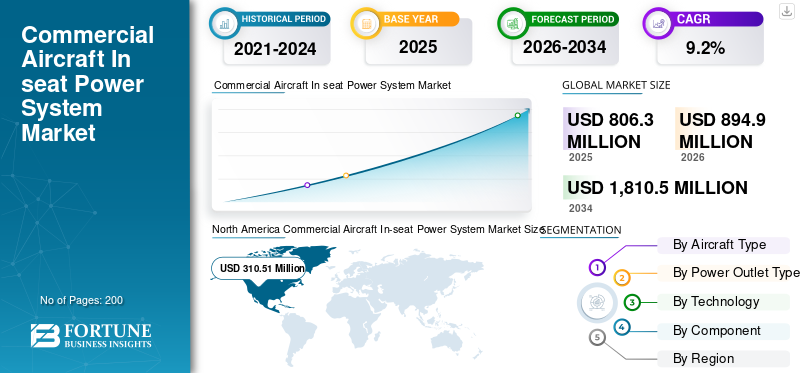
The global commercial aircraft in-seat power system market size was valued at USD 806.3 million in 2025. The market is projected to grow from USD 894.9 million in 2026 to USD 1,810.5 million by 2034, exhibiting a CAGR of 9.2% during the forecast period. North America dominated the global market with a market share of 38.51% in 2025.
The market encompasses the design, manufacturing, and integration of power delivery solutions embedded within aircraft passenger seating, enabling in-flight charging and connectivity for personal electronic devices. These systems typically include AC outlets, USB ports, and power supply units integrated into seatback or armrest modules across various aircraft classes. Driven by evolving passenger expectations for connectivity and productivity during flights, airlines are increasingly retrofitting and outfitting new aircraft with these systems. The market spans narrow-body and wide-body aircraft platforms, serving commercial airlines seeking enhanced passenger experience, operational differentiation, and alignment with modern cabin electrification standards across the aviation industry.
Key players in the market include Astronics Corporation, KID-Systeme GmbH, Burrana Pty Ltd., Panasonic Avionics Corporation, and Thales Group. These companies compete through lightweight and compact power module designs, expanding compatibility with multiple device standards, enhanced safety and certification compliance, seamless integration with in-flight entertainment systems, and strategic partnerships with airlines and seat manufacturers, positioning themselves to address the growing demand for reliable, passenger-centric power solutions across commercial aviation fleets.
Download Free sample to learn more about this report.
Commercial Aircraft In seat Power System Market Key Takeaways
 Global Market Size & Forecast
- 2025 Market Size: USD 806.3 million
- 2026 Market Size: USD 894.9 million
- 2034 Forecast Market Size: USD 1,810.5 million
- CAGR: 9.2% from 2026-2034
 Market Share
- North America market held a 38.51% share in 2025, valued at USD 310.51 million, driven by high passenger connectivity expectations and fleet modernization.
- The narrow-body aircraft market dominated in 2025, driven by rising deployment on short- and medium-haul routes.
- The AC power outlets market dominated in 2025, driven by passenger demand for charging laptops and other high-power devices.
 Key Regional Highlights
North America
The market reached USD 310.51 million in 2025, driven by high connectivity expectations and cabin modernization.
Asia Pacific
The market is projected to reach USD 220.6 million in 2026, driven by rapid fleet expansion and rising air travel.
Europe
The market is estimated at USD 245.4 million in 2026, supported by fleet modernization and retrofit activity.
U.S.
The market is estimated at USD 315.9 million in 2026, driven by passenger connectivity and fleet modernization.
Japan
The market is estimated at USD 38.0 million in 2026, supported by demand for premium passenger comfort and service quality.
Read More

COMMERCIAL AIRCRAFT IN-SEAT POWER SYSTEM MARKET TRENDS
Growing Integration of Power Systems with Smart Cabin and IFE Platforms to be a Significant Market Trend
Airlines are increasingly integrating in-seat power systems with broader smart cabin ecosystems, linking power delivery with in-flight entertainment, connectivity, and passenger management platforms. This convergence allows airlines to offer a unified, app-controlled passenger experience while enabling real-time monitoring of system performance and maintenance needs. Seat manufacturers and power system providers are collaborating closely to design modular, easily upgradable units that fit seamlessly into evolving cabin architectures. This trend reflects a broader shift toward digitized, connected cabins where power access is no longer standalone but part of an integrated passenger experience strategy embraced by airlines globally.
MARKET DYNAMICS
MARKET DRIVERS
Download Free sample to learn more about this report.
Rising Passenger Reliance on Personal Electronic Devices During Travel to Drive Market Growth
Increasing passenger dependence on smartphones, laptops, and tablets for work, entertainment, and communication is driving the global commercial aircraft in-seat power system market growth. Long-haul and business travelers particularly expect uninterrupted device charging as a baseline amenity rather than a premium feature. Airlines are responding by installing power systems across cabin classes to improve passenger satisfaction and loyalty. Additional drivers include competitive pressure among carriers to differentiate cabin offerings and the broader digitization of travel, where connectivity and device usage remain central to the passenger experience, reinforcing sustained investment in in-seat power infrastructure across commercial fleets.
MARKET RESTRAINTS
High Installation and Certification Costs Limiting Widespread Adoption
The installation of in-seat power systems involves substantial costs related to wiring, weight management, and rigorous aviation certification requirements. Airlines, especially budget and regional carriers, may hesitate to invest given tight profit margins and long return-on-investment timelines. Retrofitting existing aircraft further adds complexity, requiring extensive testing, and regulatory approval before deployment. These financial and procedural burdens can delay adoption, particularly among smaller carriers with limited capital expenditure budgets, thereby restraining the pace at which in-seat power systems are integrated across the broader global commercial aircraft fleet.
MARKET OPPORTUNITIES
Expanding Retrofit Demand across Aging Global Aircraft Fleets to Create Growth Opportunities
A significant opportunity lies in the retrofit segment, as airlines operating older aircraft seek to modernize cabins without full fleet replacement. Retrofitting in-seat power systems allows carriers to quickly enhance passenger satisfaction and remain competitive against newer entrants offering connected cabins. This is particularly relevant for low-cost and regional carriers upgrading narrow-body fleets to meet changing passenger expectations. Suppliers offering flexible, certification-ready retrofit kits stand to benefit from this demand, especially as airlines balance capital constraints with the need to deliver modern in-flight amenities across diverse and aging aircraft portfolios.
MARKET CHALLENGES
Ensuring System Reliability and Weight Optimization across Diverse Fleets to Restrain Market Growth
Manufacturers face the challenge of designing power systems that are lightweight, durable, and compatible across varied seat configurations and aircraft types without compromising fuel efficiency. Ensuring consistent reliability under demanding operational conditions, including frequent usage cycles and temperature variations, remains technically demanding. Additionally, integrating these systems with existing cabin wiring and entertainment infrastructure without extensive redesign adds complexity. Balancing performance, safety compliance, and cost-efficiency while meeting airline-specific customization requests continues to challenge suppliers striving to deliver dependable, scalable power solutions across diverse global aircraft fleets.
Segmentation Analysis
By Aircraft Type
Rising Narrow-Body Aircraft Deployment on Short and Medium-Haul Routes Led to Dominance of Narrow-Body Aircraft Segment
Based on aircraft type, the market is segmented into narrow-body aircraft, wide-body aircraft, and regional aircraft.
The narrow-body aircraft segment accounted for the largest market share in 2025. Demand is rising as airlines operating high-frequency regional and domestic routes are increasingly equipping these aircraft with in-seat power to match passenger expectations traditionally associated with long-haul travel, encouraging wider adoption across low-cost and mainline carriers alike.
The regional aircraft segment is anticipated to rise with a CAGR of 9.6% over the forecast period.
By Power Outlet Type
Growing Passenger Demand for Universal Charging Accessibility is Driving Demand for AC Power Outlets Segment
Based on power outlet type, the market is segmented into AC power outlets, USB Type-A ports, USB Type-C ports, wireless charging systems, and others.
In 2025, the AC power outlets segment dominated the global market. The growth is contributed to passengers traveling with laptops and other high-power devices that require standard electrical outlets rather than USB-only charging. Airlines are prioritizing AC outlet installation to accommodate diverse device types, particularly for business travelers needing reliable power throughout longer flights.
The USB Type-C ports segment is projected to grow at a CAGR of 9.5% over the forecast period.
To know how our report can help streamline your business, Speak to Analyst
By Technology
Increasing Need for Centralized and Scalable Cabin Electrification to Drive Demand for AC Power Systems Segment
Based on technology, the market is segmented into AC power systems, DC power systems, USB power delivery systems, wireless power transfer systems, and hybrid power systems.
The AC power systems segment is anticipated to witness a dominating commercial aircraft in-seat power system market share over the forecast period. Demand for AC power systems is rising as airlines require robust, centralized architectures capable of supporting multiple outlets across cabin sections efficiently. These systems offer better scalability for retrofits and new installations, making them essential as airlines expand power accessibility across all seating classes.
The wireless power transfer systems segment is projected to grow at a high CAGR of 10.9% over the forecast period.
By Component
Rising Emphasis on Lightweight and Efficient Power Conversion Fueled Demand for Power Supply Units Segment
Based on component, the market is segmented into power supply units, power distribution units, seat power modules, outlets, ports, and charging pads, cables, connectors, and control electronics, and others.
The power supply units segment dominated the segmental market share in 2025. Demand for power supply units is rising as airlines seek compact, energy-efficient components that convert aircraft power safely for passenger use without adding excessive weight. Their critical role in ensuring stable power delivery makes them indispensable across all in-seat power system installations.
In addition, the cables, connectors, and control electronics are projected to grow at a CAGR of 10.3% during the forecast period.
Commercial Aircraft In-seat Power System Market Regional Outlook
By geography, the market is categorized into North America, Europe, Asia Pacific, and the rest of the world.
North America
North America Commercial Aircraft In-seat Power System Market Size, 2025 (USD Million)
To get more information on the regional analysis of this market, Download Free sample
North America held the dominant share in 2024, valuing at USD 266.02 million, and also maintained the leading share in 2025, with USD 310.51 million. North America shows strong demand due to high passenger connectivity expectations, a large fleet of long-haul aircraft, and early adoption of cabin modernization initiatives by major carriers seeking to enhance in-flight passenger experience.
U.S. Commercial Aircraft In-seat Power System Market
Based on North America’s strong contribution and the U.S.’ dominance within the region, the U.S. market can be analytically approximated at around USD 315.9 million in 2026, representing roughly 9.3% of CAGR during the forecast period. The U.S. shows robust demand driven by major airlines prioritizing passenger connectivity, extensive long-haul operations, and continuous fleet modernization efforts aimed at maintaining competitive advantage in a mature, passenger-experience-focused aviation market.
Europe
Europe is estimated to reach USD 245.4 million in 2026 and secure second position in the market. Europe demonstrates steady demand driven by fleet modernization programs, stringent passenger comfort standards, and increasing retrofit activity among legacy carriers aiming to remain competitive with newer, technologically advanced airline entrants.
U.K. Commercial Aircraft In-seat Power System Market
In 2026, the U.K. is estimated at around USD 50.4 million and represent roughly 8.6% of CAGR over the forecast period. The U.K. demonstrates consistent demand supported by strong international travel volumes, airline emphasis on premium cabin experiences, and ongoing retrofit initiatives across legacy fleets serving both business and leisure passengers.
Germany Commercial Aircraft In-seat Power System Market
Germany is projected to reach approximately USD 45.1 million in 2026. Germany shows steady demand as carriers focus on cabin modernization and passenger comfort, supported by the presence of key industry suppliers and strong engineering capabilities within the country's aerospace manufacturing ecosystem.
Asia Pacific
Asia Pacific is projected to record the highest CAGR of 9.9% during the forecast period and is set to reach USD 220.6 million in 2026. Asia Pacific exhibits growing demand fueled by rapid fleet expansion, rising air travel penetration, and increasing investment by regional carriers in passenger-centric cabin technologies to support expanding domestic and international network.
China Commercial Aircraft In-seat Power System Market
China’s market is projected to be one of the largest in Asia Pacific, with 2026 revenues estimated at around USD 79.0 million. China exhibits rising demand due to rapid fleet expansion, growing domestic air travel, and increasing airline investment in passenger amenities to meet the expectations of an expanding middle-class traveler base.
Japan Commercial Aircraft In-seat Power System Market
Japan’s market is estimated at around USD 38.0 million in 2026, accounting for roughly 9.5% of CAGR during the forecast period. Japan shows moderate but steady demand as carriers emphasize high service quality and passenger comfort, integrating advanced in-seat power systems to maintain their reputation for premium air travel experiences.
India Commercial Aircraft In-seat Power System Market
India is estimated to reach USD 30.0 million in 2026 and represents a fast-growing market. India demonstrates growing demand driven by rapid aviation sector expansion, rising domestic and international passenger traffic, and increasing airline focus on enhancing cabin amenities to compete in a fast-evolving market.
Rest of the World
The rest of the world include the Middle East & Africa and Latin America and are expected to witness moderate growth during the forecast period. The Middle East & Africa and Latin America markets are estimated to capture USD 52.7 million and USD 31.0 million, respectively in 2026. Rest of the World shows emerging demand as carriers in the Middle East, Latin America, and Africa gradually adopt in-seat power systems to enhance service offerings and align with global aviation passenger experience standards.
COMPETITIVE LANDSCAPE
Key Industry Players
Key Players Focus on High-Power USB-C Charging, Lightweight Power Architectures, and Integrated Cabin Connectivity to Boost Market Growth
The commercial aircraft in-seat power system market is being strengthened by key players that are shifting aircraft cabins from conventional AC outlets and low-output USB-A ports toward lighter, higher-capacity, and digitally managed power solutions. Astronics Corporation, KID-Systeme, Burrana, Panasonic Avionics, Thales, Safran Passenger Innovations, Collins Aerospace, IFPL, IMAGIK, and Amphenol PCD are focusing on 60W–100W USB-C power delivery, compact seat power modules, reduced wiring weight, intelligent load management, wireless charging, and integrated in-flight entertainment and connectivity architectures. Astronics is expanding demand through modular AC and USB-C systems designed for line-fit and retrofit programs, while KID-Systeme and Burrana are supporting full-cabin electrification with lightweight power supplies and high-output charging ports. Panasonic Avionics, Thales, and Safran are integrating passenger power directly into next-generation IFE platforms, enabling airlines to improve device charging, cabin functionality, and the overall passenger experience while reducing installation complexity and lifecycle costs.
LIST OF KEY COMMERCIAL AIRCRAFT IN-SEAT POWER SYSTEM COMPANIES PROFILED IN REPORT
- Astronics Corporation (U.S.)
- KID-Systeme GmbH (Germany)
- Burrana Pty Ltd. (Australia)
- Panasonic Avionics Corporation (U.S.)
- Thales Group (France)
- Safran Passenger Innovations (U.S.)
- Collins Aerospace (U.S.)
- IFPL Group Limited (U.K.)
- IMAGIK International Corporation (U.S.)
- Amphenol PCD, Inc. (U.S.)
KEY INDUSTRY DEVELOPMENTS
- February 2026: Ryanair and CFM International signed a memorandum of understanding for a long-term material services agreement covering Ryanair’s fleet of approximately 2,000 CFM56 and LEAP engines installed on its Boeing 737 aircraft.
- October 2025: Panasonic Avionics Corporation entered into an agreement with Air India to deploy its Astrova in-flight entertainment system and digital services across 34 new widebody aircraft, comprising six Airbus A350-1000s, 14 A350-900s, and 14 Boeing 787-9s. The system features 67W USB-C power for rapid charging of passenger devices, along with integrated LED lighting designed to improve cabin ambience and passenger comfort.
- May 2025: WeSky installed its 60W USB-C Recharge in-seat power system in the business-class cabin of a SriLankan Airlines Airbus A330-200. Weighing approximately 110 grams per seat, the company positioned the solution as one of the lightest in-seat power systems available in the aviation industry.
- June 2022: Panasonic Avionics Corporation partnered with United Airlines to introduce its Astrova in-flight engagement solution. United planned to install the system on new Boeing 787 and Airbus A321XLR aircraft from 2025, providing passengers with up to 100W of USB-C DC power for fast device charging during flights.
- June 2022: Recaro Aircraft Seating was selected by KLM Royal Dutch Airlines, Transavia France, and Transavia Airlines to supply economy-class seating for their new Airbus aircraft. The agreement strengthened Recaro’s position as a key seating supplier to major European airline groups.
REPORT COVERAGE
The commercial aircraft in-seat power system market research report offers a detailed analysis of emerging trends and rapidly adopted technologies in the industry across key regions. It also outlines key drivers of market growth and challenges to expansion, delivering a detailed overview of the market. The study highlights recent advancements to boost industry insights and support stakeholders in making well-informed decisions.
Request for Customization to gain extensive market insights.
Report Scope & Segmentation
| ATTRIBUTE | DETAILS |
| Study Period | 2021-2034 |
| Base Year | 2025 |
| Estimated Year | 2026 |
| Forecast Period | 2026-2034 |
| Historical Period | 2021-2024 |
| Growth Rate | CAGR of 9.2% from 2026-2034 |
| Unit | Value (USD Million) |
| Segmentation | By Aircraft Type, Power Outlet Type, Technology, Component, and Region |
| By Aircraft Type |
|
| By Power Outlet Type |
|
| By Technology |
|
| By Component |
|
| By Region |
|
Frequently Asked Questions
According to Fortune Business Insights, the global market value stood at USD 806.3 million in 2025 and is projected to reach USD 1,810.5 million by 2034.
In 2025, North Americas market value stood at USD 310.51 million.
The market is expected to exhibit a CAGR of 9.2% during the forecast period of 2026-2034.
By narrow-body aircraft segment dominated the market.
Rising passenger reliance on personal electronic devices during travel is driving market growth.
Astronics Corporation (U.S.), KID-Systeme GmbH (Germany), Burrana Pty Ltd. (Australia), Panasonic Avionics Corporation (U.S.), and Thales Group (France) are the top players in the global market.
North America held the largest market share in 2025.



- 2021-2034
- 2025
- 2021-2024
- 200
Get 30-60 hrs Free Customization
Expand Regional and Country Coverage, Segments Analysis, Company Profiles, Competitive Benchmarking, and End-user Insights.




















Related Reports
-
US +1 833 909 2966 ( Toll Free )
-
Get In Touch With Us