Commercial Renewable Energy Market Size, Share & Industry Analysis, By Type (Wind {Onshore and Offshore}, Solar {PV, CSP, and Thermal}, Bioenergy {Solid, Liquid, and Gas}, Geothermal {Shallow, Deep, and Great Depth}, Ocean Energy {Wave and Tidal}, and Hydropower {Small and Large}), By Deployment (On-Grid, and Off-Grid), By End-User (Retail and Malls, Corporate Office Buildings, Hotels, Hospitals, Data Centre, Educational Institutions, and Others) and Regional Forecast, 2026-2034
 Download Free Sample
KEY MARKET INSIGHTS
 Listen to Audio Version
The global Commercial Renewable Energy market size was valued at USD 163.88 billion in 2025 and is projected to be worth USD 172.22 billion in 2026 and expected to reach USD 250.99 billion by 2034, exhibiting a CAGR of 4.82% during the forecast period. Asia Pacific dominated the global market with a share of 66.56% in 2025.
Increasing grid electricity tariffs and fuel prices are prompting commercial establishments to adopt renewables (solar, wind, hybrid) and reduce long-term operating costs. Renewable energy offers stable and predictable pricing through power purchase agreements (PPAs) or captive generation. The commercial renewable energy market is growing due to various economic, environmental, and technological factors.
Commercial renewable energy is increasingly replacing fossil fuels as businesses shift toward cleaner and more sustainable energy sources. It is playing a significant role in electricity generation across various sectors such as data centers, real estate and others. Green hydrogen is emerging as a key clean fuel within the commercial renewable energy landscape.
NextEra Energy, Orsted, and Vestas Wind Systems are few major vendors in the commercial renewable energy industry. NextEra is the world's largest producer of wind and solar energy, with over 70 GW of installed clean energy capacity. The company has a massive portfolio of corporate power purchase agreements with commercial users such as Data centers (e.g., Google and Microsoft).
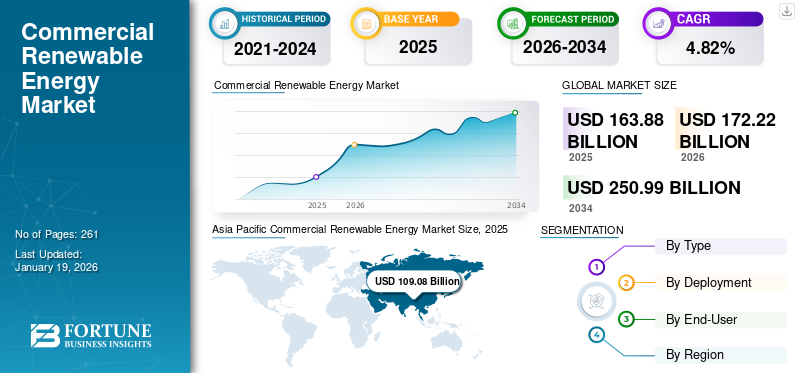
Download Free sample to learn more about this report.
Commercial Renewable Energy Market Takeaways
 Global Market Size & Forecast
- 2025 Market Size: USD 163.88 billion
- 2026 Market Size: USD 172.22 billion
- 2034 Forecast Market Size: USD 250.99 billion
- CAGR: 4.82% from 2026–2034
 Market Share
- Asia Pacific dominated the commercial renewable energy market with a 66.56% share in 2025.
- The wind energy segment held the largest market share, while the solar segment remained the second-leading technology, supported by the market's 4.82% CAGR during 2026–2034.
- The on-grid segment accounted for the largest share, driven by strong adoption across commercial buildings and infrastructure.
 Key Regional Highlights
North America
North America generated USD 21.83 billion in 2025 and is expected to grow to USD 22.48 billion in 2026, driven by rising investments in commercial clean energy projects.
Europe
Europe accounted for USD 21.26 billion in 2025 and is projected to reach USD 22.45 billion in 2026, reflecting continued expansion of renewable energy infrastructure.
Asia Pacific
Asia Pacific led the global market with USD 109.08 billion in 2025 and is projected to reach USD 115.13 billion in 2026, supported by extensive renewable energy deployment.
U.S.
The market is supported by increasing commercial adoption of wind and solar projects, aided by favorable policies, corporate sustainability initiatives, and grid modernization investments.
Japan
The market is witnessing steady growth due to increasing deployment of rooftop solar systems, energy efficiency initiatives, and the country's commitment to expanding renewable energy capacity.
Read More

MARKET DYNAMICS
MARKET DRIVERS
Growth of Commercial Infrastructure and Strategic Partnership with Energy Companies to Drive Market
The rapid development of commercial infrastructure such as office buildings, malls, hospitals, hotels, airports, data centers, and logistics parks significantly increases electricity demand from the commercial sector. Businesses are turning to renewable energy solutions to meet this growing need sustainably and cost-effectively. Auto manufacturers are shifting toward clean energy for manufacturing operations, EV production plants, and charging infrastructure. Both public and private entities are actively investing in commercial renewable energy projects to meet rising energy demands.
In August 2025, BayWa r.e. Solar Trade planned to increase its commercial storage options in Europe by partnering with Western Heat Energy Solutions for distribution. Under this agreement with the top-tier manufacturer, BayWa r.e. will distribute WHES battery storage systems in significant European markets. This deal gives BayWa r.e. exclusive rights to distribute in Germany, Italy, Belgium, Luxembourg, Spain, Portugal, Austria, Switzerland, Lithuania, Greece, Albania, and Kosovo. This partnership strengthens BayWa r.e.'s commercial renewable energy storage offerings in the region.
MARKET RESTRAINTS
High Initial Capital Costs to Hinder Market Growth
Installing renewable energy systems including solar panels, wind turbines, or battery storage units requires a large upfront investment. While these systems reduce electricity costs in the long term, the initial expenditure can be a major barrier for many businesses. Various small businesses operate on tight budgets and lack the capital or credit lines needed for large infrastructure investments. This results in delayed adoption or complete avoidance of renewable installations.
MARKET OPPORTUNITIES
Integration with Smart Energy Management Systems to Create Opportunity for Market
Smart Energy Management is a digital platform or software tool that help businesses monitor, control, and optimize their energy usage. These systems use real-time data, AI, and IoT sensors to track power consumption, predict demand, and manage distributed energy sources such as solar panels or batteries.
In May 2025, IQ Energy Management was released by Enphase Energy, Inc., a major global energy technology company and the top micro inverter-based solar and battery systems provider. IQ Energy Management works with Enphase solar and battery systems to enable intelligent management of variable electricity costs and certain third-party electric vehicle (EV) chargers, heat pumps, and resistive electric water heaters in France. Utilizing artificial intelligence (AI)-driven management of essential home energy equipment, through the Enphase App, it allows homeowners to reduce costs and increase self-consumption.
Commercial Renewable Energy Market Trends
Growth of Urban Microgrids has Emerged as a Significant Market Trend
Urban microgrids are localized energy systems operating independently or in conjunction with the main power grid. They integrate renewable energy sources, battery storage, and smart controls to supply reliable electricity to commercial buildings, tech parks, hospitals, data centers, and malls in cities.
In April 2024, Enphase Energy, a provider of energy technology, and Octopus Energy formed a strategic alliance to integrate their platforms and offer U.K. retail clients access to inexpensive residential energy. This has allowed Octopus Energy customers to build virtual power plants (VPPs), and support battery management to alleviate power grid congestion.
Download Free sample to learn more about this report.
SEGMENTATION ANALYSIS
By Type
Growing Grid Connectivity to Drive the Wind Energy Segment Growth
The market by type covers wind (Onshore and Offshore), solar (PV, CSP, and thermal), bioenergy (Solid, Liquid, and Gas), Geothermal (Shallow, Deep, and Great Depth), Ocean Energy (wave, tidal), and hydropower (small, large).
Wind energy is the dominating segment in the market. Onshore and offshore wind farms generate high volumes of electricity to the Power grid, supplying ideal amounts of electricity to the commercial buildings & infrastructure including data centers.
Solar is the second leading segment in the market. Commercial buildings often have large unused rooftops. These are ideal for rooftop solar installations, helping companies generate electricity and reduce grid reliance. Solar systems integrate efficiently with battery storage, smart meters, and energy management systems. This offers real-time control and efficiency for commercial energy users. Businesses adopt solar through third-party owned models, leasing, and power purchase agreements (PPAs).
By Deployment
Minimal Maintenance Requirement in the On-grid system to Lead the segment's growth
By deployment, the market is segmented into on-grid and off-grid.
The on-grid segment held the largest commercial renewable energy market share. On-grid systems allow commercial users to feed renewable energy into the main power grid seamlessly. On-grid setups support high energy demands of office buildings, shopping malls, manufacturing units, and warehousing hubs.
Off-Grid is the second largest segment in the market. Off-grid systems are ideal for commercial operations in remote locations with limited or unreliable grid access. Buildings are shifting to off-grid renewables to ensure an uninterrupted power supply and avoid disruptions due to grid instability, especially in rural or disaster-prone areas.
By End-User
High and Constant Energy Demand from Retail and Malls Sector to Drive the Segment Growth
The market is segmented by end-user into retails and malls, corporate office buildings, hotels, hospitals, data centers, educational institutions, and others.
Retails and malls dominate the commercial renewable energy market growth. Malls and big box retail stores have vast rooftop areas ideal for installing solar PV panels, capturing maximum sunlight with minimal obstruction. On-site solar reduces dependence on the grid, lowering utility bills and peak demand charges. Many retailers benefit from net metering, tax incentives, and faster ROI.
The data center is the second largest segment in the market. Power is one of the biggest recurring expenses for data centers. Renewable energy (solar, wind, hydro, and others) helps reduce grid dependency and long-term operational costs. Data centers are growing due to their high power needs, strong sustainability commitments, financial incentives, and global pressure to adopt green power.
COMMERCIAL RENEWABLE ENERGY MARKET REGIONAL OUTLOOK
The market has been divided geographically in North America, Europe, Asia Pacific, Latin America, and the Middle East & Africa.
North America
Asia Pacific Commercial Renewable Energy Market Size, 2025 (USD Billion)
To get more information on the regional analysis of this market, Download Free sample
The market in North America reached USD 21.83 billion in 2025, representing 13.32% of total market revenue, and is projected to reach USD 22.48 billion in 2026. Corporations in the U.S. and Canada are assuring net zero emissions and 100% renewable energy sourcing (e.g, RE 100 members such as Apple, Google, and Walmart). These commitments drive commercial-scale adoption of solar, wind, and other renewables. Commercial users face increasing utility prices, especially in peak demand seasons. Renewable energy offers long-term cost stability and protection from energy price volatility. Malls, warehouses, data centers, and office complexes are installing rooftop solar PV systems, using solar carports and battery storage. These reduce grid dependency and lower operating costs.
U.S.
The U.S. offers strong policy support, such as the Investment Tax Credit, Production Tax Credit, State Level Incentive, and Renewable Portfolio Standards. Rapid development in retail and malls, office buildings, warehouses, and logistics hubs also drives the country's market growth. Many businesses install rooftop solar panels, solar carports, and microgrids for energy independence. Investments in renewable energy projects is also the major factor driving market growth in the country.
Europe
Europe contributed approximately USD 21.26 billion to the global market in 2025, accounting for 12.97% share, and is expected to reach USD 22.45 billion in 2026. Europe is leading in climate action through the European Green Deal, a net-zero emissions target by 2050, and mandatory corporate sustainability disclosures. These push businesses to adopt clean and renewable power. European companies including IKEA, Nestle, Unilever, and BMW are committing to 100% renewable energy, aligning with science-based targets. This is driving investment in on-site and purchased renewable power.
Asia Pacific
In 2025, the Asia Pacific market stood at USD 109.08 billion, representing 66.56% of global demand, and is projected to grow to USD 115.13 billion in 2026 owing to the increasing consumption of electricity in commercial sectors across emerging economies thus prompting the adoption of renewable energy. Booming economies such as China, India, and Southeast Asia are building more offices, malls, factories, and logistics hubs, hence increasing electricity consumption in commercial sectors. This drives the need for clean and cost-effective energy solutions in the Asia Pacific renewable energy sector. Asia is a global leader in manufacturing low-cost solar panels, batteries, and wind turbines. This makes renewable projects cheaper and more scalable for commercial use.
Latin America
The Latin America market accounted for USD 7.43 billion in 2025, representing 4.53% of the global industry, and is expected to reach USD 7.72 billion in 2026. Latin America has the world’s best solar and wind resources, especially in Chile's Atacama Desert, Brazil, and Argentina. This makes it highly cost-effective for commercial sectors to adopt renewables. In many Latin American countries, grid electricity prices are volatile and expensive, particularly during peak hours. To reduce operational costs, businesses are investing in on-site solar, wind, and battery systems.
Middle East & Africa
Middle East & Africa maintained a strong presence in the global market, reaching USD 4.29 billion in 2025, accounting for 2.62% share, and is expected to reach USD 4.44 billion in 2026. The Middle East & Africa region has some of the highest solar irradiance in the world, especially in GCC Countries (UAE, Saudi Arabia, and Oman), North Africa (Egypt, Morocco), and Sub-Saharan Africa. This makes solar PV highly efficient and cost-effective for commercial use. Rapid growth in malls, hotels, offices, logistics hubs, and industrial zones. These sectors demand stable, affordable, and clean electricity, pushing the adoption of renewables.
COMPETITIVE LANDSCAPE
Key Industry Players
Rising Strategic Partnership by the Leading Companies for Product Development to Beef Up their Market Share
Key players in the commercial renewable energy sector such as NextEra Energy, Orsted, Vestas Wind Systems and others, are staying ahead by focusing on technological innovation, strategic partnerships, and large-scale project development. They are heavily investing in advanced energy storage systems, smart grid integration, and next-generation solar and wind technologies to increase efficiency and reduce costs. Companies are also expanding their presence globally by securing long-term Power Purchase Agreements (PPAs) with major corporations and governments, ensuring stable revenue streams.
List of Key Commercial Renewable Energy Companies Profiled
- NextEra Energy (U.S.)
- Orsted (Denmark)
- Vestas Wind Systems (Denmark)
- Siemens Gamesa Renewable Energy SA (Spain)
- Brookfield Renewable Partners (Bermuda)
- Canadian Solar (Canada)
- First Solar (U.S.)
- Enphase Energy and SolarEdge Technologies (Israel)
- Jinko Solar (China)
- Neoen (France)
- ACMA Solar Holdings (India)
- ReNew Power (India)
- SMA Solar Technologies (Germany)
- Veolia (France)
- GridBeyond (Ireland)
- General Electric (U.S.)
KEY INDUSTRY DEVELOPMENTS
- In May 2025, ReNew Energy Global announced plans to invest approximately USD 2.57 billion in its hybrid renewable energy project in Andhra Pradesh, located in eastern India. This major initiative aims to support the country's rapidly growing demand for clean energy. The project will have a total capacity of 2.8 gigawatts (GW), combining 1.8 GW of solar power and 1 GW of wind energy. Designed to enhance grid stability, the facility will be capable of supplying electricity during peak demand periods for up to four hours each day.
- In May 2025, Germany-based TURN2X and the tech firm Siemens announced a Global Partnership, stating that the partnership would focus on fostering the manufacturing of sustainable natural gas via extensive technology cooperation. This collaboration addresses the market's increasing awareness of renewable natural gas as essential to a sustainable and balanced energy transition.
- In December 2024, First Solar and Juniper Green Energy agreed to purchase 1 GW of solar modules. According to a business statement, the renewable energy firm headquartered in Gurgaon intends to use these modules in the next fiscal year for its projects in Rajasthan, Gujarat, and Maharashtra.
- In July 2024, Enphase Energy, a worldwide energy technology business and provider of battery and solar systems based on microinverters, unveiled household and commercial products that may aid solar projects in meeting domestic content bonus credit requirements. Projects that employ particular Enphase microinverters purchased from U.S. production partners and solar racking gear manufactured in the United States may be eligible.
- In November 2023, with the opening of the biggest solar power facility on a seawater desalination plant in Oman, Veolia is collaborating with the Sultanate of Oman and its partner TotalEnergies to advance this shift to clean, renewable energy. This program is included as part of the Group's continuing efforts to decarbonize its operations and help its clients achieve their carbon neutrality goals.
REPORT COVERAGE
The report provides a detailed analysis of the market. It focuses on key aspects such as leading companies, product/service processes, competitive landscape, and the leading commercial renewable energy market. Besides, the report offers insights into the market trends and highlights key industry developments. In addition to the factors above, the report encompasses several factors that contributed to the market's growth in recent years.
Request for Customization to gain extensive market insights.
Report Scope & Segmentation
|
ATTRIBUTE |
DETAILS |
|
Study Period |
2021-2034 |
|
Base Year |
2025 |
|
Estimated Year |
2026 |
|
Forecast Period |
2026-2034 |
|
Historical Period |
2021-2024 |
|
Growth Rate |
CAGR of 4.82% from 2026 to 2034 |
|
Unit |
Value (USD Billion), Volume (MW) |
|
Segmentation |
By Type
|
|
By Deployment
|
|
|
By End-User
|
|
|
By Geography
|
Frequently Asked Questions
As per the Fortune Business Insights study, the market size was USD 163.88 billion in 2025.
In 2025, the Asia Pacific market value stood at USD 109.08 billion.
The market is expected to exhibit a CAGR of 4.82% during the forecast period of 2026-2034.
The retail and mall segment led the market by end users.
Expansion of Commercial Infrastructure and increasing usage in the automotive industry to drive the Market.
Some of the top major players in the market are NextEra Energy, First Solar, Canadian Solar, and Others.
Asia Pacific dominated the market in 2025.



- 2021-2034
- 2025
- 2021-2024
- 261
Get 30-60 hrs Free Customization
Expand Regional and Country Coverage, Segments Analysis, Company Profiles, Competitive Benchmarking, and End-user Insights.



















-
US +1 833 909 2966 ( Toll Free )
-
Get In Touch With Us