Drone Market Size, Share & Industry Analysis, By Component (Hardware, Software, Services), By Product, By Technology, By Payload Capacity, By Power Source, By End-use and Regional Forecast, 2026-2034
 Download Free Sample
Drone Market Size & Share
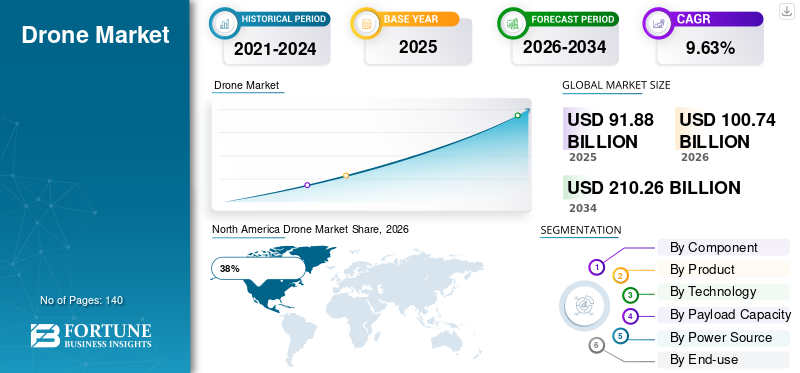
- The global drone market is projected to reach USD 210.26 billion by 2034, rising from USD 91.88 billion in 2025 to USD 100.74 billion in 2026, at a compound annual growth rate (CAGR) of 9.63% during the forecast period.
- Adoption of drones is likely to accelerate with increasing use across commercial, defense, industrial, and public safety sectors, supported by growing demand for aerial mapping, surveillance, and inspection applications.
- Although the industry continues to evolve, drone deployment is expanding across precision agriculture, infrastructure inspection, logistics operations, and monitoring applications, strengthening its role across multiple end-use industries.
- The drone market is being driven by rising investments in unmanned aerial systems (UAS) and the growing integration of drones into operational workflows, supporting long-term market expansion worldwide.
The global drone market size was valued at USD 91.88 billion in 2025 and is projected to grow from USD 100.74 billion in 2026 to USD 210.26 billion by 2034, exhibiting a CAGR of 9.63% during the forecast period. The industry growth is driven by expanding commercial applications, autonomous flight technologies, and increasing industrial adoption (2026–2034).

The global drone market is experiencing rapid transformation due to rising adoption across commercial, defense, industrial, and public safety sectors. Drone market Analysis indicates that aerial mapping, surveillance, precision agriculture, infrastructure inspection, and logistics operations are creating strong demand for unmanned aerial systems worldwide.
Fixed-wing drones, rotary-wing drones, and hybrid platforms are being integrated into energy, mining, and construction projects to improve operational efficiency and reduce labor intensity. Drone industry report findings show that AI-enabled navigation, real-time imaging, and autonomous flight technologies are strengthening market penetration across enterprise users. Drone market Growth is also supported by increasing procurement of tactical drones for border security, disaster response, and environmental monitoring applications.
The United States drone market holds nearly 32% share of the global drone market size due to strong defense procurement, advanced aerospace manufacturing capabilities, and high adoption in commercial industries. More than 870,000 registered drones were operating across the country during 2025, including commercial and recreational units.
Drone market research report findings indicate that agriculture monitoring in over 210 million acres of farmland supported demand for imaging drones and crop analytics platforms. Infrastructure inspection projects across highways, transmission lines, and oil pipelines accelerated the deployment of autonomous UAV fleets. Drone Industry Analysis also highlights the growing use of delivery drones in healthcare logistics and retail distribution across major metropolitan regions in the United States.
The global drone market is experiencing sustained expansion as unmanned aerial systems become increasingly integrated into commercial, industrial, and governmental operations. Growing demand for operational efficiency, real-time intelligence, and automated data acquisition is accelerating adoption across diverse end-use sectors. Consequently, the drone market size continues to expand, supported by technological advancements, improving regulatory frameworks, and increasing investment in aerial mobility solutions.
Commercial deployment remains a fundamental driver of drone market growth. Organizations are increasingly utilizing drone technology for infrastructure inspection, surveying, mapping, precision agriculture, logistics support, environmental monitoring, and public safety operations. These applications provide measurable cost efficiencies while improving safety, productivity, and decision-making capabilities. As a result, the commercial drone segment continues to capture a significant portion of overall market activity.
Technological innovation is reshaping competitive dynamics throughout the industry. Advances in battery life, artificial intelligence, machine learning, sensor integration, and autonomous navigation systems are enhancing operational performance and expanding mission capabilities. Drone manufacturers are investing heavily in research and development to improve payload flexibility, flight endurance, and autonomous functionality. The market is also witnessing a gradual progression from remotely piloted operations toward fully autonomous systems capable of executing increasingly complex tasks.
North America maintains a leading position within the global drone market due to strong commercial adoption, advanced technological infrastructure, and supportive regulatory development. Asia Pacific is emerging as the fastest-growing regional market, supported by expanding manufacturing capabilities, rising investment, and increasing government initiatives. Meanwhile, Europe continues to focus on commercial airspace integration and regulatory harmonization.
Current drone market trends emphasize automation, intelligent analytics, and industry-specific platform development. Although operational restrictions and regulatory complexities remain important considerations, continuous technological advancements are expected to support long-term drone market growth. The industry outlook remains favorable as organizations increasingly adopt drones as strategic tools for efficiency, data intelligence, and digital transformation initiatives worldwide.
Download Free sample to learn more about this report.
Key Takeaways
Market Size & Growth
- Global market size 2025: USD 91.88 billion
- Global market size 2034: USD 210.26 billion
- CAGR (2025–2034): 9.63%
Market Share – Regional
- North America: 38%
- Europe: 27%
- Asia-Pacific: 29%
- Rest of World: 6%
Country-Level Shares
- Germany: 29% of Europe’s market
- United Kingdom: 21% of Europe’s market
- Japan: 18% of the Asia-Pacific market
- China: 32% of the Asia-Pacific market
Key Market Dynamics
Market Trends
Drone market trends indicate significant movement toward autonomous operations, AI-driven analytics, and compact, lightweight drone architectures. Enterprises are increasingly adopting drones equipped with thermal cameras, multispectral sensors, and LiDAR systems for industrial monitoring applications. Drone market forecast assessments reveal that beyond-visual-line-of-sight operations are becoming more accepted across logistics, agriculture, and energy sectors due to evolving aviation regulations and safety frameworks. Drone industry analysis also identifies increasing demand for swarming technology in defense applications, where multiple drones operate collaboratively for surveillance and tactical missions.
Download Free sample to learn more about this report.
Battery technology improvements are enabling longer flight durations exceeding 55 minutes in many commercial drone models, while hydrogen-powered drone systems are gaining traction for industrial operations requiring extended range. Drone market insights further show that software-defined drones integrated with cloud analytics are reshaping aerial data processing across infrastructure inspection and geospatial mapping industries. Demand for first-person-view drones has expanded in media production and sports broadcasting sectors due to the rising adoption of immersive video technology.
The drone market is undergoing rapid transformation as automation, intelligent analytics, and advanced connectivity become central to industry development. One of the most influential drone market trends is the increasing transition toward fully autonomous operations. Artificial intelligence and machine learning technologies are enabling drones to execute complex missions with reduced human intervention and greater operational consistency.
Demand for industry-specific solutions is also rising. Drone manufacturers are developing specialized platforms designed for precision agriculture, infrastructure inspection, logistics, energy monitoring, mining, and public safety applications. These tailored systems improve operational efficiency and strengthen value propositions across end-use sectors.
Fixed-wing platforms continue to gain prominence for long-range missions due to their extended endurance and superior coverage capabilities. At the same time, multirotor systems remain dominant in inspection and surveillance applications requiring maneuverability and precise positioning.
Integration with cloud computing platforms and enterprise software ecosystems is becoming increasingly common. Organizations are leveraging real-time analytics and automated data processing to transform aerial information into actionable intelligence.
Another significant trend involves the expansion of autonomous fleet management capabilities. These systems enable centralized mission planning, monitoring, and performance optimization across multiple drone assets. As organizations prioritize operational efficiency and digital transformation, these developments are expected to continue shaping future drone market trends and expanding commercial adoption worldwide.
Market Drivers
Rising Adoption of Drones across Defense and Industrial Surveillance Applications.
The drone market is expanding rapidly due to growing utilization of unmanned aerial systems for defense surveillance, border patrol, and industrial monitoring. More than 62 countries increased tactical drone procurement programs during 2025 to strengthen reconnaissance and intelligence operations. Drone market analysis shows that industrial facilities reduced inspection downtime by nearly 41% after deploying autonomous drones for infrastructure assessment.
Energy companies operating over 3.8 million kilometers of transmission infrastructure have adopted UAV inspection systems to improve maintenance efficiency and reduce operational hazards. Drone Market Research Report findings indicate that mining operations improved site mapping accuracy by 36% through drone-enabled geospatial imaging systems. Agricultural drone deployments also exceeded 1.9 million units globally, driven by precision farming initiatives and automated crop monitoring.
The drone market growth is primarily driven by expanding adoption across commercial, industrial, and government sectors seeking greater operational efficiency and improved data collection capabilities. Organizations increasingly deploy drones to perform surveying, inspection, monitoring, and mapping activities that traditionally required substantial labor, time, and financial resources.
Precision agriculture remains a major catalyst for market expansion. Agricultural enterprises are utilizing drone technology for crop monitoring, irrigation management, field assessment, and resource optimization. These capabilities improve productivity while supporting data-driven farming practices and sustainable agricultural operations.
Public safety agencies are also accelerating deployment. Drones are increasingly used for emergency response, disaster assessment, border monitoring, search-and-rescue operations, and law enforcement activities. Real-time aerial intelligence enhances situational awareness and supports faster decision-making during critical incidents.
Technological advancements continue to strengthen adoption across industries. Improvements in battery life, imaging systems, autonomous navigation, and artificial intelligence are expanding operational capabilities. Enhanced performance allows drones to conduct increasingly complex missions with greater accuracy and reliability.
Growing investment by drone manufacturers is further supporting market expansion. Expanded production capacity, improved manufacturing capabilities, and continuous product innovation are making advanced systems more accessible. These factors collectively reinforce long-term drone market growth and support increasing adoption across both commercial and public sector applications globally.
Market Restraints
Strict Aviation Regulations and Limited Airspace Permissions.
Drone industry analysis identifies regulatory restrictions as a major challenge affecting commercial drone deployment worldwide. Many countries continue to impose strict operational limitations related to altitude control, urban airspace usage, and beyond-visual-line-of-sight flights. Drone market outlook data shows that approximately 43% of commercial drone operators faced delays in obtaining aviation approvals for industrial operations during 2025.
Regulatory fragmentation across international markets also creates operational complexity for manufacturers and service providers operating across multiple jurisdictions. Drone market Forecast assessments reveal that compliance costs related to licensing, pilot certification, and cybersecurity standards increased by nearly 29% among enterprise drone operators. Privacy concerns associated with aerial imaging and data collection are further limiting drone adoption in densely populated urban environments.
The drone market faces several challenges that may limit adoption despite strong growth prospects. Regulatory complexity remains one of the most significant barriers. Airspace regulations, pilot certification requirements, operational approvals, and restrictions on beyond-visual-line-of-sight operations vary across jurisdictions, creating compliance challenges for operators.
Privacy concerns continue to influence market development. Drones equipped with advanced imaging and surveillance technologies raise questions regarding data collection, monitoring practices, and information security. Organizations must comply with evolving privacy regulations, often increasing operational complexity and implementation costs.
Battery life limitations remain an important technical constraint. Although technological advancements have improved endurance, many drone systems continue to face restrictions related to flight duration and payload performance. These limitations can reduce operational effectiveness in long-range inspection, logistics, and surveillance applications.
Cybersecurity risks also represent a growing concern. Increased connectivity exposes drones to potential threats, including unauthorized access, communication interference, and data breaches. Organizations must invest in secure infrastructure and risk mitigation measures to protect operations.
Weather dependency further affects deployment reliability. Strong winds, heavy rainfall, and poor visibility can limit flight operations and reduce mission effectiveness. Collectively, these challenges continue to influence purchasing decisions and moderate the pace of drone market growth across multiple industries.
Market Opportunities
Expansion of Drone Delivery and Smart Logistics Infrastructure.
Drone market opportunities are accelerating due to increasing investment in autonomous logistics and last-mile delivery networks. More than 540 pilot drone delivery programs were launched globally during 2025 across healthcare, food delivery, and e-commerce sectors. Drone Market Research Report findings indicate that medical drone deliveries reduced emergency transportation times by nearly 47% in remote healthcare regions.
Retail distribution centers are adopting autonomous UAV fleets for rapid inventory transfer and warehouse operations. Drone industry report analysis highlights growing demand for lightweight cargo drones capable of carrying payloads exceeding 20 kilograms for industrial transportation applications. Smart city infrastructure development is further creating opportunities for aerial traffic monitoring, emergency response coordination, and environmental inspection services.
The drone market presents significant opportunities as organizations increasingly adopt aerial intelligence solutions to enhance efficiency, safety, and decision-making. Expanding commercial acceptance is creating new revenue streams across hardware, software, and service segments while supporting broader industry development. Logistics and last-mile delivery represent major long-term opportunities. Advancements in autonomous navigation, airspace management systems, and regulatory frameworks are increasing the feasibility of drone-based transportation networks. These capabilities offer potential benefits in speed, accessibility, and operational efficiency.
Precision agriculture continues to provide substantial growth potential. Farmers are investing in drone technology to improve crop monitoring, resource management, and productivity optimization. Rising emphasis on sustainable agricultural practices is expected to support continued deployment across global farming operations. Infrastructure modernization initiatives are generating additional opportunities. Drones are increasingly used to inspect transportation assets, telecommunications networks, energy facilities, and industrial infrastructure. These applications reduce manual inspection requirements while improving worker safety and operational effectiveness.
Public safety and environmental monitoring applications are also expanding rapidly. Governments are deploying drones for disaster response, wildlife conservation, border surveillance, and environmental assessment activities. Growing mission complexity is creating demand for advanced sensors, analytics platforms, and autonomous capabilities.
Asia Pacific, Latin America, the Middle East, and Africa represent attractive growth regions due to increasing investment in digital infrastructure and expanding awareness of drone technology benefits. Continued technological advancements and regulatory progress are expected to support long-term market expansion.
Market Challenges
Cybersecurity Risks and Limited Battery Endurance.
Drone market insights reveal that cybersecurity vulnerabilities remain a significant concern for enterprise drone operations. Unauthorized signal interference, GPS spoofing, and data breaches continue to affect commercial drone networks operating in critical infrastructure environments. Drone Industry Analysis indicates that nearly 31% of enterprise operators increased cybersecurity investments during 2025 to secure drone communication systems and cloud-based analytics platforms.
Battery limitations also continue to affect long-range and heavy-payload operations across logistics and industrial inspection sectors. Many commercial drones still operate with flight durations below 45 minutes under high payload conditions, reducing operational efficiency for large-scale projects. Drone market Growth is additionally constrained by high replacement costs for lithium-ion battery systems and thermal management challenges in extreme weather environments.
Drone Market Segmentation Analysis
By Component
Hardware
Hardware represents the largest revenue-generating segment within the drone market, encompassing airframes, propulsion systems, flight controllers, sensors, communication modules, batteries, and payload systems. Demand for advanced hardware continues to increase as commercial and industrial operators seek higher performance, improved durability, and greater mission flexibility.
Drone manufacturers are investing heavily in lightweight materials, enhanced battery life, and intelligent navigation systems to improve operational efficiency. Advances in imaging technologies, thermal sensors, and LiDAR integration are expanding drone applications across infrastructure inspection, precision agriculture, and public safety operations.
Hardware remains central to the overall drone market size because performance capabilities directly influence operational effectiveness. Growing adoption of fully autonomous and remotely piloted systems continues to drive innovation in component design and manufacturing capabilities.
Hardware accounts for nearly 61% of the drone market share due to rising production of fixed-wing drones, rotary-wing drones, propulsion systems, sensors, and imaging equipment. Drone Industry Report analysis shows that over 4.3 million commercial drone units were manufactured globally during 2025.
Advanced hardware integration, including LiDAR modules, thermal cameras, radar systems, and GPS stabilization technologies, is improving drone operational capabilities across industrial sectors. Defense procurement programs significantly contribute to hardware demand through investments in tactical surveillance drones and autonomous combat UAV systems. Drone market Insights further indicate that lightweight composite materials reduced drone structural weight by nearly 24%, enhancing endurance and maneuverability.
Software
Software represents approximately 24% of the drone market size due to increasing adoption of AI-enabled navigation systems, cloud analytics platforms, and automated flight management tools. Drone market Trends indicate that autonomous mission planning software reduced manual operational intervention by nearly 39% during industrial inspection activities.
Software is emerging as one of the fastest-growing segments within the drone market. Modern drone operations increasingly depend on mission planning platforms, fleet management systems, autonomous navigation software, data analytics tools, and cloud-based processing environments. Organizations are prioritizing software solutions that enable real-time monitoring, automated flight operations, predictive maintenance, and regulatory compliance management. Artificial intelligence and machine learning technologies are becoming increasingly important in data interpretation and mission optimization.
Real-time data analytics, geospatial imaging software, and predictive maintenance applications are strengthening enterprise demand for integrated drone ecosystems. Drone Industry Analysis also highlights the growing implementation of cybersecurity software for encrypted drone communication networks and remote fleet monitoring systems.
Services
Services hold nearly 15% of the drone market share and continue expanding due to rising demand for drone-as-a-service business models. Drone Market Research Report findings reveal that infrastructure inspection, aerial surveying, and environmental monitoring services increased by 34% globally during 2025.
The services segment includes drone-as-a-service offerings, maintenance, training, consulting, inspection services, and data analytics support. Increasing adoption among organizations lacking in-house expertise is driving demand for specialized service providers.
Service-based models reduce capital investment requirements and enable enterprises to access advanced drone capabilities without managing hardware ownership. Demand remains particularly strong in construction, energy, agriculture, and infrastructure management sectors. As commercial deployment expands globally, services are expected to become an increasingly important contributor to drone market growth and long-term industry development.
Enterprises are increasingly outsourcing drone operations to specialized service providers to reduce equipment ownership costs and compliance burdens. Drone Industry Report analysis indicates strong demand for pilot training, maintenance services, cloud-based aerial analytics, and fleet management consulting. Agricultural drone spraying services also experienced substantial growth due to increasing precision farming adoption across large-scale agricultural operations.
To know how our report can help streamline your business, Speak to Analyst
By Product
Product-based segmentation contributes nearly 27% of the drone market size, driven by the rising deployment of multi-rotor drones, fixed-wing drones, and hybrid UAV systems.
Fixed Wing
Fixed-wing drones are widely utilized for long-range operations requiring extensive coverage and extended endurance. These systems are particularly effective in mapping, surveying, environmental monitoring, and agricultural assessment applications.
Their aerodynamic efficiency enables longer flight durations compared with multirotor platforms, making them attractive for large-area missions. Demand continues to increase among government agencies and commercial operators requiring broad geographic coverage. The segment plays an important role in drone market growth due to increasing adoption across industrial and environmental monitoring applications.
Rotary Wing
Rotary wing drones dominate commercial deployment due to their maneuverability, vertical takeoff capabilities, and operational flexibility. These platforms are extensively used in inspection, surveillance, public safety, and photography applications.
Their ability to hover and operate in confined environments supports widespread adoption across diverse industries. Continuous technological advancements are enhancing payload capacity and operational efficiency.
This segment accounts for a substantial portion of the global drone market share and remains a key revenue contributor.
Hybrid
Hybrid drones combine the endurance advantages of fixed-wing systems with the maneuverability of rotary-wing platforms. These systems are increasingly deployed in missions requiring both long-range travel and precise operational control.
Demand is growing in logistics, defense, and industrial inspection applications where versatility is critical. Although adoption remains relatively limited compared with conventional platforms, hybrid systems represent an important innovation segment.
Multi-rotor drones dominate urban surveillance and photography applications due to vertical takeoff capabilities and maneuverability advantages. Fixed-wing drones are widely adopted for long-range mapping and military reconnaissance operations. Drone market Analysis indicates that hybrid VTOL systems experienced 22% deployment growth during 2025 due to increasing demand for extended endurance and operational flexibility. Product diversification continues to support enterprise procurement across logistics, infrastructure inspection, and defense surveillance sectors.
By Technology
Technology-based applications account for approximately 21% of the drone market share due to the integration of AI, machine vision, thermal imaging, and autonomous navigation technologies. Drone market Insights reveal that AI-powered drones improved industrial inspection efficiency by nearly 37% compared with manual inspection methods. LiDAR-enabled drones are increasingly utilized for terrain mapping and forestry management projects. Autonomous collision avoidance systems and machine-learning analytics are strengthening adoption across defense and commercial logistics sectors.
Remotely Piloted
Remotely piloted drones currently account for the majority of global deployments. These systems rely on human operators for navigation and mission execution while benefiting from advanced stabilization, navigation, and communication technologies.
Organizations favor remotely piloted platforms due to regulatory familiarity and operational control. They remain widely used across commercial, industrial, and public safety applications.
The segment continues to maintain a significant drone market share due to broad regulatory acceptance and established operational frameworks.
Semi-Autonomous
Semi-autonomous drones combine automated flight functions with operator supervision. Capabilities such as waypoint navigation, obstacle avoidance, automated return-to-home functionality, and mission automation improve operational efficiency.
This segment is experiencing strong adoption as organizations seek greater productivity without fully relinquishing human oversight. Industries value the balance between automation and control offered by these systems.
Semi-autonomous technology is increasingly becoming a standard feature across commercial drone platforms.
Fully Autonomous
Fully autonomous drones represent one of the most transformative areas of industry development. These systems execute missions independently using artificial intelligence, machine learning, and advanced sensor technologies.
Applications include logistics, infrastructure monitoring, security operations, and environmental assessment. Although regulatory frameworks continue to evolve, demand for autonomous capabilities is increasing rapidly.
This segment is expected to become a major contributor to future drone market growth as technology and regulatory acceptance mature.
By Payload Capacity
Payload capacity applications represent nearly 18% of the drone market growth due to increasing use of drones for cargo transportation, agricultural spraying, and industrial logistics. Heavy-payload drones capable of carrying more than 25 kilograms are gaining adoption across mining, healthcare logistics, and military resupply operations. Drone market Forecast analysis indicates that medium-payload drones dominate infrastructure inspection and emergency response applications due to balanced endurance and mobility performance. Improvements in propulsion systems and lightweight structural materials are enhancing payload efficiency across commercial UAV fleets.
Below 2 Kg
Drones with a payload capacity below 2 kg represent the most widely deployed category due to affordability, portability, and regulatory accessibility. Many jurisdictions impose fewer operational requirements on lightweight platforms, encouraging adoption among commercial users, public safety agencies, and small enterprises.
These systems are extensively used for aerial photography, surveillance, site monitoring, and basic inspection activities. Their compact design enables rapid deployment and efficient operation in urban and confined environments. Improvements in miniaturized sensors and imaging technologies continue to enhance functionality despite payload limitations.
This segment contributes significantly to shipment volumes within the drone market. While average selling prices remain comparatively lower, widespread adoption supports substantial unit demand and reinforces overall market expansion.
2 Kg–25 Kg
The 2 kg–25 kg category represents the commercial core of the drone market. These platforms provide an effective balance between payload capacity, endurance, operational flexibility, and regulatory compliance. Organizations increasingly deploy these drones across infrastructure inspection, precision agriculture, mapping, surveying, and industrial monitoring applications.
Advanced payload integration capabilities allow deployment of thermal cameras, multispectral sensors, LiDAR systems, and specialized inspection equipment. Enterprises favor this category because it supports scalable operations while maintaining manageable operating costs.
As a result, this segment accounts for a substantial share of the drone market size and remains one of the primary drivers of commercial adoption globally.
Above 25 Kg
Drones exceeding 25 kg payload capacity are primarily utilized for specialized applications requiring extended endurance, larger payloads, or heavy-duty operational capabilities. These systems support logistics operations, industrial inspections, defense activities, and large-scale surveillance missions.
Regulatory requirements are more stringent due to operational complexity and safety considerations. Consequently, deployment volumes remain relatively limited compared with lighter categories. However, revenue contribution per unit is significantly higher.
The segment represents an important long-term growth opportunity as regulatory frameworks evolve and commercial heavy-payload applications expand.
By Power Source
Power source segmentation contributes around 16% of the drone market share, with lithium-ion battery drones dominating commercial operations. Battery-powered drones are preferred due to low operational noise, reduced maintenance, and compact design efficiency. Drone Industry Report findings indicate that hydrogen fuel-cell drones experienced 19% deployment growth during 2025 in long-range industrial operations. Solar-assisted drone systems are also emerging for environmental monitoring and defense reconnaissance applications. Hybrid propulsion systems combining electric and fuel-based technologies are improving endurance for logistics and surveillance operations across remote regions.
Battery Powered
Battery-powered drones dominate the global drone market due to operational simplicity, lower maintenance requirements, and growing advancements in battery technology. These systems are widely deployed across commercial, industrial, and recreational applications.
Improvements in battery life, charging efficiency, and energy density continue to enhance performance. Battery-powered platforms are particularly attractive for inspection, surveillance, photography, and precision agriculture operations where operational flexibility is essential.
This segment currently accounts for the largest share of market deployments and remains central to ongoing drone market growth.
Hybrid Powered
Hybrid-powered drones combine battery systems with supplementary power sources to improve endurance and operational range. These platforms address limitations associated with conventional battery-powered systems while maintaining flexibility.
Demand is increasing among operators conducting long-duration inspections, logistics missions, and environmental monitoring activities. Hybrid systems enable extended flight times without significantly compromising operational efficiency.
As mission requirements become increasingly complex, hybrid-powered solutions are expected to gain broader commercial acceptance and support future market expansion.
Fuel Cell Powered
Fuel cell-powered drones represent an emerging segment focused on extended endurance and high-efficiency operations. These systems offer longer flight durations than conventional battery-powered platforms and are gaining attention for specialized industrial and defense applications.
Although adoption remains limited due to infrastructure and cost considerations, ongoing technological advancements are improving commercial viability. Interest is particularly strong in sectors requiring persistent aerial monitoring and long-range operations.
This segment is expected to benefit from continued innovation and growing demand for high-endurance drone solutions.
By End-use
End-use applications account for approximately 18% of the drone market size, driven by expanding deployment across agriculture, defense, logistics, construction, mining, and public safety sectors. Agriculture remains a major commercial end-use segment with over 210 million hectares monitored using drones globally during 2025. Drone market Opportunities are also increasing in oil and gas inspection, renewable energy monitoring, and emergency disaster management. Defense agencies continue investing heavily in surveillance and tactical drone fleets to strengthen intelligence gathering capabilities. Construction firms increasingly utilize drones for progress monitoring, 3D mapping, and safety inspections across large infrastructure projects.
Commercial
The commercial segment represents the largest contributor to the drone market size, driven by expanding deployment across construction, agriculture, logistics, telecommunications, media, and energy industries. Organizations increasingly utilize drones to improve efficiency, reduce costs, and enhance operational visibility.
Applications include infrastructure inspection, surveying, mapping, crop monitoring, asset management, and delivery support. Continuous technological advancements are expanding use cases and strengthening return on investment.
Commercial adoption remains the primary engine of long-term drone market growth.
Government & Public Safety
Government agencies and public safety organizations increasingly deploy drones for emergency response, border security, disaster management, search-and-rescue operations, and law enforcement activities.
Real-time aerial intelligence improves situational awareness while reducing risks to personnel. Growing emphasis on emergency preparedness and security modernization continues to support demand across this segment.
The increasing integration of drone technology into public safety operations is strengthening overall market development.
Defense & Military
Defense organizations represent a major end-user segment, utilizing drones for surveillance, reconnaissance, intelligence gathering, target acquisition, and tactical operations. Military modernization programs continue to drive investment in advanced unmanned systems.
Technological developments in autonomous navigation, secure communications, and sensor integration are enhancing operational capabilities. Demand remains strong across both developed and emerging defense markets.
This segment contributes significantly to industry revenues and technological innovation.
Agriculture
Agriculture remains one of the fastest-growing drone end-use sectors. Farmers increasingly deploy drones for precision agriculture applications, including crop monitoring, soil analysis, irrigation assessment, and yield optimization.
Drone technology enables data-driven farming practices that improve productivity while reducing resource consumption. Rising focus on sustainable agriculture is expected to support continued adoption globally.
The segment remains an important contributor to future drone market growth.
Others
Other end-use sectors include mining, environmental monitoring, insurance, education, healthcare, and scientific research. These industries are increasingly exploring drone capabilities to improve operational efficiency and data collection.
Growing awareness of drone benefits and expanding application diversity continue to create new revenue opportunities. As technology matures, these emerging use cases are expected to contribute meaningfully to overall market expansion.
Regional Insights
North America Drone Market Analysis:
North America Drone Market Share, 2025 (%)
To get more information on the regional analysis of this market, Download Free sample
North America remains a leading regional market, supported by advanced technological infrastructure, favorable regulatory development, and strong commercial adoption. Organizations increasingly utilize drone technology across logistics, infrastructure inspection, agriculture, and public safety applications. Continued investment in autonomous systems and aerial analytics supports market expansion. The region maintains a significant drone market share due to innovation leadership and the strong presence of major industry participants.
North America commands approximately 38% of the global drone market share due to extensive deployment across defense, agriculture, logistics, and industrial inspection sectors. The United States dominates regional demand with more than 870,000 registered drones operating across commercial and recreational applications in 2025.
Drone market Analysis indicates that over 46% of enterprise drone usage in the region was linked to infrastructure inspection, public safety monitoring, and energy asset surveillance. Commercial drones are increasingly utilized for transmission line inspection, railway monitoring, and pipeline assessment to reduce manual operational risks.
United States Drone Market:
The United States dominates the North American drone market, driven by widespread commercial deployment and substantial investment in research and development. Demand remains strong across construction, agriculture, energy, logistics, and defense sectors. Technological advancements and regulatory modernization continue to support adoption. Growing utilization of fully autonomous and remotely piloted systems strengthens drone market growth and reinforces the country’s industry leadership.
Europe Drone Market Analysis:
Europe represents nearly 27% of the global drone market size due to increasing industrial automation, infrastructure modernization, and environmental monitoring initiatives. Drone market Trends show strong adoption across Germany, France, Italy, and the United Kingdom for aerial mapping, logistics optimization, and smart city surveillance projects. More than 31% of industrial inspection activities across Europe integrated drone-based imaging and analytics systems during 2025.
Europe represents a mature drone market characterized by regulatory harmonization and increasing commercial deployment. Governments and enterprises are expanding drone usage across inspection, environmental monitoring, logistics, and public safety operations. Strong emphasis on operational safety and airspace integration supports industry development. Continuous investment in drone technology and innovation contributes to steady drone market growth across major European economies.
Renewable energy companies extensively deploy drones for wind turbine maintenance, offshore inspection, and solar farm monitoring operations. Drone market Growth is also supported by precision agriculture initiatives utilizing autonomous UAV systems for crop analysis and irrigation management. European aviation authorities continue strengthening UAV integration through harmonized regulatory frameworks and pilot certification programs. Emergency response agencies are deploying drones for wildfire detection, flood monitoring, and coastal surveillance applications.
Germany Drone Market:
Germany accounts for approximately 29% of the European drone market share due to advanced aerospace engineering, industrial manufacturing capabilities, and strong automation adoption.
Germany remains a key contributor to the European drone market due to its advanced industrial base and strong engineering capabilities. Organizations increasingly deploy drones for manufacturing inspection, infrastructure monitoring, logistics, and precision agriculture. Technological innovation and industrial automation initiatives continue to support adoption. The country maintains a significant position within the regional drone market share through ongoing investment and commercial implementation.
United Kingdom Drone Market:
The United Kingdom drone market is expanding steadily, supported by growing adoption across commercial, infrastructure, and public sector applications. Demand is increasing for inspection, surveying, emergency response, and environmental monitoring activities. Regulatory initiatives aimed at enabling commercial operations are supporting market development. Continued investment in autonomous systems and aerial analytics contributes to long-term drone market growth within the country.
The United Kingdom contributes nearly 21% of the European drone market size due to increasing adoption across defense, healthcare logistics, infrastructure inspection, and smart mobility sectors. Drone market Forecast assessments indicate that over 9,500 enterprise drone operators were active across the country during 2025. Healthcare logistics providers increasingly deploy drones for emergency medical transportation, laboratory sample delivery, and pharmaceutical distribution services. Offshore energy operators are utilizing drones for oil platform inspection, maritime surveillance, and coastal monitoring activities.
Asia-Pacific Drone Market Analysis:
Asia Pacific represents the fastest-growing regional drone market, driven by expanding manufacturing capabilities, rising investment, and increasing commercial adoption. Countries throughout the region are deploying drones across agriculture, infrastructure development, logistics, and public safety applications. Government support and technological advancements continue to accelerate industry expansion. Strong production capacity and innovation contribute significantly to the overall drone market size growth.
Asia-Pacific holds approximately 29% of the global drone market share and remains one of the fastest-expanding regional markets due to strong electronics manufacturing capabilities and rising commercial UAV adoption. China, Japan, South Korea, and India are leading contributors to regional drone deployment growth.
Japan Drone Market:
Japan contributes nearly 18% of the Asia-Pacific drone market share due to strong robotics integration and advanced industrial automation capabilities. Drone market Analysis indicates that automated agricultural drones were deployed across more than 3 million hectares of farmland during 2025.
Japan’s drone market benefits from advanced technological expertise and increasing demand for automation solutions. Organizations utilize drones for infrastructure inspection, disaster management, agriculture, and industrial monitoring. The country’s focus on robotics, artificial intelligence, and autonomous technologies supports continued innovation. Growing adoption across commercial sectors contributes to steady drone market growth and strengthens Japan’s position within the Asia Pacific region.
China Drone Market:
China dominates the Asia-Pacific drone market with approximately 32% regional market share due to large-scale manufacturing infrastructure and extensive commercial drone exports. Drone market Growth is supported by the strong production of consumer drones, industrial UAV systems, and advanced aerial imaging technologies.
China represents one of the largest drone markets globally, supported by strong manufacturing capabilities and the presence of major drone manufacturers. Commercial deployment continues to expand across logistics, agriculture, infrastructure inspection, and public safety applications. Government support and technological advancements reinforce market development. The country maintains a dominant position in the global drone market share through large-scale production and innovation.
Latin America Drone Market Analysis:
Latin America is experiencing increasing drone adoption across agriculture, mining, infrastructure, and environmental monitoring sectors. Organizations are leveraging drone technology to improve operational efficiency and reduce monitoring costs. While regulatory frameworks continue to evolve, growing awareness of commercial benefits supports market expansion. Increasing investment and expanding industrial applications contribute to gradual drone market growth throughout the region.
Middle East & Africa Drone Market Analysis:
The Middle East and Africa drone market is developing steadily as governments and enterprises invest in digital transformation initiatives. Drones are increasingly utilized across infrastructure inspection, energy operations, security, and environmental monitoring applications. Rising awareness, improving regulatory environments, and technological advancements support adoption. Growing investment opportunities continue to strengthen drone market growth across the region.
Drone Industry Competitive Landscape:
The global drone market is characterized by intense competition among established drone manufacturers, defense contractors, software developers, and emerging technology companies. Market participants compete on product performance, autonomous capabilities, payload flexibility, software integration, and operational reliability. As commercial adoption accelerates, competitive positioning increasingly depends on the ability to deliver end-to-end drone ecosystems rather than standalone hardware solutions.
Leading companies continue to invest heavily in research and development to strengthen technological differentiation. Advancements in artificial intelligence, autonomous navigation, obstacle avoidance, imaging systems, and cloud-based analytics are becoming critical competitive factors. Organizations are also focusing on extending battery life and improving flight endurance to address evolving customer requirements across commercial and industrial applications.
The competitive landscape remains highly diverse. Consumer and commercial markets are led by specialized drone manufacturers, while defense-oriented companies focus on surveillance, reconnaissance, and tactical unmanned systems. Strategic partnerships between hardware providers, software developers, and service operators are becoming increasingly common as companies seek to expand capabilities and improve market reach.
Software platforms are emerging as a major source of differentiation. Fleet management, mission planning, real-time analytics, and automated reporting solutions are helping vendors build recurring revenue streams while enhancing customer retention. As a result, competition is shifting beyond hardware performance toward integrated operational ecosystems.
Regional dynamics also influence competition. Asia Pacific benefits from strong manufacturing capabilities and production scale, while North America emphasizes innovation, autonomous technologies, and enterprise applications. European companies focus on regulatory compliance, industrial solutions, and airspace integration initiatives.
The drone market reflects a competitive environment driven by technological advancements, expanding commercial applications, and increasing demand for intelligent aerial systems. Continuous innovation, strategic collaboration, and software-enabled value creation are expected to shape future drone market share distribution and long-term industry leadership.
List of Top Drone Companies
- SZ DJI Technology Co., Ltd.
- Northrop Grumman Corporation
- AgEagle Aerial Systems Inc
- Lockheed Martin Corporation
- Autel Robotics
- RTX Corporation
- Parrot Drone SAS
- 3DR, Inc.
- Pix4D
- Elbit Systems Ltd.
- Skydio
- Teledyne FLIR LLC
- Yuneec International
Top Two Companies with the Highest Market Share
- SZ DJI Technology Co., Ltd. – 43% market share
- Northrop Grumman Corporation – 11% market share
Investment Analysis and Opportunities
Drone market investment analysis indicates rising capital allocation toward autonomous navigation systems, AI-driven analytics platforms, and advanced propulsion technologies. More than 420 venture funding deals associated with drone startups were recorded globally during 2025. Drone market Opportunities continue increasing across logistics automation, smart agriculture, and industrial inspection applications. Defense modernization programs across North America, Europe, and the Asia-Pacific are generating significant procurement investments in tactical UAV systems and swarm drone technologies. Drone Market Research Report findings indicate that industrial drone infrastructure investments increased by nearly 33% across energy, mining, and construction sectors during 2025.
Warehouse automation projects and autonomous delivery networks are attracting substantial private-sector investments, particularly among retail and healthcare logistics providers. Drone Industry Analysis also identifies growing opportunities in drone cybersecurity software, aerial imaging analytics, and drone traffic management systems. Hydrogen-powered UAV research programs are receiving increased funding due to demand for extended endurance operations. Emerging economies are investing heavily in drone-based agricultural modernization and environmental monitoring projects. Drone market Forecast assessments reveal expanding opportunities for cloud-based fleet management services and drone-as-a-service operational models that reduce enterprise capital expenditure requirements.
New Product Development
Drone market trends indicate strong innovation activity focused on autonomous flight capability, AI-enhanced imaging, and modular payload systems. Manufacturers are developing drones equipped with advanced obstacle avoidance technology, thermal imaging sensors, and real-time edge computing capabilities. Drone market Insights reveal that several enterprise-grade drones launched during 2025 achieved flight endurance exceeding 60 minutes through hybrid propulsion integration and lightweight structural materials. AI-powered navigation software capable of autonomous route optimization is becoming a major product differentiator across industrial and logistics applications.
Drone industry report analysis highlights the rising development of compact tactical drones with encrypted communication systems for defense and public safety operations. Manufacturers are also introducing waterproof drone platforms for offshore inspection and maritime surveillance projects. Agricultural drone innovations include precision spraying systems capable of reducing chemical usage by nearly 28% while improving crop monitoring accuracy. Drone Market Research Report findings further indicate strong development activity in swarm drone technology for coordinated surveillance and emergency response missions.
Latest Drone Industry Developments
- February 2025: DJI introduced the DJI Dock 3 automated drone deployment system with Matrice 4D and 4TD drones – Expanding autonomous remote operations for industrial inspection and public safety missions – Deployment of drone-in-a-box technology, mobile vehicle launch capability, automated charging infrastructure, and remote mission management systems.
- June 2025: DJI unveiled the Matrice 400 heavy-lift enterprise drone – Expanding capabilities for infrastructure inspection, mapping, and public safety operations. Support for advanced LiDAR payloads, multi-sensor configurations, extended endurance systems, and enterprise software integration.
- December 2025: United States Federal Communications Commission (FCC) – Implemented restrictions affecting approval of new foreign-manufactured drone models within the United States – Strengthening national security oversight and promoting domestic drone ecosystem development – Application of Covered List regulatory controls impacting future market access for selected drone manufacturers.
- March 2026: Skydio secured a U.S. Army contract exceeding $52 million for more than 2,500 X10D drones – Expanding domestic defense drone deployment and strengthening U.S. manufacturing leadership – Utilization of autonomous navigation, thermal imaging, secure communications, reconnaissance capabilities, and GPS-independent operational technologies.
Report Coverage of the Drone Market
Drone market report coverage includes a comprehensive analysis of market trends, technological innovation, industrial adoption patterns, competitive landscape evaluation, and regional deployment strategies across commercial and defense sectors. Drone market Analysis examines operational advancements in autonomous flight systems, AI-driven imaging platforms, and cloud-based drone analytics technologies. The report evaluates segmentation by type, product category, payload capacity, power source, technology integration, and end-use industries, including agriculture, logistics, defense, mining, construction, and public safety.
Request for Customization to gain extensive market insights.
Drone market research report findings also provide a detailed assessment of manufacturing trends, procurement activities, regulatory developments, and investment opportunities influencing global UAV deployment. Regional evaluation covers North America, Europe, Asia-Pacific, and the rest of the world markets with detailed country-level insights for major drone-producing and drone-adopting economies. Drone Industry Analysis further includes examination of enterprise adoption strategies, cybersecurity considerations, fleet management systems, and infrastructure inspection applications.



- 2021-2034
- 2025
- 2021-2024
- 140
-

(Offer valid till 15th Oct 2026)
Get 30-60 hrs Free Customization
Expand Regional and Country Coverage, Segments Analysis, Company Profiles, Competitive Benchmarking, and End-user Insights.




















Related Reports
-
US +1 833 909 2966 ( Toll Free )
-
Get In Touch With Us