Diethanolamine Market Size, Share & Industry Analysis, By Application (Detergents, Personal Care Products, Textiles, Herbicides, Pharmaceuticals, and Others), and Regional Forecast, 2026-2034
 Download Free Sample
 KEY MARKET INSIGHTS
 Listen to Audio Version
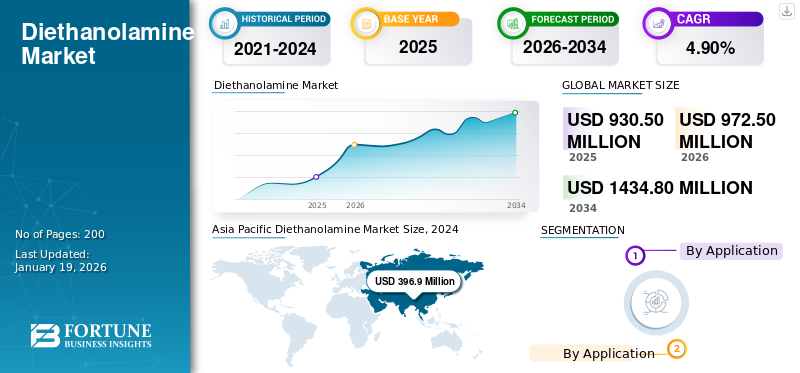
The global diethanolamine market size was valued at USD 930.5 million in 2025. The market is projected to grow from USD 972.5 million in 2026 to USD 1,434.8 million by 2034, exhibiting a CAGR of 4.9% during the forecast period. Asia Pacific dominated the diethanolamine market with a market share of 45.00% in 2025.
Diethanolamine (DEA) is an organic compound that produces surfactants, emulsifiers, and corrosion inhibitors. It plays an important role in the manufacturing of personal care products, detergents, textiles, pharmaceuticals, and gas treatment processes due to its versatile chemical properties. The market is noticing substantial growth driven by rising demand from the personal care industry, expansion in the textile and agricultural sectors, and rising use of gas-sweetening processes within the oil and gas industry. Additionally, the surge in industrialization and the growing demand for multifunctional chemical intermediates across both developed and developing economies are expected to drive market growth during the forecast period. Major manufacturers operating in the market include Dow, Merck KGaA, BASF SE, Avantor, Inc., and Thermo Fisher Scientific Inc.
- According to the U.S. Environmental Protection Agency (EPA), the California Environmental Protection Agency (CalEPA) has set a chronic reference exposure level (REL) for diethanolamine at 0.02 milligrams per cubic meter (mg/m3), highlighting the importance of regulatory compliance in industries utilizing this compound.
Download Free sample to learn more about this report.
Diethanolamine Market Key Takeaways
 Global Market Size & Forecast
- 2025 Market Size: USD 930.5 million
- 2026 Market Size: USD 972.5 million
- 2034 Forecast Market Size: USD 1,434.8 million
- CAGR: 4.9% from 2026–2034
 Market Share
- Asia Pacific dominated the diethanolamine market with a 45.00% share in 2025.
- The detergents segment held a dominant global diethanolamine market share in 2024.
- The personal care products segment is expected to grow with rising demand for hygiene and grooming products.
 Key Regional Highlights
Asia Pacific
The Asia Pacific market accounted for USD 415.8 million in 2025, representing 45.00% of the global industry, and is expected to reach USD 436 million in 2026.
North America
North America maintained a strong presence in the global market, reaching USD 228.7 million in 2025, accounting for 25.00% share, and is expected to reach USD 238.6 million in 2026.
Europe
In 2025, Europe generated USD 179.8 million, contributing 19.00% to global market revenue, and is projected to grow to USD 187.3 million in 2026.
U.S.
In the U.S., increasing demand across the personal care, agriculture, and pharmaceutical sectors, along with research, innovation, and robust manufacturing infrastructure, supports market growth.
Japan
Rising demand for high-quality personal care products, specialty chemicals, and environmentally compliant formulations is expected to support steady market growth.
Read More

MARKET DYNAMICS
MARKET DRIVERS
Rising Demand from Personal Care and Industrial Sectors to Boost Product Consumption
The increasing use of personal care items and industrial formulations drives product consumption across multiple sectors. With greater awareness among consumers and improving living standards, especially in developing nations, the demand for shampoos, soaps, and skincare products, including diethanolamine-based surfactants, is growing steadily. Additionally, the compound is widely used in producing emulsifiers and corrosion inhibitors, such as oil and gas, textiles, and agriculture. The continuous expansion of industrial activities and advancements in chemical formulation processes are expected to drive the global diethanolamine market growth.
- According to the Observatory of Economic Complexity (OEC), the global trade in beauty products was valued at USD 70.4 billion in 2023, indicating strong demand for personal care items that commonly use DEA, thereby supporting its market growth.
MARKET RESTRAINTS
Changes in Raw Material Prices May Hinder Market Growth
The production of diethanolamine relies on key raw materials such as ethylene oxide and ammonia, the prices of which are subject to significant fluctuations due to the shift in crude oil prices and global supply-demand dynamics. These price variations can increase manufacturing costs, affecting the profit margin of producers. In response, companies may seek alternative production methods or substitute chemicals, which can impact overall market stability. Consequently, such volatility in raw material pricing is expected to pose a challenge to the consistent growth of the DEA market during the forecast period.
MARKET OPPORTUNITIES
Increasing Demand for High-Performance Formulations to Support Market Expansion
The increasing need for high-performance and multifunctional ingredients across various industries presents a major opportunity for the product. Its versatility as a surfactant, emulsifier, and corrosion inhibitor makes it a valuable material in sectors such as personal care, industrial cleaning, and chemical processing. The growing interest in enhancing product stability, efficiency, and shelf life encourages manufacturers to incorporate DEA into advanced formulations. The shift toward customized chemical solutions tailored to specific industrial requirements offers scope for expanding its application range. These factors are expected to create favorable conditions for market growth in the coming years.
MARKET CHALLENGES
Stringent Environmental Regulations and Rising Alternatives Create Pressure on Market
The production and use of DEA face increasing scrutiny due to potential environmental and health concerns, particularly related to air & water emissions. Regulatory bodies have introduced stricter guidelines for handling, exposure levels, and disposal, requiring manufacturers to invest in safer and more compliant production methods. Additionally, the growing availability of alternative, less hazardous chemicals in formulations is intensifying competition. These challenges compel producers to enhance safety standards for innovative products and adapt to evolving regulatory landscapes to maintain market relevance.
DIETHANOLAMINE MARKET TRENDS
Shift toward Sustainable Manufacturing and Innovation in Applications to Boost Market Growth
The DEA industry is increasingly focusing on sustainable manufacturing practices and technological enhancements. Producers are adopting cleaner production methods, improving energy efficiency, and exploring the use of renewable or bio-based inputs to minimize environmental impact. This shift is largely influenced by tightening environmental regulations and the rising demand for safer, environmentally responsible materials across multiple sectors. As a result, innovation in production processes and the development of greener formulations are becoming central to market evolution.
Download Free sample to learn more about this report.
Segmentation Analysis
By Application
Detergents Segment to Lead Market Due to Increasing Demand for Cleaning and Hygiene Solutions
Based on application, the market is segmented into detergents, personal care products, textiles, herbicides, pharmaceuticals, and others.
The detergents segment held a dominant global diethanolamine market share in 2024 due to its extensive application in the formulation of household and industrial cleaning products such as liquid laundry detergents, dishwashing liquids, and surface cleaners. DEA enhances these products by acting as a surfactant, emulsifier, and foam stabilizer, which improves their overall cleaning efficiency and performance. With increasing demand for effective, affordable, and high-foaming cleaning solutions, this segment continues to experience steady growth and remains a key driver of overall market expansion.
In the personal care products segment, the DEA plays an important role in formulating shampoos, body washes, facial cleaners, and creams. It helps stabilize emulsions, enhance product texture and consistency, and is a key ingredient in producing foaming agents that improve lather and user experience. With rising consumer awareness of hygiene and grooming, coupled with increasing demand for multifunctional personal care products, the use of DEA in this segment is expected to grow further.
In the herbicides segment, DEA is used as a neutralizing agent and solubilizer in the formulation of glyphosate-based herbicides. Its ability to improve the effectiveness and shelf life of herbicidal solutions has made it a preferred ingredient in agricultural chemicals. With global emphasis on improving crop yields and the rising adoption of modern farming techniques, the use of DEA in herbicides continues to expand.
Diethanolamine Market Regional Outlook
By geography, the market is categorized into Asia Pacific, North America, Europe, Latin America, and the Middle East & Africa.
Asia Pacific
Asia Pacific Diethanolamine Market Size, 2025 (USD Million)
To get more information on the regional analysis of this market, Download Free sample
The Asia Pacific market accounted for USD 415.8 million in 2025, representing 45.00% of the global industry, and is expected to reach USD 436 million in 2026. Rapid development in industries such as personal care, textiles, agriculture, and water treatment is boosting the consumption of DEA-based products. Government support for industrial growth and increased investment in manufacturing and chemical processing further support market expansion. Additionally, rising consumer awareness of hygiene and grooming, and the growth of domestic production facilities contribute to the steady demand for DEA across the region.
- According to OEC, China was the leading importer of beauty products, with imports valued at USD 10.4 billion in 2023, highlighting a robust demand for materials such as DEA used in personal care formulations.
North America
North America maintained a strong presence in the global market, reaching USD 228.7 million in 2025, accounting for 25.00% share, and is expected to reach USD 238.6 million in 2026. The market is expected to grow in North America primarily due to increasing demand across the personal care, agriculture, and pharmaceutical sectors. Rising usage in the formulation of herbicides, surfactants, and cosmetic products is contributing to market expansion. In the U.S. and Canada, stringent environmental regulations also encourage the adoption of more sustainable chemical formulations, including diethanolamine-based products. Moreover, ongoing research and innovation in chemical processing and robust manufacturing infrastructure further support the regional market growth.
- According to OEC, the U.S. was the top importer of pharmaceutical products, with an importing value of USD 170 billion in 2023, indicating a strong and growing demand for DEA in the U.S. market.
Europe
In 2025, Europe generated USD 179.8 million, contributing 19.00% to global market revenue, and is projected to grow to USD 187.3 million in 2026. In Europe, the market is shaped by strict environmental and safety regulations that encourage the use of sustainable and biodegradable chemical ingredients. The region’s focus on green chemistry and eco-friendly formulations drives demand in applications such as personal care, pharmaceuticals, and agriculture. Countries including Germany, France, and the U.K. are witnessing growing adoption of DEA in producing herbicides, cosmetics, and emulsifiers due to rising sustainability standards. With a strong manufacturing sector and an emphasis on regulatory compliance, Europe remains a key consumer in the global market.
- According to OEC, France was the top exporter of beauty products, with an export value of USD 13.1 billion in 2023, reflecting rising global demand for DEA used in cosmetics.
Latin America
Latin America contributed 4.00% to the global market in 2025, with a valuation of USD 35.1 million, and is projected to reach USD 36.5 million in 2026. In Latin America, the DEA market is supported by expanding agricultural activities, rising demand for personal care products, and growth in the chemical processing sector. Countries including Brazil and Mexico are seeing increased use of DEA in the production of agrochemicals, particularly herbicides, to support large-scale farming. The region is also experiencing growth in the cosmetics and hygiene product segments, further driving demand. Additionally, ongoing industrial development and efforts to improve manufacturing capabilities contribute to the growing consumption of DEA across the region.
- According to World Integrated Trade Solution (WITS), Brazil exported diethanolamine and its salts worth USD 0.198 million in 2023, with a total quantity of 148.95 tons. Major export destinations included Argentina, Paraguay, Colombia, South Africa, and Peru.
Middle East & Africa
In 2025, Middle East & Africa represented USD 71.1 million, accounting for 7.00% of the worldwide market, and is projected to grow to USD 74 million in 2026. In the Middle East & Africa, the market is growing steadily due to its rising use in natural gas treatment, a key industry in the region. Rising demand from agriculture, personal care, and industrial sectors is also supporting market expansion. With growing investment in chemical manufacturing and a focus on economic diversification, the region is witnessing higher product consumption in various applications, such as surfactants, herbicides, and cosmetic products.
- According to WITS, in 2023, Brazil exported 6.22 tons of diethanolamine and its salts to South Africa, valued at approximately USD 0.013 million. This reflects the increasing demand for DEA in South Africa, driven by the growing application in various industries.
COMPETITIVE LANDSCAPE
Key Industry Players
Adoption of New Product Innovation Strategy by Key Companies to Increase their Market Share
The global market is highly competitive, with key players that focus on new product advancements, joint ventures, mergers & acquisitions, and capacity expansion to increase their market presence. Key global companies include Dow, Merck KGaA, BASF SE, Avantor, Inc., and Thermo Fisher Scientific Inc. These companies compete based on purity levels, cost-effective processing techniques, supply chain integration, and regional dominance while investing in sustainable extraction technologies to address environmental concerns. While global leaders dominate in developed markets, regional players are expanding aggressively in emerging economies, intensifying competition in the industry.
LIST OF KEY DIETHANOLAMINE COMPANIES PROFILED
- Dow (U.S.)
- Elchemy (India)
- Merck KGaA (Germany)
- BASF SE (Germany)
- Spectrum Chemical (U.S.)
- INEOS Group Ltd. (U.K.)
- CJ Chemicals (South Korea)
- Avantor, Inc. (U.S.)
- Thermo Fisher Scientific Inc. (U.S.)
- Junsei Chemical Co., Ltd. (Japan)
KEY INDUSTRY DEVELOPMENTS
- February 2023: Nippon Shokubai received ISCC PLUS certification for 19 products by promoting the use of biomass-derived raw materials including ethylene oxide which is a key precursor in the production of DEA. This reflects a growing industry focus on sustainable and environmentally conscious manufacturing practices.
- July 2022: Dow and Al-Hejailan Group signed an MoU to establish a joint venture MDEA (methyl diethanolamine) plant in Saudi Arabia to meet the increasing demand for natural gas purification in the Middle East and support high-performance gas treatment applications.
REPORT COVERAGE
The global market analysis provides market size & forecast by all the segments included in the report. It includes details on the market dynamics and trends expected to drive the market in the forecast period. It offers information on the key regions/countries, key industry developments, new product launches, details on partnerships, and mergers & acquisitions. The report covers a detailed competitive landscape with information on the market share and profiles of key players.
Request for Customization to gain extensive market insights.
Report Scope & Segmentation
|
ATTRIBUTE |
DETAILS |
|
Study Period |
2021-2034 |
|
Base Year |
2025 |
|
Estimated Year |
2026 |
|
Forecast Period |
2026-2034 |
|
Historical Period |
2021-2024 |
|
Growth Rate |
CAGR of 4.90% from 2026 to 2034 |
|
Unit |
Value (USD Million) and Volume (Kiloton) |
|
Segmentation
|
By Application
|
|
By Region
|
Frequently Asked Questions
Fortune Business Insights says that the global market value stood at USD 972.5 million in 2026 and is projected to reach USD 1,434.8 million by 2034.
In 2025, the market value stood at USD 415.8 million.
The market is expected to exhibit a CAGR of 4.90% during the forecast period.
The key factors driving the market are the increasing demand from the personal care and cosmetics industry and other industrial sectors.
Dow, Merck KGaA, BASF SE, Avantor, Inc., and Thermo Fisher Scientific Inc. are the top players in the market.
Asia Pacific holds the largest share of the market.



- 2021-2034
- 2025
- 2021-2024
- 200
Get 30-60 hrs Free Customization
Expand Regional and Country Coverage, Segments Analysis, Company Profiles, Competitive Benchmarking, and End-user Insights.


















Related Reports
-
US +1 833 909 2966 ( Toll Free )
-
Get In Touch With Us