Helicopter Market Size, Share & Industry Analysis, By Weight Class (Light, Light-Twin, Intermediate, Medium, and Heavy-Lift), By Propulsion Architecture (Piston, Turboshaft, Hybrid-Electric, and Fully Electric), By Technology Adoption Level (Conventional, Digitally Enhanced, and Autonomy-Enabled), By Revenue Stream (New Sales, Aftermarket, and Training), By Rotor System (Single Main Rotor, Fenestron, NOTAR, and Tandem), By Ownership Model (Direct Ownership, Contracted Operations, and Leasing), By End User (Commercial, Government, Defense, and Private), and Regional Forecast, 2026-2034
 Download Free Sample
Helicopter Market Size and Future Outlook
 Listen to Audio Version
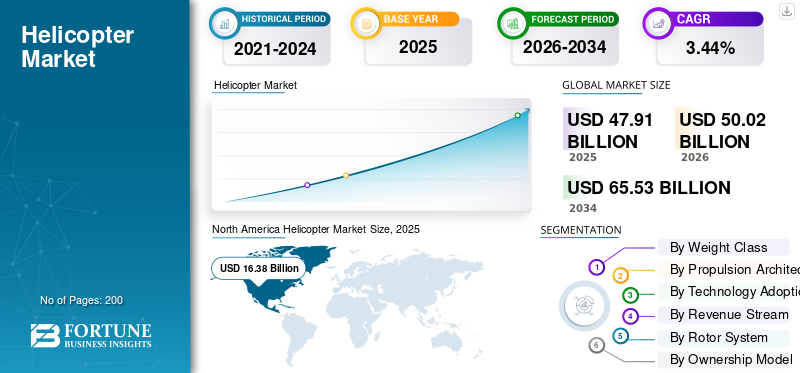
The global helicopter market size was valued at USD 47.91 billion in 2025. The market is projected to grow from USD 50.02 billion in 2026 to USD 65.53 billion by 2034, exhibiting a CAGR of 3.44% during the forecast period. North America dominated the helicopter market with a market share of 34.18% in 2025.
The global market covers civil, parapublic, and military rotorcraft used for emergency medical services, offshore transport, utility operations, law enforcement, VIP/corporate mobility, search & rescue, troop transport, attack, maritime patrol, and heavy-lift missions. The market is not high-volume similar to fixed-wing aviation, but remains strategically important as helicopters serve missions where runway access is limited or impossible.
The global market growth is driven by defense modernization, replacement of aging military fleets, rising demand for EMS/search & rescue helicopters, offshore energy support, disaster-response operations, and utility missions in remote regions. The defense demand is especially important as global military expenditure is surging, whereas the civil demand is supported by multi-mission aircraft, fleet renewal, and higher-value turbine copter deliveries.
Major players in the global market include Airbus Helicopters SAS, Leonardo S.p.A., Bell Textron Inc., Sikorsky Aircraft Corporation / Lockheed Martin Corporation, JSC Russian Helicopters, and The Boeing Company. Key players are focusing on product upgrades, digital avionics, mission-specific variants, long-term service/MRO contracts, military modernization programs, local assembly/partnerships, and next-generation rotorcraft technologies such as tiltrotor, autonomy, improved fuel efficiency, and connected fleet-support systems.
Download Free sample to learn more about this report.
Helicopter Market Trends
Autonomy, Open Architecture, Crewed-Uncrewed Teaming, and High-Speed Vertical Lift Are Reshaping OEM Strategies
A major market trend is the move from airframe-only competition to software-defined, mission-system-led competition. OEMs are investing in open architecture, autonomy, sensor fusion, digital cockpits, predictive maintenance, drone teaming, C-UAS integration, and rapid upgrade pathways. Sikorsky’s MATRIX-equipped UH-60MX Black Hawk shows how existing helicopter families can be converted into optionally piloted and autonomous operations. On the other hand, Airbus and Quantum Systems are exploring C-UAS interceptor integration on military copters starting with the H145M.
The next-generation rotorcraft is also moving toward speed, range, modularity, and lower production cost. In June 2026, Bell completed the first two MV-75 wing structures and reported major labor-hour reductions versus the initial V-22 wing build, showing a clear push toward production efficiency and affordability.
Market Dynamics
MARKET DRIVERS
Download Free sample to learn more about this report.
Defense Modernization and Mission-Critical Civil Services to Push Industry Growth
The global helicopter market growth is being driven mainly by military fleet renewal, public-safety modernization, EMS, search & rescue, offshore transport, border security, and special-mission mobility. Defense demand is the strongest driver given that helicopters remain critical for troop transport, casualty evacuation, heavy lift, maritime operations, attack missions, and logistics in areas where fixed-wing aircraft cannot operate. SIPRI reported that the global military expenditure reached USD 2.887 trillion in 2025, marking the 11th consecutive year of growth, which supports continued funding for rotorcraft modernization and replacement programs driving market expansion.
OEMs are responding by upgrading proven platforms rather than relying only on clean-sheet aircraft. For instance, in June 2026, Airbus delivered Belgium’s first H145M helicopter. Belgium also exercised an option for three more aircraft, taking its total order to 20 helicopters.
MARKET RESTRAINTS
High Acquisition and Maintenance Cost May Limit Industry Growth
The market is restrained by high unit cost, long procurement cycles, pilot and maintainer shortages, spare-parts pressure, certification complexity, and expensive mission-system integration. After copter purchase, operators must fund training, depot maintenance, engine overhaul, avionics updates, survivability upgrades, and mission equipment for decades. GAMA’s 2025 data showed that the total helicopter shipments declined by 1.9% to 938 units, even though total billings rose 5.5% to USD 4.7 billion, indicating that the demand is shifting toward higher-value platforms rather than broad volume expansion.
MARKET OPPORTUNITIES
Local Manufacturing and EMS Demand to Create Strong Growth Pockets
New helicopter sales and lifecycle value are significant opportunities for industry expansion. The lifecycle value comprises MRO, training, localized production, mission kits, avionics upgrades, survivability systems, and digital fleet-support services. Countries are increasingly looking for sovereign or local industrial participation, especially for military and government programs. Leonardo’s February 2026 partnership with Adani Defence & Aerospace is a good example, as it targets helicopter manufacturing, sustainment, pilot training, MRO, phased indigenization, and Indian military requirements for AW169M and AW109 TrekkerM helicopters.
There is also a strong opportunity in EMS, police aviation, rescue, mountainous transport, and offshore energy support, where governments and operators are replacing older aircraft with safer, quieter, digitally equipped, multi-role helicopters.
For instance, in June 2026, Airbus signed Armenia’s first helicopter contract for six H145s, positioning the aircraft for transport missions in high-altitude and mountainous operating conditions.
MARKET CHALLENGES
Contested Airspace Survivability Concerns to Create Challenges for Industry Expansion
The biggest challenge for market expansion is survivability in contested airspace. Ukraine and other recent conflicts have shown that low-altitude aircraft face higher risk from drones, MANPADS, short-range air defense, electronic warfare, and cheap networked sensors. This does not remove the need for helicopters, but it changes how they must operate. More standoff operations, better self-protection, stronger mission planning, degraded-visual-environment support, C-UAS payloads, drone teaming, and faster integration of electronic warfare and data links are becoming mandatory rather than optional.
SEGMENTATION ANALYSIS
By Weight Class
Medium Segment to Expand at the Fastest CAGR due to Mission Flexibility
The global market, by weight class, is classified into Light (Under 2,200 kg), Light-Twin (2,200 - 3,200 kg), Intermediate (3,200 - 7,000 kg), Medium (7,000 - 11,000 kg), Heavy-Lift (11,000 kg - 20,000 kg), and Ultra-Heavy / Class 1 Heavy-Lift (Above 20,000 kg+)
The medium (7,000 - 11,000 kg) segment is estimated to depict the highest CAGR of 3.90% during the forecast period of 2026-2034. This segment accounted for the largest market share of 32.44% in 2025. The segment growth is mainly supported by its balanced payload capacity, operating range, and mission flexibility. Medium helicopters are widely used for defense transport, offshore operations, emergency medical services, search & rescue, and government utility missions, making them more commercially useful than very light or highly specialized heavy-lift platforms.
The intermediate (3,200 - 7,000 kg) segment accounted for the second-largest helicopter market share of 24.66% in 2025. In addition, the segment is projected to grow at a CAGR of 3.51% during the forecast period.
By Propulsion Architecture
Fuel-Efficiency Pressure to Boost Hydrogen/SAF-Compatible Segment Growth
By propulsion architecture, the global market is classified into piston engine, conventional turboshaft, hybrid-electric (turboshaft + electric motor), fully electric (battery eVTOL), and hydrogen / SAF-compatible.
The hydrogen / SAF-compatible segment is estimated to grow at the highest CAGR of 5.27% during the forecast period of 2026-2034. This growth is linked to the rising pressure on operators and OEMs to reduce fuel burn, noise, emissions, and operating costs without fully depending on battery-only propulsion. Hybrid-electric systems are attractive as they can combine the reliability of turboshaft engines with electric assistance for efficiency, redundancy, and lower mission-level fuel consumption.
The conventional turboshaft segment accounted for the largest market share of 93.91% in 2025. In addition, the segment is projected to grow at a CAGR of 3.35% during the forecast period.
By Technology Adoption Level
Crewed-Uncrewed Teaming / UAS-Integrated Rotorcraft Segment to Expand with Surge in Defense Modernization
The global market, by technology adoption level, is classified into conventional helicopters, digitally enhanced helicopters, fly-by-wire / advanced flight control helicopters, autonomy-enabled / optionally piloted helicopters, and crewed-uncrewed teaming / UAS-integrated rotorcraft.
The crewed-uncrewed teaming / UAS-integrated rotorcraft segment is estimated to grow at the highest CAGR of 6.13% during the forecast period of 2026-2034. The segment growth is driven by defense modernization, where choppers are increasingly expected to operate with drones, loitering sensors, launched effects, and unmanned reconnaissance systems. This improves battlefield awareness and reduces crew exposure in high-risk environments.
The conventional helicopters segment accounted for the largest market share of 53.80% in 2025 and is projected to grow at a CAGR of 2.33% during the forecast period.
By Revenue Stream
Fleet Renewal Demand to Boost New Helicopter Sales Segment Growth
The global market, by revenue stream, is classified into new helicopter sales, aftermarket & lifecycle services, training & simulation, and leasing, resale & fleet management.
The new helicopter sales segment is estimated to expand at the highest CAGR of 4.15% during the forecast period of 2026-2034. The segment growth is being supported by fresh procurement, replacement of aging fleets, defense modernization, and new public-service aircraft purchases. While aftermarket services remain large, the higher growth in new sales shows that operators are moving beyond basic maintenance and are actively upgrading fleets.
The aftermarket & lifecycle services segment held the largest market share of 46.02% in 2025 and is projected to grow at a CAGR of 2.93% during the forecast period.
By Rotor System
Speed and Range Advantages to Push Compound Rotorcraft Segment Growth
By rotor system, the global market is classified into single main rotor with tail rotor, fenestron / shrouded tail rotor, NOTAR, tandem rotor, coaxial rotor, compound rotorcraft, and tiltrotor / convertible rotorcraft adjacency.
The compound rotorcraft segment is estimated to grow at the highest CAGR of 5.96% during the forecast period of 2026-2034. Compound rotorcraft systems are gaining traction as they can offer higher speed, longer range, and improved mission performance compared with traditional single-main-rotor helicopters. This makes them attractive for military assault, rapid response, special operations, and long-distance utility missions.
The single main rotor with tail rotor segment captured the largest market share of 77.63% in 2025 and is projected to grow at a CAGR of 2.83% during the forecast period.
By Ownership Model
Budget Flexibility to Bolster the Expansion of the Government Outsourcing Segment
The global market, by ownership model, is classified into direct ownership, contracted operations, leasing & finance, government outsourcing, public-private operations, and fractional / managed fleet operations
The government outsourcing segment is estimated to grow at the highest CAGR of 4.00% during the forecast period of 2026-2034. Governments are increasingly outsourcing helicopter operations for air ambulance, law enforcement, border surveillance, firefighting, disaster response, and search & rescue missions. This allows public agencies to access modern aircraft and skilled operators without carrying the full burden of direct fleet ownership.
The direct ownership segment accounted for the largest market share of 73.90% in year 2025 and is projected to grow at a CAGR of 3.44% during the forecast period.
To know how our report can help streamline your business, Speak to Analyst
By End User / Customer
Defense Customers Segment to Grow at the Fastest Rate with Surge in Geopolitical Tensions and Fleet Renewal Initiatives
By end user / customer, the global market is classified into commercial operators, government & parapublic agencies, defense customers, and private & corporate buyers.
The defense customers segment is estimated to grow at the highest CAGR of 3.96% during the forecast period of 2026-2034. In addition, this segment accounted for the largest market share of 45.50% in 2025. The segment growth is supported by rising geopolitical tensions, fleet replacement, tactical mobility needs, maritime security, special operations, and battlefield logistics. Helicopters remain essential for missions that fixed-wing aircraft or drones cannot fully replace, especially casualty evacuation, troop movement, attack support, and heavy-lift operations.
The commercial operators segment garnered the largest market share of 23.61% in 2025 and is projected to grow at a CAGR of 2.52% during the forecast period.
By Direct Ownership x By End User / Customer
Due to Long-Term Fleet Control, Defense Customers Grow Fastest
The global market, by direct ownership x by end user / customer, is classified into commercial operators, government & parapublic agencies, defense customers, and private & corporate buyers
The defense customers segment is estimated to grow at the highest CAGR of 3.96% during the forecast period of 2026-2034. In addition, this sub-segment accounted for the largest market share of 48.87% in year 2025. Defense forces prefer direct ownership given that military helicopters are strategic assets that require full control over deployment, maintenance standards, mission configuration, and operational security. This is especially important for attack, troop transport, naval, and special-mission helicopters.
The commercial operators segment accounted for the largest market share of 24.20% in year 2025. In addition, the segment is projected to grow at a CAGR of 2.56% during the forecast period.
By Contracted Operations x By End User / Customer
Government & Parapublic Agencies Segment to Grow with Surge in Third-party Operators
The global market, by contracted operations x by end user / customer, is classified into commercial operators, government & parapublic agencies, defense customers, and private & corporate buyers.
The government & parapublic agencies segment is projected to expand at the highest CAGR of 4.20% during the forecast period of 2026-2034. This is due to the rise in third-party operators for EMS, firefighting, police aviation, border patrol, coastal surveillance, and disaster-response missions. Public agencies often need helicopter capability but may not want to manage the full aircraft ownership and operating structure.
The commercial operators segment accounted for the second-largest market share of 27.67% in year 2025. In addition, the segment is projected to grow at a CAGR of 2.61% during the forecast period.
By Leasing & Finance x By End User / Customer
Limited-Budget Procurements to Favor Government & Parapublic Agencies Segment Growth
The global market, by leasing & finance x by end user / customer, is classified into commercial operators, government & parapublic agencies, defense customers and private & corporate buyers.
The government & parapublic agencies segment is estimated to expand at the highest CAGR of 3.51% during the forecast period of 2026-2034. Leasing helps agencies access helicopters for public-service missions without committing large upfront defense budgets. This is useful for regions where EMS, police, fire, and rescue aviation demand is rising but procurement budgets remain limited.
The commercial operators segment accounted for the largest market share of 37.70% in 2025. In addition, the segment is projected to grow at a CAGR of 2.05% during the forecast period.
By Government Outsourcing x By End User / Customer
Defense Customers Segment to Grow at the Fastest Pace due to Mission Outsourcing
The global market, by government outsourcing x by end user / customer, is classified into commercial operators, government & parapublic agencies, defense customers, and private & corporate buyers.
The defense customers segment is estimated to grow at the highest CAGR of 4.34% during the forecast period of 2026-2034. In addition, this segment accounted for the largest market share of 48.29% in 2025. This indicates that defense organizations are increasingly using outsourced support for training, logistics, maintenance, utility lift, surveillance support, and non-combat aviation services. Outsourcing allows militaries to focus internal resources on combat readiness while relying on specialized providers for support-heavy operations.
The government & parapublic agencies segment accounted for the largest market share of 35.59% in year 2025 and is projected to grow at a CAGR of 4.21% during the forecast period.
By Public-Private Operations x By End User / Customer
Government & Parapublic Agencies to Expand at the Fastest Rate due to Feasibility of Public-Private Structures
The global market, by public-private operations x by end user / customer, is classified into commercial operators, government & parapublic agencies, defense customers, and private & corporate buyers.
The government & parapublic agencies segment is estimated to grow at the highest CAGR of 3.76% during the forecast period of 2026-2034. In addition, this segment accounted for the largest market share of 44.40% in 2025. This model is growing as helicopter missions such as EMS, firefighting, disaster relief, and law enforcement often require both public funding and private operating expertise. Public-private structures help agencies expand aviation services while controlling budget pressure.
The defense customers segment held the largest market share of 33.83% in 2025. In addition, the segment is projected to grow at a CAGR of 3.72% during the forecast period.
By Fractional / Managed Fleet Operations x By End User / Customer
Government & Parapublic Agencies Segment to Grow Due to Flexible Fleet Requirements
The global market, by fractional / managed fleet operations x by end user / customer, is classified into commercial operators, government & parapublic agencies, defense customers, and private & corporate buyers.
The government & parapublic agencies segment is estimated to grow at the highest CAGR of 2.08% during the forecast period of 2026-2034. Growth is slower than other ownership models, but this is still the leading segment as some agencies need occasional or seasonal access to helicopters rather than full-time ownership. This can apply to disaster response, temporary surveillance, regional EMS coverage, or event-based security support.
The commercial operators segment accounted for the largest market share of 27.79% in the year 2025. In addition, the segment is projected to grow at a CAGR of 1.27% during the forecast period.
Helicopter Market Regional Outlook
By region, the market is categorized into Europe, North America, Asia Pacific, the Middle East & Africa, and Latin America.
North America
North America Helicopter Market Size, 2025 (USD Billion)
To get more information on the regional analysis of this market, Download Free sample
North America held the dominant market share in 2025, valued at USD 16.38 billion, and is anticipated to maintain the leading share in 2026, with a value of USD 16.91 billion. The regional market growth is driven by the U.S. Army’s Future Long Range Assault Aircraft program, as the Army is moving toward higher speed, longer range, digital engineering, and future battlefield mobility through the MV-75/FLRAA pathway.
U.S. Helicopter Market
Based on North America's strong contribution and the U.S. dominance within the region, the U.S. market reached USD 14.54 billion in 2025 and is estimated to depict a CAGR of 2.11% during the forecast period.
Europe
Europe is projected to grow at the highest CAGR of 5.07% during the forecast period. In 2025, the market value stood at USD 12.67 billion. The product demand in Europe is rising as governments are replacing aging fleets and expanding tactical lift, training, light attack, naval, and disaster-response capability.
U.K. Helicopter Market
The U.K. market was valued at USD 2.00 billion in 2025 and is estimated to grow at a rate of 5.72% during the forecast period.
Germany Helicopter Market
In 2025, the Germany market was valued at USD 2.51 billion and is estimated to grow at a rate of 6.56% during the forecast period.
France Helicopter Market
The France market was valued at USD 2.36 billion in 2025 and is estimated to grow at a rate of 4.90% during the forecast period.
Asia Pacific
The Asia Pacific market was valued at USD 13.69 billion in 2025 and held the position of the second-largest region in the market. The regional market growth is supported by the rising need for high-altitude and border-security solutions and building a domestic MRO network. Hence, there is a requirement for interoperable utility-lift capabilities for defense, special operations, and humanitarian-assistance missions.
China Helicopter Market
The China market was valued at USD 4.21 billion in 2025 and is estimated to grow at a rate of 2.56% during the forecast period.
India Helicopter Market
The India market value stood at USD 2.86 billion in 2025 and is estimated to grow at a rate of 5.57% during the forecast period.
Japan Helicopter Market
The Japan market was valued at USD 1.70 billion in 2025 and is estimated to grow at a rate of 1.36% during the forecast period.
Middle East & Africa
The Middle East & Africa market is expected to witness significant growth at a CAGR of 4.14% during the forecast period of 2026-2034. The region held a value of USD 3.41 billion in 2025. The product demand in the Middle East is driven by force protection, border security, and attack chopper acquisition. The region also depicts counterterrorism and internal security needs, creating demand for armed rotary-wing platforms, munitions, training, and sustainment support.
Gulf Countries Helicopter Market
The Gulf countries market was valued at USD 1.27 billion in 2025 and is estimated to grow at a rate of 4.95% during the forecast period.
Turkey Helicopter Market
The Turkey market was valued at USD 0.61 billion in 2025 and is estimated to grow at a rate of 6.02% during the forecast period.
Israel Helicopter Market
The Israel market was valued at USD 0.45 billion in 2025 and is estimated to grow at a rate of 3.49% during the forecast period.
Latin America
The Latin America market was valued at USD 1.76 billion in 2025. The regional growth is led by Brazil, where the product demand is linked to Amazon operations, search & rescue, civil-support missions, and modernization of military rotary-wing fleets.
Brazil Helicopter Market
In 2025, the Brazil market was valued at USD 0.75 billion and is estimated to grow at a rate of 1.61% during the forecast period.
Mexico Helicopter Market
In 2025, the Mexico market was valued at USD 0.43 billion and is estimated to grow at a rate of 1.11% during the forecast period.
COMPETITIVE ANALYSIS
Key Industry Players
Companies to Invest in Open Architecture and Plug-and-Play Mission Systems to Consolidate their Industry Positions
The helicopter market is becoming more competitive as governments and operators are no longer buying only airframes. They are demanding mission-ready platforms with avionics, sensors, autonomy, survivability, training, and long-term support. Major OEMs are developing multi-role copters, upgraded heavy-lift platforms, light attack variants, and next-generation vertical-lift systems to meet defense, EMS, SAR, offshore, and parapublic requirements.
Competitive growth is also being shaped by sustainment and localization, given that customers want aircraft availability, faster upgrades, domestic assembly, training capacity, and MRO support rather than one-time procurement. OEMs are, therefore, investing in open architecture, plug-and-play mission systems, supervised autonomy, crewed-uncrewed teaming, improved drivetrain and fuel systems, and localized industrial partnerships to protect long-term revenue.
LIST OF KEY HELICOPTER COMPANIES PROFILED
- Airbus Helicopters SAS (France)
- Bell Textron Inc. (U.S.)
- Leonardo S.p.A. (Italy)
- Sikorsky Aircraft Corporation / Lockheed Martin Corporation (U.S.)
- The Boeing Company (U.S.)
- JSC Russian Helicopters (Russia)
- Robinson Helicopter Company, Inc. (U.S.)
- MD Helicopters LLC (U.S.)
- Hélicoptères Guimbal SAS (France)
- Kopter Group AG (Switzerland)
- Hindustan Aeronautics Limited (India)
- Korea Aerospace Industries, Ltd. (South Korea)
- Turkish Aerospace Industries Inc. (Turkey)
- Kawasaki Heavy Industries, Ltd. (Japan)
- Aviation Industry Corporation of China, Ltd. (China)
- Denel SOC Ltd / Denel Aeronautics (South Africa)
KEY INDUSTRY DEVELOPMENTS
- June 2026: Romania’s Ministry of Internal Affairs signed a contract with Airbus Helicopters. The contract, for which the value was not disclosed, has been inked for seven H160 and five H145 helicopters, aimed at emergency response, civil protection, public safety, and law-enforcement modernization.
- June 2026: Avincis placed an order with Leonardo for 15 helicopters, including 10 AW169 and five AW139 aircraft, supporting European emergency response, rescue, and offshore transport fleet modernization. The value of the transaction was not disclosed.
- March 2026: The U.K. Ministry of Defence awarded Leonardo UK a USD 1.23 billion contract for 23 AW149 New Medium Helicopters, strengthening the U.K.’s medium-lift battlefield mobility and future uncrewed/autonomous rotorcraft pathway.
- December 2025: The U.S. Army Contracting Command awarded Boeing a USD 2.73 billion contract for AH-64 Apache post-production support services, supporting fleet readiness, sustainment, and long-term operational availability through 2030.
- December 2025: Spain’s Directorate General for Armament and Material placed four contracts with Airbus Helicopters. The value was not disclosed for the transaction involving 100 helicopters, including H135, H145M, H175M, and NH90 platforms for Spanish military modernization.
- March 2025, India’s Ministry of Defence signed two contracts with Hindustan Aeronautics Limited worth USD 6.64 billion for 156 LCH Prachand combat helicopters, with 66 for the Indian Air Force and 90 for the Indian Army.
REPORT COVERAGE
The global helicopter market analysis includes a comprehensive study of the market size & forecast by all the market segments included in the report. It contains details on the market dynamics and trends expected to drive the market over the forecast period. It provides information on key aspects, including an overview of technological advancements, pipeline candidates, the regulatory environment, and product launches. Additionally, it details partnerships, mergers & acquisitions, as well as key aviation industry developments by major regions. The global market research report also provides a detailed competitive landscape with information on the market share and profiles of key operating players.
Request for Customization to gain extensive market insights.
Report Scope & Segmentation
| ATTRIBUTE | DETAILS |
| Study Period | 2021-2024 |
| Base Year | 2025 |
| Forecast Period | 2026-2034 |
| Historical Period | 2021-2024 |
| Growth Rate | CAGR of 3.44% from 2026-2034 |
| Unit | Value (USD Billion) |
|
Segmentation |
By Weight Class
By Propulsion Architecture
By Technology Adoption Level
By Revenue Stream
By Rotor System
By Ownership Model
By End User / Customer
By Direct Ownership x By End User / Customer
By Contracted Operations x By End User / Customer
By Leasing & Finance x By End User / Customer
By Government Outsourcing x By End User / Customer
By Public-Private Operations x By End User / Customer
By Fractional / Managed Fleet Operations x By End User / Customer
By Region
|
Frequently Asked Questions
Fortune Business Insights says that the global market value stood at USD 47.91 billion in 2025 and is projected to reach USD 65.53 billion by 2034.
In 2025, the Europe market value stood at USD 12.67 billion.
The market is expected to exhibit a CAGR of 3.44% during the forecast period.
The medium (7,000 - 11,000 kg) segment is expected to hold the highest CAGR over the forecast period.
A rise in defense modernization and mission-critical civil services is a key factor driving the market.
Major players in the market are Airbus Helicopters SAS, Leonardo S.p.A., Bell Textron Inc., Sikorsky Aircraft Corporation / Lockheed Martin Corporation, JSC Russian Helicopters, and The Boeing Company.
North America dominated the market in 2025.



- 2021-2034
- 2025
- 2021-2024
- 200
Get 30-60 hrs Free Customization
Expand Regional and Country Coverage, Segments Analysis, Company Profiles, Competitive Benchmarking, and End-user Insights.




















Related Reports
-
US +1 833 909 2966 ( Toll Free )
-
Get In Touch With Us