Disposable Underpads Market Size, Share & Industry Analysis, By Absorbency Level (Light, Moderate, Heavy, and Overnight/Extra-heavy Absorbency), By Size (Small, Medium, Large, and Extra-large), By Back Sheet Material (Poly Film, Polypropylene, and Breathable Back), By Application (Adult Incontinence & Geriatric Care, Clinical & Maternity Care, and Infant & Child Care), By End-User (Healthcare Institutions, Residential & Long-term Care, and Veterinary & Animal Care), By Distribution Channel (Hypermarkets & Supermarkets, Pharmacy Stores, and Online Retail), and Regional Forecast, 2026-2034
 Download Free Sample
(Offer valid till 31st Oct 2026)

Disposable Underpads Market Size and Future Outlook
 Listen to Audio Version
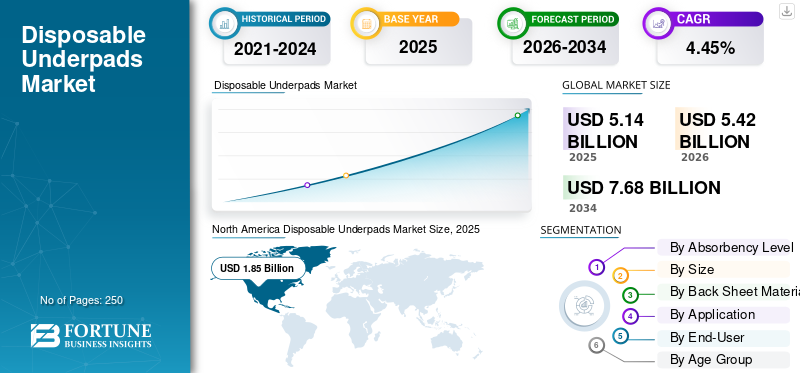
The global disposable underpads market size was valued at USD 5.14 billion in 2025. The market is projected to grow from USD 5.42 billion in 2026 to USD 7.68 billion by 2034, exhibiting a CAGR of 4.45% during the forecast period. North America dominated the disposable underpads market with a market share of 35.99% in 2025.
Seniors and post-surgery patients use disposable pads to have a protective layer from urinary continence, sweat, accidental spills, wound drainage, or post-surgical discharges. These products are beneficial in skin infection prevention & protection, and fluid containment efficiency. The increasing population aging and the growing usage of underpads among patients with mobility issues across hospitals, nursing homes, and other personal care settings are driving the global market growth. According to the World Bank Group, there is a significant aging population increase in Japan. In 2024, around 30% of the population aged 65 years and above was in Japan, compared to 26% in 2023.
Prominent companies in the global market include Kimberly-Clark Corporation, Essity AB, Ontex Group NV, Hengan International Group Company Limited, and First Quality Enterprises, Inc.
Download Free sample to learn more about this report.
Disposable Underpads Market Key Takeaways
 Global Market Size & Forecast
- 2025 Market Size: USD 5.14 billion
- 2026 Market Size: USD 5.42 billion
- 2034 Forecast Market Size: USD 7.68 billion
- CAGR: 4.45% (2026–2034)
 Market Share
- North America dominated the market with a 35.99% share in 2025.
- The moderate absorbency segment held the leading market share of 32.70% in 2025 and is projected to grow at a 4.30% CAGR.
- The medium segment held the leading market share of 43.25% in 2025 and is projected to grow at a 4.05% CAGR.
 Key Regional Highlights
Asia Pacific
Asia Pacific ranked third with a 25.11% share and a market size of USD 1.29 billion in 2025; it is projected to grow at the fastest 5.71% CAGR.
North America
North America held the largest market share of 36.05%, with a market size of USD 1.94 billion projected for 2026.
Europe
Europe ranked second, with a market size of USD 1.46 billion in 2025, accounting for approximately 28.45% of global sales.
U.S.
U.S. market reached USD 1.52 billion in 2025, accounting for 29.51% of global sales.
Japan
Japan market stood at approximately USD 0.23 billion in 2025, representing around 4.79% of global revenues.
Read More

DISPOSABLE UNDERPADS MARKET TRENDS
Rising Demand for Smart Underpads Enabled with IoT-based Real-time Moisture Monitoring System to be a Significant Market Trend
Disposable hygiene products, including smart bed pads, are equipped with microscopic sensors and IoT-based capabilities of monitoring moisture level in real-time, drastically reducing the risk of painful bedsores, skin breakdown, and urinary tract infections. Such products are increasingly popular among upper-income consumer groups. Shifting consumer preference from buying traditional disposable pads to such smart technology-based products is favoring the global market growth. In addition, advancements in the development of pads with high-efficiency Superabsorbent Polymers (SAP) that instantly trap liquids and turn them into an immobile gel are augmenting the global market expansion.
- For instance, in October 2025, GDM, a global designer and manufacturer of disposable hygiene products, launched UP Plus, an advanced underpad designed with Superabsorbent Polymer (SAP)-based absorbent cores that absorb liquid and convert it into gel-like, immobilized form.
MARKET DYNAMICS
MARKET DRIVERS
Download Free sample to learn more about this report.
Expanding Healthcare and Institutional Infrastructure to Drive Product Sales from Business-to-Business (B2B) Procurement Contracts
Facilities offering healthcare services manage vast numbers of bedridden or high-acuity patients who require frequent bed changes. These facilities require significant amounts of disposable products to improve patients’ health and aid in daily personal hygiene. Expanding infrastructure of nursing homes, long term care facilities, maternity care hospitals, and acute-care clinics is driving the product sales from manufacturers’ B2B commercial contracts, accelerating the global disposable underpads market growth. According to the Federal Statistical Office, a federal authority of Germany, the number of nursing homes in Germany increased to 16,505 in 2023, up from 11,634 in 2009.
MARKET RESTRAINTS
High Cost of Premium-based Bed Pads to Restrain Market Growth
Producing disposable pads requires sourcing of certified, plant-based raw materials, bio-derived absorbent polymers, and others. Manufacturers tend to increase product prices to maintain profit margins and recover sourcing costs. The high cost of premium-based bed pads is restraining their demand among price-sensitive household consumers across many countries. In addition, significant investment in R&D activities to produce products featuring fluid retention properties over traditional products made of petroleum-based polymers is hindering the global market expansion.
MARKET OPPORTUNITIES
Rising Adoption of Underpads with Skin-friendly and Anti-leakage Structure to Create Growth Opportunities
The growing number of users and caregivers seeking bed pads made of skin-friendly and anti-leakage structures to protect both the skin and bed surface is creating newer market growth opportunities. In addition, consistent manufacturers’ production of soft nonwoven top sheets for patients suffering from mobility issues to avoid prolonged skin contact with wet surfaces that may increase discomfort, rashes, and skin irritation is favoring the global market growth. The growing number of brands offering products with odor control and quick-dry SAP-based core technologies for consumers’ efficient incontinence care needs is augmenting the product sales globally.
MARKET CHALLENGES
Volatility in Prices of Superabsorbent Polymers and Fabric to Challenge Industry Growth
Volatility in the prices of raw materials used in bed pad construction, including superabsorbent polymers (SAP), fluff pulp, nonwoven fabric, polyethylene back sheets, adhesives, and packaging films, is incurring additional procurement costs, posing challenges to the industry's growth. In addition, increasing competitive pressure from the private label manufacturing producing low-cost products is hampering the key players’ product sales across many countries.
Segmentation Analysis
By Absorbency Level
Balanced Mix of Leakage Absorbency and Affordability over Counterparts Led to Dominance of Moderate Absorbency Segment
Based on absorbency level, the market is segmented into light absorbency, moderate absorbency, heavy absorbency, and overnight/extra-heavy absorbency.
The moderate absorbency segment accounted for the leading global disposable underpads market share of 32.70% in 2025 and is projected to grow at a CAGR of 4.30% from 2026 to 2034. Moderate absorbency provides a balanced mix of absorption capability, comfort, thickness, and cost-efficiency. These moderate absorbency-based products provide better leakage protection than low-absorbency pads and are more affordable than overnight or extra-heavy products. In addition, increasing demand for such products among consumers with moderate urinary leakage, mobility limitations, or temporary recovery needs is driving the segment’s growth.
To know how our report can help streamline your business, Speak to Analyst
The overnight/extra-heavy absorbency segment is projected to grow at the fastest CAGR of 5.11% during 2026-2034. Overnight absorbency pads are designed to absorb higher fluid volumes and reduce leakage for the overnight duration. The rising demand for long-duration protection among elderly populations, bedridden patients, and people with severe incontinence is driving the segment’s growth.
By Size
Most practical Usage of Medium-sized Sheets across Households Led to Dominance of Medium Segment
By size, the market is divided into small, medium, large, and extra-large.
The medium segment exhibited a leading global market share of 43.25% in 2025 and is projected to grow at a CAGR of 4.05% from 2026 to 2034. Medium-sized sheets provide enough coverage surface for leakage when users lie on beds, chairs, and examination tables. Most practical usage of medium-sized sheets among households and institutional settings generates considerable segmental revenues. In addition, the growing number of nursing homes and hospitals preferring medium-sized bed pads, as such products are easy to store, distribute, and dispose of, compared to larger pads, is driving the segment’s growth.
The extra-large segment is projected to grow at the fastest CAGR of 5.00% from 2026 to 2034. Increasing usage of extra-large pads over recliners and mattresses in institutional and home care settings is driving the segment’s growth.
By Back Sheet Material
Affordability and Robust Leakage Protection Performance of Poly Film Back Sheets Led to Dominance of Poly Film Back Segment
By back sheet material, the market is divided into poly film back, polypropylene back, and breathable/air-permeable back.
The poly film back segment exhibited a leading global market share of 50.34% in 2025 and is projected to grow at a CAGR of 3.99% from 2026 to 2034. Poly film back-based sheets provide enhanced leakage protection and are available at affordable prices compared to the products of counterpart back sheet materials. In addition, poly films are lightweight, widely available, and compatible with high-speed disposable hygiene product manufacturing. Wider consumers’ acceptability of poly film-based products mainly generates considerable revenues from the poly film back segment. In addition, the greater poly film pads’ effectiveness in reducing strike-through risk during routine use is augmenting the demand for such products.
The breathable/air-permeable back segment is projected to grow at the fastest CAGR of 5.27% from 2026 to 2034. Rising demand for disposable underpads that provide skin comfort, air circulation, and moisture management is driving the segment’s growth.
By Application
Need for Skin Protection and Bed Hygiene Led to Dominance of Adult Incontinence & Geriatric Care Segment
Based on application, the market is divided into adult incontinence & geriatric care, clinical & maternity care, infant & child care, pet care, and general bedding/furniture & surface protection.
The adult incontinence & geriatric care segment exhibited a leading global market share of 81.82% in 2025 and is growing at a CAGR of 4.52% from 2026 to 2034. Significant consumer base of elderly users, bedridden patients, and individuals with urinary or fecal incontinence seeking underpads for skin protection and bed hygiene is generating considerable revenues from such a segment. In addition, rising population aging is driving the demand for such products.
The pet care segment is projected to grow at the fastest rate of 5.56% during the forecast period. Increasing humanization of animals and rising demand for premium-based pet hygiene products are driving the segment’s growth.
By End-User
Significant At-home Consumer Demand for Underpads for Incontinence Management Led to Dominance of Residential & Long-term Care Segment
Based on end-user, the market is divided into healthcare institutions, residential & long-term care, veterinary & animal care facilities, and others.
The residential & long-term care segment exhibited a leading global market share of 86.65% in 2025 and is growing at a CAGR of 4.55% from 2026 to 2034. Significant at-home consumers’ demand for bed pads for incontinence management when seated on beds, chairs, and in living spaces is generating considerable revenues from this segment. The rising number of nursing homes, assisted healthcare living centers, and old-age homes seeking affordable and value-added disposable products is driving the segment’s growth.
The veterinary & animal care facilities segment is projected to grow at the fastest rate of 6.49% during the forecast period owing to the expanding number of veterinary clinics and pet care centers seeking premium-based absorbent pads globally. Moreover, bed pads are increasingly used for post-surgery recovery and urine leakage management of pets.
By Age Group
Greater Number of Older Individuals Suffering from Incontinence Seeking Bed Pads Led to Dominance of Above 60 Years Segment
Based on age group, the market is divided into up to 18 years, 18-40 years, 40-60 years, and above 60 years.
The above-60-years segment exhibited a leading global market share of 69.15% in 2025 and is growing at the fastest CAGR of 4.65% from 2026 to 2034. Compared to other age groups, consumers aged 60 years & above are primarily suffering from incontinence and mobility issues and seek disposable hygiene products for their personal care. Significantly older-aged consumers’ demand for disposable hygiene products is generating considerable segmental revenues. In addition, rising population aging and the increasing number of old-aged homes seeking personal hygiene products are driving the segmental revenue growth.
The 40-60 years segment is projected to grow at the second-fastest rate of 4.32% during the forecast period. The rising number of consumers aged 40 to 60 years suffering from early-stage mobility restrictions, obesity-related incontinence, and chronic diseases, who seek bed pads for hygiene, is driving the segment’s growth.
By Distribution Channel
Significant Purchases of Bulk Volume of Hygiene Products by Long-term Healthcare Facilities Led to Dominance of Direct Sales Channel
Based on distribution channel, the market is divided into hypermarkets & supermarkets, pharmacy stores, direct sales, online retail, and others.
The direct sales segment exhibited a leading global market share of 32.54% in 2025 and is growing at a CAGR of 4.50% from 2026 to 2034. Significant purchases of disposable hygiene products among long-term care facilities, nursing homes, and households through direct-to-consumer (DTC) channels and physical brand retailing stores led to the dominance of the direct sales segment. In addition, increasing bed occupancy among nursing homes and home care settings is driving the direct sales channel revenues and product sales growth.
The online retail segment is projected to grow at the fastest CAGR of 5.75% during the forecast period. Rising adoption of online shopping of personal care goods among at-home geriatric consumers is augmenting the online retail segment’s growth.
Disposable Underpads Market Regional Outlook
By region, the market is categorized into North America, Europe, Asia Pacific, South America, and the Middle East & Africa.
North America
North America Disposable Underpads Market Size, 2025 (USD Billion)
To get more information on the regional analysis of this market, Download Free sample
North America region held the largest global market share of 36.05% in 2025. The North American market size is estimated to reach USD 1.94 billion by 2026 and is projected to grow at 3.98% during 2026-2034. The increasing prevalence of urinary incontinence and broader base of home healthcare facilities are generating considerable product demand across the region. In addition, advancements in the development of modern disposable products with sophisticated multilayered designs and superabsorbent polymer structures are positively contributing to the market expansion in the region.
U.S. Disposable Underpads Market
The U.S. market size reached USD 1.52 billion in 2025 and accounted for 29.51% of the global sales in 2025. Rising demand for specialized medical underpads among nursing homes and hospitals for patients’ personal care is driving the U.S. market growth.
Europe
The European region is expected to maintain its second-leading global market position during the forecast period. The European market size reached USD 1.46 billion in 2025, accounting for approximately 28.45% of the global product sales. The region’s market is projected to grow at 3.75% during 2026-2034. The growing number of eco-conscious consumers seeking plant and biodegradable material-based disposable pads to reduce environmental impact and contribute toward environmental sustainability is augmenting the European market growth. In addition, the expanding number of nursing homes and old-age homes seeking products with minimalistic design features is driving the region’s market growth.
U.K. Disposable Underpads Market
The U.K. market reached USD 0.20 billion in 2025, representing approximately 3.89% of global sales.
Germany Disposable Underpads Market
Germany’s market reached USD 0.27 billion in 2025, equivalent to around 5.16% of global sales.
Asia Pacific
The Asia Pacific market is projected to grow at the fastest rate of 5.71% from 2026 to 2034. The region held a third-leading global market share of 25.11% and a market size of USD 1.29 billion in 2025. Structural shift toward westernized hygiene standards in both residential & clinical care and rising construction of residential housing facilities seeking affordable products is driving the region’s market growth. In addition, the emergence of direct-to-consumer (DTC) online portals offering discounted and premium products is augmenting the product revenues across the region.
China Disposable Underpads Market
China’s market is projected to be one of the largest in the Asia Pacific, with revenues of USD 0.46 billion in 2025, representing roughly 8.90% of global product sales. The rising number of elderly-care facilities seeking innovative bed pads for personal hygiene is driving the market growth. According to the China State Council, Ministry of Civil Affairs, in the second quarter of 2024, China had 410,000 elderly-care institutions and facilities. These facilities had doubled compared with 2019.
India Disposable Underpads Market
The Indian market stood at around USD 0.20 billion in 2025, accounting for roughly 3.94% of global market revenues.
Japan Disposable Underpads Market
The Japanese market stood at around USD 0.23 billion in 2025, accounting for roughly 4.79% of global revenues.
South America
The market in the South American region is expected to grow at a moderate CAGR of 4.51% from 2026 to 2034. The South American market in 2025 reached a valuation of USD 0.27 billion. The increasing prevalence of chronic medical conditions, including diabetes, causing clinical bladder and bowel dysfunction among senior citizens, is driving the product demand across Brazil, Chile, Colombia, and Peru. In addition, the growing disposable income and urbanization are augmenting the product sales in the region.
Middle East & Africa
The market in the Middle East & Africa region is expected to hold a second CAGR position of 4.90% during the forecast period of 2026 to 2034. The expanding infrastructural facilities of healthcare clinics, pet care centers, and nursing homes seeking premium-based hygiene products are driving Middle Eastern market growth. Shifting patient preference from cotton-based, cheaper pads to the medical-grade disposable products for personal hygiene is driving the African market growth.
UAE Disposable Underpads Market
The UAE market reached a valuation of USD 0.042 billion in 2025.
South Africa Disposable Underpads Market
The South African market reached USD 0.053 billion in 2025, accounting for roughly 1.03% of global market revenues. Increased awareness of personal hygiene and rising demand for personal care products is driving South African market growth.
COMPETITIVE LANDSCAPE
Key Industry Players
Portfolio Expansion and Retail Base Building to Help Key Players Maintain Market Position
The key players in the market are Kimberly-Clark Corporation, Essity AB, Ontex Group NV, Hengan International Group Company Limited, and First Quality Enterprises, Inc. These companies focus on building partnerships with commercial facilities, including old-age homes, nursing homes, and healthcare clinics, to drive their B2B product sales globally. In addition, they focus on investing in R&D activities to produce ultra-absorption technology-based products and build their product portfolio.
LIST OF KEY DISPOSABLE UNDERPADS COMPANIES PROFILED IN REPORT
- Kimberly-Clark Corporation (U.S.)
- Essity AB (Sweden)
- Ontex Group NV (Belgium)
- Hengan International Group Company Limited (China)
- First Quality Enterprises, Inc. (U.S.)
- ABENA A/S (Denmark)
- PAUL HARTMANN AG (Germany)
- Cardinal Health, Inc. (U.S.)
- Medline Industries, LP (U.S.)
- Journey Personal Care Holdings Ltd. (U.S.)
KEY INDUSTRY DEVELOPMENTS
- April 2026: Graffin Care, a U.S.-based manufacturer of disposable absorbent products, including pet training pads, incontinence underpads, and repositioning pads, expanded its production facility at Bridgeton, New Jersey, to drive its product sales in the U.S.
- July 2025: BW Converting launched AURA-UP, a modular converting platform designed for adult underpads, baby change pads, and pet pads. The platform was positioned as a flexible production solution for manufacturers seeking to produce multiple absorbent pad formats on a single configurable line.
REPORT COVERAGE
The global disposable underpads market analysis provides an in-depth study of market insights, size, and forecast by business model and all other market segmentation bases included in the report. In addition, the report provides details on the market outlook, market dynamics, and trends expected to drive the market during the forecast period. The market report includes information on technological advancements, new product launches, key industry developments, partnerships, and mergers & acquisitions. The market research report also includes a detailed competitive landscape, with market share and profiles of key players.
Request for Customization to gain extensive market insights.
Report Scope & Segmentation
| ATTRIBUTE | DETAILS |
| Study Period | 2021-2034 |
| Base Year | 2025 |
| Estimated Year | 2026 |
| Forecast Period | 2026-2034 |
| Historical Period | 2021-2024 |
| Growth Rate | CAGR of 4.45% from 2026 to 2034 |
| Unit | Value (USD Billion) |
| Segmentation | By Absorbency Level, Size, Back Sheet Material, Application, End-User, Age Group, Distribution Channel, and Region |
| By Absorbency Level |
|
| By Size |
|
| By Back Sheet Material |
|
| By Application |
|
| By End-User |
|
| By Age Group |
|
| By Distribution Channel |
|
| By Region |
|
Frequently Asked Questions
Fortune Business Insights says that the global market value stood at USD 5.14 billion in 2025 and is projected to reach USD 7.68 billion by 2034.
In 2025, the North America’s market value stood at USD 1.85 billion.
At a CAGR of 4.45%, the global market is projected to grow from 2026 to 2034.
By absorbency level, the moderate absorbency segment led the market.
The expanding institutional and healthcare infrastructure is expected to drive product sales from business-to-business (B2B) procurement contracts and favor the global market growth.
Kimberly-Clark Corporation, Essity AB, Ontex Group NV, Hengan International Group Company Limited, and First Quality Enterprises, Inc. are the top players in the market.
North America held the largest market share in 2025.
The rising adoption of underpads with skin-friendly and anti-leakage structures is expected to create new market growth opportunities.



- 2021-2034
- 2025
- 2021-2024
- 250
-
(Offer valid till 31st Oct 2026)
Get 30-60 hrs Free Customization
Expand Regional and Country Coverage, Segments Analysis, Company Profiles, Competitive Benchmarking, and End-user Insights.





Related Reports
-
US +1 833 909 2966 ( Toll Free )
-
Get In Touch With Us