Edge AI Semiconductor Market Size, Share & Industry Analysis, By Chip Type (CPU, GPU, NPU / AI Accelerator, FPGA, ASIC / Custom AI SoC, and Others), By Device Type (Smartphones & Tablets, PCs & Laptops, Edge Servers, Edge Gateways, Vision Systems & Smart Cameras, Autonomous Machines & Robots, In-vehicle Computing Systems, Wearables & Smart Consumer Devices, and Others), By End-user (Consumer Electronics, Automotive, Manufacturing, Healthcare, Retail & Consumer Goods, IT & Telecom, Energy & Utilities, and Others), and Regional Forecast, 2026-2034
 Download Free Sample
EDGE AI SEMICONDUCTOR MARKET SIZE AND FUTURE OUTLOOK
 Listen to Audio Version
The global edge AI semiconductor market size was valued at USD 25.81 billion in 2025. The market is projected to grow from USD 29.85 billion in 2026 to USD 107.86 billion by 2034, exhibiting a CAGR of 17.4% during the forecast period. Asia Pacific dominated the edge AI semiconductor market with a market share of 32.86% in 2025.
The market refers to chips and chipsets that enable AI processing directly on edge devices or near the data source, reducing reliance on cloud computing. It includes CPUs, GPUs, NPUs/AI accelerators, FPGAs, ASIC/custom AI SoCs, DSPs, and other AI-enabled processing components used in smartphones, PCs, edge servers, gateways, smart cameras, robots, in-vehicle systems, wearables, and other edge devices. These semiconductors support real-time inference, analytics, sensor fusion, and decision making, helping reduce latency, improve data privacy, enhance energy efficiency, and enable automation across consumer electronics, automotive, manufacturing, healthcare, retail, IT and telecom, energy and utilities, government, and other industries.
NVIDIA Corporation, Qualcomm Incorporated, Intel Corporation, Advanced Micro Devices, Inc., MediaTek Inc., Samsung Electronics Co., Ltd., NXP Semiconductors N.V., Ambarella, Inc., Lattice Semiconductor Corporation, and Hailo Technologies Ltd. are the top players in the market.
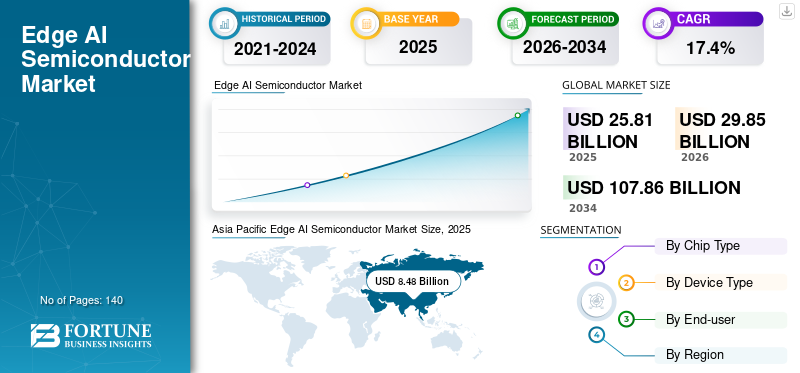
Download Free sample to learn more about this report.
Edge AI Semiconductor Market Key Takeaways
 Global Market Size & Forecast
- 2025 Market Size: USD 25.81 billion
- 2026 Market Size: USD 29.85 billion
- 2034 Forecast Market Size: USD 107.86 billion
- CAGR: 17.4% from 2026-2034
 Market Share
- Asia Pacific dominated the edge AI semiconductor market with a 32.86% share in 2025.
- The GPU segment held the largest market share of 27.2% in 2025.
- The smartphones & tablets segment accounted for the largest share of 20.6% in 2025.
 Key Regional Highlights
North America
North America holds the second-largest share in the global market.
Asia Pacific
Asia Pacific dominated the market with a 32.86% share in 2025.
Europe
Europe holds a significant share in the global market.
U.S.
The U.S. market reached USD 1.25 billion in 2025.
Japan
The Japan market reached USD 1.36 billion in 2025.
Read More

EDGE AI SEMICONDUCTOR MARKET TRENDS
Increasing Adoption of Edge AI Vision SoCs in Smart Cameras and Robotics
Device manufacturers are increasingly integrating edge AI vision SoCs into smart cameras, drones, robots, industrial automation systems, and security devices to support real-time image processing and perception at the device level. These semiconductors enable functions such as object detection, video analytics, sensor fusion, autonomous navigation, and intelligent monitoring without depending entirely on cloud processing. The trend is gaining momentum as industries require faster response times, lower bandwidth usage, improved privacy, and energy efficient AI performance across surveillance, robotics, automotive, industrial, and consumer applications.
- In January 2026, Ambarella launched its CV7 edge AI vision SoC for applications including 8K consumer cameras, enterprise security cameras, robotics, drones, industrial automation, and video conferencing devices. This highlights the growing shift toward on-device vision AI and supports demand for these semiconductors.
MARKET DYNAMICS
MARKET DRIVERS
Download Free sample to learn more about this report.
Rising Demand for Real-Time On-Device AI Processing to Drive Semiconductor Adoption
Industries are increasingly integrating AI processing capabilities directly into edge devices to enable faster decision-making, lower latency, and reduced dependence on cloud-based infrastructure. These semiconductors, including NPUs, GPUs, ASICs, FPGAs, and AI-enabled SoCs, allow smartphones, PCs, smart cameras, autonomous vehicles, robots, industrial machines, and edge servers to process data locally. This supports real-time analytics, improved data privacy, reduced bandwidth use, and faster AI-driven responses across consumer electronics, automotive, manufacturing, healthcare, retail, IT and telecom, and energy sectors. These factors are poised to impel edge AI semiconductor market growth.
- In 2025, Intel reported that it was on track to deliver 100 million cumulative AI PCs by the end of the year, powered by Intel Core Ultra processors. This highlights the rising adoption of NPU-enabled devices and supports the demand for these semiconductors.
MARKET RESTRAINTS
High Chip Development Costs and Export Control Uncertainty to Limit Wider Adoption
The market faces restraints from high design complexity, advanced fabrication costs, supply chain dependence, and regulatory uncertainty around AI chip exports. Developing NPUs, GPUs, ASICs, and custom AI SoCs requires heavy investment in chip architecture, software compatibility, testing, and access to advanced foundries. Export controls and trade restrictions can also affect the availability of advanced AI chips across regions, delaying product launches and increasing procurement complexity for device manufacturers, automotive companies, industrial automation vendors, and telecom edge infrastructure providers.
- In January 2025, the U.S. Bureau of Industry and Security published updated controls on advanced computing integrated circuits and certain AI model weights under the Export Administration Regulations. This indicates that regulatory restrictions around advanced AI chips may create supply uncertainty and limit access to high-performance semiconductor components in some markets.
MARKET OPPORTUNITIES
Expansion of Edge AI Semiconductors in Automotive and Industrial Edge Applications to Offer New Avenues
The market has significant opportunities in automotive and industrial edge applications, as vehicles, factories, robots, smart cameras, and connected machines increasingly require real-time AI processing at the device level. These semiconductors, such as NPUs, AI accelerators, vision SoCs, FPGAs, and custom AI SoCs, enable faster perception, predictive maintenance, sensor fusion, autonomous navigation, intelligent monitoring, and machine-to-machine decision-making without relying entirely on cloud infrastructure. The product adoption is expected to grow as automotive OEMs, industrial automation companies, and semiconductor vendors focus on low-power consumption and high-performance AI chips for safety-critical and latency-sensitive use cases.
- In February 2025, NXP Semiconductors announced an agreement to acquire Kinara to strengthen its edge AI portfolio with NPUs and AI software for industrial and automotive edge markets. This highlights the growing opportunity for these semiconductors in intelligent vehicles, industrial systems, and connected edge devices.
EDGE AI SEMICONDUCTOR MARKET SEGMENTATION ANALYSIS
By Chip Type
GPU Segment to Dominate Owing to Strong Parallel Processing and Wider Edge AI Deployment
Based on chip type, the market is divided into CPU, GPU, NPU/AI accelerator, FPGA, ASIC/Custom AI SoC, and others.
The GPU segment holds the largest edge AI semiconductor market share of 27.2% due to its strong parallel processing capabilities and high-performance AI workloads. GPUs are widely used in edge servers, AI PCs, smart cameras, robotics, autonomous systems, and automotive computing platforms. Their mature ecosystem, developer support, and strong availability across enterprise and embedded applications further support their leading position.
The NPU / AI accelerator segment is expected to grow at the highest CAGR of 19.5% over the forecast period. Device manufacturers increasingly require dedicated, low-power AI chips for real-time on-device inference, image processing, speech recognition, and sensor-based decision-making, propelling segment growth.
By Device Type
Smartphones & Tablets Segment to Lead Owing to High Shipments and Growing On-Device AI Integration
Based on device type, the market is divided into smartphones & tablets, PCs & laptops, edge servers, edge gateways, vision systems & smart cameras, autonomous machines & robots, in-vehicle computing systems, wearables & smart consumer devices, and others.
The smartphones & tablets segment holds the largest share of 20.6% as they represent the highest-volume device category using edge AI semiconductors. AI-enabled mobile processors are widely used for camera enhancement, facial recognition, voice assistants, personalization, security, and power-efficient on-device AI features. Their large installed base and frequent processor upgrades make them the leading revenue contributor in the market.
The edge servers segment is projected to grow at the highest CAGR of 19.4% over the analysis period. Enterprises, telecom operators, and cloud providers deploy distributed AI infrastructure closer to users and data sources for low-latency inference, analytics, automation, and real-time decision-making, which is a significant factor influencing segment growth.
By End-user
To know how our report can help streamline your business, Speak to Analyst
Consumer Electronics Segment to Dominate Driven by Mass Adoption of AI-enabled Connected Devices
By end-user, the market is segmented into consumer electronics, automotive, manufacturing, healthcare, retail & consumer goods, IT & telecom, energy & utilities, and others.
The consumer electronics segment leads the market with a share of 25.7%. Smartphones, tablets, PCs, wearables, smart cameras, and smart home devices account for the largest deployment base of edge AI semiconductors, fostering the dominance of the segment. These devices increasingly use AI chips to support imaging, voice interaction, personalization, security, gaming, productivity, and battery-efficient performance. The segment benefits from high shipment volumes, rapid product refresh cycles, and growing demand for AI-enabled user experiences.
The IT & telecom segment is expected to record the highest CAGR of 18.2% over the analysis period. The segment growth can be credited to the increasing demand for high-performance edge AI chips with 5G networks, edge data centers, private networks, AI servers, network optimization, and distributed inference workloads.
EDGE AI SEMICONDUCTOR MARKET REGIONAL OUTLOOK
By geography, the market is categorized into North America, South America, Europe, Asia Pacific and the Middle East and Africa.
Asia Pacific
Asia Pacific Edge AI Semiconductor Market Size, 2025 (USD Billion)
To get more information on the regional analysis of this market, Download Free sample
Asia Pacific holds the largest market share due to its strong semiconductor manufacturing base, high-volume consumer electronics production, and high demand for AI-enabled smartphones, PCs, cameras, and connected devices. Countries such as China, Taiwan, South Korea, Japan, and India support the region’s leadership through chip manufacturing, electronics assembly, automotive electronics, robotics, and industrial automation. Smart factories, smart cities, surveillance systems, and telecom infrastructure sectors are increasingly adopting AI-enabled edge devices, benefiting the region. Taiwan’s leadership in advanced semiconductor production and broader expansion of the Asia Pacific in chip manufacturing continue to strengthen the region’s market position.
To know how our report can help streamline your business, Speak to Analyst
Japan Edge AI Semiconductor Market
The Japan market reached a value of around USD 1.36 billion in 2025, accounting for roughly 5.3% of global revenues.
China Edge AI Semiconductor Market
The China market is projected to be one of the largest markets worldwide. This market reached revenues of around USD 3.33 billion in 2025, representing roughly 12.9% of the global sales.
India Edge AI Semiconductor Market
The India market reached around USD 0.43 billion in 2025, accounting for roughly 7.5% of global revenues.
North America
North America holds the second-largest share due to the strong presence of leading AI chip designers, cloud and edge infrastructure providers, automotive AI developers, and enterprise technology adopters. The U.S. is home to major companies such as NVIDIA, Qualcomm, Intel, AMD, Ambarella, and Lattice Semiconductor, which support the region’s leadership in GPUs, NPUs, AI accelerators, FPGAs, and edge AI platforms. The regional growth is also supported by the demand for AI PCs, edge servers, robotics, smart cameras, autonomous systems, and telecom edge infrastructure.
- The region’s semiconductor ecosystem is further supported by U.S. policy initiatives, with the U.S. Government Accountability Office noting that the U.S. Commerce Department expects the U.S. share of leading-edge logic manufacturing to rise from 0% in 2022 to 20% by 2030.
U.S. Edge AI Semiconductor Market
The U.S. market can be analytically approximated to have reached around USD 1.25 billion in 2025, accounting for roughly 4.8% of sales.
Europe
Europe holds a significant share in the market due to its strong automotive, industrial automation, robotics, energy, healthcare, and machine vision ecosystems. Germany, the U.K., France, Italy, Benelux, and the Nordics contribute to the product demand in ADAS, in-vehicle computing, smart factories, predictive maintenance, industrial cameras, and regulated enterprise applications. The region’s semiconductor demand is also supported by policy efforts to improve chip sovereignty and strengthen local semiconductor capabilities.
- The European Commission states that the European Chips Act is intended to boost Europe’s sovereignty and competitiveness in semiconductor technologies, which supports long-term regional participation in AI chip and edge semiconductor value chains.
U.K. Edge AI Semiconductor Market
The U.K. market reached around USD 0.90 billion in 2025, representing roughly 3.5% of the global revenues.
Germany Edge AI Semiconductor Market
The Germany market hit a value of USD 1.38 billion in 2025, equivalent to around 5.4% of global sales.
Middle East & Africa
The Middle East & Africa market is expected to grow at the highest CAGR over the analysis period as the region is starting from a smaller base while rapidly increasing investments in AI infrastructure, smart cities, telecom edge, security systems, and digital government platforms. The GCC countries, Israel, Turkey, and South Africa are driving adoption through AI-ready data centers, surveillance analytics, energy automation, connected infrastructure, and industrial digitalization. The demand for edge AI semiconductors is increasing as these projects require local processing, low latency, real-time monitoring, and secure data handling across distributed assets.
- In 2025, Abu Dhabi announced a USD 13 billion digital strategy focused on AI-native government services, reflecting the region’s accelerating push for AI and edge infrastructure.
GCC Edge AI Semiconductor Market
The GCC market reached a value of around USD 0.75 billion in 2025, representing roughly 2.9% of global revenues.
South America
The South America market is expected to grow at an average rate as product adoption increases. However, the region has a smaller semiconductor ecosystem and lower edge infrastructure density than Asia Pacific, North America, and Europe. Brazil, Argentina, and the rest of South America are recording demand from retail automation, telecom edge rollout, smart surveillance, agriculture technology, energy monitoring, and industrial modernization. However, growth is moderated by limited local semiconductor manufacturing, higher import dependence, macroeconomic volatility, and slower enterprise-level adoption of advanced AI hardware.
Brazil Edge AI Semiconductor Market
In 2025, the Brazil market touched a value of around USD 0.82 billion, accounting for roughly 3.2% of global revenues.
COMPETITIVE LANDSCAPE
Key Industry Players
Leading Market Players Launch New Solutions to Consolidate their Market Positioning
Industry players launch new solutions to enhance their industry standing by leveraging technological advancements and addressing the diverse needs of consumers to stay abreast of their competitors. They prioritize portfolio enhancement, strategic collaborations, and acquisitions to strengthen their offerings. Such strategic launches enable technology companies to maintain and expand their market share in a rapidly evolving landscape.
LIST OF KEY EDGE AI SEMICONDUCTOR COMPANIES PROFILED
- NVIDIA Corporation (U.S.)
- Qualcomm Incorporated (U.S.)
- Intel Corporation (U.S.)
- Advanced Micro Devices, Inc. (U.S.)
- MediaTek Inc. (Taiwan)
- Samsung Electronics Co., Ltd. (South Korea)
- NXP Semiconductors N.V. (Netherlands)
- Ambarella, Inc. (U.S.)
- Lattice Semiconductor Corporation (U.S.)
- Hailo Technologies Ltd. (Israel)
KEY INDUSTRY DEVELOPMENTS
- September 2025: MediaTek launched the Dimensity 9500 flagship 5G mobile platform for next-generation smartphones. The platform is designed to support advanced on-device AI, improved power efficiency, and AI-enabled mobile experiences.
- August 2025: NVIDIA announced the general availability of the Jetson AGX Thor developer kit and production modules for robotics, physical AI, and real-time edge AI workloads. The launch supports semiconductor demand for edge AI across manufacturing, logistics, transportation, healthcare, agriculture, and retail applications.
- July 2025: Hailo announced the commercial availability of Hailo-10H, its second-generation edge AI accelerator with generative AI capabilities. The product supports generative AI workloads at the edge and expands the market for discrete edge AI processors.
- February 2025: NXP announced a definitive agreement to acquire Kinara, Inc., a company focused on high-performance, energy-efficient programmable NPUs. The acquisition strengthens NXP’s edge AI portfolio for industrial, automotive, and connected edge applications.
- January 2025: Qualcomm expanded its Snapdragon X Series AI PC platform, stating that it had over 60 designs in production and more than 100 designs expected by 2026. This development strengthens the adoption of NPU-powered AI PCs and supports demand for edge AI semiconductors.
- January 2025: Intel launched new Intel Core Ultra processors for AI PCs and edge computing at CES 2025. The launch supports on-device AI processing and expands Intel’s role in the adoption of edge AI semiconductors across business PCs and edge computing systems.
- January 2025: AMD announced its expanded AI PC portfolio, including Ryzen AI Max Series and Ryzen AI Max PRO Series processors with an NPU delivering up to 50 TOPS. This strengthens AMD’s position in on-device AI computing and supports the rising demand for AI-enabled PC semiconductors.
REPORT COVERAGE
The global market analysis provides an in-depth study of the size and forecast by all the market segments included in the report. It includes details on the market dynamics and market trends expected to drive the market over the forecast period. It offers information on the technological advancements, key developments, and details on partnerships, mergers, and acquisitions. The market research report also includes a detailed competitive landscape, providing market share and profiles of key players.
Request for Customization to gain extensive market insights.
REPORT SCOPE & SEGMENTATION
| ATTRIBUTE | DETAILS |
| Study Period | 2021-2034 |
| Base Year | 2025 |
| Estimated Year | 2026 |
| Forecast Period | 2026-2034 |
| Historical Period | 2021-2024 |
| Growth Rate | CAGR of 17.4% from 2026-2034 |
| Unit | Value (USD Billion) |
| Segmentation | By Chip Type, By Device Type, By End-user, and By Region |
| By Chip Type |
|
| By Device Type |
|
| By End-user |
|
| By Region |
|
Frequently Asked Questions
Fortune Business Insights says that the global market value stood at USD 25.81 billion in 2025 and is projected to reach USD 107.86 billion by 2034.
In 2025, Asia Pacific’s market value stood at USD 8.48 billion.
The market is expected to grow at a CAGR of 17.4% over the forecast period of 2026-2034.
By end-user, the consumer electronics segment leads the market.
The market is driven by on-device AI, AI devices, edge infrastructure, automotive AI, and industrial AI adoption.
NVIDIA Corporation, Qualcomm Incorporated, Intel Corporation, and Advanced Micro Devices, Inc. are the prominent players in the market.
Asia Pacific dominates the market in terms of share.
The product adoption is expected to rise with demand for low-latency, private, energy-efficient edge AI across devices, vehicles, industrial systems, and smart infrastructure.


- 2021-2034
- 2025
- 2021-2024
- 140
Get 30-60 hrs Free Customization
Expand Regional and Country Coverage, Segments Analysis, Company Profiles, Competitive Benchmarking, and End-user Insights.




















Related Reports
-
US +1 833 909 2966 ( Toll Free )
-
Get In Touch With Us