Edible Oil Alternatives Market Size, Share & Industry Analysis, By Type (Lipid Based Alternatives {High Smoke Point Plant Oils, Low Smoke Point Finishing Oils, Solid-At-Room Temp Fat Oils, and Clarified Animal Fats}, Non Lipid Alternatives {Fruit Based Purees, Protein Based Bases, and Vegetable Based Purees}, and Blended and Hybrid Solutions), By End Use (Retail, Foodservice, and Industrial / Food Processing), By Processing Type (Refined and Unrefined), and Regional Forecast, 2026-2034
 Download Free Sample
(Offer valid till 30th Sep 2026)

Edible Oil Alternatives Market Size and Future Outlook
 Listen to Audio Version
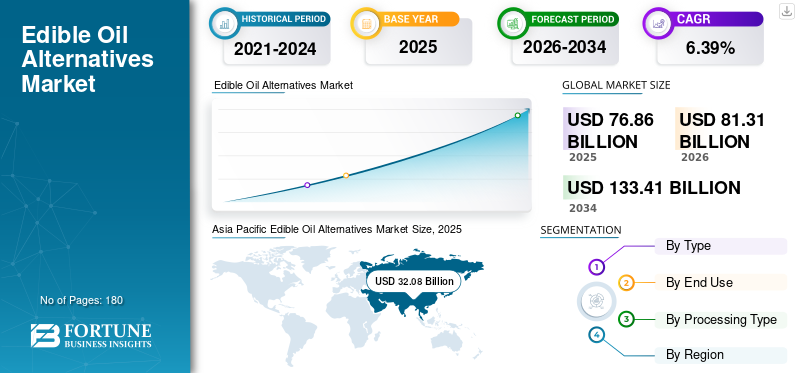
The global edible oil alternatives market size was valued at USD 76.86 billion in 2025. The market is projected to grow from USD 81.31 billion in 2026 to USD 133.41 billion by 2034, exhibiting a CAGR of 6.39% during the forecast period. Asia Pacific dominated the edible oil alternatives market with a market share of 41.74% in 2025.
Edible oil alternatives are fats and oils that consumers use instead of regular refined vegetable or seed oils. Some examples include vegetable oils such as olive oil, avocado oil, coconut oil, ghee, and animal fats such as tallow. These alternatives are chosen for their functional properties, nutritional profile, or specific cooking applications. The market is growing rapidly due to increasing concerns over the health and environmental impact of highly processed seed oils and rising demand for natural, minimally processed fats. As people want higher-quality cooking ingredients and more people are following diets such as keto and paleo, there is a growing use of high-smoke-point oils in stores and restaurants.
Companies such as Deoleo, Chosen Foods, Nutiva, and others are some of the key players operating in this market. The launch of new products and expansion of market presence are the key strategies which are boosting product sales and supporting the market growth.
Download Free sample to learn more about this report.
Edible Oil Alternatives Market Key Takeaways
 Global Market Size & Forecast
- 2025 Market Size: USD 76.86 billion
- 2026 Market Size: USD 81.31 billion
- 2034 Forecast Market Size: USD 133.41 billion
- CAGR: 6.39% from 2026–2034
 Market Share
- Asia Pacific dominated the edible oil alternatives market with a 41.74% share in 2025.
- The lipid-based alternatives segment accounted for the largest market share in 2025.
- The blended and hybrid solutions segment is projected to grow at a CAGR of 5.52% during the forecast period.
 Key Regional Highlights
Europe
Europe reached USD 22.03 billion in 2025.
North America
North America was valued at USD 16.01 billion in 2025.
Asia Pacific
Asia Pacific led the market at USD 32.08 billion in 2025.
U.S
The market stood at USD 12.88 billion in 2025.
Japan
The market reached USD 3.54 billion in 2025, accounting for 4.61% of global revenue.
Read More

EDIBLE OIL ALTERNATIVES MARKET TRENDS
Expanding Use in Frying, Baking, Dressings, and Foodservice Applications to Drive Product Innovation
Edible oil alternative products are being used more often in cooking, baking, frying, salad dressings, spreads, and foodservice recipes. High-smoke-point options such as avocado oil, ghee, and tallow are becoming more popular for frying, grilling, and sautéing as they can handle high heat. Foodservice businesses are using specialty oil alternatives to offer premium menus and unique flavors. Blended and hybrid oil solutions are also being used in processed foods to balance function, taste, nutrition, and cost.
MARKET DYNAMICS
MARKET DRIVERS
Download Free sample to learn more about this report.
Rising Health Concerns over Refined Oils to Drive Demand for Natural Alternatives
The market is driven by increasing consumer awareness regarding the health risks associated with excessive consumption of refined vegetable and seed oils. The rising prevalence of cardiovascular diseases, obesity, and metabolic disorders is encouraging consumers to shift toward healthier alternatives such as olive oil, avocado oil, coconut oil, and animal fats such as ghee. Additionally, the growing demand for clean label, minimally processed, and natural food products is accelerating the adoption of such oils. The rise of premium cooking oils and increasing popularity of specialized diets such as keto and paleo further support edible oil alternatives market growth.
MARKET RESTRAINTS
High Product Costs and Limited Supply Availability to Restrict Wider Market Adoption
Premium oil alternatives cost more than regular edible oils, which makes them less popular among price conscious consumers. Some oils, such as avocado oil, are difficult to find and face supply chain challenges, which can make it difficult to scale up production. In developing regions, limited product awareness and increased preferences for traditional cooking oils further impacts market growth. Differences in regulations and concerns about saturated fat in some oils can affect how consumers view these products.
MARKET OPPORTUNITIES
Growing Demand for Functional Blends and Specialty Diet Oils to Create Market Expansion Potential
There are strong opportunities to expand product lines by offering blended and functional oil alternatives that support health goals such as heart health and weight management. As consumers choose plant-based and specialty diets, there are significant opportunities to develop niche products for these markets. Innovating in packaging, distribution, and marketing can also make products easier to access and help connect with more customers.
Edible Oil Alternatives Market Segmentation Analysis
By Type
Functional Replacement of Conventional Oils in Cooking and Food Processing to Drive Lipid-Based Alternatives Segment Dominance
The market is segmented by type into lipid based alternatives, non-lipid alternatives, and blended and hybrid solutions.
The lipid based alternatives segment held the largest edible oil alternatives market share in 2025. These products work similar to regular edible oils in cooking and food processing. Olive oil, avocado oil, coconut oil, ghee, and animal fats can easily replace traditional oils for frying, baking, sautéing, and making dressings. These oils are widely used, easy to find, and work well in both home and industrial kitchens, which leads to high demand. There is also strong demand from health-conscious buyers and high-end foodservice businesses, since these oils are seen as both useful and healthy.
The blended and hybrid solutions segment holds the second-largest market share and is expected to grow at a CAGR of 5.52% during the forecast period. They combine different oil sources to improve performance, cost, and nutrition. They are being used more often in processed foods and foodservice to balance smoke point, flavor, and shelf life. However, their use is still in the developing phase compared to single-source lipid alternatives, which limits their market share even though interest is growing.
By End Use
High Household Consumption and Wide Availability to Drive the Dominance of Retail Segment
Based on end use, the market is segmented into retail, foodservice, and industrial / food processing.
The retail segment accounted for the largest market share in 2025 due to strong household consumption and increasing adoption of healthier cooking oils at the consumer level. Consumers are actively replacing conventional oils with alternatives such as olive oil, avocado oil, and coconut oil for daily cooking, baking, and dressing applications. More people are focused on health, looking for higher-quality products, and buying these oils often, all of which increase demand in stores.
The industrial / food processing segment holds the second-largest share of the market and is expected to grow at a CAGR of 6.16% during the forecast period. This segment holds the second-largest share as restaurants, cafes, and commercial kitchens increasingly adopt oil alternatives for premium menu offerings and health-focused positioning. However, bulk cost considerations and operational constraints limit widespread adoption compared to retail consumption.
To know how our report can help streamline your business, Speak to Analyst
By Processing Type
High Suitability for Cooking Led to Dominance of the Refined Segment
The market is segmented by processing type into refined and unrefined.
The refined segment led the global market in 2025. The dominance is due to more stable nature, neutral taste, and usability for high-temperature cooking such as frying, sautéing, and industrial food processing. Refining removes impurities, odor, and color from the oil. This gives it a longer shelf life and consistent quality, suitable for large-scale use in homes and foodservice. Refined oils also have higher smoke points can be used in more types of cooking. Their cost efficiency and ability to scale make them popular, especially in mass-market and commercial settings.
The unrefined segment is anticipated to expand at a CAGR of 6.21% during the forecast period. Unrefined oils are the second most popular choice as they are healthier, natural, and richer in flavor. They are often chosen for premium and specialty uses such as salad dressings and finishing touches as they do not handle heat as well.
Edible Oil Alternatives Market Regional Outlook
By geography, the market is categorized into Europe, North America, Asia Pacific, South America, and the Middle East & Africa.
Asia Pacific
Asia Pacific Edible Oil Alternatives Market Size, 2025 (USD Billion)
To get more information on the regional analysis of this market, Download Free sample
The Asia Pacific market was valued at USD 32.08 billion in 2025 and is the leading region in the world. In the Asia pacific region, premium oil alternatives are mainly found in urban Tier 1 cities, showing that adoption patterns are fragmented. In India, ghee is increasingly being seen as a healthy fat, while in China, people prefer imported olive and avocado oils. In Japan, there is a small but steady demand for functional oils. The market faces limits as traditional oils such as palm, soybean, and mustard are still widely used, making large-scale changes difficult. Southeast Asian nations are major palm oil production countries further supporting product availability.
India Edible Oil Alternatives Market
The India market was valued at USD 5.25 billion in 2025, accounting for roughly 6.83% of the global market demand.
China Edible Oil Alternatives Market
In 2025, the China market was valued at around USD 11.47 billion, representing roughly 14.92% of the global market share. The China market is import-driven, with growing demand for olive oil and avocado oil among urban middle- and high-income consumers. The market is concentrated in Tier 1 cities, where Western dietary influence and health awareness are higher.
Japan Edible Oil Alternatives Market
The Japan market reached a valuation of around USD 3.54 billion in 2025, accounting for roughly 4.61% of global market revenues.
North America
The market in North America reached a valuation of USD 16.01 billion in 2025. Avocado oil and specialty fats such as ghee and MCT oils have become popular in North America, moving beyond the usual focus on olive oil. Retailers in the U.S. are offering more choices, especially blended oils made for cooking at high temperatures. Store brands are becoming more common in large retail stores, which is making it harder for premium brands to keep their prices high. Restaurants are choosing these oils carefully, with most adoption increasing in fast-casual and upscale dining.
U.S. Edible Oil Alternatives Market
In 2025, the U.S. market reached USD 12.88 billion. The U.S. market is diverse, with avocado oil, coconut oil, MCT oils, and animal fats such as tallow which are widely used. Growth in this category comes from products marketed for keto and paleo diets, as well as those used for high-heat cooking. Stores offer blends designed to balance cost and performance. Premium and health-focused chains use them more often than large fast-food chains, mainly due to higher cost.
Europe
The Europe market reached a valuation of USD 22.03 billion in 2025. Olive oil is still the main product in the European market, but growth comes from new options such as avocado and nut oils that do not contain seeds. Southern Europe is a mature market with strong consumer base for alternatives of edible oil, but Northern and Western Europe are seeing more growth due to increasing demand for organic products and cold-pressed oils. New rules about labeling, providing traceability information also impacts the marketability of the products. Traceability and PDO/PGI certifications are key parameters that help brands remain visible in the market.
Germany Edible Oil Alternatives Market
The Germany market reached USD 2.62 billion in 2025, representing roughly 3.40% of the global market revenues. This market is driven by strong demand for organic-certified and cold-pressed oils, particularly olive oil and emerging alternatives such as flaxseed and avocado oil.
U.K. Edible Oil Alternatives Market
The U.K. market reached approximately USD 1.84 billion in 2025, equivalent to around 2.40% of the global market sales.
South America and Middle East & Africa
Over the forecast period, South America is expected to experience significant growth in this market. The South America market recorded a value of USD 3.36 billion in 2025. In South America, most adoption occurs in export-focused countries such as Chile, known for olive oil, and Peru, known for avocado oil. Most high-value oils are sold as premium products or exported to other countries. In Brazil, specialty oils are slowly becoming more available in stores. There is strong production, but the local demand for these oils is still weak.
The Middle East & Africa market reached a valuation of USD 3.40 billion in 2025. The Middle East relies on imports, with most demand for olive and avocado oils coming from the UAE and Saudi Arabia, especially in premium retail stores. In the foodservice sector, only high-end hotels and restaurants use these oils. In Africa, the market is still developing and most people continue to use conventional oils as specialty oils are less affordable.
UAE Edible Oil Alternatives Market
The UAE market is set to grow at a CAGR of 4.66% during the forecast period. This market is highly import-dependent, with demand concentrated in premium retail and expatriate-driven consumption. Olive oil dominates, followed by the growing availability of avocado and coconut oils. An increasing number of products are used for finishing, dressings, and premium cooking rather than bulk applications.
COMPETITIVE LANDSCAPE
Key Industry Players
Leading Companies’ Emphasis on Origin and Processing Methods to Bolster their Industry Positions
The edible oil alternatives market is segmented across premium global brands, regional producers, and new niche companies, due to which it is heavily fragmented. Major players such as Deoleo (olive oil), Chosen Foods (avocado oil), Nutiva (coconut oil), and La Tourangelle focus on origin, processing methods. Brands differentiate itself through claims such as cold-pressed, high smoke point, keto-friendly, or seed-oil-free, instead of merely competing on price. Private label products, are also competing with other major market players by offering cheaper options compared to premium brands.
LIST OF EDIBLE OIL ALTERNATIVES COMPANIES PROFILED
- Deoleo S.A. (Spain)
- Sovena Group (Portugal)
- Pompeian, Inc. (U.S.)
- California Olive Ranch (U.S.)
- Chosen Foods LLC (U.S.)
- Nutiva (U.S.)
- GCMMF (India)
- AAK AB (Sweden)
- Fuji Oil Holdings Inc. (Japan)
- Bunge Limited (U.S.)
KEY INDUSTRY DEVELOPMENTS
- January 2026: Dutch butter and dough producer Royal VIVBuisman merged with Van der Pol to create Royal Van Ballegooijen Foods or Royal VBF. The merged entity can develop high-quality butter and dough products to bakers and industrial partners.
- December 2025: Cobram Estate Olives Limited entered a binding agreement and acquired the U.S.-headquartered company California Olive Ranch, Inc. It is one of the leading producers and marketers of Californian extra virgin olive oil.
- August 2024: Challenge Butter, a brand of Challenge Dairy Products, launched Spreadable Lactose Free Clarified Butter with Canola Oil. This product was across the U.S. market.
- July 2024: Primal Kitchen expanded its portfolio of oils and launched new avocado oil in the market. This Pure Organic Avocado Oil is suited for people with specific dietary needs such as keto, paleo, and others. The product is suitable for roasting, baking, sautéing, and stir-frying.
- February 2022: Portugal based company Coração do Vale which is a premium manufacturer of extra virgin olive oil entered in the Indian market. The product is marketed and distributed by Leads Brand Connect in India.
REPORT COVERAGE
The global edible oil alternatives market research report provides an in-depth study of market size and forecast by all the market segments included in the report. The market analysis includes details on the market dynamics, regional analysis, and trends expected to drive the market during the forecast period. It offers information on the market forecast, technological advancements, new product launches, key industry developments, and details on partnerships, mergers, and acquisitions. The industry also encompasses detailed competitive landscape with information on the market segmentation, market share, and profiles of key operating players.
Request for Customization to gain extensive market insights.
Report Scope & Segmentation
| ATTRIBUTE | DETAILS |
| Study Period | 2021-2034 |
| Base Year | 2025 |
| Estimated Year | 2026 |
| Forecast Period | 2026-2034 |
| Historical Period | 2021-2024 |
| Growth Rate | CAGR of 6.39% from 2026-2034 |
| Unit | Value (USD Billion) |
| Segmentation | By Type, By End Use, By Processing Type, and Region |
| By Type |
|
| By End Use |
|
| By Processing Type |
|
| By Region |
|
Frequently Asked Questions
Fortune Business Insights says that the global market value stood at USD 76.86 billion in 2025 and is projected to reach USD 133.41 billion by 2034.
In 2025, the Asia Pacific market value stood at USD 32.08 billion.
The market is expected to exhibit a CAGR of 6.39% during the forecast period.
By end use, the retail segment led the global market in 2025.
The rising health concerns over refined oils is a key factor driving the market.
Deoleo, Chosen Foods, and Nutiva are the key players in the market.
Asia Pacific held the largest market share in 2025.
Expanding use in frying, baking, dressings, and foodservice applications is a major trend in the market.



- 2021-2034
- 2025
- 2021-2024
- 180
-
(Offer valid till 30th Sep 2026)
Get 30-60 hrs Free Customization
Expand Regional and Country Coverage, Segments Analysis, Company Profiles, Competitive Benchmarking, and End-user Insights.




















Related Reports
-
US +1 833 909 2966 ( Toll Free )
-
Get In Touch With Us