Empty Coffee Capsules & Lids Market Size, Share & Industry Analysis, By Material (Aluminum, Plastic, and Others), By Product Type (Empty Capsule Bodies and Lids/Foil Seals), By End User (Institutional, Retail, and Commercial), By System Compatibility (Nespresso Original Compatible, Keurig K-Cup Compatible, Lavazza Systems, and Others), and Regional Forecast, 2026-2034
 Download Free Sample
(Offer valid till 15th Oct 2026)

KEY MARKET INSIGHTS
 Listen to Audio Version
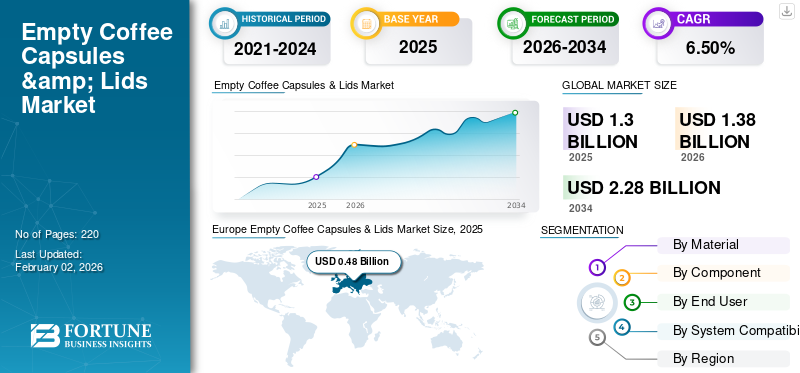
The global empty coffee capsules & lids market size was valued at USD 1.30 billion in 2025. It is projected to be worth USD 1.38 billion in 2026 and reach USD 2.28 billion by 2034, exhibiting a CAGR of 6.50% during the forecast period. Europe dominated the Empty Coffee Capsules & Lids Market with a market share of 37.00% in 2025.
Recently, coffee capsules have been among the most profitable industries in the food and beverage sector. Vacuum-packaged single-serving coffee capsules need proper gear for use. Health-conscious shoppers are consuming more coffee. Manufacturers are hence introducing creative new formulations, including coffee capsules, to the market. Encouraging both created and developing market regions, the chain coffee store industry has been comparatively consistent throughout all demographics. Recent changes in customer behavior have often raised caffeine beverages.
Furthermore, caffeine enhances athletic performance by raising metabolism, oxidation of fatty acids, and release of fatty acids from adipose cells. Decaf is becoming somewhat well-known among health-conscious customers for its anti-cancer effects. Among companies in the coffee capsules industry, one of the most recent trends is the use of bioplastics and biodegradable materials in the manufacture of coffee capsules. Rather than using plastic and aluminum to encapsulate the coffee extract, companies are concentrating on producing the capsules with biodegradable materials and bioplastics, which is fueling growth in the empty coffee capsule industry.
Amcor and Mondi are the leading manufacturers of empty coffee capsules & lids, accounting for the largest market share.
Download Free sample to learn more about this report.
EMPTY COFFEE CAPSULES AND LIDS MARKET KEY TAKEAWAYS
 Market Size & Forecast
- 2025 Market Size: USD 1.30 Billion
- 2026 Market Size: USD 1.38 Billion
- 2034 Forecast Market Size: USD 2.28 Billion
- CAGR: 6.50% from 2026–2034
 Market Share
- Europe dominated the Empty Coffee Capsules & Lids Market with a market share of 37.00% in 2025.
- Empty capsule bodies dominated the product type segment with an 89.34% share in 2026.
- Retail emerged as the leading end-user segment, holding a 63.40% market share in 2026.
 Key Regional Highlights
North America
The North America market generated USD 0.37 billion in 2025, representing 28.29% of the global market landscape, and is expected to reach USD 0.39 billion in 2026.
Europe
Europe contributed 37.00% to the global market in 2025, with a valuation of USD 0.48 billion, and is projected to reach USD 0.51 billion in 2026.
Asia Pacific
Asia Pacific accounted for USD 0.32 billion in 2025, representing 24.19% of the global market share, and is projected to reach USD 0.34 billion in 2026.
U.S.
The market is projected to reach USD 0.32 billion in 2026, fueled by strong demand for convenient, high-quality coffee solutions and increasing adoption of eco-friendly capsule formats.
Japan
The market is projected to reach USD 0.08 billion in 2026, supported by rising coffee consumption, premium coffee preferences, and growing adoption of single-serve brewing systems.
Read More

MARKET DYNAMICS
MARKET DRIVERS
Accelerating Demand for Sustainability is Driving Market Growth
The rising awareness of environmental issues among consumers and more stringent rules regarding single-use plastics significantly boost the need for sustainable coffee capsules. This shift is propelling the market for compostable and biodegradable coffee capsules, with forecasts indicating considerable expansion in the years ahead.
The demand for sustainable coffee capsules is growing as consumers become more aware of environmental challenges and seek eco-friendly options. This demand is fueling advancements in the design and materials of coffee capsules, emphasizing compostable, biodegradable, and recyclable alternatives.
To reduce waste, numerous specialty coffee roasters are transitioning to completely recyclable or compostable packaging. Refillable coffee pods are becoming popular among consumers who wish to enjoy their preferred coffee while avoiding single-use waste. Henceforth, the augmenting demand for sustainability among consumers and manufacturers drives the global coffee capsule market.
Growing Regulatory Compliance and Premiumization of Coffee Formats Strengthens Market Growth
Increasing concerns about sustainability are pushing consumers to request eco-friendlier coffee options, pressuring industry stakeholders to respond. As a result, mandatory regulations addressing all three pillars of sustainability—environmental, social, and economic—have been implemented. These three pillars are interconnected, meaning that a deficiency in one can negatively impact the others.
Regulatory compliance for empty coffee capsules is increasing due to environmental issues and the demand for sustainable practices. Major points of concern include minimizing waste, ensuring recyclability, and sourcing materials that do not contribute to deforestation. Many regions are implementing measures to reduce waste from coffee capsules, such as restrictions on single-use plastics and promoting recycling programs.
According to the National Coffee Association in the U.S., in 2024, the specialty coffee sector saw considerable expansion, with 57% of American adults consuming a specialty coffee within the last week, marking an increase of 7.5% compared to the previous year. Within the specialty coffee category, the highest growth in past-week consumption was observed in espresso-based drinks, rising by 10%. Thus, the premiumization of coffee formats contributes to the empty coffee capsules & lids market growth.
MARKET RESTRAINTS
Rising Prices of Aluminum Material and System Lock-in Obstruct Market Growth
Aluminum is widely used in coffee capsule packaging, especially for premium capsules (e.g., Nespresso), due to its superior barrier properties against oxygen, light, and moisture. This ensures longer shelf life and better flavor preservation. The changing prices of aluminum directly influence the cost of coffee capsules, which is an important consideration for both producers and consumers. This is due to aluminum is the main material utilized in making empty capsules.
An increase in aluminum prices can cause production costs to rise, which may lead to higher retail prices for coffee capsules. This situation can impact the buying choices of consumers, particularly those who are sensitive to price. Moreover, smaller brands relying on third-party suppliers face more acute pricing pressure and risk being priced out of the market.
This adds environmental compliance costs for brands aiming for ESG (Environmental, Social, Governance) targets. For instance, Nespresso has had to absorb higher aluminum prices or pass them on to consumers, which affects demand elasticity. Brands such as Nespresso emphasize the importance of aluminum in maintaining the freshness and quality of coffee, showcasing its protective features against oxygen, light, and moisture.
MARKET OPPORTUNITIES
New Filler Business Models Will Offer Potential Market Opportunities
New business models in the coffee sector, particularly those emphasizing sustainability, premium coffee experiences, and digital innovations, are unlocking new market potential. These developments are fueled by changing consumer tastes, an increasing recognition of high-quality and distinctive coffee experiences, and a growing demand for convenient and customized choices.
The introduction of new filler business models is studied to offer potential market opportunities. New filler business models refer to service-based coffee capsule-filling operations that enable local roasters or independent cafes to create and sell their capsules without a large investment. This includes third-party capsule fillers, shared capsule production facilities, and mobile or decentralized filling units.
Furthermore, shared capsule manufacturing facilities present an economical option for enterprises aiming to debut or grow in the coffee capsule sector, especially for smaller firms or newly established businesses. These facilities grant access to advanced machinery and expert knowledge, minimizing the upfront investment and operational uncertainties linked to establishing a separate production line. These facilities also help reduce capital costs, share operational expenses, provide access to specialized expertise, and potentially lead to quicker market entry. Therefore, it is projected that the new filler models will offer potential growth opportunities.
MARKET CHALLENGES
Rising Material Costs Hinder Market Growth
Volatile prices of raw materials, particularly aluminum and bioplastics, raise production expenses and put pressure on profit margins. Sustainability issues create an additional challenge, with consumers and regulators seeking eco-friendly, recyclable, or compostable options, necessitating significant R&D investment. Fierce rivalry among producers restricts pricing options and profit margins. Moreover, fake and inferior capsules impact brand image and their compatibility with coffee machines. Intricate recycling systems, especially for composite materials, limit the use of eco-friendly options. Disruptions in global supply chains and differing international regulations make it more difficult to expand into markets and achieve standardization across regions.
EMPTY COFFEE CAPSULES & LIDS MARKET TRENDS
Increased Coffee Consumption is a Key Trend in Market
Coffee consumption trends are reshaping the empty capsule industry by encouraging premium, sustainable, and personalized offerings that meet consumer desires for both quality and convenience. As the market matures, the focus will remain on innovation, ethical sourcing, and digital engagement, enabling brands to differentiate and scale effectively.
The demographic landscape of coffee consumers has undergone significant changes. Although the majority of adults consume coffee, Millennials and Gen Z are the ones leading the way in innovation in the coffee market. These two generations represent 52% of the global population and are vital consumer groups.
Consumers are becoming more discerning about quality, leading to a surge in demand for specialty coffee capsules. Single-origin, organic, and ethically sourced coffee varieties are gaining traction. Flavor experimentation (vanilla, caramel, mocha blends) in capsules is expanding the market to younger and adventurous demographics.
In 2023, a trends report from the National Coffee Association (NCA) revealed that 61% of Americans had traditional coffee within the past week, while 52% had opted for a specialty drink. Among specialty coffees, lattes, espressos, and cappuccinos were each favored by 16% of consumers, with a significant 85% preferring hot beverages over iced ones. The medium size was the most commonly chosen option at 52%, whereas only 12% of Americans selected a large size, and 32% of consumers added flavoring to their coffee. Such trends influence the global empty capsules and lids market.
According to CBI EU (Centre for the Promotion of Imports from developing countries), Europe is a significant region for coffee consumption, representing the largest share of the global market. In the year 2023/2024, Europe comprised 30.4% of worldwide coffee consumption, equating to 3.2 million tons. Although coffee consumption in Europe is anticipated to stay consistent in volume, it is expected to rise in value due to an uptick in demand for coffee pods and premium, sustainable coffee options.
Download Free sample to learn more about this report.
SEGMENTATION ANALYSIS
By Material
Premium Look and Eco-Friendliness Propel Aluminum to Lead Market
Based on material, the market is segmented into aluminum, plastic, and others.
Aluminum is the leading material segment, propelled by its excellent barrier qualities that safeguard coffee from moisture, oxygen, and light, maintaining optimal freshness and aroma. Its luxurious look, eco-friendliness, and suitability for high-pressure coffee machines make it the top choice for manufacturers and consumers alike.accounting for 50.20% market share in 2026
Plastic occupies the second-largest portion of the market, appreciated for its lightweight properties, affordability, and design adaptability. Plastic lidding films and capsules provide convenience, simple manufacturing, and compatibility with various coffee machines, making them favored for mass-market and private-label uses.
By Component
Brewing Compatibility and Product Customization Propel Empty Capsule Bodies to Market Leadership
Based on product type, the market is segmented into empty capsule bodies and lids/ foil seals.
Empty capsule bodies held the largest empty coffee capsules & lids market share due to their essential influence on coffee portioning, brewing compatibility, and overall product quality. The rising use of single-serve coffee systems and the increasing desire for tailored capsule sizes and materials continue to propel this segment.accounting for 89.34% market share in 2026
Lids/foil seals account for the second-largest portion, as they offer vital sealing capabilities, safeguarding coffee from oxygen, moisture, and impurities. Aluminum and plastic lids/foil seals are commonly utilized, providing sturdiness, protective features, and ease of use.
By End User
Growing Demand for Convenience and Specialty Coffee Drives Retail Sector Dominance
By end user, the global empty coffee capsules & lids market is segmented into institutional, retail, and commercial.
Retail is the leading sector, fueled by the rising trend of coffee consumption at home and the growing appeal of single-serve coffee systems among consumers. Ease of access, diverse flavor options, and the growing fascination with high-quality and specialty coffee offerings drive strong demand within the retail sector.accounting for 63.40% market share in 2026
The commercial sector accounts for the second-largest portion, driven by the uptake of single-serve coffee options in offices, hotels, and cafés. Companies are progressively utilizing coffee capsules to ensure uniform quality, minimize waste, and satisfy the convenience needs of staff and clients.
To know how our report can help streamline your business, Speak to Analyst
By System Compatibility
High Consumer Adoption and Preference for Specialty Coffee Propel Nespresso Original Compatible Capsules to Lead Market
The global empty coffee capsules & lids market is segmented by system compatibility into Nespresso Original Compatible, Keurig K-Cup Compatible, Lavazza Systems, and Others.
Nespresso original compatible capsules lead the market thanks to their extensive use in households and workplaces around the globe. Their alignment with a vast existing market of Nespresso machines, along with increasing consumer desire for high-quality and specialty coffee at home, fuels significant demand. Furthermore, the presence of both standard and personalized empty capsules boosts their attractiveness in the market.accounting for 63.31% market share in 2026
Keurig K-Cup compatible capsules possess the second-largest market share, bolstered by robust usage in North America and increasing popularity elsewhere. The ease of use, individual serving capability, and wide range of flavors provided by K-Cup systems lead to steady interest from both retail and business customers.
EMPTY COFFEE CAPSULES & LIDS MARKET REGIONAL OUTLOOK
The market has been studied geographically across five main regions: North America, Europe, Asia Pacific, Latin America, and the Middle East & Africa.
Europe
Europe Empty Coffee Capsules & Lids Market Size, 2025 (USD Billion)
To get more information on the regional analysis of this market, Download Free sample
Busy Urban Lifestyles and Rising Home Brewing Trends Fuel Growth of Europe’s Coffee Capsules Market
Europe contributed 37.00% to the global market in 2025, with a valuation of USD 0.48 billion, and is projected to reach USD 0.51 billion in 2026. The market in Europe is expanding thanks to the increasing demand for convenient, personalized instant coffee. As people's daily lives get busier and busier, coffee capsules, which produce coffee quickly and of a high standard without sacrificing its flavor, are becoming increasingly popular. New cuts in the pie are being introduced due to this shift in consumer taste, especially in urban areas.The UK market is projected to reach USD 0.09 billion by 2026, while the Germany market is projected to reach USD 0.15 billion by 2026.
Europe's coffee scene is booming, with more and more individuals prepared to try making coffee on their own. The market is growing as a result of trends such as the advent of home coffee makers and the wide variety of capsule flavors and roasts available, which are inspiring more people to begin their coffee journey in their kitchens.
- The Austrian Coffee and Tea Association (KTV) and Altstoff Recycling Austria AG (ARA), with the support of key industry partners, including us, Constantia Flexibles, have embraced this challenge with remarkable success. In just six months, more than 9 million coffee capsules, equating to 120.33 tons, were collected in pilot regions, marking a 22% increase since the project’s launch in October 2023. Leading coffee producers, retailer Billa Plus, and packaging manufacturer Greiner Packaging support this ambitious recycling initiative. Due to its success, the initiative has been extended until the end of June 2024.
North America
Rising Demand for Convenient and Premium Coffee Drives Innovation and Sustainability in North America’s Coffee Capsules Industry
The North America market generated USD 0.37 billion in 2025, representing 28.29% of the global market landscape, and is expected to reach USD 0.39 billion in 2026. There are major developments in the North America coffee capsules industry for a number of reasons. One of the major market forces is the rapid rise in consumer preference for convenience and quality. Many consumers' busy lifestyles have fueled demand for fresh, high-quality single-serve coffee substitutes easy to prepare. The growing popularity of gourmet and specialty coffee has also led to a more diverse range of coffee capsules meant for a wider spectrum of consumers. Many voids that may be filled exist in this market. Many businesses have developed innovative, environmentally friendly packaging in addition to biodegradable coffee capsules in response to growing concerns about sustainability.The U.S. market is projected to reach USD 0.32 billion by 2026.
- For instance, in March 2025, A new era for sustainable coffee begins with KEYGEA, the innovative compostable single-serve pod born from the synergy between FLO Group, a leading European player in the vending and food packaging sector, and NatureWorks, the world’s largest producer of PLA-based biopolymers.
Asia Pacific
Rising Incomes and Demand for Convenience Drive Growth of Coffee Capsules in Asia Pacific
Asia Pacific accounted for USD 0.32 billion in 2025, representing 24.19% of the global market share, and is projected to reach USD 0.34 billion in 2026. The popularity of coffee pods in the Asia Pacific coffee capsule market is on the rise, spurred by elements such as higher disposable incomes, the presence of major coffee-producing countries, and the proliferation of coffee culture, especially in urban settings. This upward trend is propelled by a transition from conventional brewing techniques to convenient single-serve solutions such as coffee pods and capsules.The Japan market is projected to reach USD 0.08 billion by 2026, the China market is projected to reach USD 0.08 billion by 2026, and the India market is projected to reach USD 0.06 billion by 2026.
- The presence of top coffee-producing countries plays a vital role in boosting the market growth. For instance, Vietnam ranks as the second-largest producer of coffee in the world. The country mainly grows Robusta beans, recognized for their bold flavor and high caffeine levels. With over 1.5 million metric tons of coffee exported annually, it stands as their second most significant export after rice. Coffee was introduced to Vietnam by French colonizers in the 1800s in the Buôn Ma Thuột region, where the country continues to cultivate and process coffee to this day.
Latin America
Rising Demand for Certified Coffee and Single-Serve Systems Boosts Market Growth in Latin America
Latin America contributed approximately USD 0.08 billion to the global market in 2025, accounting for 6.10% share, and is expected to reach USD 0.08 billion in 2026. Various factors influence the empty capsules and lids market in Latin America. It includes the growing need for certified coffee products, consumers' acceptance of single-serve coffee brewing systems, and ongoing innovations in flavors and packaging within the coffee industry. For many years, coffee from Latin America has been recognized for the distinctiveness of its beans, especially regarding their flavors and aromas.
- In 2021, the coffee output from South and Central America and Mexico represented 61% of the worldwide total, with Brazil being responsible for 34% of that, producing 56.3 million bags of 60 kilograms each.
Middle East & Africa
Deep-Rooted Coffee Traditions and Rising Demand for Premium Convenience Drive Market in Middle East & Africa
In 2025, Middle East & Africa held 4.43% of the global market, reaching a valuation of USD 0.06 billion, and is projected to grow to USD 0.06 billion in 2026. The coffee capsules and lids market in the Middle East & Africa is seeing substantial growth. This is attributed to the convenience and variety provided by single-serve coffee options and the rising trend of home brewing, and the embrace of coffee culture among younger consumers.
The region’s deep-rooted coffee culture, coupled with a growing preference for premium and specialty coffee, signals a promising future for the sector. The coffee market in the Middle East is vibrant, with increasing interest in both traditional Qahwa and specialty coffee. The region’s deep-rooted coffee tradition, combined with economic development and evolving consumer tastes, is driving this growth.
- The Middle East boasts one of the world's oldest cultures centered around coffee. In fact, traditional Arabic coffee (Qahwa) was recognized by UNESCO as an Intangible Cultural Heritage in 2015. Additionally, its historical & cultural importance, the coffee sector has been thriving in recent years. It thus encourages the demand for coffee pods in the region.
COMPETITIVE LANDSCAPE
KEY INDUSTRY PLAYERS
Key Market Participants to Witness Significant Growth Opportunities with New Product Launches
The global empty coffee capsules & lids market is highly fragmented and competitive. A few significant players are dominating the market by offering innovative packaging solutions in the packaging industry. These major market players constantly focus on expanding their customer base across regions by innovating their existing range of products. The market report also highlights the key developments by the manufacturers.
Major producers of empty coffee capsules & lids in the industry include Amcor, Mondi, Constantia Flexibles, Ahlstrom, and AluSense. Numerous other companies operating in the market are focused on market scenarios and delivering advanced metal packaging solutions.
List of Key Empty Coffee Capsules & Lids Companies Profiled
- Amcor (Switzerland)
- Mondi (U.K.)
- Constantia Flexibles (Austria)
- Ahlstrom (Finland)
- AluSense (Belgium)
- PACCOR (Belgium)
- AFPAK Machine (China)
- Suzhou Expak Packaging (China)
- AikouFoil (China)
- ML Group (Russia)
- Gisbert Caps (Spain)
- Novo Capsule AG (Switzerland)
- Dätwyler Holding Inc. (Switzerland)
KEY INDUSTRY DEVELOPMENTS
- In May 2025, Ahlstrom, a worldwide leader in specialty materials made from fibers, announced the successful acquisition of the Stevens Point facility, which is renowned for its premium solutions in food and consumer packaging, as well as e-commerce applications. This acquisition also introduces high-quality products, established customer partnerships, and the knowledge and skills of the site's 260 employees.
- In May 2025, Constantia Flexibles, a key player in the flexible packaging industry, introduced EcoVerHighPlus, a groundbreaking mono PP laminate that is revolutionizing coffee packaging. Created in close collaboration with Delica AG, part of the Migros Industrie AG group – a prominent Swiss manufacturer of high-quality chocolate, snacks, cooking items, and coffee – this soft bag merges enhanced sustainability with exceptional performance.
- In June 2024, AluSense introduced its newest innovation, BioSense: Nespresso-compatible home compostable capsules. With the highest production capacity for compatible empty aluminum capsules, AluSense products are distributed in more than 80 countries around the globe. AluSense provides the first capsule made from 80% recycled aluminum and holds a CO2-neutral certification, guaranteeing no environmental impact.
- In June 2022, AFPak unveiled its latest coffee capsule packaging machine, engineered to streamline the process of packaging coffee capsules. This innovative machine can fill and seal as many as 120 coffee capsules each minute, positioning it among the quickest machines available. With this new equipment, AFPak intends to simplify the task for businesses that need to package significant volumes of coffee capsules swiftly and effortlessly.
- In March 2022, Faerch, a prominent European provider of rigid food packaging and the first global integrated recycler of PET food packaging, announced its acquisition of PACCOR Packaging. This acquisition highlights Faerch’s commitment to establishing circularity in food packaging. It will expedite the necessary material transformation toward sustainable packaging solutions within the European dairy industry, which is the largest segment in rigid food packaging.
INVESTMENT ANALYSIS AND OPPORTUNITIES
- In April 2022, Novelis, the global leader in aluminum rolling and recycling, announced it is investing more than USD 30 million to build a new continuous annealing line at its Plettenberg-Ohle, Germany, facility. The additional line will double the plant's capacity for aluminum used in the production of coffee capsules. This market is growing in response to increased demand for sustainable packaging solutions.
REPORT COVERAGE
The market research report provides a detailed market analysis. The empty coffee capsules & lids market overview also focuses on key aspects, such as top key players, competitive landscape, product/service types, market segments, Porter's five forces analysis, and leading segments of the product. Besides, the report offers insights into the empty coffee capsules & lids market trends and highlights key industry developments. In addition to the abovementioned factors, the report encompasses several factors that have contributed to the market intelligence & growth in recent years.
Request for Customization to gain extensive market insights.
Report Scope and Segmentation
|
ATTRIBUTE |
DETAILS |
|
Study Period |
2021-2034 |
|
Base Year |
2025 |
|
Estimated Year |
2026 |
|
Forecast Period |
2026-2034 |
|
Historical Period |
2021-2024 |
|
Growth Rate |
CAGR of 6.50% from 2026 to 2034 |
|
Unit |
Value (USD Billion) |
|
Segmentation |
By Material
|
|
By Component
|
|
|
By End User
|
|
|
By System Compatibility
|
|
|
By Region
|
Frequently Asked Questions
As per the Fortune Business Insights study, the market size was USD 1.30 billion in 2025.
The market will likely grow at a CAGR of 6.50% over the forecast period (2026-2034).
The retail end-user segment leads the market.
The Europe market size stood at USD 0.48 billion in 2025.
The key market drivers are the accelerating demand for sustainability is driving the market growth.
Some of the top players in the market are Amcor, Mondi, Constantia Flexibles, Ahlstrom, and AluSense, and others.
The global market size is expected to reach USD 2.28 billion by 2034.



- 2021-2034
- 2025
- 2021-2024
- 220
-
(Offer valid till 15th Oct 2026)
Get 30-60 hrs Free Customization
Expand Regional and Country Coverage, Segments Analysis, Company Profiles, Competitive Benchmarking, and End-user Insights.








-
US +1 833 909 2966 ( Toll Free )
-
Get In Touch With Us