 Download Free Sample



Get a Quote
Receive a tailored pricing based on your needs.
- Choose license type
- Multiple user options
- Custom scope & coverage
- Fast turnaround
"Designing Growth Strategies is in our DNA"
 Listen to Audio Version
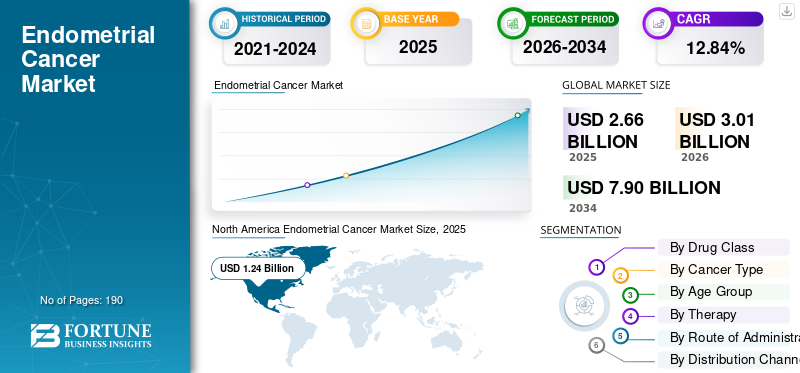
The global endometrial cancer market size was valued at USD 2.66 billion in 2025 and is projected to grow from USD 3.01 billion in 2026 to USD 7.90 billion by 2034, exhibiting a CAGR of 12.84% during the forecast period. North America dominated the endometrial cancer market with a market share of 46.61% in 2025.
The global market comprises therapies used for the treatment of early-stage, advanced, recurrent, and metastatic endometrial cancer. The market is gaining momentum as the number of diagnosed cases increases, biomarker testing becomes more common, and treatment decisions shift toward immunotherapy-based and targeted combinations. As healthcare systems focus on improving survival outcomes in gynecologic cancers, companies are strengthening their product portfolios through label expansions, clinical trial readouts, and regulatory approvals.
Major players, such as Merck & Co., Inc., Eisai Co., Ltd., GSK plc, and AstraZeneca PLC, are streamlining their resources toward research and development, expanding their pipelines, diversifying their offerings, and improving patient outcomes.
Download Free sample to learn more about this report.
 Global Market Size & Forecast
 Market Share
 Key Regional Highlights
Asia Pacific
Asia Pacific is projected to reach USD 0.53 billion by 2026, driven by improving oncology care.
North America
North America reached USD 1.24 billion in 2025, supported by advanced cancer treatment.
Europe
Europe is projected to reach USD 0.83 billion by 2026, driven by expanding immunotherapy adoption.
U.S.
U.S. is projected to reach USD 1.29 billion by 2026, fueled by strong oncology infrastructure.
Japan
Japan is projected to reach USD 0.13 billion by 2026, driven by rising cancer awareness.
Read More

Growing Pipeline Activity for Novel Immuno-Oncology and Targeted Agents Is an Emerging Trend Observed
A significant global trend in the market is a shift toward an innovation-led phase. As companies expand development beyond standard Chemotherapy and established checkpoint inhibitors, the trend is gaining momentum as patients with advanced, recurrent, or biomarker-defined disease still need better treatment options after first-line therapy. As a result, pharmaceutical companies are investing in novel immuno-oncology combinations, antibody-drug conjugates, and targeted agents that can improve response rates, extend disease control, and support more personalized treatment pathways. Key companies operating in the market are focusing on pipeline development to address this unmet clinical demand.
Download Free sample to learn more about this report.
Rising Incidence of Endometrial Cancer to Drive Market Growth
A key factor driving the global endometrial cancer market growth is the rising number of diagnosed patients across developed and emerging regions. This elevated rise in patient population is linked to aging populations, obesity, metabolic disorders, and better cancer detection. As the patient base grows, demand for innovative therapy options increases. This also encourages hospitals and cancer centers to strengthen gynecologic oncology services, improve access to molecular testing, and adopt newer treatment protocols. Additionally, higher recurrence rates in advanced disease continue to drive global market demand.
High Treatment Cost to Hamper Market Growth
The high cost of these advanced regimens remains a key restraint in the market. Treatments such as immune checkpoint inhibitors and targeted therapies often require repeated dosing, biomarker testing, monitoring, and adverse-event management, which increases the total cost of care. As a result, even when these therapies show meaningful survival benefits, their adoption can be slower in cost-sensitive healthcare systems, countries with limited reimbursement, and patient groups facing high out-of-pocket spending. This creates a gap between clinical innovation and real-world access, thereby limiting the market's full growth potential.
Expansion of Biomarker-Guided Treatment Approaches to Offer Several Growth Opportunities
The global market is creating strong growth opportunities as treatment decisions increasingly move toward biomarker-based patient selection. Advanced and recurrent endometrial cancer includes different molecular subgroups, since not all patients respond equally to standard Chemotherapy or immunotherapy alone. As a result, companies are developing targeted combinations for HER2-expressing, dMMR/MSI-H, and pMMR patient groups to improve response rates, extend survival, and expand treatment options within more defined patient populations. Such development supports the wider adoption of precision oncology in endometrial cancer care.
Inconsistent Clinical Benefit Across Earlier-Stage Treatment Settings Remains a Key Market Challenge
One of the major challenges faced by the market is the inconsistent clinical benefit of therapies when evaluated in broader or earlier-stage treatment settings. These factors create uncertainty for companies as failed or mixed trial outcomes can delay label expansion, reduce physician confidence in some treatment approaches, and slow investment in similar combinations. As a result, while the market continues to grow, companies must generate stronger evidence across different disease stages and patient subgroups before these therapies can be adopted more widely.
PD-1 Inhibitors Segment Dominated due to their Higher Treatment Value Compared With Conventional Generic Chemotherapy
Based on drug class, the market is categorized into PD-1 inhibitors, platinum compounds, taxanes, VEGFR/multikinase inhibitors, progestins, PD-L1 inhibitors, and others.
PD-1 inhibitors dominated the market as it plays a central role in the treatment of advanced and recurrent endometrial cancer, especially through the use of pembrolizumab and dostarlimab used in combination with Chemotherapy and as maintenance therapy. Additionally, their dominance is supported by broader approvals across mismatch repair subgroups, stronger survival evidence, and higher treatment value compared with conventional generic Chemotherapy.
The PD-L1 inhibitors segment is expected to grow at a CAGR of 19.39% over the forecast period.
To know how our report can help streamline your business, Speak to Analyst
Large Patient Pool of Endometrioid Adenocarcinoma Propelled the Growth in the Segment
Based on cancer type, the market is segmented into endometrioid adenocarcinoma, serous endometrial carcinoma, clear cell carcinoma, carcinosarcoma, and others.
In 2025, the endometrioid adenocarcinoma accounted for the largest share as it is the most common histological subtype of endometrial carcinoma and represents the largest diagnosed patient pool. Since this subtype accounts for the majority of cases, it generates higher treatment volume across surgery, Chemotherapy, hormonal therapy, immunotherapy, and recurrence management. This large patient pool creates a larger commercial base for drug utilization, leading to the Segment's dominance. Key companies are focusing on research and development, followed by subsequent approvals from regulatory bodies, further supporting the segment's growth.
The others segment is projected to grow at a CAGR of 15.03% during the forecast period.
Higher Systemic Therapy Use Boosted Adult Segment Growth
Based on age group, the market is segmented into pediatric and adults.
In 2025, the adults segment is likely to dominate the market as endometrial cancer mainly affects post-menopausal women, while pediatric cases are extremely rare. The adult segment has a much larger diagnosed population, higher systemic therapy use, and a greater need for long-term oncology management. As a result, most product approvals, clinical trials, reimbursement decisions, and treatment guidelines are focused on adult patients, which keeps this segment dominant throughout the forecast period.
The pediatric segment is projected to grow at a CAGR of 16.79% during the forecast period.
Use of Chemotherapy as A Standard Endometrial Cancer Treatment to Lead the Dominance of the Segment
Based on therapy, the market is segmented into chemotherapy, immunotherapy, targeted therapy, hormonal therapy, and others.
In 2025, chemotherapy dominated the market as platinum-taxane regimens remain widely used as the treatment backbone for advanced, recurrent, and high-risk endometrial cancer. Even when immunotherapy is added, carboplatin and paclitaxel continue to be used in many approved first-line regimens, which keeps chemotherapy volumes high. The segment’s high share is further supported by broad availability, physician familiarity, generic competition, regulatory approval, and use across multiple patient groups regardless of biomarker status.
The immunotherapy segment is projected to grow at a CAGR of 18.69% during the forecast period.
Shift Toward Immunotherapy Plus Chemotherapy Supported Parenteral Segment Growth
Based on route of administration, the market is segmented into oral and parenteral.
In 2025, the parenteral segment held the largest endometrial cancer market share. Many core therapies for endometrial cancer are given by intravenous infusion. This route is preferred for hospital-based oncology treatment as it enables controlled dosing, infusion monitoring, and management of adverse events during systemic therapy. As a result, the shift toward immunotherapy plus chemotherapy further strengthens the parenteral segment. New product launches in the segment align with the trend.
The oral segment is projected to grow at a CAGR of 13.83% during the forecast period.
Strategic Collaboration with Hospitals to Expand Access to Lead Hospital Pharmacies Segment Growth
Based on distribution channel, the market is segmented into hospital pharmacies, drug stores & retail pharmacies, online pharmacies, and specialty pharmacies.
The hospital pharmacies segment is poised to dominate the market as endometrial cancer treatment is highly specialist-driven and often involves infusion-based therapies, oncology supervision, biomarker review, and toxicity monitoring. Advanced and recurrent cases usually require treatment in hospitals or cancer centers where chemotherapy and immunotherapy products can be prepared, administered, and monitored safely. As a result, hospital pharmacies capture a larger share of high-value injectable oncology medicines. Underscoring this importance, key market players focus on strategic collaborations to expand access.
The online pharmacies segment is projected to grow at a CAGR of 16.92% over the study period.
By geography, the market is categorized into Europe, North America, Asia Pacific, Latin America, and the Middle East & Africa.
North America Endometrial Cancer Market Size, 2025 (USD Billion)
To get more information on the regional analysis of this market, Download Free sample
North America held the dominant share in 2024 at USD 1.11 billion and maintained its leading position in 2025 at USD 1.24 billion. The market is growing in the region due to high disease diagnosis, strong oncology infrastructure, and faster adoption of immunotherapy-based combinations. Broad access to biomarker testing and favorable reimbursement support the use of premium therapies.
Given North America's substantial contribution and the U.S. dominance in the region, the U.S. market is poised to reach around USD 1.29 billion by 2026, accounting for roughly 43.00% of the global sales.
Europe is projected to grow at 12.49% over the coming years, the second-highest among all regions. The market is expected to reach a valuation of USD 0.83 billion by 2026. Growth across the region is supported by expanding regulatory approvals, national cancer programs, and wider use of guideline-based treatment. Increasing access to PD-1 inhibitors and chemotherapy-immunotherapy combinations is improving treatment adoption.
The U.K. market is poised to reach around USD 0.14 billion in 2026, representing roughly 4.51% of the global sales.
Germany's market is projected to reach approximately USD 0.16 billion by 2026, equivalent to around 5.36% of the global sales.
Asia Pacific is estimated to reach USD 0.53 billion by 2026, securing the position of the third-largest region in the market. The market is growing in the region due to a large patient pool, rising cancer awareness, and improving access to oncology care.
The Japanese market is poised to reach around USD 0.13 billion by 2026, accounting for approximately 4.19% of the global sales.
China's market is projected to be among the largest worldwide, with 2026 revenue estimates around USD 0.22 billion, accounting for approximately 7.32% of global sales.
The Indian market is expected to reach around USD 0.05 billion by 2026, accounting for roughly 1.58% of global revenues.
The Latin America and Middle East & Africa regions are expected to witness moderate growth in the market during the forecast period. The market in Latin America is estimated to reach a valuation of USD 0.15 billion by 2026. Growth in Latin America is supported by improved cancer screening, greater specialist access, and the gradual adoption of advanced oncology medicines. Public and private healthcare systems are expanding access to cancer treatment in major markets such as Brazil and Mexico. This creates opportunities for broader use of endometrial cancer therapies. In the Middle East & Africa, the GCC is set to reach USD 0.04 billion by 2026.
The South African market is projected to reach approximately USD 0.02 billion by 2026, accounting for roughly 0.56% of global revenues.
Key Players Focus on Biomarker-Based Treatment Development to Strengthen their Market Progress
The global market is moderately consolidated, with companies such as Merck & Co., Inc., GSK plc, Eisai Co., Ltd., AstraZeneca PLC, Daiichi Sankyo Company, Limited, Pfizer Inc., Fresenius Kabi AG, Hikma Pharmaceuticals PLC, Teva Pharmaceutical Industries Ltd., and Accord Healthcare Limited accounting for a significant share. Ongoing product approvals, label expansions, clinical trial advancements, and biomarker-based treatment development are further helping these companies strengthen their market positions and improve their revenue share in the sector.
Other notable participants in the global market include Sandoz Group AG, Viatris Inc., Bristol Myers Squibb Company, Cipla Limited, Karyopharm Therapeutics Inc., and Acrivon Therapeutics, Inc. These companies are expected to focus on generic oncology supply, biomarker-led clinical trials, and hospital-based oncology distribution to strengthen their market positions. The rest of the market remains fragmented among regional manufacturers, specialty oncology companies, and injectable generic suppliers serving high-volume chemotherapy and supportive cancer treatment segments.
The report provides a comprehensive global endometrial cancer market analysis. It covers detailed market analysis across drug class, cancer type, age group, therapy, route of administration, and distribution channel. It examines the demand for therapies used in endometrioid adenocarcinoma, serous endometrial carcinoma, clear cell carcinoma, carcinosarcoma, and other endometrial cancer types, while also assessing the role of PD-1 inhibitors, platinum compounds, taxanes, VEGFR/multikinase inhibitors, progestins, PD-L1 inhibitors, and other drug classes in current treatment practice. The study further provides regional insights across key geographies, competitive landscape analysis, company profiling, recent developments, and evaluation of the major factors driving, restraining, and shaping future opportunities in the market.
Request for Customization to gain extensive market insights.
| ATTRIBUTE | DETAILS |
| Study Period | 2021-2034 |
| Base Year | 2025 |
| Estimated Year | 2026 |
| Forecast Period | 2026-2034 |
| Historical Period | 2021-2024 |
| Growth Rate | CAGR of 12.84% from 2026 to 2034 |
| Unit | Value (USD Billion) |
| Segmentation | By Drug Class, Cancer Type, Age Group, Therapy, Route of Administration, Distribution Channel, and Region |
| By Drug Class |
|
| By Cancer Type |
|
| By Age Group |
|
| By Therapy |
|
| By Route of Administration |
|
| By Distribution Channel |
|
| By Region |
|
According to Fortune Business Insights, the global market value stood at USD 2.66 billion in 2025 and is projected to reach USD 7.90 billion by 2034.
In 2025, the market value stood at USD 1.24 billion.
The market is expected to grow at a CAGR of 12.84% over the forecast period.
By drug class, the PD-1 inhibitors segment led the market.
The rising incidence of endometrial cancer globally is the key factor driving market growth.
Merck & Co., Inc., Eisai Co., Ltd., GSK plc, and AstraZeneca PLC are among the major players in the global market.
North America dominated the market.

Get 30-60 hrs Free Customization
Expand Regional and Country Coverage, Segments Analysis, Company Profiles, Competitive Benchmarking, and End-user Insights.













.webp)






Related Reports
Get In Touch With Us
US +1 833 909 2966 ( Toll Free )
Receive a tailored pricing based on your needs.
Discuss your questions with our industry experts.
Have questions? Get quick answers before you purchase.

