Endonucleases Market Size, Share & Industry Analysis, By Type (Specific Endonucleases {Restriction Enzymes, CRISPR-Cas Nucleases, and Others} and Non-specific Endonucleases {DNases, RNases, and Others}), By Application (Genomics & Genetic Engineering, Drug Discovery & Research, Molecular Biology, and Others), By Source (Prokaryotic, Eukaryotic, and Others), By End User (Pharmaceutical and Biotechnology Companies, Academic & Research Institutes, and Others), and Regional Forecast, 2026-2034
 Download Free Sample
KEY MARKET INSIGHTS
 Listen to Audio Version
The global endonucleases market size was valued at USD 193.43 million in 2025 and is projected to grow from USD 209.34 million in 2026 to USD 407.15 million by 2034, exhibiting a CAGR of 8.67% during the forecast period. North America dominated the global endonucleases market with a market share of 46.87% in 2025.
Endonucleases are a broad category of enzymes that are essential in DNA manipulation. These enzymes act similar to molecular scissors for the cutting of DNA at internal sites (within the strand) unlike exonucleases that cut DNA from the ends. These enzymes are widely used in genetic engineering, recombinant DNA technology, and other areas. The market is witnessing an upward growth trajectory owing to increasing genomic research, development of personalized medicine, and higher funding for research & development.
Furthermore, the key players in the market include Takara Bio Inc., Thermo Fisher Scientific, Inc., and New England Biolabs. These players focus on expanding their geographic presence, product portfolio, and focus on innovative product launches to maintain their market positions.
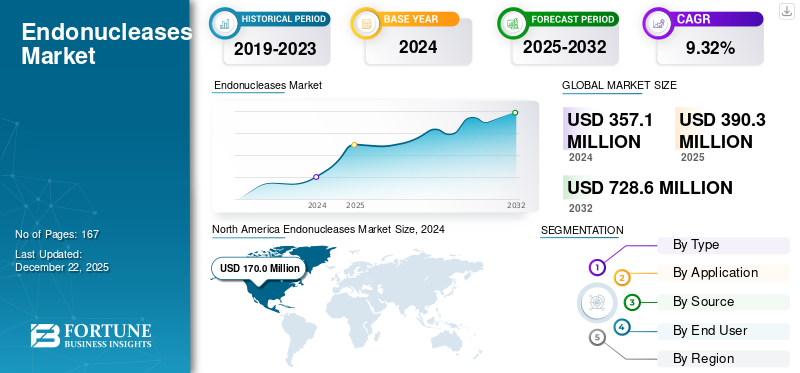
Download Free sample to learn more about this report.
Endonucleases Market Key Takeaways
 Market Size & Forecast
- 2025 Market Size: USD 193.43 million
- 2026 Market Size: USD 209.34 million
- 2034 Forecast Market Size: USD 407.15 million
- CAGR: 8.67% from 2026–2034
 Market Share
- North America dominated the endonucleases market with a 46.87% share in 2025.
- The Specific Endonucleases segment accounted for the largest market share in 2024.
- The Prokaryotic segment held the dominant market position in 2024.
 Key Regional Highlights
Asia Pacific
Asia Pacific accounted for USD 35.62 million in 2025 and is projected to reach USD 39.18 million in 2026.
North America
North America reached USD 90.67 million in 2025 and is projected to grow to USD 97.48 million in 2026.
Europe
Europe generated USD 53.3 million in 2025 and is expected to reach USD 57.94 million in 2026.
U.S.
The market is valued at USD 34.53 billion by 2026.
Japan
The market is valued at USD 11.89 billion by 2026.
Read More

MARKET DYNAMICS
MARKET DRIVERS
Technological Innovations Leading to Increased Research Activities to Boost the Market Growth
The most prominent driver for the market are the innovations in the gene-editing technologies. The advancements in CRISPR-Cas systems have significantly boosted the demand for endonucleases. These systems along with high -fidelity variants improve accuracy & precision and also reduce off-target effects, making them essential for therapeutic and research applications. Owing to this, research activities using endonucleases are significantly increasing leading to the overall market growth.
- For instance, according to an article published in CRISPR Medicine News in February 2025, more than 150 trials currently active that involve gene-editing therapeutic candidates.
MARKET RESTRAINTS
Regulatory Barriers & Ethical Concerns to Limit Market Expansion
Regulatory and ethical barriers significantly limit the endonucleases market growth. This due to safety and moral concerns associated with genome-editing technologies. The use of CRISPR in human genome editing has raised concerns leading to stricter regulations and lengthy approval timelines. The confluence of all these factors result in delayed commercialization of products, in turn hampering the market growth.
- For example, the “CRISPR babies” incident in China has raised concerns about the ethical use of enzymes and technologies.
MARKET OPPORTUNITIES
Focus on Precision Genomics and Personalized Medicine to Create Lucrative Growth Opportunities
In the recent years, the demand for personalized medicine is rapidly increasing; creating strong growth opportunities for endonucleases. These enzymes play an important role in precision genomics by enabling targeted modifications at the DNA level. This shift is further driven by collaborations between genomic research firms and pharmaceutical companies, which expand the application of endonucleases in clinical pipelines. This results in making personalized genomics one of the most lucrative growth avenues.
- For instance, CRISPR Therapeutics is developing CTX112: Anti-CD19 allogeneic CAR T to treat CD19+ malignancies and autoimmune diseases. This candidate is CRISPR/Cas9 gene-edited.
ENDONUCLEASES MARKET TRENDS
Shift towards CRISPR-based Diagnostics is Amongst Important Endonucleases Market Trends
The field of diagnostics is undergoing a significant shift towards CRISPR-based technologies, particularly for infectious disease detection and other applications. This shift is driven by CRISPR's advantages in terms of sensitivity, specificity, speed, and cost-effectiveness, compared to traditional methods such as PCR. Additionally, CRISPR systems can detect specific nucleic acid sequences with high accuracy, often comparable to or even exceeding traditional methods like PCR. This is anticipated to boost the growth of the market during the forecast period.
- For instance, DETECTR (DNA endonuclease-targeted CRISPR trans reporter) is a CRISPR-based technology that uses Cas12 for detecting DNA and R targets.
Download Free sample to learn more about this report.
MARKET CHALLENGES
Technical Limitations to Restrict Opportunities for Market Growth
Technological limitations is considered to be one of the significant factors challenging the market growth. For the accurate results, the efficient delivery of these enzymes into target cells/tissues is essential. Inefficient delivery due to technical issues reduces efficacy in therapeutic applications. Additionally, off-target effects of some specific endonucleases may result in unintended cuts at off-target sites which leads to genomic instability.
- For instance, viral vectors such as lentivirus, AAV have size limitations which limits the delivery of larger nucleases like Cas9.
Segmentation Analysis
By Type
High Demand for Specific Endonucleases Supplemented the Segmental Growth
On the basis of type, the market is segmented into specific endonucleases and non-specific endonucleases. Specific endonucleases is further divided into restriction enzymes, CRISPR-Cas nucleases, and others and non-specific endonucleases are categorized into DNases, RNases, and others.
The specific segment accounted for the significant endonucleases market share in 2024. Growing demand for these products for precision in molecular biology & genomics, expanding applications in diagnostics, and advances in gene editing technologies such as CRISPR have primarily driven the segment growth.
- For instance, Cas9 GMP-grade nucleases are considered as standard inputs for cell & gene therapy manufacturing.
By Application
Increasing Focus on Genomics Research Fuels Growth of Genomics & Genetic Engineering Segment
In terms of application, the market is categorized into genomics & genetic engineering, molecular biology, drug discovery & research, and others.
In 2024, the genomics & genetic engineering segment dominated the market with largest share. The dominance of the segment can be attributed to several factors including increasing adoption of CRISPR and other programmable nucleases, wide applications in academic research, and rising number of approvals for cell and gene therapies.
- For instance, according to the data published by the American Society of Cell & Gene Therapies in April 2024, the number of gene, cell, and RNA therapies in development has exceeded 4,000.
Drug discovery & research segment is anticipated to grow at a strong growth rate over the forecast period.
By Source
Widespread Usage of Prokaryotic Endonucleases Supplemented Its Segment Growth
Based on source, the market is segmented into prokaryotic, eukaryotic, and others.
The prokaryotic segment held the dominating market position in 2024. Wide applications of prokaryotic-derived endonucleases, rising usage in synthetic biology, and expanding research using these products are some of the factors responsible for the segmental growth.
- For instance, Thermo Fisher Scientific Inc. is a one of the leading entities in the market that offers a wide variety of prokaryotic endonucleases.
By End User
Focus on Gene-based Research Initiatives by Pharmaceutical & Biotechnology Companies to Augment Segment’s Dominance
In terms on end-user, the market is segmented into academic & research institutes, pharmaceutical and biotechnology companies, and others.
In 2024, pharmaceutical and biotechnological companies dominated the global market in terms of end-user. Increasing demand of these products for gene editing for therapeutic development, biologics drug discovery & optimization, and rising usage of endonucleases in cell and gene therapy have fueled the segment growth.
- For instance, Intellia Therapeutics and CRISPR Therapeutics are involved in development of innovative therapeutics with Cas9 nucleases as a core element of their clinical pipelines.
In addition, academic & research institutes end users are estimated to witness a steady CAGR during the forecast period.
Endonucleases Market Regional Outlook
In terms of regions, the market is segmented into North America, Europe, Asia Pacific, Latin America, and Middle East & Africa.
North America
North America Endonucleases Market Size, 2025 (USD Million)
To get more information on the regional analysis of this market, Download Free sample
North America recorded a market size of USD 90.67 Million in 2025, capturing 46.87% of the global market share, and is projected to reach USD 97.48 Million in 2026. Strong biotechnology infrastructure, high influx of research funding for advanced research, and increasing adoption of tools for molecular biology in the region are some of the factors fostering the region’s dominance. The U.S. market is valued at USD 34.53 billion by 2026.
- For instance, in January 2023, Agilent Technologies, Inc. invested approximately USD 725.0 million to double the manufacturing capacity of therapeutic nucleic acids in Colorado.
Europe
On the other hand, In 2025, Europe represented USD 53.3 million, accounting for 27.56% of the worldwide market, and is projected to grow to USD 57.94 Million in 2026. This is led by innovation clusters and genomic medicine adoption. The U.K. market is valued at USD 6.54 billion by 2026, while the Germany market is valued at USD 8.9 billion by 2026.
Asia Pacific
In terms of market share, the Asia Pacific market captures the third-largest position in the global market. The Asia Pacific market generated USD 35.62 Million in 2025, representing 18.41% of the global market landscape, and is expected to reach USD 39.18 Million in 2026. In the region, some of the key countries include India and China, and they are estimated to reach considerable market value in 2025. The Japan market is valued at USD 11.89 billion by 2026, while the China market is valued at USD 11.17 billion by 2026 and the India market is valued at USD 10.47 billion by 2026.
Latin America and Middle East & Africa
The markets in Latin America and Middle East & Africa regions are anticipated to witness a moderate growth over the forecast period. Middle East & Africa accounted for USD 5.2 Million in 2025, representing 2.69% of the global market share, and is projected to reach USD 5.52 Million in 2026.. Rapidly expanding biotechnology research coupled with increasing investments in genomics research in these regions drives the regional market growth.
In 2025, Latin America held 4.47% of the global market, reaching a valuation of USD 8.65 Million, and is projected to grow to USD 9.22 Million in 2026.
COMPETITIVE LANDSCAPE
Key Industry Players
Exclusive Distribution Network of Key Companies Maintained their Leading Position
The global endonucleases market represents a semi-fragmented structure with a mix of global leaders and numerous small-to-mid-sized biotechnology companies. Market leaders such as New England Biolabs, Takara Bio Inc., and Thermo Fisher Scientific Inc. leverage their extensive distribution networks, broad enzyme portfolios, and strong academic & industrial partnerships to maintain their market dominance. Additionally, the availability of end-to-end solutions and strong focus on high-fidelity engineered nucleases by these companies further support their leading position.
On the other hand, other prominent and emerging companies focus on gaining market share through offering specialized endonucleases, CRISPR-related innovations, and region-specific penetration. These players are also emphasizing R&D investments and partnerships with diagnostic companies with the aim to expand applications of endonucleases.
LIST OF KEY ENDONUCLEASES COMPANIES PROFILED
- Takara Bio Inc. (Japan)
- Thermo Fisher Scientific Inc. (U.S.)
- New England Biolabs (U.S.)
- Promega Corporation (U.S.)
- QIAGEN (Germany)
- Agilent Technologies Inc. (U.S.)
- Merck KGaA (Germany)
- F. Hoffmann-La Roche Ltd (Switzerland)
KEY INDUSTRY DEVELOPMENTS
- July 2025: New England Biolabs launched Monarch DNase I, in lyophilized formulation. The product can be used to remove contaminating genomic DNA from RNA samples.
- May 2025: Biomay AG introduced its FDA grade CRISPR/Cas9 nuclease product. This is now commercially available for genome-editing applications.
- October 2021: Krishgen Biosystems announced the launch of Endonuclease S.marcescens ELISA. This is used for quantitative determination of endonuclease in samples.
- January 2023: Aldevron LLC. launched Eureca-V Nuclease for diagnostic, therapeutic, and agricultural workflows.
- January 2020: ERS Genomics Limited and New England Biolabs signed an agreement for the commercialization of CRISPR gene editing tools and reagents.
REPORT COVERAGE
The global endonucleases market analysis provides an in-depth study of market size & forecast by all the market segments included in the report. It includes details on the market trends expected to drive the market in the forecast period along with the current market dynamics. It offers information on the technological advancements, new product launches, key industry developments, and details on partnerships, mergers & acquisitions. The market research report also encompasses detailed competitive analysis with profiles of key operating players and information on the company market share.
Request for Customization to gain extensive market insights.
Report Scope & Segmentation
|
ATTRIBUTE |
DETAILS |
|
Study Period |
2021-2034 |
|
Base Year |
2025 |
|
Estimated Year |
2026 |
|
Forecast Period |
2026-2034 |
|
Historical Period |
2021-2024 |
|
Unit |
Value (USD Billion) |
|
Growth Rate |
CAGR of 8.67% from 2026 to 2034 |
|
Segmentation |
By Type
|
|
By Application
|
|
|
By Source
|
|
|
By End User
|
|
|
By Geography
|
Frequently Asked Questions
Fortune Business Insights says that the global market value stood at USD 209.34 million in 2026 and is projected to reach USD 407.15 million by 2034.
In 2025, the market value stood at USD 90.67 million.
The market is expected to exhibit a CAGR of 8.67% during the forecast period.
The specific segment led the market by type.
The key factors driving the market include growing demand for endonucleases in DNA manipulation workflows, focus on development of precision medicine, and others.
New England Biolabs, Thermo Fisher Scientific Inc., Promega Corporation, and Takara Bio Inc., are some of the prominent players in the market.
North America dominated the market in 2025.
Increase in demand from research community for therapeutic development coupled in advances in gene-based research are driving the product adoption.



- 2021-2034
- 2025
- 2021-2024
- 167
Get 30-60 hrs Free Customization
Expand Regional and Country Coverage, Segments Analysis, Company Profiles, Competitive Benchmarking, and End-user Insights.













.webp)






Related Reports
-
US +1 833 909 2966 ( Toll Free )
-
Get In Touch With Us