 Download Free Sample



Get a Quote
Receive a tailored pricing based on your needs.
- Choose license type
- Multiple user options
- Custom scope & coverage
- Fast turnaround
"Designing Growth Strategies is in our DNA"
 Listen to Audio Version
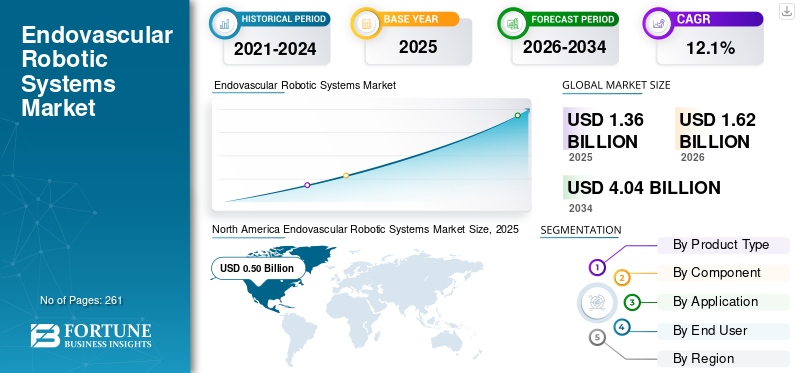
The global endovascular robotic systems market size was valued at USD 1.36 billion in 2025 and is projected to grow from USD 1.62 billion in 2026 to USD 4.04 billion by 2034, exhibiting a CAGR of 12.1% during the forecast period. North America dominated the endovascular robotic systems market with a market share of 36.76% in 2025.
Endovascular robotic systems are computer-assisted, remotely operated technology that is used in minimally invasive vascular procedures to enhance stability, precision, and reduce radiation exposure among the patient population. The increasing prevalence of cardiovascular conditions, growing surgical procedure volumes, and integration of hybrid operating rooms are resulting in a rising adoption rate of these systems in the market. The growing aging population is further increasing the prevalence of disorders, resulting in an increase in minimally invasive surgical procedures among patients, thereby fueling the adoption rate of endovascular robotic systems in the market.
Additionally, the growing technological advancements in these systems among the prominent players, such as Siemens Healthineers AG and Microbot Medical Inc., among others, are further contributing to the demand for these devices in the market.
Download Free sample to learn more about this report.
 Global Market Size & Forecast
 Market Share
 Key Regional Highlights
North America
Reached USD 0.50 billion and led the market in 2025.
Europe
The market is projected to reach USD 0.47 billion by 2026, growing at a 10.9% CAGR.
Asia Pacific
The market is projected to reach USD 0.41 billion by 2026, ranking as the third-largest region.
U.S
The market is projected to reach USD 0.53 billion by 2026.
Japan
The market is projected to reach USD 0.09 billion by 2026.
Read More

Rising Technological Advancements in these Products to Fuel the Market Development
A prominent trend is the shift from first-generation robotic assistance to next-generation systems developed for smooth deployment, smaller footprints, and improved patient outcomes. Additionally, manufacturers are focusing on ecosystem strategic initiatives, including integration of robotics with imaging, navigation, and potentially dedicated systems.
Additionally, growing partnerships among imaging devices companies with players dedicated to robotics systems are further expanding indications of these products, thereby fueling the adoption rate for these products in the market.
Download Free sample to learn more about this report.
Growing Volume of Invasive Surgical Procedures to Fuel the Market Growth
The growing prevalence of chronic conditions such as cardiovascular disorders and others is resulting in an increasing number of minimally invasive surgical procedures among the patient population, subsequently boosting the demand for endovascular robotic systems in the market.
This, along with increasing focus of health facilities on scaling complex interventions, further increases the adoption rate for robotics systems supporting higher throughput and reproducibility. Therefore, the factors above, along with the rising focus of prominent players on introducing R&D activities to launch novel devices, are anticipated to fuel the adoption rate of these systems, thereby supporting the global endovascular robotic systems market size.
High Cost Associated with Advanced Devices to Hamper the Market Growth
There is a growing adoption of robotic systems for minimally invasive surgical procedures among the patient population. However, the high cost associated with advanced robotic systems hampers the adoption rate for these products, particularly in developing countries, including Brazil, Mexico, and others.
Moreover, the hospitals may justify these investments through higher procedure volumes; however, many mid-tier centers face challenges owing to the high cost of robotics systems. The additional cost, including the cost associated with staff training, installation/integration, annual service coverage, and procedure-linked consumables, further increases the financial burden, thereby limiting the growth of the market globally.
Growing Expansion of Healthcare Networks in Emerging Nations to Create Market Opportunities
There is a growing expansion of healthcare networks in emerging nations, including India, Mexico, and others. The increasing number of surgeries, expansion of hospital infrastructure, growing number of hospitals, and catheterization laboratories are subsequently boosting the adoption of endovascular robotic systems in clinical settings.
Additionally, the increasing preference for minimally invasive surgical procedures due to their benefits, such as shorter patient stays, faster turnover times, and others, is fueling the focus of healthcare settings towards adopting next-generation robotic systems in healthcare facilities.
Limited Healthcare Access in Developing Nations to Stifle the Market Growth
There is a growing demand for minimally invasive surgeries among the patient population. However, shortage of technologically advanced products, limited healthcare expenditure, coupled with an inadequate reimbursement framework, especially in emerging nations, are resulting in limited access to healthcare facilities among the patient population.
Furthermore, a limited number of clinical facilities and limited professionals, among others, are some of the prominent factors, resulting in the delayed minimally invasive surgical procedures among the patient population, particularly in emerging countries, including Mexico, Brazil, among others.
Increasing Number of Surgical Procedures Led to the Dominance of the Electromechanical Manipulation Systems
Based on the product type, the market is classified into electromechanical manipulation systems, magnetic navigation systems, and others.
To know how our report can help streamline your business, Speak to Analyst
The electromechanical manipulation systems segment held the largest revenue share in 2025. The growth is owing to the growing prevalence of chronic conditions among patients, resulting in a rising number of minimally invasive surgical procedures globally. This, along with the increasing focus of prominent companies on launching innovative products, is further anticipated to contribute to the global endovascular robotic systems market growth.
The magnetic navigation systems segment is expected to grow at a CAGR of 12.2% over the forecast period.
Increasing Benefits of Interventional Console Led to the Dominance of the Segment
Based on component, the market is segmented into imaging integration system, robotic catheters/ guide sheaths, interventional console, and others.
The interventional console segment dominated the global market share by 38.3% in 2025. The growth is owing to the growing benefits of interventional consoles, such as enhance procedural accuracy, improved stability in catheter manipulation, reduced radiation exposure, improved clinical outcomes, and others, resulting in a growing demand for these interventional consoles, thereby supporting the penetration rate of these products in the market.
The robotic catheters/ guide sheaths segment is set to flourish with a CAGR of 13.0% over the forecast period.
Increasing Prevalence of Chronic Conditions Led to the Dominance of the Percutaneous Coronary Intervention (PCI) Segment
Based on application, the market is segmented into embolization & interventional oncology, percutaneous coronary intervention (PCI), peripheral vascular intervention (PVI), and others.
The percutaneous coronary intervention (PCI) segment dominated the global market share of 45.6% in 2025. The growth is owing to the increasing prevalence of chronic conditions, such as cardiovascular diseases, among others, resulting in a growing number of these procedures globally, thereby supporting the adoption rate of these devices in the market.
The embolization & interventional oncology segment is set to flourish with a growth rate of 17.7% across the forecast period.
Rising Number of Surgical Procedures Led to the Hospitals Segmental Dominance
Based on end user, the market is classified into hospitals, specialty clinics, and others.
The hospitals segment dominated the market in 2025. The growing prevalence of chronic diseases, increasing number of surgical procedures, and rising number of hospitals, among others, are some of the prominent factors supporting the growth of the segment. Furthermore, the segment is set to hold a 77.3% share in 2026.
In addition, the specialty clinics’ segment is projected to grow at a 13.1% CAGR during the forecast period.
Based on region, the market has been studied across North America, Europe, Asia Pacific, Latin America, and the Middle East & Africa.
North America Endovascular Robotic Systems Market Size, 2025 (USD Billion)
To get more information on the regional analysis of this market, Download Free sample
The North America market held the dominant share in 2024, valued at USD 0.41 billion, and also led the market share in 2025 with USD 0.50 billion. The rising prevalence of chronic diseases, a high number of minimally invasive surgeries, advanced hospital infrastructure, favorable reimbursement policies, and a growing number of procedures such as peripheral vascular interventions, among others, are some of the vital factors contributing to the growth of the segment in the market.
Based on North America’s strong contribution and the U.S. dominance within the region, the U.S. market is expected to hit USD 0.53 billion in 2026, accounting for roughly 32.4% of global sales.
Europe is projected to record a growth rate of 10.9% during the forecast period, which is the second highest among all regions, and to reach a valuation of USD 0.47 billion by 2026. The growing number of minimally invasive procedures and advanced medical technologies in these products is likely to support the market growth.
The U.K. market in 2026 is to be estimated at USD 0.47 billion, representing roughly 4.0% of global revenues.
Germany’s market is projected to reach approximately USD 0.10 billion in 2026, equivalent to around 5.9% of global sales.
Asia Pacific is estimated to reach USD 0.41 billion in 2026 and secure the position of the third-largest region in the market. The prevalence of coronary artery disease, the fastest growth in surgical procedures volume, expanding hospital infrastructure, and rising healthcare access are anticipated to support the development of the market. In the region, India and China are both estimated to reach USD 0.05 billion and USD 0.13 billion, respectively, in 2026.
The Japan market in 2026 is estimated to hit USD 0.09 billion, accounting for roughly 5.4% of global revenues. Japan has historically reported a relatively increasing prevalence of chronic diseases, with a growing number of surgical procedure volumes.
China’s market is projected to be one of the largest globally, with 2026 revenues estimated at around USD 0.13 billion, representing roughly 8.3% of global sales.
The Indian market size in 2026 is estimated at around USD 0.05 billion, accounting for roughly 3.3% of global revenues.
The Latin America and Middle East & Africa regions are expected to witness moderate growth in the market during the forecast period. The Latin America market is set to reach a valuation of USD 0.09 billion in 2026. The growth is due to the increasing number of surgical procedures in these regions. In the Middle East & Africa, the GCC is set to reach a value of USD 0.03 billion in 2026.
The South African market is projected to reach around USD 0.03 billion in 2026, representing roughly 0.7% of global revenues.
Robust and Diversified Product Portfolio Contributes to the Dominance of the Industry Players
A robust and diversified product portfolio, along with a significant emphasis on inorganic growth strategies globally, is one of the vital factors contributing to the dominance of these companies in the market. Siemens Healthineers AG, and Microbot Medical Inc., are major companies in the market in 2025. Moreover, the growing focus of key players on attending conferences and strategic partnerships is expected to strengthen their presence, further supporting the global endovascular robotic systems market share.
Other key players, including Robocath, Inc., and others, are also growing in the market, primarily due to their increasing focus on presenting their clinical studies results, and mergers and acquisitions are expected to strengthen their presence in the market.
The report provides a detailed global endovascular robotic systems market analysis and focuses on key aspects such as leading companies and market segmentation, including product type, component, application, and end user. Besides this, the global report offers insights into the market growth trends and highlights key industry developments. In addition to the aforementioned factors, the report encompasses several factors that have contributed to the growth and advancement of the market over recent years.
Request for Customization to gain extensive market insights.
| ATTRIBUTE | DETAILS |
| Study Period | 2021-2034 |
| Base Year | 2025 |
| Estimated Year | 2026 |
| Forecast Period | 2026-2034 |
| Historical Period | 2021-2024 |
| Growth Rate | CAGR of 12.1% from 2026-2034 |
| Unit | Value (USD Billion) |
| Segmentation | By Product Type, Component, Application, End User, and Region |
| By Product Type |
|
| By Component |
|
| By Application |
|
| By End User |
|
| By Region |
|
Fortune Business Insights says that the global market size was USD 1.36 billion in 2025 and is projected to reach USD 4.04 billion by 2034.
In 2025, the North America regional market value stood at USD 0.50 billion.
Growing at a CAGR of 12.1%, the market will exhibit steady growth over the forecast period.
By product type, the electromechanical manipulation systems segment is the leading segment in this market.
The introduction of novel endovascular robotic systems is one of the major factors driving the markets growth.
Siemens Healthineers AG and Microbot Medical, Inc., are the major players in the global market.
North America dominated the market share in 2025.
The growing prevalence of chronic disorders, the increasing number of surgical procedures, among others, are some of the prominent factors expected to boost the adoption of these products worldwide.

Get 30-60 hrs Free Customization
Expand Regional and Country Coverage, Segments Analysis, Company Profiles, Competitive Benchmarking, and End-user Insights.













.webp)






Related Reports
Get In Touch With Us
US +1 833 909 2966 ( Toll Free )
Receive a tailored pricing based on your needs.
Discuss your questions with our industry experts.
Have questions? Get quick answers before you purchase.

