Enhanced Vision System Market Size, Share & Industry Analysis, By System Type (Enhanced Vision System, Flight Vision System, and Combined Vision System), By Technology (Infrared Imaging, Synthetic Vision System, and Millimeter-Wave Radar), By Component (Sensors/Camera Units, Display Systems, and Vision Processing Units), By Display Systems (Head-Up, Head-Down, and Helmet-Mounted Display), By Platform (Fixed-Wing, Rotary-Wing, and Unmanned Aerial Vehicles), By Sales Channel (OEM and Aftermarket), By End User (Military & Defense and Commercial Airlines), and Regional Forecast, 2026-2034
 Download Free Sample
Enhanced Vision System Market Size and Future Outlook
 Listen to Audio Version
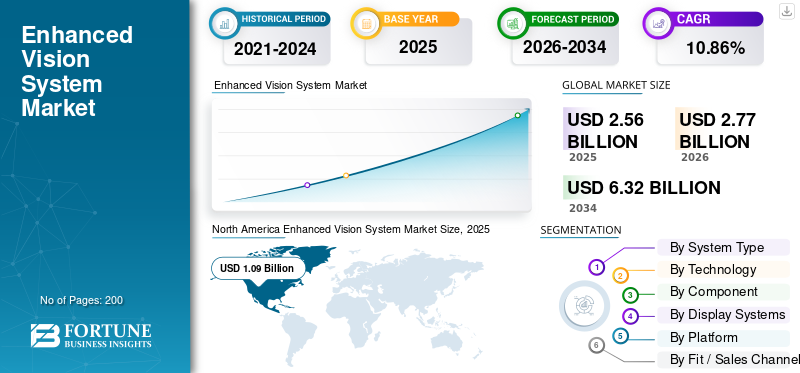
The global enhanced vision system market size was valued at USD 2.56 billion in 2025 and is projected to grow from USD 2.77 billion in 2026 to USD 6.32 billion by 2034, exhibiting a CAGR of 10.86% during the forecast period. North America dominated the enhanced vision system market with a market share of 42.58% in 2025.
The global market covers sensor-based cockpit technologies that provide pilots with a real-time view of terrain, runways, obstacles, and external conditions through infrared, low-light, multispectral cameras, head-up displays, or wearable displays. Demand is driven by improved flight safety, reduced pilot workload, reliable operations during darkness and degraded visibility, and regulatory provisions allowing qualified EFVS-equipped aircraft to operate at lower approach minima.
Major market participants include RTX Corporation’s Collins Aerospace, Elbit Systems Ltd. and its Universal Avionics subsidiary, Honeywell Aerospace, Astronics Corporation, and Thales Group. These companies provide EVS cameras, combined-vision systems, synthetic vision system and software, head-up guidance systems, helmet-mounted or wearable displays, and integrated flight-deck imaging solutions for commercial aircraft, business jets, helicopters, and military platforms.
Download Free sample to learn more about this report.
Enhanced Vision System Market KEY TAKEAWAYS
 Global Market Size & Forecast
- 2025 Market Size: USD 2.56 billion
- 2026 Market Size: USD 2.77 billion
- 2034 Forecast Market Size: USD 6.32 billion
- CAGR: 10.86% from 2026–2034
 Market Share
- North America dominated the enhanced vision system market with a 42.58% share in 2025.
- External vision system is projected to grow at the highest CAGR of 13.12% during the forecast period.
- AI/ML-based image enhancement & object detection is projected to grow at the highest CAGR of 15.21%.
 Key Regional Highlights
North America
North America led the market with a value of USD 1.09 billion in 2025.
Asia Pacific
Asia Pacific ranked second with a market value of USD 0.50 billion in 2025.
Europe
Europe is projected to record the highest regional CAGR of 12.27% during the forecast period.
U.S.
U.S. The market reached USD 1.00 billion in 2025 and is projected to grow at a 9.67% CAGR.
Japan
Japan The market was valued at USD 0.08 billion in 2025 and is projected to grow at a 10.62% CAGR.
Read More

Enhanced Vision System Market Trends
Shift Toward Multispectral, Combined, and Wearable Vision Systems from Standalone Infrared Cameras is a Key Market Trend
The technology direction is moving from a single thermal image displayed on a cockpit screen toward a fused visual environment. New systems combine visible-light, short-wave infrared, long-wave infrared, synthetic terrain, navigation data, runway information, and flight-guidance symbology in one conformal view. Collins Aerospace uses a tri-band sensor approach, Bombardier combines synthetic and enhanced imagery, Elbit Systems offers multi-sensor imagery through conventional HUDs and SkyLens wearable displays, and Dassault uses dual HUDs with FalconEye. This approach improves performance as no single sensor band works equally well across darkness, fog, smoke, precipitation, thermal crossover, and low-contrast terrain.
Military development is also pushing the market toward helmet-mounted displays, low-latency processing, augmented reality, 360-degree awareness, and open software architectures. Future value is therefore shifting toward image-processing algorithms, sensor-fusion software, high-integrity databases, compact computing, display ergonomics, and secure avionics integration.
- In December 2025, Collins Elbit Vision Systems completed the Critical Design Review of the Zero-G Helmet Mounted Display System+ for the U.S. Navy. The system combines low-latency tracking with sensor video, mission information, and weapon-system data and is planned for integration on F/A-18E/F Super Hornets and EA-18G Growlers, with initial operational capability targeted for 2027.
MARKET DYNAMICS
MARKET DRIVERS
Download Free sample to learn more about this report.
Low-Visibility Safety Benefits and Operational Credits are Strengthening EVS Adoption
Enhanced Vision System (EVS) provides pilots with a real-time image of terrain, runways, obstacles, and external surroundings using technologies such as forward-looking infrared, low-light imaging, millimeter-wave radiometry, and radar. When this sensor imagery is integrated with flight guidance information and presented through a head-up or equivalent display, the system can qualify as an Enhanced Flight Vision System. FAA regulations permit approved EFVS operations below normal decision altitude or minimum descent altitude, while EASA provisions provide operational credits during qualifying three-dimensional approaches. These benefits can reduce missed approaches, diversions, cancellations, and airport-access limitations during darkness and poor visibility.
Aircraft manufacturers are therefore moving EVS from an optional safety camera toward an integrated flight-deck capability. Collins Aerospace’s EVS-3600 combines short-wave infrared, long-wave infrared, and visible cameras, while Bombardier’s Combined Vision System merges real-time enhanced imagery with synthetic terrain information.
- In June 2026, Dassault Aviation completed the maiden flight of the Falcon 10X, beginning its flight-test and certification campaign. The aircraft incorporates standard dual FalconEye combined vision systems and dual head-up displays, demonstrating the movement of enhanced vision technology into the standard configuration of high-value business aircraft.
MARKET RESTRAINTS
Certification, Aircraft Integration, and Lifecycle Costs Restrict Fleet-Wide Installation
EVS installation involves considerably more than mounting an infrared camera. A certified system may require an external sensor window or radome, image processor, head-up or head-worn display, navigation and flight-guidance interfaces, electrical modifications, cockpit controls, software changes, and precise alignment between imagery and the outside scene. FAA guidance requires manufacturers to address latency, field of regard, image conformality, jitter, flicker, artifacts, sensor resolution, electromagnetic interference, high-intensity radiated fields, and system failure conditions. These requirements create long and platform-specific engineering and flight-testing programs, particularly for older aircraft retrofits.
MARKET OPPORTUNITIES
Military Degraded-Visibility Operations, Autonomous Flight, and Retrofit Programs Offer Major Expansion Potential
Military helicopters and transport aircraft frequently operate in dust, sand, snow, smoke, fog, darkness, and unprepared landing zones where normal external visibility is inadequate. The U.S. Army identifies sensing, pilot cueing, modernized flight controls, and high-performance computing as the core elements of a complete degraded-visual-environment solution. This creates opportunities beyond traditional infrared cameras, including multispectral sensors, millimeter-wave systems, real-time image fusion, obstacle detection, three-dimensional landing-zone mapping, helmet-mounted displays, and automatic flight-control coupling.
Autonomous and optionally piloted aircraft represent another important opportunity as these platforms require reliable machine-readable perception for navigation, obstacle avoidance, and landing. Honeywell’s acquisition of Civitanavi Systems added high-precision inertial navigation and stabilization technologies that can support sensor-fused and autonomous aviation solutions.
- In September 2025, the U.S. Army authorized procurement and fielding of additional CH-47F Block II Chinook helicopters. Its Modular Open Systems Approach-based Common Avionics Architecture System is designed to support degraded-visual-environment sensors, semi-autonomous flight capabilities, and potential future full autonomy.
MARKET CHALLENGES
Sensor Limitations, LED Airport Lighting, and Human-Factor Risks Can Reduce Operational Reliability
Enhanced vision does not provide uniform performance in every weather or lighting condition. Infrared imagery can be affected by heavy rain, fog, cloud layers, snow, thermal crossover, reflections, low scene contrast, sensor blooming, water droplets, and physical contamination of the sensor window. A significant emerging issue is the conversion of airport approach lighting from incandescent lamps to LEDs. The FAA reported that 28 approach-lighting systems had received LED lamps by May 2025 and expected more than 900 medium-intensity systems to be converted over five to seven years. As current EFVS products primarily use infrared sensors, LED lighting can provide a weaker infrared signature and reduce the system’s visual advantage.
SEGMENTATION ANALYSIS
By System Type
Wider Situational Awareness and Blind-Zone Reduction are Accelerating External Vision System Segment Growth
The global market by system type is classified into enhanced vision system, enhanced flight vision system, combined vision system, external vision system, mission-enhanced vision system, and others.
The external vision system segment is estimated to grow at the highest CAGR of 13.12% during the forecast period. The growth is driven by the need to provide pilots and remote operators with a broader view around the aircraft, particularly where cockpit geometry, weather conditions, or aircraft structures restrict natural visibility.
The enhanced vision system segment accounted for the largest market share of 29.30% in 2025. In addition, the segment is projected to grow at a CAGR of 9.32% during the forecast period.
By Technology
Automated Image Interpretation is Driving AI/ML-Based Image Enhancement & Object Detection Segment Growth
The global market by technology is classified into Infrared (IR) imaging, Synthetic Vision System (SVS), Combined Vision System (CVS), Enhanced Flight Vision System (EFVS), Millimeter-Wave (MMW) radar-based vision, low-light / visible-spectrum CMOS cameras, AI/ML-based image enhancement & object detection, and LiDAR-assisted vision.
The AI/ML-based image enhancement & object detection segment is estimated to grow at the highest CAGR of 15.21% during the forecast period. AI-based processing can improve low-contrast, infrared, and degraded-weather imagery while automatically identifying runways, terrain, vehicles, people, wires, and other potential hazards.
The Infrared (IR) imaging segment accounted for the largest market share of 27.36% in 2025. In addition, the segment is projected to grow at a CAGR of 8.04% during the forecast period.
By Component
Increasing Dependence on Sensor Fusion is Expanding Software & Image-Processing Algorithms Segment Demand
The global market, by component, is classified into sensors / camera units (EO/IR), display systems, vision processing units / mission computers, software & image processing algorithms, and wiring, mounts & integration hardware.
The software & image processing algorithms segment is estimated to grow at the highest CAGR of 12.73% during the forecast period. Modern vision systems depend on software to combine infrared, visible-spectrum, synthetic terrain, radar, and navigation information into a single understandable display. As aircraft add more sensors, software becomes essential for reducing image noise, correcting distortion, aligning imagery, detecting hazards, and managing different sensor feeds in real time.
The sensors / camera units (EO/IR) segment accounted for the largest market share of 34.75% in 2025. In addition, the segment is projected to grow at a CAGR of 10.35% during the forecast period.
By Display Systems
Hands-Free Information Access is Boosting Helmet-Mounted / Head-Worn Display Segment Adoption
The global market by display systems is classified into Head-Up Display (HUD), head-down display (PFD/MFD), and helmet-mounted / head-worn display.
The helmet-mounted / head-worn display segment is estimated to grow at the highest CAGR of 11.84% during the forecast period. These displays allow pilots to view sensor imagery, navigation cues, targeting information, and flight data while looking outside the aircraft rather than continuously checking fixed cockpit screens.
The Head-Up Display (HUD) segment accounted for the largest market share of 46.32% in 2025. In addition, the segment is projected to grow at a CAGR of 10.66% during the forecast period.
By Platform
Vision-Dependent Flight Operations are Accelerating eVTOL / Advanced Air Mobility Segment Adoption
The global market by platform is classified into fixed-wing, rotary-wing, unmanned aerial vehicles (UAV/UAS), and eVTOL / advanced air mobility.
The eVTOL / advanced air mobility segment is estimated to grow at the highest CAGR of 13.34% during the forecast period. eVTOL aircraft are expected to operate at low altitudes, near buildings, within urban environments, and at compact landing locations where obstacle awareness and precise approach guidance are critical. Enhanced and external vision technologies can support landing-zone assessment, wire and structure detection, night operations, and safe navigation during poor visibility.
The fixed-wing segment accounted for the largest market share of 53.18% in 2025. In addition, the segment is projected to grow at a CAGR of 9.91% during the forecast period.
By Fit / Sales Channel
Fleet Modernization Needs are Supporting Faster Aftermarket Segment Growth
The global market by fit / sales channel is classified into OEM (line-fit / forward-fit) and aftermarket (retrofit / upgrade / MRO).
The aftermarket (retrofit / upgrade / MRO) segment is estimated to grow at the highest CAGR of 11.06% during the forecast period. Many operational aircraft were delivered without modern multispectral cameras, synthetic vision, AI image enhancement, or advanced head-up and head-worn displays. Operators are therefore upgrading existing fleets to improve safety, extend aircraft service life, and comply with evolving operational requirements without purchasing new platforms.
The OEM (line-fit / forward-fit) segment accounted for the largest market share in 2025. In addition, the segment is projected to grow at a CAGR of 10.71% during the forecast period.
By End User
To know how our report can help streamline your business, Speak to Analyst
Degraded-Visibility and Mission-Survivability Requirements are Driving Military & Defense Segment Growth
The global market by end user is classified into military & defense, commercial airlines / operators, business & general aviation operators, parapublic, and UAV / AAM operators.
The military & defense segment is estimated to grow at the highest CAGR of 12.01% during the forecast period. In addition, this segment accounted for the largest market share of 38.28% in 2025. Defense aircraft frequently operate at night and in dust, smoke, fog, snow, mountainous terrain, and unprepared landing zones where natural pilot visibility is limited. Enhanced vision systems improve terrain awareness, low-level navigation, target recognition, landing safety, and survivability during contested or degraded operational conditions.
The business & general aviation operators segment accounted for the second-largest market share in 2025. In addition, the segment is projected to grow at a CAGR of 9.43% during the forecast period.
Enhanced Vision System Market Regional Outlook
By region, the market is categorized into Europe, North America, Asia Pacific, the Middle East & Africa, and Latin America.
North America
North America Enhanced Vision System Market Size, 2025 (USD Billion)
To get more information on the regional analysis of this market, Download Free sample
North America held the dominant share in 2025, valued at USD 1.09 billion, and also maintained the leading share in 2026, with USD 1.16 billion. The North America enhanced vision system market growth is driven as the Federal Aviation Administration (FAA) permits approved EFVS-equipped aircraft to continue approaches below conventional visibility limits. This enables business aviation and special-mission operators to adopt the technology. It also helps reduce diversions, missed approaches, and weather-related operational disruption.
U.S. Enhanced Vision System Market
Based on North America's strong contribution and the U.S. dominance within the region, the U.S. market reached USD 1.00 billion in 2025 and is estimated to register a CAGR of 9.67% during the forecast period.
Asia Pacific
The Asia Pacific market was valued at USD 0.50 billion in 2025 and secured the position of the second-largest region. International Civil Aviation Organization (ICAO) Asia Pacific framework identifies EFVS as an airborne capability that can satisfy visibility requirements and reduce dependence on extensive ground-based landing infrastructure. Further, operators can improve access to remote and lower-equipped airports.
China Enhanced Vision System Market
The China market in 2025 was valued at USD 0.15 billion and is estimated to grow at a rate of 9.97% during the forecast period.
India Enhanced Vision System Market
The Indian market in 2025 was valued at USD 0.10 billion and is estimated to grow at a rate of 13.93% during the forecast period.
Japan Enhanced Vision System Market
The Japan market in 2025 was valued at USD 0.08 billion and is estimated to grow at a rate of 10.62% during the forecast period.
Europe
The Europe market is projected to grow at the highest CAGR of 12.27% during the forecast period. In 2025, the market value stood at USD 0.69 billion. As the European Union Aviation Safety Agency (EASA) allows qualified EFVS installations to receive visibility and runway visual range credits during approved three-dimensional approaches, European operators can access airports more reliably during poor weather.
U.K. Enhanced Vision System Market
The U.K. market growth in 2025 was valued at USD 0.14 billion and is estimated to grow at a rate of 10.79% during the forecast period.
Germany Enhanced Vision System Market
The Germany market growth in 2025 was valued at USD 0.12 billion and is estimated to grow at a rate of 12.91% during the forecast period.
France Enhanced Vision System Market
The France market growth in 2025 was valued at USD 0.15 billion and is estimated to grow at a rate of 9.32% during the forecast period.
Middle East & Africa
The Middle East & Africa market was valued at USD 0.21 billion in 2025. The growth is anticipated as the ICAO’s Middle East Air Navigation Strategy identifies enhanced vision for taxi operations and improved airport-surface situational awareness. This is creating a stronger operational foundation for EVS deployment among all regional aviation authorities.
Gulf Countries Enhanced Vision System Market
The Gulf Countries market growth in 2025 was valued at USD 0.08 billion and is estimated to grow at a rate of 10.69% during the forecast period.
Latin America
The Latin America market was valued at USD 0.08 billion in 2025. The Brazilian Civil Aviation Agency, ANAC (Agencia Nacional de Aviacao Civil), permits approaches using EVS operational credits and has established certification requirements for enhanced and synthetic vision installations. This provides aircraft manufacturers and operators with a clearer pathway for adopting the technology.
Brazil Enhanced Vision System Market
The Brazil market growth in 2025 was valued at USD 0.04 billion and is estimated to grow at a rate of 7.83% during the forecast period.
COMPETITIVE LANDSCAPE
Key Industry Players
Focus on Sensor Fusion, Certification, and Aircraft Integration By Key Players Defines Market Competition
The global enhanced vision system market share is moderately concentrated around established avionics, sensor, display, and aircraft-system suppliers. These suppliers include Collins Aerospace, Elbit Systems and Universal Avionics, Honeywell Aerospace, Thales, Astronics, and aircraft OEMs developing proprietary combined-vision capabilities. Competition is shifting from standalone infrared cameras toward complete vision suites. These systems combine short-wave infrared, long-wave infrared, visible-light cameras, synthetic terrain imagery, navigation data, and flight-guidance information. Suppliers are also developing wearable displays, dual head-up displays, high-definition processors, low-latency tracking, and augmented-reality interfaces to provide pilots with a clearer and more continuous external view. This technology direction is increasing the importance of sensor-fusion software, image-processing algorithms, human-machine-interface design, and certification expertise alongside conventional hardware capabilities.
Market growth is increasingly driven by line-fit agreements with aircraft manufacturers, retrofit certifications for existing fleets, military modernization contracts, and partnerships that combine sensors, displays, navigation, and flight-control technologies. Companies are using joint ventures and acquisitions to strengthen their capabilities in inertial navigation, autonomous operations, stabilization, helmet-mounted displays, and integrated aircraft perception.
LIST OF KEY ENHANCED VISION SYSTEM COMPANIES PROFILED
- Collins Aerospace (RTX Corporation) (U.S.)
- Honeywell International Inc. (U.S.)
- Elbit Systems Ltd. (Israel)
- Universal Avionics Systems Corporation (U.S.)
- Thales S.A. (France)
- Astronics Corporation (U.S.)
- BAE Systems plc (U.K.)
- Leonardo S.p.A. (Italy)
- Safran Electronics & Defense (Safran S.A.) (France)
- HENSOLDT AG (Germany)
- Aselsan A.Ş. (Turkey)
- Israel Aerospace Industries Ltd. (IAI) (Israel)
- CMC Electronics Inc. (TransDigm Group) (Canada)
- Dassault Aviation S.A. (France)
- Genesys Aerosystems (Moog Inc.) (U.S.)
KEY INDUSTRY DEVELOPMENTS
- June 2026: Universal Avionics was selected by GFD GmbH, an Airbus company, under a contract of undisclosed value to provide its InSight Flight Display System for GFD’s Learjet 35A/36A special-mission fleet. On the other hand, Scandinavian Avionics is expected to develop the supplemental type certificate and perform the cockpit installations.
- March 2026: Elbit Systems of America received a USD 49.9 million IDIQ contract from the U.S. Army Contracting Command to produce color head-up displays for the Air Soldier System used on UH-60 Black Hawk and CH-47 Chinook helicopters. Further, this contract will include post-production support through December 2030.
- January 2026: Thales received a contract of undisclosed value from the NATO Helicopter Management Agency, or NAHEMA, to develop advanced TopOwl Digital Display helmet capabilities for NH90 helicopters. Further, including augmented-reality imagery, high-definition camera feeds, spatial alerts, and degraded-visibility flight support.
- June 2025: Astronautics Corporation of America received an IDIQ contract of undisclosed value from the U.S. Naval Air Systems Command’s PMA-207 office to supply up to 74 RoadRunner electronic flight instruments for 27 C/KC-130T aircraft. Further, improving terrain awareness, cockpit visibility, navigation, and future synthetic-vision compatibility.
- May 2025: Thales Defense & Security received an order of undisclosed value from the NATO Support and Procurement Agency. This order was received on behalf of the U.S. Air Force for Scorpion helmet-mounted display retrofit kits for active-duty F-16 Block 40 and 50 aircraft, providing full-color symbology and combined day-and-night visualization.
REPORT COVERAGE
The global enhanced vision system market analysis includes a comprehensive study of the market size & forecast by all the market segments included in the report. It contains details on the market dynamics and global market trends and is expected to drive the market over the forecast period. It provides information on key aspects, including an overview of technological advancements, pipeline candidates, the regulatory environment, and product launches. Additionally, it details partnerships, mergers & acquisitions, as well as key aviation and defense industry developments and prevalence by key regions. The global market research report also provides a detailed competitive landscape with information on the market share and profiles of key operating players.
Request for Customization to gain extensive market insights.
Report Scope & Segmentation
| ATTRIBUTE | DETAILS |
| Study Period | 2021-2034 |
| Base Year | 2025 |
| Estimated Year | 2026 |
| Forecast Period | 2026-2034 |
| Historical Period | 2021-2024 |
| Growth Rate | CAGR of 10.86% from 2026-2034 |
| Unit | USD Billion (Value) |
|
Segmentation |
By System Type
By Technology
By Component
By Display Systems
By Platform
By Fit / Sales Channel
By End User
By Regionally
|
Frequently Asked Questions
Fortune Business Insights says that the global market value stood at USD 2.56 billion in 2025 and is projected to reach USD 6.32 billion by 2034.
In 2025, the market value stood at USD 0.69 billion.
The market is expected to exhibit a CAGR of 10.86% during the forecast period.
The military & defense segment is expected grow at a highest CAGR over the forecast period.
Low-visibility safety benefits and operational credits are strengthening EVS adoption.
RTX Corporation’s Collins Aerospace, Elbit Systems Ltd. and its Universal Avionics subsidiary, Honeywell Aerospace, Astronics Corporation, and Thales Group are the top key players in the market.
North America dominated the market in 2025.



- 2021-2034
- 2025
- 2021-2024
- 200
Get 30-60 hrs Free Customization
Expand Regional and Country Coverage, Segments Analysis, Company Profiles, Competitive Benchmarking, and End-user Insights.




















Related Reports
-
US +1 833 909 2966 ( Toll Free )
-
Get In Touch With Us