Flight Information Display System Market Size, Share & Industry Analysis, By Offering (FIDS Software Platform, Display Hardware, and Cloud/SaaS FIDS), By System Type (FIDS, GIDS, BIDS, and CIDS), By Deployment Model (On-Premise, Cloud-Based, and Hybrid FIDS), By Display Technology (LCD/Digital Displays, LED Displays, and Video Walls), By Airport Type (International Hub Airports, Medium Commercial Airports, and Regional Airports), By Installation Type (New Installation and Replacement/Retrofit), By End User (Airport Operators, Airlines, and Ground Handlers), and Regional Forecast 2026-2034
 Download Free Sample
Flight Information Display System Market Size and Future Outlook
 Listen to Audio Version
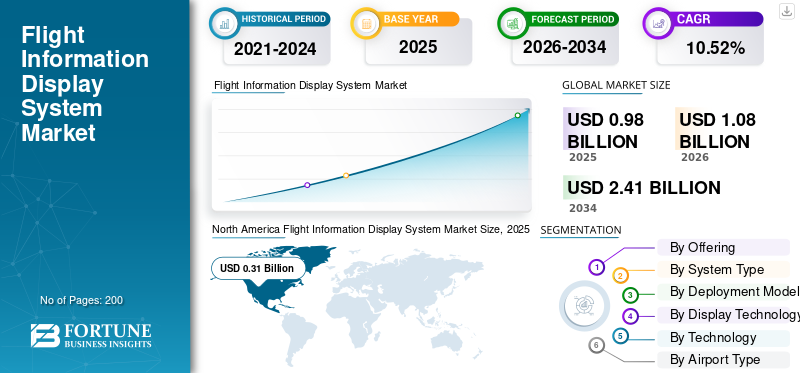
The flight information display system market size was valued at USD 0.98 billion in 2025. The market is projected to grow from USD 1.08 billion in 2026 to USD 2.41 billion by 2034, exhibiting a CAGR of 10.52% during the forecast period. North America dominated the flight information display system market with a market share of 31.63% in 2025.
The market covers airport systems that collect operational flight data and display real time flight departures, arrivals, delays, boarding gates, baggage belts, boarding status, service alerts, and passenger messages across terminal screens and digital channels. The market is at the intersection of airport operations software, digital signage, AODB integration, and passenger-experience technology.
Key growth drivers are rising air passenger volumes, airport terminal expansion, and pressure on airports to reduce passenger confusion, queues, and manual announcements. ACI forecasts global airport passenger traffic to nearly double by 2042 versus the 2024 projection, while International Air Transport Association (IATA) reported record-high passenger demand in 2025. This directly increases demand for scalable, real time updates on passenger information systems.
Major players include SITA, Collins Aerospace, Amadeus IT Group, S.A., NEC Corporation, TAV Technologies and others. Across the market, key players are pushing cloud/web-based platforms, real time AODB and airline-system integration, multilingual/customizable displays, media/advertising management, modular deployment, and broader smart-airport digital transformation rather than selling FIDS as a standalone screen network.
Download Free sample to learn more about this report.
Flight Information Display System Market Key Takeaways
 Global Market Size & Forecast
- 2025 Market Size: USD 0.98 billion
- 2026 Market Size: USD 1.08 billion
- 2034 Forecast Market Size: USD 2.41 billion
- CAGR: 10.52% from 2026–2034
 Market Share
- North America dominated the flight information display system market with a 31.63% share in 2025.
- The FIDS software platform segment held a 23.50% share in 2025.
- The staff / operational FIDS segment is projected to grow at a 12.17% CAGR.
 Key Regional Highlights
North America
North America reached USD 0.31 billion in 2025 and is projected to maintain its leading position with USD 0.34 billion in 2026.
Asia Pacific
Asia Pacific is the fastest-growing region, with a 12.31% CAGR and a market value of USD 0.25 billion in 2025.
Europe
Europe is witnessing steady adoption of flight information display systems across airports and aviation facilities.
U.S.
The market reached USD 0.28 billion in 2025 and is projected to grow at a 9.00% CAGR.
Japan
The market was valued at USD 0.03 billion in 2025 and is estimated to grow at a 9.55% CAGR.
Read More

Flight Information Display System Market Trends
Shift Toward Cloud and API-Based Integration are Emerging Market Trends
The major technology trend is platform convergence. SITA is replacing separate FIDS, advertising CMS, media tools, baggage displays, and turnaround displays with one airport digital content management system, using open APIs, AODB/RMS integration, emergency broadcast, no-code scheduling, and Smart TV System-On-Chip support. Amadeus is also moving in the same direction with cloud/local hosting, AODB interfaces, external data feeds, monitor health checks, sleep/wake scheduling, and automatic community-model updates.
OEM strategy is shifting from screen supply to connected airport operations. SITA’s Phu Quoc project includes AODB, AirportVision evolved across 397 displays, baggage management, biometric passenger processing, and airport management workstations, showing how FIDS is now bundled into wider airport transformation contracts.
For instance, in June 2026, ADB SAFEGATE opened a new global headquarters and factory in Belgium to support next-generation airport technologies, digital airport solutions, and AI-enabled airport applications.
Market Dynamics
MARKET DRIVERS
Download Free sample to learn more about this report.
Rising Passenger Traffic and Airport Expansion Are Driving Market Growth
The main driver for the flight information display system market growth is the steady rise in passenger traffic, new terminal construction, and higher pressure on airports to move passengers with fewer bottlenecks. ACI World forecast global airport passenger traffic at 10.2 billion in 2026 and 18.8 billion by 2045, which directly increases demand for real time data of flight, boarding gate, baggage, delay, wayfinding, and emergency information systems.
Airports are also expanding physical infrastructure, such as India’s 2025 airport and terminal openings at Navi Mumbai, Patna, Datia, Satna, Amravati, Tuticorin, Purnea, and Guwahati, creating natural replacement and installation demand for FIDS. Technology upgrades are strengthening this driver as airports currently want FIDS connected with AODB, resource management, baggage, public address, emergency alerts, advertising, and wayfinding rather than isolated display screens.
For instance, in March 2026, IATA reported January 2026 global passenger demand up 3.8% year-on-year, with international demand up 5.9%, supporting continued airport digital-display investment.
MARKET RESTRAINTS
High Integration Cost, Cybersecurity Exposure, And Weak Airport Margins Can Hamper Market Development
A key market restraint includes hardware and its integration cost. A modern FIDS must take clean data from airline systems, AODB, gate assignments allocation, baggage belts, departure control, security, and sometimes weather or ground transport feeds. When an airport has legacy systems, different vendor platforms, old display controllers, or manual flight-data workflows, the upgrade becomes a live- airport operational databases project rather than a simple IT purchase. SITA’s 2026 research states that data not flowing freely across systems and partners prevents aviation technology investment from delivering full value.
MARKET OPPORTUNITIES
Smart-Airport Programs and Display Monetization Create Growth Opportunities
The strongest opportunity is to position FIDS as part of a broader smart airport operating layer, not as a standalone display network. Airports can use FIDS screens for flight updates, gate changes, baggage belts, queue and walk-time guidance, retail promotions, crisis communication, and staff-facing operational messages. SITA claims its platform can cut energy cost per screen by up to 50%, support existing displays, and generate higher advertising and concession revenue, whereas, Amadeus also highlights non-aeronautical revenue generation through digital display advertising.
Government-backed airport modernization programs is another direct opportunity. The FAA’s Airport Terminal Program allocates USD 5 billion to USD 1 billion annually from 2022–2026, for U.S. airport terminal development, airport-owned towers, and multimodal airport access projects.
For instance, in May 2026, the U.S. DOT/FAA FY2026 Airport Terminal Program notice listed about USD 1 billion in competitive funds for terminal and airport-owned tower projects, creating a funding window for digital terminal systems including information displays and wayfinding
MARKET CHALLENGES
Real Time Data Reliability and Stakeholder Coordination Remain Key Market Challenges
The main challenge hampering the market is that FIDS accuracy depends on many systems and stakeholders behaving correctly at the same time. Wrong airline data, delayed AODB updates, poor gate-resource synchronization, or network outages can quickly create wrong passenger instructions, missed boarding, congestion, and staff workload. As airports connect more systems, cybersecurity becomes a bigger operational risk. SITA noted that cyber incidents can affect the accuracy and availability of shared airport operational databases data such as gate assignments changes, turnaround status, and passenger information.
Brussels Airport’s October 2025 update also showed how a cyberattack affecting Collins Aerospace check-in and boarding systems caused flight cancellations and forced accelerated deployment of a new system.
SEGMENTATION ANALYSIS
By Offering
Cloud / Saas Fids Will Grow at Fastest Rate as Airports Demand Scalable Systems with Lower Local Burden
The global market by offering is classified into FIDS software platform, display hardware, data integration & middleware, content management system, and cloud / SaaS FIDS, and managed services & support.
The cloud / SaaS FIDS segment is estimated to grow at a fastest rate with a highest CAGR of 13.77% during the forecast period. This growth is driven by airports moving away from heavy on-premise infrastructure toward subscription-based, remotely managed platforms. Cloud/SaaS FIDS allows airports to update flight information, advertising content, emergency messages, and multilingual passenger communication from centralized dashboards.
The FIDS software platform accounted for the largest market share of 23.50% in 2025. In addition, it is projected to grow at a CAGR of 9.52% during the forecast period.
By System Type
Growing Demand for Real-Time Flight Information Will Lead to Staff / Operational FIDS Growth at Fastest Rate
By system type, the market is classified into FIDS (Flight Information Display System), GIDS (Gate Information Display System), BIDS (Baggage Information Display System), CIDS (Check-in Information Display System), and staff / operational FIDS.
The staff / operational FIDS segment is predicted to grow at a fastest rate with a highest CAGR of 12.17% during the forecast period. Airports are investing in internal operational displays as gate agents, ramp teams, baggage handlers, turnaround teams, and operations control centers need the same real-time flight information as passengers, but with more operational detail. This growth is caused by rising flight volumes, tighter turnaround windows, labor shortages, and disruption-management needs.
The FIDS (flight information display system) segment held the largest market share of 36.30% in 2025. In addition, it is projected to grow at a CAGR of 9.24% during the forecast period.
By Deployment Model
Cloud-Based FIDS is Probable to Grow at Fastest Rate as Airports Need Centralized Control Across Terminals and Airport Networks
The global market, by deployment model, is classified into on-premise FIDS, cloud-based FIDS, hybrid FIDS, edge-based FIDS, and multi-airport centralized FIDS.
The cloud-based FIDS segment will grow at a fastest rate with a highest CAGR of 12.08% during 2026-2034. The growth comes from airports increasingly demanding centralized management of multiple displays across gates, check-in areas, baggage halls, lounges, curbside areas, and multiple airport locations. Cloud-based deployment helps airport operators reduce dependence on local hardware, manage content remotely, monitor display health, and roll out software updates faster.
In 2025, the on-premise FIDS segment had largest market share of 37.16%. In addition, the segment is projected to grow at a CAGR of 8.93% during the forecast period.
By Display Technology
Mobile / Web Displays Will Grow at Fastest Rate as Flight Information is Shifting Beyond Terminal Screens to Passenger Devices
By display technology, the market is divided into LCD / commercial digital displays, LED displays, video walls, interactive displays, mobile / web displays, and low-power / specialty displays.
The mobile / web displays sub-segment is estimated to grow at a fastest rate and hold highest CAGR of 12.76% during the forecast period. This is due to passengers no longer depending only on physical boards inside the terminal, as they expect real-time flight, gate, baggage, delay, and boarding information on phones, airport websites, kiosks, and airline-linked digital channels. Airports are adopting mobile/web FIDS as it improves communication before passengers reach the terminal and reduces congestion around traditional display boards.
The LCD / commercial digital displays segment accounted for the largest market share of 44.96% in year 2025 and is projected to grow at a CAGR of 9.05% during the forecast period.
By Technology
AI / Rules-Based Automation is Expected to Grow at Fastest CAGR as Airports Are Looking for Automatic Updates and Fewer Manual Display Errors
The market, by technology, is segmented into real-time data automation, cloud-native FIDS, edge & offline resilience, device monitoring & remote management, AI / rules-based automation, cybersecure FIDS, and advertising & analytics layer.
Over the forecast period, AI / rules-based automation segment is predicted to the grow at a fastest rate and with a highest CAGR of 12.71%. This growth is driven by the need to automate repetitive FIDS functions such as gate-change alerts, delay updates, baggage belt assignments, boarding status changes, and emergency messaging. Airports are implementing rules-based logic and AI-supported workflows as manual updates are slow, inconsistent, and risky during peak operations or disruption events.
The real-time data automation segment accounted for the largest share of 25.04% in 2025. It is projected to grow at a CAGR of 7.89% during the forecast period.
By Airport Type
Rapid Modernization of Medium Commercial Airport While Managing Rising Traffic Pressure Will Allows Segment to Grow at Fastest CAGR
The global market by airport type is classified into large international hub airports, medium commercial airports, regional airports, and low-cost carrier airports.
The medium commercial airports segment is estimated to develop at a fastest rate and with a highest CAGR of 11.30% during the forecast period. They are noticing higher passenger traffic, new route additions, terminal upgrades, and pressure to deliver a hub-like passenger experience with smaller budgets.
In 2025, large international hub airports segment accounted for the largest flight information display system market share of 46.87%. In addition, it is projected to grow at a CAGR of 9.99% during the forecast period.
By Installation Type
Expansion Segment is Expected to Grow at Fastest Rate as Airport Terminal, Gate, And Baggage Capacity Additions Require New FIDS Coverage
The global market, by installation type, is classified into new installation, replacement / retrofit, and expansion.
The expansion segment is estimated to grow at a fastest rate with highest CAGR of 11.16% during the forecast period. This growth is directly linked to airports adding new terminals, concourses, gates, baggage claim belts, lounges, check-in zones, and curbside passenger areas. Every physical expansion creates a need for additional displays, controllers, content-management systems, network connectivity, and integration with core airport databases.
The replacement / retrofit segment accounted for the largest market share of 44.32% in 2025. In addition, it is likely to grow at a CAGR of 9.84% during the forecast period.
By End User
To know how our report can help streamline your business, Speak to Analyst
Government / Border Agencies Segment Will Grow at Fastest Rate as Security, Immigration, and Border-Control Processes Need Clearer Real-Time Passenger Information
By end user, the market is classified into airport operators, airlines, ground handlers, government / border agencies, transport & hospitality users, and general aviation / FBO operators.
The government / border agencies segment will grow at a fastest rate with a highest CAGR of 11.95% during the forecast period. This growth is being driven by digital border control, biometric processing, customs modernization, immigration queue management, and the need for multilingual passenger instructions.
The airport operators segment accounted for the largest market share of 59.46% in 2025 and is projected to grow at a CAGR of 10.23% during the forecast period.
Flight Information Display System Market Regional Outlook
By region, the market is categorized into Europe, North America, Asia Pacific, the Middle East & Africa, and Latin America.
North America
North America Flight Information Display System Market Size, 2025 (USD Billion)
To get more information on the regional analysis of this market, Download Free sample
North America held a dominant share in 2025, valued at USD 0.31 billion and will maintain the leading share in 2026, with USD 0.34 billion revenue. The dominance is driven by FAA’s funding for airport modernization programs through the Airport Terminal Program, with USD 5 billion allocated from 2022–2026. Airports are also upgrading passenger-facing systems such as FIDS to support safer, more accessible, and smoother terminal movement.
U.S. Flight Information Display System Market
Based on North America's strong contribution, the U.S. market reached USD 0.28 billion in 2025 and is estimated to have a CAGR of 9.00% during the forecast period.
Europe
The Europe market was valued at USD 0.26 billion in 2025 and secured the position of the second-largest region in the market. European airports are prioritizing digitalization and automation of passenger experience. The market growth is also being driven by the need to replace static legacy screens with smart, integrated display systems connected to airport operations.
U.K. Flight Information Display System Market
The U.K. market in 2025 was valued at USD 0.05 billion and is estimated to grow at a rate of 9.56% during the forecast period.
Nordic Countries Flight Information Display System Market
The Nordic Countries market in 2025 was valued at USD 0.02 billion and is predicted to grow at a rate of 11.25% during the forecast period.
Rest of Europe Flight Information Display System Market
In 2025, the Rest of Europe market was valued at USD 0.04 billion and is estimated to grow at a rate of 9.38% during the forecast period.
Asia Pacific
Asia Pacific is projected to grow at fastest growing rate with a highest CAGR of 12.31% during the forecast period. In 2025, the market value stood at USD 0.25 billion. Asia Pacific airports are facing strong traffic expansion, especially from India and Vietnam and thus the demand is growing with new terminals, airports, and regional-route expansion. ACI Asia Pacific & Middle East projects 4.8% annual passenger growth in Asia Pacific during 2025–2028, while India is targeting 50 more airports in five years and 120 new destinations in ten years and creating direct demand for integrated passenger-information systems.
China Flight Information Display System Market
The China market in 2025 was at USD 0.08 billion and is projected to grow at 12.49% CAGR during the forecast period.
India Flight Information Display System Market
The India market, in 2025, reached USD 0.05 billion and is estimated to grow at a rate of 14.47% during the forecast period.
Japan Flight Information Display System Market
In 2025, the Japan market was valued at USD 0.03 billion and is estimated to grow at 9.55% CAGR during the forecast period.
Middle East & Africa
The Middle East & Africa market was valued at USD 0.10 billion in 2025. Middle East is building mega-hub capacity and Africa is seeing strong traffic recovery, and its airports need scalable FIDS for high-volume wayfinding, transfer control, multilingual alerts, and disruption messaging.
Gulf Countries Flight Information Display System Market
The Gulf Countries market in 2025 was valued at USD 0.05 billion and is estimated to grow at a rate of 12.85% during the forecast period.
Latin America
The Latin America market was valued at USD 0.05 billion in 2025. Latin America’s growth is mainly domestic and intra-regional as airports need FIDS to manage more frequent short-haul flights, gate changes, baggage information, and passenger movement across regional terminals.
Brazil Flight Information Display System Market
The Brazil market in 2025 was at USD 0.02 billion and is estimated to grow at a rate of 7.34% during the forecast period.
COMPETITIVE LANDSCAPE
Key Industry Players
Adoption of Integrated Smart-Airport Digital Platforms Boosts Market Competition
The market is developing around end-to-end airport digital display platforms, where FIDS is bundled with AODB, baggage, ramp, wayfinding, advertising, public announcement, and emergency messaging. This is due to airports demand fewer disconnected systems, lower IT overhead, better passenger flow, and faster disruption communication. Key players are therefore competing on open APIs, cloud/local hosting, system-agnostic deployment, Smart TV/System-on-Chip support, remote monitoring, cybersecurity, and advertising monetization. OEM portfolios show this direction clearly: SITA positions one platform to replace separate FIDS, advertising CMS, media, baggage, and turnaround displays as Amadeus supports cloud/local hosting and AODB interfaces; and TAV emphasizes integration with AODB, RMS, PAS, IVR, fire alarm, and building management systems.
Competitive growth is mainly contract-led and modernization-led, not simple product replacement. Airports are buying FIDS as part of larger terminal transformation projects, such as Heathrow’s smart FIDS/RIDS upgrade across 3,200 displays and Phu Quoc’s new terminal deployment using AODB plus AirportVision Evolved across 397 displays.
LIST OF KEY FLIGHT INFORMATION DISPLAY SYSTEM COMPANIES PROFILED
- SITA (Switzerland)
- Amadeus IT Group, S.A. (Spain)
- Collins Aerospace (RTX) (U.S.)
- ADB SAFEGATE (Belgium)
- TAV Technologies (Turkey)
- Damarel Systems International Ltd. (U.K.)
- Simpleway Europe a.s. (Czechia)
- RESA Airport Data Systems (France)
- A-ICE S.r.l. (Italy)
- Indra Sistemas, S.A. (France)
- NEC Corporation (Japan)
- AeroCloud Systems Limited (U.K.)
- Navori SA / Navori Labs (Switzerland)
- Net Display Systems B.V. / NDS (Netherlands)
- Naitec S.r.l. (Italy)
KEY INDUSTRY DEVELOPMENTS
- June 2026: Infax, Inc. was listed for award by the City of Amarillo for Rick Husband Amarillo International Airport, with a contract value of USD 4.36 million to replace the existing Flight Information Display System and provide five years of daily flight-information service after the current vendor ends service in October 2026.
- October 2025: Infax, Inc. received a USD 5.39 million contract from the Savannah Airport Commission to replace legacy FIDS screens and convert static advertising displays into dynamic digital displays across baggage claim, ticketing, concourse, and pre-security areas.
- July 2025: Infax, Inc. received a five-year USD 3.30 million service renewal from the Savannah Airport Commission to provide licensing and technical support for MUFIDS, passenger display systems, baggage claim displays, gate displays, ramp/ticket-counter displays, advertising screens, and parking exit signage.
- June 2024: SITA Information Networking Computing USA Inc. received a USD 5.07 million award from the Hawaii Department of Transportation Airports Division for maintenance of the Kahului Airport Flight Information Display System, Public Address System, and Gate Management System.
- March 2024: Infax, Inc. received a not-to-exceed USD 2.34 million contract from the City of Houston/Houston Airport System to provide multi-use FIDS, including flight arrival/departure data, baggage carousel assignments, gate status information, and maintenance/support services.
REPORT COVERAGE
The global flight information display system market analysis includes a comprehensive study of the market size & forecast by all the market segments included in the report. It contains details on the market dynamics and market trends expected to drive the market over the forecast period. It provides information on key aspects, including an overview of technological advancements, pipeline candidates, the regulatory environment, and product launches. Additionally, it details partnerships, mergers & acquisitions, as well as key aviation industry developments and prevalence by key regions. The global market research report also provides a detailed competitive landscape with information on the market share and profiles of key operating players.
Request for Customization to gain extensive market insights.
Report Scope & Segmentation
| ATTRIBUTE | DETAILS |
| Study Period | 2021-2034 |
| Base Year | 2025 |
| Estimated Year | 2026 |
| Forecast Period | 2026-2034 |
| Historical Period | 2021-2024 |
| Growth Rate | CAGR of 10.52% from 2026-2034 |
| Unit | Value (USD Billion) |
| Segmentation |
By Offering
By System Type
By Deployment Model
By Display Technology
By Technology
By Airport Type
By Installation Type
By End User
By Region
|
Frequently Asked Questions
Fortune Business Insights says that the global market value stood at USD 0.98 billion in 2025 and is projected to reach USD 2.41 billion by 2034.
In 2025, the European market value stood at USD 0.26 billion.
The market is expected to exhibit a CAGR of 10.52% during the forecast period.
The government / border agencies segment is expected to hold the highest CAGR over the forecast period.
Rising passenger traffic and airport expansion are some key factors driving market.
SITA, Collins Aerospace (RTX), Amadeus IT Group, S.A., NEC Corporation, and TAV Technologies are the top key players in the market.
North America dominated the market in 2025.



- 2021-2034
- 2025
- 2021-2024
- 200
Get 30-60 hrs Free Customization
Expand Regional and Country Coverage, Segments Analysis, Company Profiles, Competitive Benchmarking, and End-user Insights.




















Related Reports
-
US +1 833 909 2966 ( Toll Free )
-
Get In Touch With Us