Enterprise Firewall Market Size, Share & Industry Analysis, By Solution (Hardware and Software), By Deployment (On-premises and Cloud), By Enterprise Type (Large Enterprises and SMEs), By Industry (BFSI, Retail, Manufacturing, IT & Telecom, Healthcare, and Others), and Regional Forecast, 2026–2034
 Download Free Sample
ENTERPRISE FIREWALL MARKET SIZE AND FUTURE OUTLOOK
 Listen to Audio Version
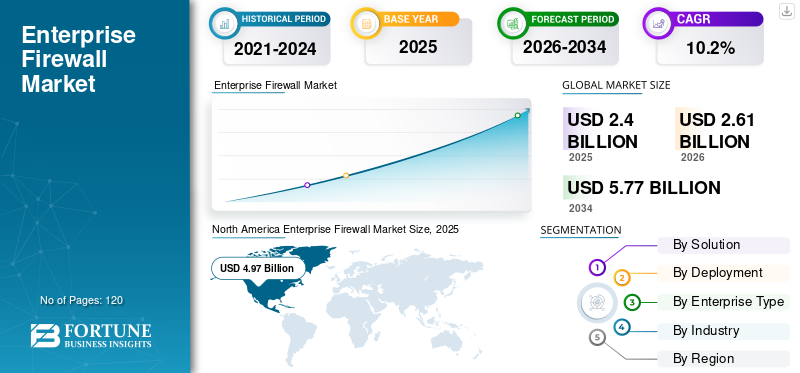
The global enterprise firewall market size was valued at USD 2.40 billion in 2025. The market is projected to grow from USD 2.61 billion in 2026 to USD 5.77 billion by 2034, exhibiting a CAGR of 10.2% during the forecast period.
Enterprise firewall protects business networks by inspecting and controlling traffic between internal systems, data centers, clouds, and the internet. The market is expanding as organizations shift from traditional perimeter security to integrated next generation, cloud based, and SASE aligned firewall architectures. The market growth is driven by rising cyber threats, multi cloud adoption, and the need for unified policy enforcement across distributed networks.
Additionally, as organizations move workloads to public clouds and operate mixed on-premises and cloud environments, they need enterprise firewall solutions that consistently secure traffic across these distributed locations. This shift increases demand for virtual firewalls, cloud native firewalls, and firewall as a service that can enforce unified policies in hybrid architectures.
The market is dominated by established key players, such as Palo Alto Networks, Fortinet, Inc., Check Point Software Technologies Ltd., Cisco Systems, Inc., Juniper Networks, Inc., and Sophos. These players are focusing on building integrated security services platforms that combine next generation firewall, SD WAN, SASE, and cloud delivered services, often strengthened through acquisitions and heavy R&D investment to expand capabilities such as zero trust, AI driven threat detection, and secure access for hybrid environments.
Download Free sample to learn more about this report.
Enterprise Firewall Market Key Takeaways
 Global Market Size & Forecast
- 2025 Market Size: USD 2.40 Billion
- 2026 Market Size: USD 2.61 Billion
- 2034 Forecast Market Size: USD 5.77 Billion
- CAGR: 10.2% from 2026–2034
 Market Share
- North America dominated the enterprise firewall market in 2025.
- The Hardware segment led the market in 2025.
- The Cloud deployment segment dominated the market in 2025.
 Key Regional Highlights
North America
North America generated USD 4.97 billion in 2025, leading the global market.
Asia Pacific
Asia Pacific is projected to reach USD 3.73 billion in 2026, registering the highest 12.9% CAGR.
Europe
Europe is projected to reach USD 3.68 billion in 2026, growing at a 9.3% CAGR.
U.S
The U.S. market is projected to reach USD 4.20 billion by 2026.
Japan
Japan is witnessing strong demand driven by rapid digitalization and cybersecurity investments.
Read More

IMPACT OF GENERATIVE AI
Rising Use of Generative AI in Firewall Analytics Strengthens Market Expansion
Generative AI is pushing firewall vendors to enhance threat detection, using models that learn from massive volumes of logs and traffic to spot subtle, previously unseen attack patterns in near real time. Simultaneously, attackers can also use generative AI to craft convincing phishing, automate malware variants, and probe defenses faster, which raises the bar for what next-generation firewalls must catch. Vendors are starting to embed AI-assisted policy tuning and configuration, which can reduce admin workload and help smaller security teams operate more complex firewall and SASE environments. Over the medium term, this will accelerate the shift toward cloud delivered, analytics heavy firewall platforms where continuous model training and telemetry sharing become core differentiators. For instance,
- In March 2025, Fortinet unveiled expanded integration of its generative AI-driven assistant, FortiAI, across its Security Fabric platform, aiming to improve autonomous threat protection and support employee use of GenAI services.
MARKET DYNAMICS
Market Drivers
Increasing Sophistication of Cyberattacks Drives Strong Firewall Adoption
The growing frequency and complexity of cyberattacks are pushing organizations to strengthen their network defenses, which directly increases demand for advanced enterprise firewalls. Modern threats often use encrypted channels, multi stage intrusion techniques, and automated attack tools that traditional firewalls cannot detect effectively. Enterprises require next generation firewalls with deeper inspection, real time analytics, and integrated threat intelligence to counter these evolving risks. As attackers target both cloud and on premises environments, businesses prioritize security investments that provide consistent protection across all network layers. This constant escalation in threat sophistication continues to be one of the strongest drivers of the enterprise firewall market growth.
- In November 2025, Cisco Systems issued a major alert on a wave of attacks exploiting zero-day vulnerabilities in its ASA and Secure Firewall devices, underscoring how outdated or unsupported firewall hardware can become entry points for advanced adversaries.
Market Restraints
High Initial Investment and Maintenance Costs Concerns May Hinder Market Growth
High upfront investment remains a major barrier as advanced next generation firewalls often require costly hardware, subscriptions, and specialized deployment services. Ongoing expenses for updates, threat intelligence feeds, and skilled administrators add to the long term financial burden, especially for smaller organizations. As cyber threats grow more complex, enterprises must frequently upgrade appliances or expand capacity, further increasing total ownership costs. These financial pressures can delay purchasing decisions and slow overall market adoption.
Market Opportunities
Growing SME Digitalization Creates Strong Demand for Modern Firewall Solutions
Many small and mid-sized enterprises in regions such as Southeast Asia, South America, and parts of Africa are still in the early stages of adopting next-generation and cloud-managed firewalls. These organizations face rising cyber risks but often lack in-house security expertise, creating strong demand for simpler, affordable, and subscription-based firewall solutions. As vendors expand lightweight virtual firewalls, FWaaS, and MSP-delivered offerings, they can tap into a large base of new buyers that previously relied on basic or legacy protections. The rapid digitalization of SMEs in retail, manufacturing, and services further accelerates this opportunity as these firms move operations online and require stronger perimeter and internal segmentation controls. For instance,
- October 2025: NETGEAR introduced a new enterprise-grade cybersecurity solution geared specifically toward Small and Mid-Sized Enterprises (SMEs) and MSPs, combining SASE, firewall, ZTNA, and SWG in one cloud-managed platform to address previously underserved SME security needs.
Enterprise Firewall Market Trends
Rising Encrypted Traffic Volumes Drive Demand for High-Performance Firewall Solutions
A growing share of enterprise network traffic is now encrypted, which makes it harder for security tools to inspect data without slowing performance. Modern firewalls are being redesigned with stronger TLS inspection, optimized hardware, and smarter packet handling to maintain security while minimizing latency. Vendors are also adding acceleration technologies and offloading techniques so deep inspection does not degrade user experience. As applications become more bandwidth intensive, enterprises prioritize firewalls that can handle high throughput and encrypted traffic at scale, making performance a key buying criterion. For instance,
- In June 2025, Microsoft introduced public preview support for high performance TLS inspection in Microsoft Entra Internet Access, enabling real time decryption and inspection of HTTPS traffic without noticeable impact on user experience, which directly reflects the trend toward handling encrypted traffic at scale.
Download Free sample to learn more about this report.
SEGMENTATION ANALYSIS
By Solution
Increasing Need for Scalable Firewall Capabilities Boosts Software Solution Applications
Based on solution, the market is divided into hardware and software.
Hardware captured the largest market share in 2025, estimated at USD 8.78 billion for 2025. Many large enterprises are dependent on high-performance, appliance-based firewalls to protect campus networks, data centers, and latency-sensitive environments. These enterprises prioritize dedicated hardware for its reliability, throughput capacity, and ability to handle advanced threat inspection and encrypted traffic at scale.
Software is anticipated to grow at the highest CAGR of 11.1% during the forecast period, as organizations are increasingly adopting virtual firewalls, subscription-based models, and cloud-delivered security that provide more flexibility and lower upfront costs.
By Deployment
Growing Reliance on Hybrid and Multi Cloud Environments Drives Cloud Firewall Adoption
Based on deployment, the market is bifurcated into on-premises and cloud.
In 2025, cloud deployment generated a revenue of 9.71 billion resulting in the segment’s dominance. Enterprises are continuing shifting workloads to multi cloud and hybrid environments, requiring firewall controls that can scale elastically and provide consistent policy enforcement across distributed users and applications. Organizations also favored cloud delivered security for its lower upfront cost, simplified management, and seamless integration with SASE and zero trust architectures.
Cloud deployment is expected to grow at the highest CAGR of 11.6% during the forecast period. As cloud-delivered firewalls support unified policy management, faster deployment, and lower operational overhead, making them the preferred choice for modern zero trust and Secure Access Service Edge (SASE) driven architectures.
By Enterprise Type
Rising Network Complexity in Large Enterprises Drives Higher Firewall Adoption
Based on enterprise type, the market is classified into large enterprises and SMEs.
By garnering a revenue of USD 9.23 billion in 2025, large enterprises attained the largest market share. As they operate complex, globally distributed networks that require advanced firewall capabilities, high throughput performance, and extensive segmentation. They also have extensive cybersecurity budgets and stricter compliance demands, leading to higher adoption of next-generation, cloud based, and integrated firewall platforms.
SMEs (small and medium sized enterprises) are expected to grow at the highest CAGR of 12.7% during the forecast period. SMEs are rapidly digitalizing and increasingly adopting cloud services, which drives demand for affordable, easy to deploy firewall and managed security solutions.
By Industry
Increasing Regulatory Demands in Financial Services Drive Strong Firewall Adoption
Based on industry, the market is categorized into BFSI, retail, manufacturing, IT & telecom, healthcare, and others (government, education, etc.).
The BFSI segment accounted for the largest market share with a valuation of USD 3.36 billion in 2025, as the sector handles highly sensitive data and faces strict regulatory requirements that demand advanced firewall protection and continuous monitoring. The sector also experiences frequent and sophisticated cyberattacks, prompting higher investment in next-generation and cloud integrated firewall solutions.
Healthcare is projected to grow at the highest CAGR of 13.0% during the forecast period. Hospitals and medical organizations are rapidly digitalizing patient records, connected devices, and telehealth services, which increases their exposure to cyber threats.
To know how our report can help streamline your business, Speak to Analyst
ENTERPRISE FIREWALL MARKET REGIONAL OUTLOOK
By geography, the market is categorized into North America, Europe, Asia Pacific, South America, and the Middle East & Africa.
North America
North America held the largest enterprise firewall market share in 2024, valued at USD 4.65 billion, and also maintained the leading share in 2025, with USD 4.97 billion. The region has a highly mature cybersecurity landscape, with enterprises adopting advanced firewalls, zero-trust frameworks, and cloud-based security platforms at a faster rate than other regions. The presence of major firewall vendors, strict regulatory standards, and a high frequency of sophisticated cyberattacks further drives strong investment in next-generation firewall solutions across the region. For instance,
North America Enterprise Firewall Market Size, 2025 (USD Billion)
To get more information on the regional analysis of this market, Download Free sample
- In February 2025, Fortinet introduced new FortiGate G series next-generation firewalls designed for distributed enterprises, emphasizing higher performance and integrated security for North American customers modernizing branch and campus networks.
In 2026, the U.S. market is estimated to reach USD 4.20 billion. The market growth is driven due to the high frequency of advanced cyberattacks targeting critical infrastructure, government networks, and large enterprises, which drives continuous investment in next-generation and cloud delivered firewalls. Additionally, the rapid adoption of hybrid cloud, remote work models, and zero trust architectures pushes organizations to upgrade to scalable, policy-driven firewall platforms that can secure distributed users and applications.
Europe
Europe is anticipated to witness a moderate growth in the forecast period by exhibiting a CAGR of 9.3% and reaching USD 3.68 billion in 2026. The region’s fourth highest growth rate is primarily attributed to strict regulatory frameworks such as GDPR, NIS2, and sector-specific cybersecurity mandates that require stronger network protection, advanced logging, and continuous monitoring. Additionally, rising cyberattacks on financial institutions, manufacturing, and critical infrastructure also push European enterprises to adopt next generation firewall solutions at a faster rate. Backed by these factors, in 2026 the U.K. is expected to reach USD 0.68 billion, while Germany and France will generate revenues of USD 0.72 billion and France USD 0.58 billion respectively.
Asia Pacific
For 2026, Asia Pacific’s market is estimated to reach USD 3.73 billion, while registering the highest CAGR of 12.9% for the forecast period. China, India, Southeast Asia, and Japan, are observing rapid digitalization which increases network complexity and exposure to cyberattacks. Governments and enterprises are also investing heavily in cloud adoption, data protection regulations, and zero trust initiatives, driving strong demand for next generation firewall solutions across the region. In 2026, India will gain a market value of USD 0.50 billion, while China is estimated to account for a larger market size of USD 0.79 billion.
South America
South America is expected to witness significant growth and reflect an estimated USD 0.81 billion in 2026. Businesses in Brazil, Argentina, and neighboring countries are accelerating cloud adoption and digital transformation, which increases the need for stronger network protection and advanced threat detection.
Middle East & Africa
The Middle East & Africa is estimated to reach USD 0.90 billion in 2026 with prominent growth. Governments and large organizations are investing in digital transformation, smart city projects, and cloud adoption, which increases the need for stronger network security and threat prevention. In terms of value the GCC will hit USD 0.29 billion in 2026. Moreover, increase in cyberattacks targeting banks, oil and gas companies, and public sector systems, in the region prompts greater deployment of highly secured firewall solutions.
Competitive Landscape
KEY INDUSTRY PLAYERS
Established Firms Prioritize Cloud-Delivered Firewalls and Integrated Security Platforms to Strengthen Market Position
Leading companies in the market are enhancing their portfolios by shifting from traditional hardware-based solutions to cloud-delivered firewalls, virtual appliances, and comprehensive SASE platforms. These vendors are developing advanced capabilities such as unified policy management, AI-driven threat detection, and deep visibility across hybrid and multi-cloud environments to meet the rising demand for scalable, flexible security. They are also focusing on improving encrypted traffic inspection, integrating enterprise firewalls with SD WAN and zero trust frameworks, and offering automation tools that simplify policy configuration and reduce operational burden.
Long List of Enterprise Firewall Companies Studied:
- Palo Alto Networks (U.S.)
- Fortinet, Inc.(U.S.)
- Check Point Software Technologies Ltd.(Israel)
- Cisco Systems, Inc. (U.S.)
- Juniper Networks, Inc. (U.S.)
- Sophos (U.K.)
- Forcepoint (U.S.)
- Huawei Technologies Co., Ltd. (China)
- WatchGuard Technologies (U.S.)
- SonicWall (U.S.)
- Barracuda Networks (U.S.)
- Hillstone Networks (China)
- Sangfor Technologies (China)
- F5, Inc. (U.S.)
- Trend Micro (Japan)
- AhnLab (South Korea)
- Stormshield (France)
- Versa Networks (U.S.)
- A10 Networks (U.S.)
- HPE Aruba Networking (U.S.)
….and more
KEY INDUSTRY DEVELOPMENTS
- October 2025: Palo Alto Networks launched new AI-driven security offerings, including Prisma AIRS 2.0 and Cortex Cloud 2.0, extending enterprise firewall and SASE capabilities into hybrid and multi-cloud environments.
- August 2025: SonicWall launched nine new “Generation 8” firewall models with built-in zero-trust, cyber-warranty, and cloud-management features, in direct response to the rising complexity and scale of attacks that demand more adaptive protection.
- August 2025: WatchGuard introduced an updated Firebox tabletop enterprise firewall series with AI powered threat detection, high speed networking, and centralized cloud management aimed at Managed Service Providers (MSPs) and growing businesses.
- July 2025: Fortinet expanded its Hybrid Mesh Firewall portfolio with the FortiGate 700G series, which delivers high-performance, post-quantum ready firewalls designed for modern distributed enterprise networks.
- May 2025: T Mobile and Palo Alto Networks announced “T Mobile SASE, with Palo Alto Networks,” a managed SASE and firewall security service for US businesses and government customers, reflecting strong regional demand for cloud-delivered firewall and SASE solutions.
REPORT COVERAGE
The report provides a detailed analysis of the market and focuses on key aspects such as leading companies, product types, and leading applications of the product. Besides, the report offers insights into the market trends and highlights key industry developments. In addition to the factors above, the report encompasses several factors that contributed to the growth of enterprise firewall market in recent years.
Request for Customization to gain extensive market insights.
REPORT SCOPE & SEGMENTATION
| Attribute | Details |
| Study Period | 2021-2034 |
| Base Year | 2025 |
| Forecast Period | 2026-2034 |
| Historical Period | 2021-2024 |
| Growth Rate | CAGR of 10.2% from 2026 to 2034 |
| Unit | Value (USD Billion) |
| Segmentation |
By Solution
By Deployment
By Enterprise Type
By Industry
By Region
|
| Companies Profiled in the Report |
|
Frequently Asked Questions
The market is expected to reach USD 5.77 billion by 2034.
In 2025, the market was valued at USD 2.40 billion.
The market is expected to grow at a CAGR of 10.2% during the forecast period.
BFSI held the leading position in 2025.
Increasing sophistication of cyberattacks drives strong firewall adoption.
Palo Alto Networks, Fortinet, Inc., Check Point Software Technologies Ltd., Cisco Systems, Inc., Juniper Networks, Inc., Sophos, Forcepoint, Huawei Technologies Co., Ltd., WatchGuard Technologies, and SonicWall are the top players in the market.
North America held the highest market share.



- 2021-2034
- 2025
- 2021-2024
- 120
Get 30-60 hrs Free Customization
Expand Regional and Country Coverage, Segments Analysis, Company Profiles, Competitive Benchmarking, and End-user Insights.




















Related Reports
-
US +1 833 909 2966 ( Toll Free )
-
Get In Touch With Us