Eye Health Supplements Market Size, Share & Industry Analysis, By Ingredient Type (Macular Carotenoids, Omega-3/Fatty Acids, Vitamin Antioxidant, Polyphenols Antioxidants, Mitochondrial Support Ingredients, and Others), By Formulation (Softgels, Capsules, Tablets, Powders, and Others), By Age Group, By Application (Macular Degeneration, Digital Eye Strain Support, Dry Eye Support, Diabetes-Related Retinal Support, Visual Performance Support), By Distribution Channel (Retail Pharmacies & Drug Stores, Health & Wellness Stores, E-commerce, and Others), and Regional Forecast, 2026-2034
 Download Free Sample
Eye Health Supplements Market Size and Future Outlook
 Listen to Audio Version
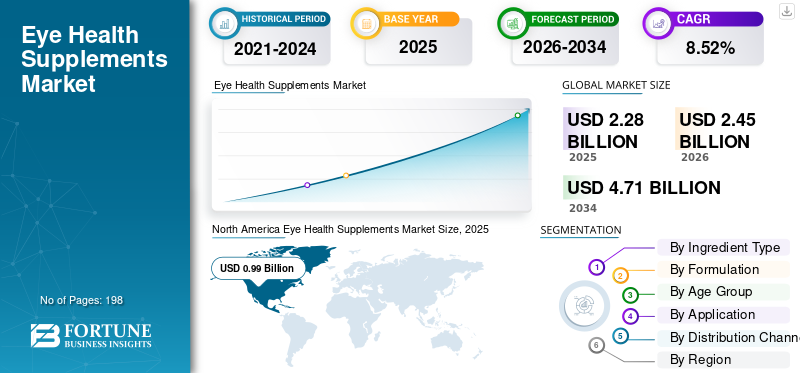
The global eye health supplements market size was valued at USD 2.28 billion in 2025. The market is projected to grow from USD 2.45 billion in 2026 to USD 4.71 billion by 2034, exhibiting a CAGR of 8.52% during the forecast period. North America dominated the eye health supplements market with a market share of 43.42% in 2025.
Eye health supplements are dietary products designed to promote visual well-being, support macular health, enhance retinal function, manage dry eyes, and alleviate eye strain associated with screens. The aging global population is propelling the market, along with the clinically proven effectiveness of AREDS2-type formulations in slowing the advancement of intermediate age-related macular degeneration. Additionally, the increasing use of carotenoid-, antioxidant-, and omega-rich formulas for preventive eye care.
Major players in the global market include Bausch + Lomb, MacuHealth, EyePromise, and ScienceBased Health, among others. These companies are focusing on clinically positioned AREDS2 and macular-support formulas, premium carotenoid blends, omega-based dry-eye offerings, and newer products aimed at digital eye strain, visual performance, and general eye wellness.
Download Free sample to learn more about this report.
Eye Health Supplements Market KEY TAKEAWAYS
 Market Size & Forecast
- 2025 Market Size: USD 2.28 Billion
- 2026 Market Size: USD 2.45 Billion
- 2034 Forecast Market Size: USD 4.71 Billion
- CAGR: 8.52% from 2026–2034
 Market Share
- North America dominated the eye health supplements market with a 43.42% share in 2025.
- The softgels segment is projected to account for 38.5% of the market in 2026.
- The adults segment is projected to account for 94.8% of the market in 2026.
 Key Regional Highlights
North America
North America generated USD 0.99 billion in 2025, driven by supplement adoption and preventive eye care awareness.
Europe
Europe is projected to grow at a CAGR of 7.88%, driven by an aging population and demand for vision health supplements.
Asia Pacific
Asia Pacific is projected to reach USD 0.58 billion in 2026, driven by rising incomes and growing eye health awareness.
U.S.
The eye health supplements market is projected to reach USD 0.94 billion in 2026.
Japan
The eye health supplements market is projected to reach USD 0.10 billion in 2026.
Read More

EYE HEALTH SUPPLEMENTS MARKET TRENDS
Increasing Preference for Natural and Plant-Based Ingredients is a Significant Trend Observed in the Market
Increasing preference for natural and plant-based ingredients is emerging as a key trend in the global market. Consumers are increasingly seeking cleaner-label products made with naturally sourced carotenoids, algae-based omega-3s, and botanical antioxidants instead of synthetic-heavy formulations. This trend is supporting demand for ingredients such as lutein and zeaxanthin from marigold, bilberry, saffron, maqui berry, and algae-derived DHA/EPA, especially in preventive eye health, dry eye support, and digital eye strain products. It is also encouraging vendors to position products around vegan, vegetarian, sustainable, and eco-conscious claims, which helps brands appeal to younger wellness-focused users as well as long-term supplement users. As a result, plant-based innovation is widening the category beyond traditional AREDS-type users and improving adoption in lifestyle-led segments. These factors are supporting the overall global market growth.
- For instance, EyePromise’s vegan omega-3 offering is positioned as a plant-based, algae-oil alternative for dry eye relief and eye comfort.
MARKET DYNAMICS
MARKET DRIVERS
Download Free sample to learn more about this report.
Increasing Demand for Preventive Eye Care is Driving Market Growth
The rising demand for preventive vision care is a major factor in the worldwide eye health supplements market growth. Consumers are taking greater initiative in safeguarding their eyesight before significant eye issues arise, particularly as screen usage increases and the global demographic ages. This is driving demand for the product aimed at macular health, overall eye wellness, dry eye relief, and visual performance instead of solely for severe eye conditions. The trend is also advantageous for formulations centered on clinically acknowledged ingredients such as lutein, zeaxanthin, vitamins, minerals, and omega-based nutrients, as consumers increasingly perceive them as essential for long-term daily health upkeep. Moreover, preventive eye care is becoming more significant as individuals seek non-prescription options that can be used regularly at home and easily acquired from pharmacies and online platforms. This is expanding the consumer audience beyond those with diagnoses and assisting eye health supplements in entering the prevalent preventive wellness sector. All these factors cumulatively drive the overall market growth.
- For instance, in June 2024, Bausch + Lomb launched Blink NutriTears in the U.S. It is a clinically proven nutritional supplement for dry eyes.
MARKET RESTRAINTS
Presence of Alternative Treatment Methods to Limit Market Growth
Presence of alternative treatment methods is a key restraint in the global market. Many consumers with dry eye, retinal disorders, or age-related vision problems may prefer prescription eye drops, OTC lubricants, in-office procedures, or other medically supervised therapies instead of oral supplements, especially when symptoms are persistent or clinically diagnosed. This limits the addressable market for supplements as they are often witnessed as supportive or preventive products rather than primary treatment options. The restraint is stronger in segments such as dry eye, where treatment decisions are more likely to be guided by ophthalmologists and optometrists. It also becomes more important as newer therapies show faster or more direct symptom relief than nutraceutical products. In addition, the National Eye Institute has reported that omega-3 fish oil supplements were no better than placebo for relieving dry-eye symptoms in a well-controlled trial, which can further shift consumer and clinician preference toward non-supplement interventions.
- For instance, in May 2025, Alcon’s U.S. FDA approved TRYPTYR for the treatment of the signs and symptoms of dry eye disease, showing how new prescription therapies can compete directly with oral eye-health supplements in important use cases.
MARKET OPPORTUNITIES
Growth in Online Supplement Sales Channels to Offer Market Growth Opportunities
The growth in online supplement sales channels is a strong opportunity in the global market. As internet access expands and supplement buying becomes more digital, brands can reach consumers directly without relying only on pharmacy shelves or clinic-based recommendations. This is especially important for eye health supplements as many products are repeat-purchase items used for long-term macular health, dry eye support, or digital eye strain management. Online channels also help companies educate consumers better through product pages, ingredient comparisons, reviews, and subscription-style replenishment, which can improve conversion and retention. In addition, e-commerce widens access in markets where premium eye health brands have limited offline distribution. This opportunity is becoming more structured at the industry level as CRN issued new voluntary guidelines for dietary supplements sold on e-commerce platforms in February 2024, showing stronger focus on digital shelf quality and consumer information. All these factors would drive the market growth in the coming years.
- For instance, in October 2024, Bausch + Lomb launched the Opal digital marketplace in the U.S. which offers faster and more convenient ordering and helps boost patient loyalty.
MARKET CHALLENGES
Potential Side Effects to Pose a Challenge to Market Growth
Potential side effects are a notable challenge in the global market as they can reduce consumer confidence, affect repeat purchases, and make physicians more selective in recommending certain formulations. Many eye supplements use high doses of vitamins, minerals, or carotenoids, and this raises concerns around tolerability, especially for long-term daily use. Safety becomes even more important in older adults, who are the core users of macular and general eye-health products and are also more likely to be taking multiple medications. All the factors cumulatively affect the market growth.
- For instance, according to NCCIH’s August 2024 clinical digest, AREDS2 supplements contain large amounts of certain vitamins and minerals that may affect food digestion and could change drug metabolism, which can limit broader adoption in sensitive users.
Segmentation Analysis
By Ingredient Type
Long-Established AREDS and AREDS2 Formulations to Support Vitamin/Mineral Antioxidant Segment Dominance
In terms of ingredient type, the market is divided into macular carotenoids, omega-3/fatty acids, vitamin/mineral antioxidant, polyphenols/flavonoids/botanical antioxidants, mitochondrial/metabolic support ingredients, and others.
The vitamin/mineral antioxidant segment led the global market share in 2025. This is mainly as the long-established AREDS and AREDS2 formulations, which are built around antioxidant vitamins and minerals such as vitamin C, vitamin E, zinc, and copper. These ingredients continue to hold the largest share as they have the strongest clinical recognition in age-related macular degeneration support, making them more trusted by both consumers and eye-care professionals than many newer specialty ingredients. Their broad use in mainstream eye-health brands, wide retail availability, and relatively familiar positioning in preventive eye care further support segment dominance. Moreover, many consumers associate antioxidant vitamin-mineral blends with daily vision maintenance as well as macular-health support, which keeps demand broad across aging and general wellness users.
- For instance, in July 2024, the NIH/National Eye Institute reported that a daily supplement containing antioxidant vitamins and minerals slowed progression of late-stage dry age-related macular degeneration.
The macular carotenoids segment is anticipated to rise with a CAGR of 10.82% over the forecast period.
To know how our report can help streamline your business, Speak to Analyst
By Formulation
Wide Availability of Products Supported the Dominance of Softgel Segment
Based on formulation, the market is classified into softgels, capsules, tablets, powders, liquids, and others.
The softgels segment captured the leading position in the global market in 2025. This is due to the reason that most of the widely used eye-health ingredients, such as omega-3 fatty acids, lutein, zeaxanthin, and fat-soluble vitamins, are well suited to softgel delivery. Softgels help improve ease of swallowing, support ingredient stability, and are commonly preferred for daily-use eye supplements, especially among adult and aging consumers. They are also widely used in premium eye-health products as they can carry oil-based and carotenoid-rich formulations more effectively than many standard tablet formats. Furthermore, the segment is set to hold 38.5% share in 2026.
- For instance, in June 2024, Focus Vitamins expanded its portfolio with Focus Lutein Capsules, a triple-carotenoid eye-health supplement with lutein, zeaxanthin, and meso-zeaxanthin, showing continued commercial expansion of easy-to-use oral formats for daily eye support.
The powders segment is anticipated to rise with a CAGR of 11.64% over the forecast period.
By Age Group
High Patient Population in Adults Segment Boosted in Growth
Based on age group, the market is classified into adults and pediatrics.
The adults segment dominated the eye health supplements market share in 2025. This is owing to the fact that most eye supplements are mainly bought by adults for age-related vision concerns, daily eye maintenance, dry eye support, and digital eye strain management. The category is especially strong among middle-aged and older consumers, as macular health, retinal support, and antioxidant-based formulas are more relevant in adult age groups than in children. Adults also have higher supplement awareness, stronger purchasing power, and greater use of preventive wellness products, which supports larger sales in this segment. Furthermore, the segment is set to hold 94.8% share in 2026.
- For instance, in April 2024, EyePromise announced updates to its nutritional program focused on aging eye care.
The pediatrics segment is anticipated to rise with a CAGR of 13.26% over the forecast period.
By Application
High Consumer Awareness Led to Dominance of Macular Degeneration/Macular Health Support Segment
On the basis of application, the market is divided into macular degeneration/macular health support, general eye health maintenance, digital eye strain support, dry eye support, diabetes-related retinal support, visual performance support, and others.
In 2025, the market share was primarily led by the macular degeneration/macular health support segment. This can be attributed to the strongest clinical support and the highest consumer awareness within the eye-health supplement category. It also benefits from a large aging population, since macular health concerns become more common with age. In addition, many leading brands place macular support at the center of their eye-health portfolios, which helps this segment maintain the largest sales base across pharmacy, wellness retail, and online channels. Furthermore, the segment is set to hold 32.4% share in 2026.
- For instance, in April 2025, Bausch + Lomb reported that its consumer business growth was driven in part by eye vitamins, showing continued commercial strength in the company’s eye-health supplement portfolio, which is strongly anchored in macular-health products such as PreserVision.
The digital eye strain support segment is anticipated to rise with a CAGR of 11.78% over the forecast period.
By Distribution Channel
Retail Pharmacies & Drug Stores Led due to Broad Customer Base
Based on distribution channel, the market is segmented into retail pharmacies & drug stores, supermarkets/health & wellness stores, e-commerce/online platforms, and others.
The retail pharmacies & drug stores segment dominated the market share in 2025. These outlets give consumers easy access to well-known brands, pharmacist guidance, and regular replenishment for daily-use products such as macular support, antioxidant blends, and dry eye supplements. The segment also benefits from strong visibility among adult and older consumers, who are more likely to shop through pharmacy-led channels for preventive eye care. In addition, retail pharmacies and drug stores support impulse purchase as well as repeat buying, especially for clinically positioned and doctor-recognized products. Furthermore, the segment is set to hold 39.8% share in 2026.
In addition, e-commerce / online platforms are projected to witness 12.02% growth rate during the forecast period.
Eye Health Supplements Market Regional Outlook
By region, the market is divided into Latin America, Asia Pacific, Europe, North America, and the Middle East & Africa.
North America
North America Eye Health Supplements Market Size, 2025 (USD Billion)
To get more information on the regional analysis of this market, Download Free sample
The North America market size attained USD 0.93 billion in 2024 and dominated the worldwide market. In 2025, the area maintained its top spot, with USD 0.99 billion. North America is being driven by very high supplement adoption, strong awareness of preventive eye care, and broad availability of premium eye-health brands across pharmacy and online channels. The region also benefits from high screen exposure and an aging consumer base that actively purchases products for macular health, dry eye, and general vision maintenance.
U.S. Eye Health Supplements Market
The U.S. market led the North American sector and is projected to be approximately USD 0.94 billion in 2026, representing about 38.6% of the worldwide market.
Europe
Europe market size is anticipated to grow at 7.88% CAGR during the forecast period. Europe is driven by its aging population and strong preventive-health culture. Eye-health supplements in this region benefit from demand linked to macular support, antioxidant-based daily maintenance, and age-related vision concerns.
U.K. Eye Health Supplements Market
The U.K. market in 2026 is estimated at around USD 0.10 billion, representing roughly 3.9% of global revenues.
Germany Eye Health Supplements Market
Germany’s market size is projected to reach approximately USD 0.11 billion in 2026, equivalent to around 4.6% of global sales.
Asia Pacific
The Asia Pacific market size is expected to reach a valuation of USD 0.58 billion by 2026. The region is expected to witness the fastest growth due to large population size, rising disposable income, growing digital-device exposure, and a very large diabetes burden that supports retinal-health demand.
Japan Eye Health Supplements Market
The Japan market size in 2026 is estimated at around USD 0.10 billion, accounting for roughly 4.2% of global revenues.
China Eye Health Supplements Market
China’s market is projected to reach revenues of around USD 0.18 billion in 2026, representing roughly 7.3% of global sales.
India Eye Health Supplements Market
The India market size in 2026 is estimated at around USD 0.08 billion, accounting for roughly 3.2% of global revenues.
Latin America and Middle East & Africa
The growth in Latin America and the Middle East & Africa regions is anticipated to be slower over the forecast period. Latin America is being driven by improving supplement awareness, urban retail expansion, and rising e-commerce access. The region also benefits from growing internet penetration and an increasing diabetes burden, which supports both general eye-health and diabetes-related retinal-support demand. The Latin America market size in 2026 is estimated at around USD 0.10 billion.
In the Middle East & Africa region, the South Africa market size is projected to reach approximately USD 0.02 billion by 2026, representing about 0.6% of worldwide revenues.
COMPETITIVE LANDSCAPE
Key Industry Players
Major Players’ Focus on Expanding Portfolios and Advanced Products to Strengthen Market Position
The global eye health supplements market features a moderately fragmented competitive landscape led by established eye-health brands and nutraceutical specialists. Prominent players include Bausch + Lomb, EyePromise, ScienceBased Health, and MacuHealth, among others. A stronger focus on portfolio expansion, strategic initiatives, and evidence-backed product communication are some of the strategies undertaken by these companies to maintain their leading positions in the market.
- For instance, in May 2025, Bausch + Lomb announced that it would present 39 scientific studies at the 2025 ARVO annual meeting, including work related to PreserVision AREDS 2 and the new PreserVision AREDS3 formula eye vitamins.
Other significant participants include Vitabiotics Ltd., Nordic Naturals, Amway, Nature's Way Brands, LLC, and VisiVite Eye Vitamin. These companies are expected to prioritize new product innovation, and portfolio expansion to improve their competitive positions over the forecast period.
LIST OF KEY EYE HEALTH SUPPLEMENTS COMPANIES PROFILED
- Bausch + Lomb (U.S.)
- EyePromise (U.S.)
- ScienceBased Health (U.S.)
- MacuHealth (U.S.)
- Vitabiotics Ltd (U.K.)
- Nordic Naturals. (U.S.)
- Amway (U.S.)
- Nature's Way Brands, LLC (U.S.)
- VisiVite Eye Vitamins (U.S.)
- Life Extension (U.S.)
KEY INDUSTRY DEVELOPMENTS
- April 2026: Bausch + Lomb announced new scientific data and educational events for the ASCRS 2026 meeting, including a paper presentation on a multi-ingredient oral supplement and broader activity across its consumer eye-health portfolio.
- October 2025: Eyecare Republic announced a partnership with eyePromise to give independent optometrists access to eyePromise’s ocular nutrition and ocular-surface wellness portfolio.
- April 2025: Focus Vitamins launched Focus Lutein Capsules, a new daily eye-health supplement formulated with lutein, zeaxanthin, and meso-zeaxanthin.
- February 2025: EyePromise announced that it had been acquired by PRN Physician Recommended Nutriceuticals, combining posterior-eye nutrition expertise with PRN’s ocular-health platform.
- April 2024: VisiVite re-launched its dry-eye product as Dry Relief quench formula, repositioning it as a more readily tolerated supplement that now requires only one softgel twice daily.
REPORT COVERAGE
The global eye health supplements market analysis includes a thorough evaluation of the market size and forecasts for every segment highlighted in the report. It offers insights into the market dynamics and trends expected to drive the market throughout the forecast period. It provides understanding of essential factors, including technological progress, product innovations, the regulatory environment, and the launch of new products. Additionally, it details partnerships, mergers & acquisitions, as well as key developments in the industry within the market. The global market forecast report also provides an in-depth competitive landscape, including information on market share and profiles of key active players.
Request for Customization to gain extensive market insights.
Report Scope & Segmentation
| ATTRIBUTE | DETAILS |
| Study Period | 2021-2034 |
| Base Year | 2025 |
| Estimated Year | 2026 |
| Forecast Period | 2026-2034 |
| Historical Period | 2021-2024 |
| Growth Rate | CAGR of 8.52% from 2026-2034 |
| Unit | Value (USD Billion) |
| Segmentation | By Ingredient Type, Formulation, Age Group, Application, Distribution Channel , and Region |
| By Ingredient Type |
|
| By Formulation |
|
| By Age Group |
|
| By Application |
|
| By Distribution Channel |
|
| By Region |
|
Frequently Asked Questions
According to Fortune Business Insights, the global market value stood at USD 2.28 billion in 2025 and is projected to reach USD 4.71 billion by 2034.
In 2025, the market value stood at USD 0.99 billion.
The market is expected to exhibit a CAGR of 8.52% during the forecast period.
By ingredient type, the vitamin/mineral antioxidant segment is expected to lead the market.
The growing geriatric population and increasing prevalence of eye-related disorders are primarily driving market expansion.
Bausch + Lomb, EyePromise, ScienceBased Health, and MacuHealth are some of the prominent players in the global market.
North America dominated the market in 2025.



- 2021-2034
- 2025
- 2021-2024
- 198
Get 30-60 hrs Free Customization
Expand Regional and Country Coverage, Segments Analysis, Company Profiles, Competitive Benchmarking, and End-user Insights.













.webp)






Related Reports
-
US +1 833 909 2966 ( Toll Free )
-
Get In Touch With Us