Fabric Softeners Market Size, Share & Industry Analysis, By Product (Liquid Fabric Softeners, Dryer Sheets, Dryer Bars, Tablets/Pods, and Others), By Formulation (Conventional and Organic), By Price Range (Mass, Mid-Range, and Premium), By End User (Household, Hospitality Settings, Laundry Services, and Others), By Distribution Channel (Supermarkets & Hypermarkets, Convenience Stores, Specialty Stores, Online Retail, and Others), and Regional Forecast, 2026-2034
 Download Free Sample
(Offer valid till 15th Sep 2026)

Fabric Softeners Market Size and Future Outlook
 Listen to Audio Version
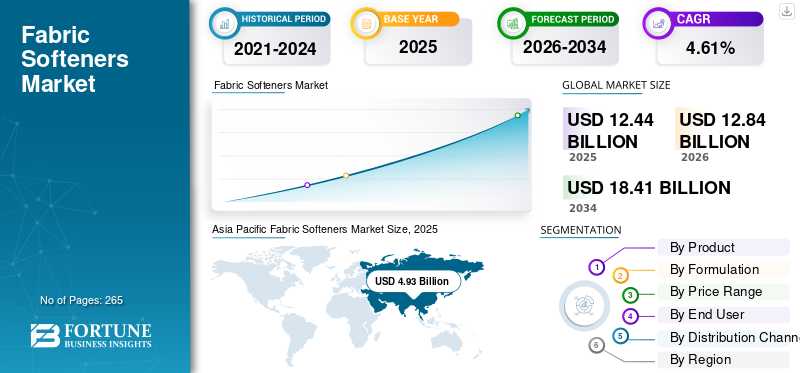
The global fabric softeners market size was valued at USD 12.44 billion in 2025. The market is projected to grow from USD 12.84 billion in 2026 to USD 18.41 billion by 2034, exhibiting a CAGR of 4.61% during the forecast period. Asia Pacific dominated the fabric softeners market with a market share of 39.63% in 2025.
The global fabric softener market is expected to grow at a steady pace, and the growth is attributed to growing urbanization, increased disposable incomes, and changing consumer preferences toward premium home care products. Based on industry estimates derived from detergent consumption patterns, more than 65–70% of households in developed countries use fabric conditioners, whereas usage in developing regions remains below 35%. Additionally, the high penetration of automatic washing machines—exceeding 60% in developed markets—continues to support demand for these products. Liquid softeners are more preferred since they are convenient and compatible with advanced machines. In addition to that, environmentally friendly options are increasingly being preferred nowadays. E-commerce is playing a key role in making the products easily available, which is further expanding market horizons.
Some of the key companies in the market include Unilever, Henkel, Procter & Gamble, Colgate-Palmolive, and Reckitt Benckiser. These players adopt multiple growth strategies to stay afloat in the industry landscape. The primary growth move involves a strong focus on product innovation and upgradation, such as plant-originated and concentrated formulations, along with fragrance enhancement technologies. Moreover, leveraging their strong brand value these players are actively penetrating developing markets through localized manufacturing and distribution networks.
Download Free sample to learn more about this report.
Fabric Softeners Market Key Takeaways
 Global Market Size & Forecast
- 2025 Market Size: USD 12.44 billion
- 2026 Market Size: USD 12.84 billion
- 2034 Forecast Market Size: USD 18.41 billion
- CAGR: 4.61% (2026–2034)
 Market Share
- Asia Pacific dominated the market with a 39.63% share in 2025.
- The tablets/pods segment is projected to register the fastest CAGR of 6.63% during the forecast period.
- The organic segment is anticipated to witness the fastest CAGR of 6.07% during the forecast period.
 Key Regional Highlights
Asia Pacific
Asia Pacific generated USD 4.93 billion in 2025 and is expected to maintain its leading position, growing at a 5.55% CAGR during the forecast period.
North America
North America reached USD 2.96 billion in 2025 and is projected to grow at a 3.56% CAGR during the forecast period.
Europe
Europe accounted for USD 3.22 billion in 2025, representing 25.90% of the global market.
U.S.
U.S. market reached USD 2.47 billion in 2025.
Japan
Japan market was valued at USD 0.88 billion in 2025.
Read More

FABRIC SOFTENERS MARKET TRENDS
Rising Demand for Sustainable and Plant-Based Fabric Softeners to be a New Market Trend
Consumer interest in conservation and stricter chemical usage rules has prompted an increase in customers’ choice for environmentally friendly fabric softeners. This shift in choice has also been brought about due to increased skin sensitivity, pollution levels, and the non-degradable characteristics of the old raw materials. There has thus been investment in green softener products, green detergents, and green packaging techniques. Corporations such as Unilever and Procter & Gamble have been diversifying their environmental product range in keeping up with this trend.
MARKET DYNAMICS
MARKET DRIVERS
Download Free sample to learn more about this report.
Increasing Washing Machine Penetration Driving Fabric Softener Adoption
The fast-growing trend of owning automatic washing machines, especially in developing countries, is causing an increase in the demand for fabric softeners. Rising urbanization, improving living standards, and greater access to electricity have made washing machines increasingly affordable for middle-class households. As a result, consumers are shifting from traditional washing methods to machine-based laundering, which drives the need for fabric softeners to maintain garment quality. Additionally, leading players such as LG Electronics and Samsung Electronics are expanding appliance availability, further supporting the fabric softeners market growth.
MARKET RESTRAINTS
Health Concern and Environmental Impact Limiting Consumer Adoption
The composition of fabric softeners, which largely includes chemical ingredients and synthetic fragrances, may lead to health concerns such as respiratory issues and skin irritation. This is a key factor limiting product adoption and, in turn, restraining overall market growth. With all the easy access to information available on the internet, consumers are well aware and conscious while making a purchase. Individuals with skin sensitivity are taking precautions, often shifting toward hypoallergenic substitutes. Moreover, poor biodegradability of certain chemical compounds and water pollution caused by these fabric softeners are attracting stricter regulatory mandates in many regions, further hampering market expansion.
MARKET OPPORTUNITIES
Expansion in Emerging Markets Creating Untapped Growth Potential
The low penetration rate in developing countries, typically under 30%, offers huge potential for further market penetration. Increased incomes, a growing urban population, and the use of washing machines have started leading consumers toward high-end laundry care products. With increased awareness of fabric care needs, new consumers who were not using any fabric softeners are now joining the market. Leading companies, including Unilever and Henkel, have started offering local and affordable products to tap this demand. This new consumer base will result in future volume and market growth.
MARKET CHALLENGES
Intense Price Competition and Private Label Pressure to Challenge Market Growth
The market is faced with stiff competition from low-priced private labels, especially in cost-conscious areas. With retailers now pushing in-house labels that perform equally well but at lower prices, consumers are likely to switch. This forces the dominant firms including Procter & Gamble and Henkel to reduce prices, making it hard for them to earn high profits. For this reason, firms have no option but to engage in more promotions and discounts in order to keep market share.
Segmentation Analysis
By Product
Convenience and Widespread Machine Compatibility Propelled Growth of Liquid Fabric Softeners Segment
By product, the market is segmented into liquid fabric softeners, dryer sheets, dryer bars, tablets/pods, and others.
The liquid fabric softeners segment dominated the fabric softeners market share, supported by its high compatibility with modern washing machines and ease of use. These products disperse evenly during rinse cycles, enhancing fabric softness, fragrance retention, and overall garment care, which makes them a preferred choice among consumers. Additionally, the increasing adoption of automatic washing machines and the availability of bulk packaging formats are driving higher consumption, reinforcing the segment’s leading position.
The tablets/pods segment is anticipated to rise at the fastest CAGR of 6.63% over the forecast period.
To know how our report can help streamline your business, Speak to Analyst
By Formulation
Cost Efficiency and Mass Availability Boosted Growth of Conventional Segment
Based on formulation, the market is divided into conventional and organic.
The conventional segment dominated the market mainly due to its strong performance in terms of fragrance longevity and softness, lower prices, and easy availability across channels. Large-scale production and established supply chains work in favor of these products, enabling economical pricing for mass-market consumers. Consequently, budget-conscious households tend to prefer traditional options over premium organic alternatives. Thus, affordability and accessibility sustain the dominance of the segment.
The organic segment is anticipated to rise at the fastest CAGR of 6.07% over the forecast period.
By Price Range
High Volume Consumption and Strong Affordability Strengthened Growth of Mass Segment
Based on price range, the market is divided into mass, mid-range, and premium.
The mass segment dominated the market, mainly driven by its widespread accessibility and affordability across both developed and developing regions. Price-sensitive consumers, particularly in high-population economies, opt for cheaper, cost-effective products for daily use, leading to higher sales volumes. The segment’s growth is further fortified by promotional pricing strategies and extensive retail distribution undertaken by leading market players.
The premium price range segment is anticipated to rise at the fastest CAGR of 5.36% over the forecast period.
By End User
Broad Consumer Base and High Frequency of Usage Fueled Growth of Household Segment
Based on end user, the market is divided into household, hospitality settings, laundry services, and others.
The household segment dominated the market share in light of the daily and recurring nature of laundry chores across a vast global consumer base. Growing hygiene-related awareness and rising penetration of washing machines have resulted in consistent demand for fabric softeners in residential set-ups. Consequently, product demand has remained constant and volume-driven compared to institutional buyers.
The hospitality settings segment is anticipated to rise at the fastest CAGR of 6.21% over the forecast period.
By Distribution Channel
Wide Consumer Reach and Strong In-Store Product Visibility Boosted Growth of Supermarket & Hypermarkets Segment
Based on distribution channel, the market is segmented into supermarkets & hypermarkets, convenience stores, specialty stores, online retail, and others.
The supermarket & hypermarkets segment held the dominant market share, driven by their wide consumer reach and strong in-store product visibility. These retail brick-and-mortar stores enable bulk purchasing, easy product comparison, and frequent discounts & promotions, prompting higher sales volume. Also, impulse purchasing behavior and the tendency to shop for one thing with others lead to the segment’s leading position.
The online retail segment is projected to grow at the CAGR of 7.48% during the forecast period.
Fabric Softeners Market Regional Outlook
By geography, the market is categorized into Europe, North America, Asia Pacific, South America, and the Middle East & Africa.
Asia Pacific
Asia Pacific Fabric Softeners Market Size, 2025 (USD Billion)
To get more information on the regional analysis of this market, Download Free sample
Asia Pacific dominated the global market, reaching USD 4.93 billion in 2025 and growing at a CAGR of 5.55% over the forecast period. The factors driving the market include urbanization, a rise in disposable income levels, and increased use of washing machines. Furthermore, the growing population of the middle classes and robust distribution network expansion by organizations such as Unilever and Procter & Gamble also drive market growth.
Japan Fabric Softeners Market
The Japanese market was valued at USD 0.88 billion in 2025, accounting for roughly 7.05% of global market revenues. Market growth in Japan can be attributed to consumers' preference for premium quality fabric softeners with added fragrances and established cultural practices for the maintenance of garments. Moreover, increased adoption of washing machines and constant innovation in the industry by brands including Lion Corporation contribute to market growth.
China Fabric Softeners Market
China’s market was valued at USD 2.57 billion in revenues in 2025, representing roughly 20.69% of global market sales.
India Fabric Softeners Market
The Indian market was valued at USD 0.46 billion in 2025, accounting for roughly 3.68% of global market revenues.
Europe
Europe held the second-largest share in 2025, valued at USD 3.22 billion and accounting for 25.90% of the global market. The European market for fabric softeners experiences tremendous demand for premium and environmentally friendly washing products, backed by high consumer awareness about the environment and strict regulatory policies. Growing preference for concentrated and skin-friendly formulas is adding momentum to product development and acceptance. Moreover, a strong presence through well-established distribution channels and brands, including those owned by Henkel and Unilever, contributes to steady market growth.
U.K. Fabric Softeners Market
The U.K. market reached USD 0.41 billion in 2025, representing roughly 3.29% of global market revenues.
Germany Fabric Softeners Market
Germany’s market reached USD 0.56 billion in 2025, equivalent to around 4.52% of global market sales.
North America
North America has emerged as a key region. It is projected to grow at a CAGR of 3.56% in the coming years, with the third-highest market share among all regions, reaching a valuation of USD 2.96 billion by 2025. The regional market growth is primarily supported by the widespread use of washing machines in more than 80% of homes, which motivates consumers to use fabric softeners regularly. The need for catering to diverse consumer preferences with luxury and fragrance-loaded laundry products plays a major role in enhancing the demand for fabric softeners. Moreover, increased acceptance of environmentally-friendly and allergy-free products has been instrumental in driving product development and replacement.
U.S. Fabric Softeners Market
With North America’s strong contribution and the U.S. dominance in the region, the U.S. market reached USD 2.47 billion in 2025, accounting for roughly 19.85% of global market sales. The country’s market development has been fueled by high penetration of automatic washing machines, strong consumer preference for premium scented laundry products, and continuous innovation by companies such as Procter & Gamble and Unilever.
South America and Middle East & Africa
The South America and Middle East & Africa regions are expected to witness moderate growth in this market during the forecast period. The South America market reached USD 0.84 billion in 2025. Rising urbanization, improving household incomes, and increasing adoption of automatic washing machines, which boost routine usage of fabric care products, drive the South America market growth.
UAE Fabric Softeners Market
The UAE market reached USD 0.03 billion in 2025.
South Africa Fabric Softeners Market
The South African market reached USD 0.08 billion in 2025, representing roughly 0.67% of global market revenues.
COMPETITIVE LANDSCAPE
Key Industry Players
Strategic Innovation and Market Expansion Shaping Competitive Dynamics
The competition among manufacturers in the fabric softeners industry is quite stiff, with major players concentrating on innovation, sustainability, and geographic expansion. For instance, Procter & Gamble, Unilever, and Henkel emphasize innovation by using sophisticated fragrances, concentrated formulas, and environmentally friendly chemicals. Strategic entry into new markets, especially developing countries, through localized production and pricing helps players increase their market share. In addition, collaborations with online marketplaces and digital marketing techniques facilitate increased consumer involvement.
LIST OF KEY FABRIC SOFTENERS COMPANIES PROFILED IN REPORT
- Procter & Gamble (U.S.)
- Unilever (Netherlands)
- Henkel (Germany)
- Colgate-Palmolive (U.S.)
- Reckitt Benckiser (U.K.)
- Kao Corporation (Japan)
- Church & Dwight (U.S.)
- C. Johnson & Son (U.S.)
- Lion Corporation (Japan)
- Godrej Consumer Products (India)
KEY INDUSTRY DEVELOPMENTS
- September 2024: Kao Corporation launched advanced eco-friendly fabric softeners in Japan with skin-sensitive formulations, targeting premium and sustainable product segments.
- May 2024: Reckitt Benckiser strengthened distribution footprint in Latin America and Southeast Asia through retail partnerships and localized product variants in home care categories.
- March 2024: Unilever expanded its Comfort range with upgraded fragrance encapsulation technology and concentrated formulations to enhance long-lasting freshness and reduce packaging waste.
- August 2023: Procter & Gamble introduced next-generation fabric enhancers with reduced water content and recyclable packaging under brands including Downy, aligning with circular economy goals.
- February 2023: Colgate-Palmolive expanded partnerships with e-commerce platforms to accelerate digital sales of home care and fabric conditioning products, improving direct-to-consumer reach.
REPORT COVERAGE
The global fabric softeners market analysis includes a comprehensive study of the market & forecast by all the market segments included in the report. This qualitative and quantitative report includes details on the market dynamics and trends that are expected to drive the market over the forecast period. It provides information on key aspects, including technological advancements and product launches. Additionally, it details partnerships, mergers & acquisitions, and key industry developments. The global report includes a detailed competitive landscape, including market share and profiles of key players.
Request for Customization to gain extensive market insights.
Report Scope & Segmentation
| ATTRIBUTE | DETAILS |
| Study Period | 2021-2034 |
| Base Year | 2025 |
| Estimated Year | 2026 |
| Forecast Period | 2026-2034 |
| Historical Period | 2021-2024 |
| Growth Rate | CAGR of 4.61% from 2026 to 2034 |
| Unit | Value (USD billion) |
| Segmentation | By Product, Formulation, Price Range, End User, Distribution Channel, and Region |
| By Product |
|
| By Formulation |
|
| By Price Range |
|
| By End User |
|
| By Distribution Channel |
|
| By Region |
|
Frequently Asked Questions
According to Fortune Business Insights, the global market value stood at USD 12.44 billion in 2025 and is projected to reach USD 18.41 billion by 2034.
In 2025, the North America’s market value stood at USD 2.96 billion.
The market is expected to grow at a CAGR of 4.61% over the forecast period.
By product, the liquid fabric softeners segment leads the market.
Rising global adoption of automatic washing machines coupled with increasing consumer preference for enhanced fabric care and long-lasting fragrance is a key driver fueling the growth of the market.
Unilever, Henkel, Procter & Gamble, Colgate-Palmolive, and Reckitt Benckiserare the top players in the global market.
Asia Pacific held the largest market share in 2025.



- 2021-2034
- 2025
- 2021-2024
- 265
-
(Offer valid till 15th Sep 2026)
Get 30-60 hrs Free Customization
Expand Regional and Country Coverage, Segments Analysis, Company Profiles, Competitive Benchmarking, and End-user Insights.



















-
US +1 833 909 2966 ( Toll Free )
-
Get In Touch With Us