 Download Free Sample



Get a Quote
Receive a tailored pricing based on your needs.
- Choose license type
- Multiple user options
- Custom scope & coverage
- Fast turnaround
"Designing Growth Strategies is in our DNA"
 Listen to Audio Version
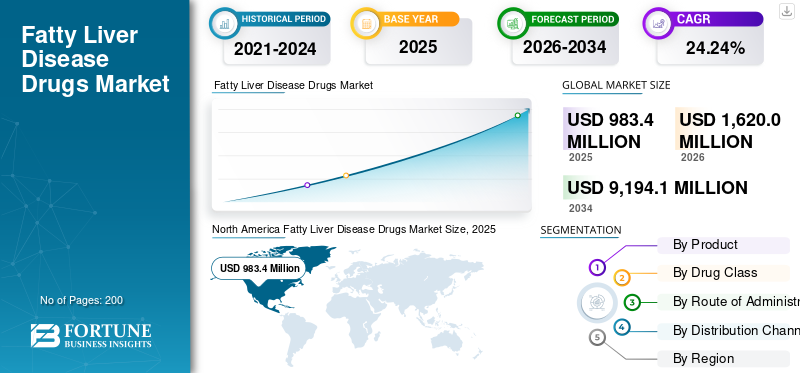
The global fatty liver disease drugs market size was valued at USD 983.4 million in 2025. The market is projected to grow from USD 1,620.0 million in 2026 to USD 9,194.1 million by 2034, exhibiting a CAGR of 24.24% during the forecast period.
The global market for fatty liver disease medications targets treatments for metabolic dysfunction-associated steatohepatitis (MASH), particularly in individuals with moderate to severe liver fibrosis. The market has transitioned from a pipeline-driven phase to an initial commercial phase as approved branded treatments are now accessible, enhancing physician confidence, payer interest, and treatment adoption. The growth of the market is bolstered by an increasing disease burden, improved identification of patients in the fibrosis stage, heightened use of non-invasive diagnostic methods, and enhanced commercial efforts in hepatology and metabolic care.
Major participants in the market consist of Madrigal Pharmaceuticals, Inc., Novo Nordisk, Inventiva, Akero Therapeutics, 89bio, Boehringer Ingelheim, Zealand Pharma, Viking Therapeutics, and Altimmune, among others. These firms are concentrating on liver-targeted oral treatments, GLP-1-related MASH therapies, FGF21-focused candidates, and various specific fibro-metabolic strategies to enhance their market standing.
Download Free sample to learn more about this report.
 Global Market Size & Forecast
 Market Share
 Key Regional Highlights
North America
Led the global market in 2025, driven by high obesity prevalence and early therapy adoption.
Europe
The market is projected to grow at a 56.46% CAGR during the forecast period.
Asia Pacific
Expected to witness the fastest regional growth due to a large patient pool and rising metabolic disorders.
U.S
The market is estimated at USD 1,553.1 million in 2026, accounting for 95.9% of the regional market.
Japan
Market growth is supported by increasing liver disease burden and expanding treatment adoption.
Read More

Rising Investment in Liver Disease Research is a Notable Market Trend
Increasing investment in liver disease research is emerging as a distinct market trend in the market, as companies allocate more funds to advanced-stage MASH programs, expanded geographic initiatives, and innovative combination approaches. This trend holds significance as increased research funding enhances the likelihood of new approvals, broadens treatment alternatives beyond initial products, and boosts long term trust among doctors, investors, and business partners. It also indicates that the market is now perceived not just as an early testing ground, but as a significant commercial sector with the potential for scalable profits. With increased funding directed toward Phase 3 trials, lifecycle expansion, and regional studies, the market pipeline grows deeper and more competitive. This, in turn, fosters future development in oral treatments, injectable fibro-metabolic therapies, and combination therapies for various stages of fibrosis. These factors are supporting the overall global market growth.
Download Free sample to learn more about this report.
Increasing Global Obesity Burden is Propelling Market Growth
The rising global obesity levels significantly propel the market, as obesity serves as one of the most prominent underlying risk factors for MASLD/MASH. With the increase in obesity, a greater number of patients experience insulin resistance, liver fat buildup, inflammation, and x, resulting in a heightened demand for specific drug therapies instead of relying solely on lifestyle changes. The commercial effect is significant as a larger obese demographic results in an expanded screening pool, a greater number of diagnosed moderate-to-advanced fibrosis patients, and a more robust long-term demand foundation for approved MASH treatments. Additionally, the anticipated treatment demographic for obesity-related liver disease is projected to significantly grow in both advanced and developing markets. All these factors cumulatively drive the global fatty liver disease drugs market growth.
High Clinical Trial Failure Rates to Hamper Market Growth
High clinical trial failure rates are a major restraint for the market as MASH/MASLD is a complex disease involving fat accumulation, inflammation, and fibrosis, which makes it difficult for one drug to deliver consistent results across endpoints. When trials fail, companies lose time, capital, and commercial confidence, which slows new product launches and delays market expansion. It also makes investors and partners more cautious, reducing funding momentum for smaller pipeline players. In addition, repeated failures make regulators and physicians expect stronger efficacy evidence, which raises the development bar for future candidates. This increases overall development risk and can limit the number of drugs that successfully reach commercialization, even in a high-need market. As a result, market growth remains dependent on a small number of validated products while many pipeline programs face uncertainty.
Increasing Partnerships and Collaborations to Offer Market Growth Opportunities
The rise in partnerships and collaborations is generating substantial growth potential in the market, as they enable companies to accelerate pipeline expansion, minimize development risk, and tap into new mechanisms without the need for complete internal development. This holds significance in MASH/MASLD as there remains a substantial unmet need in various fibrosis stages, cirrhosis, and combination therapy scenarios. Strategic partnerships enhance the pace of clinical development by uniting firms with complementary expertise in liver biology, metabolic diseases, and commercialization. With increased partnerships among companies, the market benefits from a wider array of products, enhanced innovation trends, and improved opportunities for introducing unique therapies. These partnerships are particularly important as the market progresses from initial approvals to advanced treatment approaches that involve combinations and next-generation solutions. This generates new revenue possibilities not just for endorsed brands, but also for upcoming pipeline assets aimed at more challenging patient groups.
Regulatory Uncertainties to Pose a Significant Challenge for Market Growth
Regulatory uncertainties pose a significant challenge for the market as companies continue to encounter changing approval criteria regarding endpoints, fibrosis staging, and validation of long-term outcomes in MASH/MASLD. This complicates commercialization, as a drug might demonstrate significant histology enhancement but require further proof before regulators are completely convinced. It also raises development expenses, as businesses frequently require more extensive and prolonged studies to back approval and post-approval obligations. This uncertainty can postpone launches in various regions, diminish payer confidence, and complicate revenue forecasting for both approved products and those in the pipeline. Moreover, varying regulatory timelines across the U.S., Europe, and other markets can prolong rollout strategies even with robust clinical data. Consequently, businesses need to allocate resources not only to effectiveness data, but also to regulatory planning, verification studies, and tracking long-term results, further affecting the market growth.
Regulatory Approvals and Commercial Uptake to Propel Rezdiffra (Resmetirom) Segment Growth
In terms of product, the market is divided into rezdiffra (resmetirom), wegovy (semaglutide), and others.
The rezdiffra (resmetirom) segment captured the largest global fatty liver disease drugs market share. It is the first therapy approved specifically for MASH with moderate to advanced fibrosis, giving it a strong first-mover advantage in this category. Its dominance is being supported by its early physician adoption in hepatology and gastroenterology settings, expanding reimbursement coverage, growing treatment-center activation, and rising awareness of fibrosis-targeted treatment in diagnosed MASH patients.
The wegovy (semaglutide) segment is anticipated to rise with a CAGR of 25.33% over the forecast period.
To know how our report can help streamline your business, Speak to Analyst
First-Mover Approval and Strong Commercial Performance to Support THR-beta Agonist Segment Dominance
On the basis of drug class, the market is divided into GLP-1 receptor agonist, THR-beta agonist, and others.
The THR-beta agonist segment accounted for the largest global market share in 2025. Its supremacy is reinforced by its liver-focused mechanism, which directly influences fat metabolism in the liver and aligns effectively with the treatment requirements of diagnosed MASH patients. The segment has also achieved robust initial acceptance since Rezdiffra is an oral treatment, simplifying its application in regular specialist care. Furthermore, THR-beta agonists presently have the benefit of being the most recognized drug class designed specifically for this purpose, whereas numerous rival classes are still broadening their approved uses or continue to be in development. Furthermore, the segment is set to hold 84.3% share in 2026.
The GLP-1 receptor agonist segment is expected to grow at the fastest CAGR of 25.33% over the forecast period.
Convenience and First-Mover Advantage Supported the Leading Position of Oral Segment
In terms of route of administration, the market is divided into parenteral and oral.
The oral segment captured the highest share of the global market in 2025. The segmental dominance is backed by its once-a-day tablet form, which is more convenient for patients to use and easier for doctors to prescribe in standard specialist treatment. Oral therapy enhances convenience in managing long-term diseases, which is crucial in chronic liver conditions where ongoing treatment and monitoring are essential. Furthermore, oral medications align effectively with practices in hepatology and gastroenterology, where easy-to-administer branded treatments are most likely to encourage broader adoption. Furthermore, the segment is set to hold 84.3% share in 2026.
The parenteral segment is anticipated to rise with a compound annual growth rate of 39.44% over the forecast period.
Specialty Dispensing Support and Early Access Pathways to Support Specialty Pharmacies & Others Segment Dominance
Based on distribution channel, the market is segmented into hospital pharmacies, retail pharmacies & drug stores, and specialty pharmacies & others.
In 2025, the specialty pharmacies & others segment held the leading position in the global market. This is owing to the fact that fatty liver disease drugs such as Rezdiffra are high-value branded therapies that need prior authorization support, reimbursement coordination, and patient onboarding. This makes specialty channels more suitable than standard retail outlets, especially in the early stage of market development. The segment also benefits from closer coordination between prescribers, payers, and support programs, which helps patients start treatment faster and remain on therapy. Furthermore, the segment is set to hold 59.7% share in 2026.
In addition, retail pharmacies & drug stores are projected to witness 28.60% growth rate during the forecast period.
Based on region, the market is separated into North America, Asia Pacific, Europe, and the Rest of the World.
North America Fatty Liver Disease Drugs Market Size, 2025 (USD Million)
To get more information on the regional analysis of this market, Download Free sample
The North America market reached USD 180.1 million in 2024 and led the global market. In 2025, the region continued to hold its leading position, with USD 983.4 million. The regional growth is primarily driven by high prevalence of obesity and diabetes, strong diagnosis rates for MASH/MASLD, and early access to branded therapies.
The U.S. market dominated the North American market and can be analytically approximated at around USD 1,553.1 million in 2026, accounting for roughly 95.9 % of the global market.
Europe market size is anticipated to grow at 56.46% CAGR during the forecast period. The region’s market growth is supported by rising awareness of MASLD, improving clinical guidance, and broader treatment adoption through hepatology-led care pathways.
Germany market size is projected to reach approximately USD 25.0 million in 2026, equivalent to around 1.5% of global sales.
The Asia Pacific market size is expected to grow at the fastest rate over the forecast period. The growth in this region is driven by the very large patient pool, rapid increases in obesity and metabolic disease, and the growing liver disease burden across major countries such as China, Japan, and India.
The growth is expected to come from rising prevalence of obesity, diabetes, and metabolic syndrome, along with gradual improvement in diagnosis and specialist liver care. The region also benefits from the global expansion of MASH drug development, which should improve future access once more products move beyond the U.S. and Europe.
Robust Commercial Leadership and Expanding Late-Stage Pipelines Strengthened Market Position of Key Companies
The global fatty liver disease drugs marketspace is highly consolidated in structure. Madrigal Pharmaceuticals, Inc. currently holds the leading market position as the company’s Rezdiffra was the first dedicated MASH therapy to gain regulatory approval and has already built early revenue and access momentum. Novo Nordisk is also strengthening its position through Wegovy’s U.S. MASH approval and its broader metabolic disease leadership through strategic initiatives.
Other notable players include F. Hoffmann-La Roche Ltd (89bio, Inc.), Inventiva, Boehringer Ingelheim International GmbH, and Viking Therapeutics. These companies are focusing on expanding the clinical pipeline to gain market presence.
The global fatty liver disease drugs market analysis encompasses an extensive examination of the market size and projections for all market segments featured in the report. It provides information on the market dynamics and trends that are anticipated to propel the market during the forecast period. It offers insights into crucial elements, such as innovations in products, the regulatory landscape, pipeline analysis, and the introduction of new products. Furthermore, it outlines collaborations, mergers & acquisitions, along with significant advancements in the industry within the market. The global market forecast report additionally offers a comprehensive competitive landscape with details on market share and profiles of major active participants.
Request for Customization to gain extensive market insights.
| ATTRIBUTE | DETAILS |
| Study Period | 2021-2034 |
| Base Year | 2025 |
| Estimated Year | 2026 |
| Forecast Period | 2026-2034 |
| Historical Period | 2021-2024 |
| Growth Rate | CAGR of 24.24% from 2026-2034 |
| Unit | Value (USD Million) |
| Segmentation | By Product, Drug Class, Route of Administration, Distribution Channel, and Region |
| By Product |
|
| By Drug Class |
|
| By Route of Administration |
|
| By Distribution Channel |
|
| By Region |
|
According to Fortune Business Insights, the global market value stood at USD 983.4 million in 2025 and is projected to reach USD 9,194.1 million by 2034.
In 2025, the market value stood at USD 983.4 million.
The market is expected to exhibit a CAGR of 24.24% during the forecast period.
By product, the rezdiffra (resmetirom) segment is expected to lead the market.
The rising disease burden, better identification of fibrosis-stage patients, growing use of non-invasive diagnostic pathways, and stronger commercial activity in hepatology and metabolic care are key driving factors for the global market expansion.
Madrigal Pharmaceuticals, Inc. and Novo Nordisk are some of the prominent players in the global market.
North America dominated the market in 2025.

Get 30-60 hrs Free Customization
Expand Regional and Country Coverage, Segments Analysis, Company Profiles, Competitive Benchmarking, and End-user Insights.













.webp)






Related Reports
Get In Touch With Us
US +1 833 909 2966 ( Toll Free )
Receive a tailored pricing based on your needs.
Discuss your questions with our industry experts.
Have questions? Get quick answers before you purchase.

