Flavonoids Market Size, Share & Industry Analysis, By Product Type (Flavanols, Flavonols, Isoflavones, Anthocyanins, and Others), By Source (Tea-Derived, Soy-Derived, Citrus-Derived, and Others), By Application (Food & Beverages, Dietary Supplements, Pharmaceuticals, Cosmetics & Personal Care, and Others), and Regional Forecast, 2026-2034
 Download Free Sample
(Offer valid till 31st Oct 2026)

Flavonoids Market Size and Future Outlook
 Listen to Audio Version
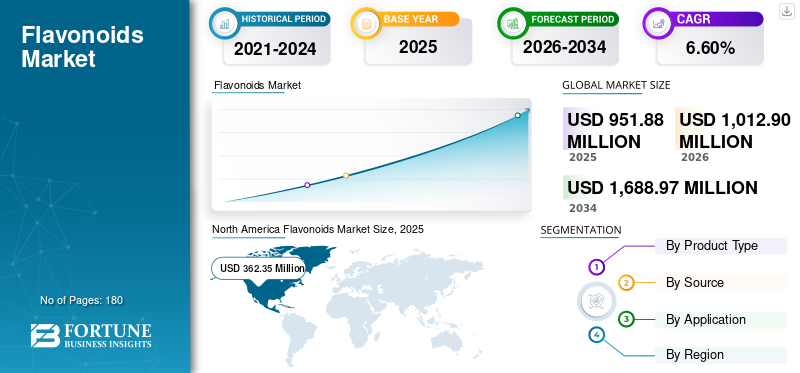
The global flavonoids market size was valued at USD 951.88 million in 2025. The market is projected to grow from USD 1,012.90 million in 2026 to USD 1,688.97 million by 2034, exhibiting a CAGR of 6.60% during the forecast period. North America dominated the flavonoids market with a market share of 38.06% in 2025.
Flavonoids belong to a class of polyphenolic plant secondary metabolites that are found in wine, tea, fruits, and vegetables. They are crystalline in nature, odorless, and bitter in taste. A few common types of flavonoids include flavonols, isoflavones, anthocyanins, and flavones. In terms of health benefits, they are known to have anti-carcinogenic, neuroprotective, and cardioprotective properties. Moreover, it improves immune function and minimizes the risk of diabetes. Geographically, North America and the Asia Pacific are the leading consumers, which supports demand for flavonoids.
Companies such as Givaudan, Nexira, and Sabinsa Corporation are prominent players in the market. New product launches are a pivotal strategy adopted by key players to improve their positions.
Download Free sample to learn more about this report.
Flavonoids Market KEY TAKEAWAYS
 Market Size & Forecast
- 2025 Market Size: USD 951.88 million
- 2026 Market Size: USD 1,012.90 million
- 2034 Forecast Market Size: USD 1,688.97 million
- CAGR: 6.60% from 2026–2034
 Market Share
- North America dominated the flavonoids market with a 38.06% share in 2025.
- The anthocyanins segment is projected to witness strong growth at a CAGR of 9.76% in 2026.
- The cosmetics & personal care segment is projected to grow at a CAGR of 10.29% in 2026.
 Key Regional Highlights
Asia Pacific
Asia Pacific led the global market in 2025, reaching a valuation of USD 362.35 million.
North America
North America was valued at USD 241.10 million in 2025, making it the second-largest regional market.
Europe
Europe reached USD 194.85 million in 2025 and is expected to grow steadily in the coming years.
U.S.
U.S. Growing consumer preference for functional foods and dietary supplements is supporting flavonoids market growth.
Japan
Japan Increasing demand for health-focused food and beverage products is driving flavonoids market expansion.
Read More

FLAVONOIDS MARKET TRENDS
Surging Use of Flavonoids in Personal Care Products is an Ongoing Trend
The global market is witnessing a trend of flavonoid-based skincare items. Today, most individuals are moving towards antioxidant-rich, plant-centric formulations, which can be achieved through flavonoid use. These ingredients (quercetin, anthocyanins), when incorporated into cosmetics, offer antioxidant properties. Moreover, few flavonoids are utilized to improve skin firmness and minimize the appearance of wrinkles. Additionally, it reduces the risk of skin irritation and inflammation, which fuels its adoption. Besides this, flavonoids enhance skin hydration and protect the outer skin layer from pollution. Seeing these advantages, companies in the market are aiming to launch new personal care products infused with botanical extracts.
MARKET DYNAMICS
MARKET DRIVERS
Download Free sample to learn more about this report.
Rising Demand for Natural/Clean-Label Ingredients Fuels the Market's Growth Potential
The surging demand for clean-label and natural ingredients is a key driver of the market's potential. In today's era, most individuals are paying attention to component lists and favor finished products that are free of artificial colorants and additives. To cater to this demand, producers are incorporating flavonoids in the production of culinary applications. In the beverage and food processing sector, catechins replace synthetic antioxidants in functional products, while anthocyanins are widely utilized as natural colorants. In the supplements sector, these ingredients are known to enhance blood sugar and lipid levels while reducing low-density lipoproteins. Moreover, it minimizes the risk of neurodegenerative diseases including Parkinson's and Alzheimer's.
MARKET RESTRAINTS
Fluctuations in Raw Material Production and Stability Concerns in Food Applications to Hinder Market's Momentum
One of the key challenges in the global flavonoid market growth is variations in raw ingredients production. Globally, flavonoids are majorly extracted from plant-centric sources such as berries, tea leaves, grapes, and soybeans. This heavy reliance on agricultural resources exposes ingredients (anthocyanins, isoflavones, and flavanols) to numerous risks, including geopolitical factors, crop diseases, and weather fluctuations. Moreover, pest outbreaks, extreme rainfall, and sudden changes in rainfall can substantially hamper the quality and yield of botanical ingredients. Another main hurdle in the industry is the instability in culinary applications. Few flavonoids, particularly anthocyanins, are sensitive to oxygen, light, and heat. This scenario, especially in the food and beverage sector, can lead to reduced functional activity and color degradation.
MARKET OPPORTUNITY
Technological Advancements to Create Growth Prospects for the Market
The adoption of various technologies in the ingredients sector unlocks a range of growth opportunities. To improve purity and yield, global producers are adopting advanced extraction technologies, such as enzyme-assisted extraction, supercritical fluid extraction, and ultrasound-assisted extraction. Upgradation of microencapsulation and nanoemulsion systems is gaining traction globally, as they are known to enhance stability and absorption in the human body. Moreover, advancements in filtration systems and chromatographic separation allow businesses to attain precise standardization of active components. In addition, analytical tools such as mass spectrometry and High-Performance Liquid Chromatography (HPLC) are used to validate label claims and strengthen quality control.
Segmentation Analysis
By Product Type
Flavanols Lead in the Market Due to Their Better Stability in Some Formulations
Based on the product type, the market is distributed into flavanols, flavonols, isoflavones, anthocyanins, and others.
The flavanols dominated the global market in 2025. Compared with other flavonoid subclasses, flavanols are widely used in fortified dairy products, supplements, confectionery, and functional drinks. This ingredient has strong evidence to support antioxidant activities and cardiovascular health, which fuels its popularity. Additionally, it has improved stability in certain formulations, further bolstering segment growth. Moreover, cocoa and tea, which are the main sources of flavanols, are produced on a larger scale, whereas anthocyanins rely on berries, which are dependent on the season.
The anthocyanins are projected to grow at a high CAGR of 9.76% over the forecast period.
By Source
Tea-Derived Segment Dominated the Market Due to Its Consumer Familiarity and Better Acceptance Rate
Depending on the source, the market is segmented into tea-derived, soy-derived, citrus-derived, and others.
In 2025, the tea-derived category led the source segment as tea is recognized to be one of the widely traded and cultivated crops globally, with considerable production across Sri Lanka, China, and India. The flavonoids derived from tea, specifically catechins, are widely utilized across functional foods, supplements, and ready-to-drink beverages. Moreover, it has a lower risk of allergens and hormonal sensitivity concerns, which have propelled its acceptance rate. Additionally, tea-derived flavonoids have improved formulation stability compared to those from berry sources. Along with this, it has better consumer familiarity, further boosting its usage.
The other segment is projected to grow at a high CAGR of 8.59% over the forecast period.
To know how our report can help streamline your business, Speak to Analyst
By Application
Dietary Supplements Led the Market Owing to High Use of Flavonoids in Health Supplements
Based on application, the market is distributed into food & beverages, dietary supplements, pharmaceuticals, cosmetics & personal care, and others.
In 2025, dietary supplements dominated 2025. Compared to cosmetics and food and beverages, flavonoids, when incorporated into supplements, pose lower sensory impact and stability concerns. Moreover, it provides precise dosage control in supplement formats, which further propels its utilization rate. Additionally, the use of new blends of flavonoids in dietary supplements strengthens innovation chances. Besides this, it has reduced regulatory barriers compared to pharmaceuticals, ultimately propelling the segment's growth.
The cosmetics & personal care segment is projected to grow at a high CAGR of 10.29% over the forecast period.
Flavonoids Market Regional Outlook
By geography, the market is studied across North America, Europe, Asia Pacific, Middle East & Africa, and South America.
Asia Pacific
North America Flavonoids Market Size, 2025 (USD Million)
To get more information on the regional analysis of this market, Download Free sample
The Asia Pacific region dominates globally and reached USD 362.35 million in 2025. The increasing health consciousness and growing inclination towards functional foods and beverages are key factors boosting the region's potential. In the region, India and China are both reached USD 61.74 million and USD 154.29 million, respectively, in 2025.
India Flavonoids Market
The India market in 2025 is estimated at around USD 61.74 million, accounting for roughly 6.49% of the global market revenues.
The rising number of health-conscious consumers and the surging demand for clean-label products are driving the country’s market growth.
China Flavonoids Market
China's market is projected to be one of the largest globally, with revenues reaching around USD 154.29 million in 2025, accounting for roughly 16.21% of global market sales.
Japan Flavonoids Market
The Japan market in 2025 touching USD 65.69 million, accounting for approximately 6.90% of the global market revenues.
North America
The North America market reached the valuation of USD 241.10 million in 2025 and holds the second position globally. The market in North America is expected to grow due to the increasing consumer awareness of health claims and rising demand for natural ingredients, enriched food and beverage products. Moreover, the new product launches and improved infrastructure are driving regional growth.
U.S. Flavonoids Market:
Based on North America's strong contribution and the U.S. dominance within the region, the U.S. market was valued at around USD 195.71 million in 2025, accounting for roughly 20.56% of global market sales.
Europe
Europe was valued at USD 194.85 million by 2025, recording a growth rate of 5.62% in the coming years, and secured the third position. The rising awareness of health promoting properties and enhanced awareness of plant-centric ingredients are propelling the region's growth potential.
Germany Flavonoids Market
The Germany market in 2025 has touched USD 43.69 million, representing roughly 4.59% of the global market revenues.
U.K. Flavonoids Market
The U.K. market is reached approximately USD 32.73 million in 2025, equivalent to around 3.44% of the global market sales.
South America and the Middle East & Africa
The South America and Middle East & Africa regions are expected to witness moderate growth in this market space during the forecast period. The South America market reached a valuation of USD 91.51 million in 2025. The growing awareness of antioxidant and anti-inflammatory properties and surging demand for flavonoid rich products are expected to drive demand in the regional market. The Middle East and Africa market is reached USD 62.07 million in 2025.
South Africa Flavonoids Market
The South Africa market is touched around USD 24.09 million in 2025, representing roughly 2.53% of global market revenues.
COMPETITIVE LANDSCAPE
Key Industry Players
New Product Launches to Key Industry Players to Improve Their Market Positions
The market exhibits a fragmented structure, with intense competition among market players operating in this segment. In the market, the key companies are primarily adopting new product launches as their main strategy. Through this approach, players can cater to rising consumer demands and enhance their brand image.
LIST OF KEY FLAVONOIDS COMPANIES PROFILED
- Indena S.p.A. (Italy)
- Givaudan (Switzerland)
- Martin Bauer Group (Germany)
- Nexira (France)
- Kemin Industries (U.S.)
- Xi'an Natural Field Bio-Technique Co., Ltd. (China)
- Chengdu Wagott Pharmaceutical Co., Ltd. (China)
- Sabinsa Corporation (U.S.)
- Layn Natural Ingredients (China)
- Hunan Nutramax Inc. (China)
KEY INDUSTRY DEVELOPMENTS
- July 2025: Wel-Bloom Biotech, a renowned jelly supplement producer in Taiwan, hosted a seminar on anthocyanins with the Taiwanese nutritionist team, "LEARN EATiNG." This event showcased trending ingredients along with its black crystal roselle.
- February 2023: Evonik, a specialty chemicals firm in Germany, released a new plant-centric premix, "PhytriCare IM" which contains plant extracts with high flavonoid content.
- January 2023: Amorepacific Corporation, a South Korean skincare conglomerate, launched Laneige anti-ageing serum that comprises a bioflavonoid ingredient.
- March 2022: Taiyo Kagaku Co., Ltd., a Japanese enterprise introduced SunActive IsoQ, a quercetin precursor ingredient that is water-soluble. This product is commercialized in the U.S. market through a distribution partner.
REPORT COVERAGE
The global flavonoids market provides an in-depth study of the market size & forecast by all the market segments included in the flavonoid market reports. The global market forecast analysis includes details on the market dynamics and market trends expected to drive the market during the forecast period. The global market analysis offers information on the technological advancements, new product launches, key industry developments, and details on partnerships, mergers & acquisitions. The industry market forecast also encompasses a detailed competitive landscape with information on the market segmentation, market share, and profiles of key operating players.
Request for Customization to gain extensive market insights.
Report Scope & Segmentation
| ATTRIBUTE | DETAILS |
| Study Period | 2021-2034 |
| Base Year | 2025 |
| Estimated Year | 2026 |
| Forecast Period | 2026-2034 |
| Historical Period | 2021-2024 |
| Growth Rate | CAGR of 6.60% from 2026-2034 |
| Unit | Value (USD Million) |
| Segmentation | By Product Type, Source, Application, Region |
| By Product Type |
|
| By Source |
|
| By Application |
|
| By Region |
|
Frequently Asked Questions
Fortune Business Insights says that the global market value stood at USD 951.88 million in 2025 and is projected to reach USD 1,688.97 million by 2034.
In 2026, the market value is set to touch USD 390.74 million.
The market is expected to exhibit a CAGR of 6.60% during the forecast period.
By source, the tea-derived segment led the global market in 2025.
Rising demand for natural/clean-label ingredients fuels the market's potential.
Givaudan, Nexira, and Sabinsa Corporation are among the top players in the market.
Asia Pacific held the largest market share in 2025.
Surging use of flavonoids in personal care products is an ongoing trend.



- 2021-2034
- 2025
- 2021-2024
- 180
-
(Offer valid till 31st Oct 2026)
Get 30-60 hrs Free Customization
Expand Regional and Country Coverage, Segments Analysis, Company Profiles, Competitive Benchmarking, and End-user Insights.



















Related Reports
-
US +1 833 909 2966 ( Toll Free )
-
Get In Touch With Us