Functional Sugar Market Size, Share & Industry Analysis, By Type (GOS, FOS/Oligofructose, Allulose, and Lactulose), By Function (Prebiotic & Digestive Health, Low-Calorie Sweetening, and Pharmaceutical Functionality), By Form (Dry Powder, Liquid Concentrates, and Granules/Flakes), By Source (Dairy-Derived, Corn/Starch-Derived, and Sugar Beet/Sugarcane-Derived), By Processing Technology (Enzymatic Conversion, Hybrid Processing, and Extraction & Purification), By Application (Food & Beverages, Infant Nutrition, and Dietary Supplements & Nutraceuticals), and Regional Forecast, 2026-2034
 Download Free Sample
(Offer valid till 30th Sep 2026)

Functional Sugar Market Size and Future Outlook
 Listen to Audio Version
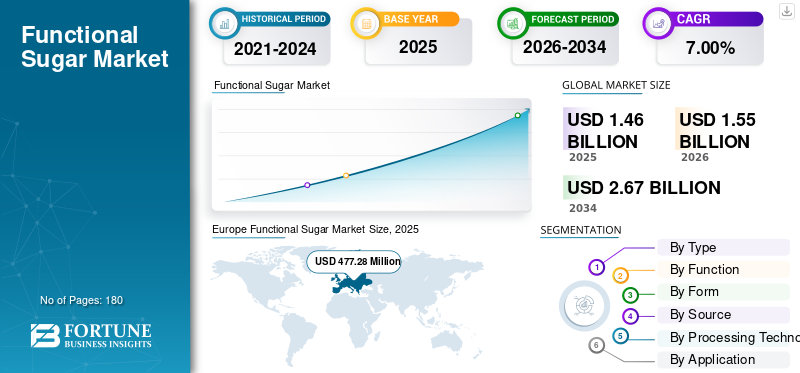
The global functional sugar market size was valued at USD 1,464.89 million in 2025. The market is projected to grow from USD 1,557.76 million in 2026 to USD 2,677.20 million by 2034, exhibiting a CAGR of 7.00% during the forecast period. Europe dominated the functional sugar market with a market share of 32.58% in 2025.
The functional sugar industry includes specialty sugars and sugar-based ingredients that do more than add sweetness. They also provide benefits such as a low glycemic response, prebiotic effects, digestive support, energy control, improved texture, and stable formulations. These ingredients include isomalto-oligosaccharides, fructo-oligosaccharides, galacto-oligosaccharides, allulose, tagatose, palatinose/isomaltulose, trehalose, and other specialty carbohydrates used in food, beverages, dietary supplements, infant nutrition, sports nutrition, and pharmaceutical formulations.
The market is expanding as manufacturers look for ways to cut down on regular sugar but still keep the same taste, texture, bulk, browning, and processing qualities in their products. There is the most demand for these ingredients in low-sugar foods, functional drinks, gut-health products, nutrition for people with diabetes, and clean-label sweeteners. Health-focused sweeteners are gaining traction as manufacturers reformulate products to reduce conventional sugar while maintaining desirable taste, mouthfeel, and processing performance.
BENEO GmbH, FrieslandCampina Ingredients, and Tereos are some of the key players in the market. New product launches are the key strategy that is boosting market expansion.
Download Free sample to learn more about this report.
FUNCTIONAL SUGAR MARKET TRENDS
Enzymatic Conversion, Prebiotic Positioning, and Sugar-System Blending Reshape Functional Sugar Innovation
The market is moving toward multifunctional sugar systems that combine sweetness, nutrition claims, and processing performance. Suppliers are using enzymatic conversion and fermentation technologies to improve production efficiency for allulose, tagatose, rare sugars, and oligosaccharides. Product developers are mixing functional sugars with fibers, polyols, high-intensity sweeteners, and natural sweeteners to create a balanced taste and texture. Prebiotic benefits are becoming more important in drinks, dairy, supplements, and infant nutrition. At the same time, low-glycemic and sustained-energy claims are growing in sports and wellness products. Innovation is moving away from just replacing sugar and toward creating carbohydrate systems designed for specific health and product goals. Growing demand for plant-based foods and beverages is increasing the adoption of functional sugars that provide sweetness, bulk, and texture while supporting clean-label and dairy-free product formulations.
MARKET DYNAMICS
MARKET DRIVERS
Download Free sample to learn more about this report.
Rising Demand for Sugar Reduction and Low-calorie Reformulation Support Market Growth
More food and beverage companies are using functional sugars as they look for ways to cut regular sugar but keep the same sweetness, texture, browning, and processing qualities. Ingredients such as allulose, tagatose, isomaltulose, trehalose, FOS, GOS, and IMO help brands promote products as having a low glycemic impact, providing steady energy, supporting gut health, and offering better nutrition. Functional sugars, unlike high-intensity sweeteners, add texture, body, and help with fermentation. This makes them especially useful in baked goods, dairy, drinks, candy, nutrition bars, and supplements, supporting the functional sugar market growth.
|
Rank |
Market Drivers |
Overall Impact Rank |
CAGR Contribution (2026-2034) |
Impact 2026-2028 |
Impact 2029-2031 |
Impact 2032-2034 |
|
1 |
Rising demand for sugar reduction and low-calorie reformulation in food and beverages |
High |
+2.25% |
High |
High |
High |
|
2 |
Expansion of prebiotic, gut-health, and digestive wellness products |
High |
+2.00% |
High |
High |
High |
|
3 |
Growth of functional beverages, sports nutrition, and active nutrition formats |
Medium-High |
+1.35% |
Medium |
High |
High |
|
4 |
Increasing use in infant nutrition, clinical nutrition, and pharmaceutical applications |
Medium |
+1.05% |
Medium |
Medium |
High |
|
5 |
Commercial scale-up of rare sugars and specialty oligosaccharides such as allulose, tagatose, and XOS |
Medium-Low |
+0.75% |
Medium |
Medium |
High |
|
6 |
Others (clean-label reformulation, improved ingredient distribution, pet nutrition use, cosmetics, and technical applications) |
Low |
+0.35% |
Low |
Low |
Low |
|
|
Total Positive Growth Contribution |
|
+7.75% |
|
|
|
MARKET RESTRAINTS
Regulatory Variation and Digestive Tolerance Concerns Slow Wider Functional Sugar Commercialization
The market faces challenges such as inconsistent regulatory approvals, differences in labeling, digestive tolerance limits, and higher costs. Different regions have their own rules for functional sugars, making it harder to launch products globally and make consistent nutrition claims. Some countries require special approval for certain ingredients, set limits on how much can be used, or have strict labeling rules to follow local laws. Digestive tolerance is another issue, especially with oligosaccharides and low-digestible carbohydrates. Using too much of these can lead to bloating or discomfort. It costs more to produce these ingredients than regular sugar, especially when they are made with enzymes or fermentation.
|
Rank |
Market Restraints |
Overall Impact Rank |
Negative CAGR Contribution (2026-2034) |
Impact 2026-2028 |
Impact 2029-2031 |
Impact 2032-2034 |
|
1 |
High production cost and price premium over commodity sugars and sweeteners |
High |
-0.35% |
High |
Medium |
Medium |
|
2 |
Regulatory uncertainty and approval delays for selected rare sugars across major markets |
Medium |
-0.25% |
Medium |
Medium |
Low |
|
3 |
Limited production scale and supply concentration for specialty functional sugars |
Medium |
-0.10% |
Medium |
Medium |
Low |
|
4 |
Others (formulation challenges, digestive tolerance limits, labeling complexity, and competition from polyols and high-intensity sweeteners) |
Low |
-0.05% |
Low |
Low |
Low |
|
|
Total Negative Growth Impact |
|
-0.75% |
|
|
|
MARKET OPPORTUNITIES
Gut-Health, Low-Glycemic, and Clean-Label Reformulation Create High-Value Growth Pathways
Major opportunities are emerging in functional beverages, dairy products, infant nutrition, sports nutrition, diabetic-friendly foods, dietary supplements, confectionery, bakery, and nutrition bars.
Prebiotic sugars such as FOS, GOS, and IMO can support gut-health positioning, while allulose, tagatose, and isomaltulose create opportunities in low-sugar and sustained-energy products. Manufacturers can use functional sugars to replace part of conventional sugar while maintaining product body and sensory quality. Demand for value-added sugar ingredients is rising as food manufacturers seek multifunctional carbohydrates that combine sweetness with nutritional, technological, and formulation advantages, creating opportunity for market growth.
Segmentation Analysis
By Type
FOS/Oligofructose Segment Led Market Due to Broad Prebiotic Functionality and Wide Food Industry Adoption
By type, the market is segmented into GOS, FOS/Oligofructose, Allulose, Lactulose, Trehalose,
Isomaltulose, XOS, Tagatose, and others.
The FOS/Oligofructose segment held the largest functional sugar market share in 2025, as they combine moderate sweetness with well-established prebiotic functionality and excellent processing versatility. The food and beverage industry widely incorporates FOS into dairy products, nutritional beverages, bakery products, cereals, confectionery, dietary supplements, and functional foods to improve digestive health while simultaneously reducing sugar content.
The GOS holds the second-largest market share and is expected to grow at a CAGR of 7.36% during the forecast period. They are extensively used in infant nutrition, clinical nutrition, dairy products, and digestive health formulations. GOS closely resembles naturally occurring human milk oligosaccharides in supporting beneficial intestinal microbiota, making it one of the most widely accepted functional carbohydrates in infant formula. The ingredient is also increasingly incorporated into yogurt, fermented dairy products, dietary supplements, and functional beverages targeting digestive wellness.
To know how our report can help streamline your business, Speak to Analyst
By Function
Growing Focus on Gut Microbiome Support Boosted Prebiotic & Digestive Health Segment Growth
Based on function, the market is segmented into prebiotic & digestive health, low-calorie sweetening, pharmaceutical/therapeutic functionality, low-glycemic/sustained energy release, texture, moisture & stability enhancement, biotech/technical stabilization, and others.
The prebiotic & digestive health segment accounted for the largest market share in 2025. Food manufacturers increasingly utilize functional sugars to selectively stimulate beneficial gut bacteria while providing additional formulation benefits such as bulking, moisture retention, and mild sweetness. Ingredients, including FOS, GOS, and IMO, are widely incorporated into dairy products, nutritional beverages, cereals, supplements, and functional snacks to support digestive wellness.
The low-calorie sweetening segment holds the second-largest market share and is expected to grow at a CAGR of 6.81% during the forecast period. Functional sugars such as allulose, tagatose, and isomaltulose help lower calories and also give foods a good texture, browning, and mouthfeel. These qualities are hard to get with only high-intensity sweeteners. Natural carbohydrate extracts are increasingly incorporated into functional food formulations as manufacturers respond to consumer preference for naturally sourced ingredients with added nutritional benefits.
By Form
Dry Powder Led Market Due to Its Superior Stability and Global Supply Chain Efficiency
By form, the market is segmented into dry powder, liquid concentrates, granules/flakes, and paste slurry.
The dry powder segment led the global market in 2025. It provides excellent storage stability, long shelf life, simplified transportation, and compatibility with industrial food manufacturing. Powdered functional sugars are easier to blend into dry formulations, nutritional premixes, infant formula, bakery ingredients, powdered beverages, and dietary supplements while reducing transportation and storage costs.
The liquid concentrates segment is set to register a CAGR of 6.91% during the forecast period. They simplify ingredient incorporation into beverages, dairy products, syrups, liquid nutritional products, and continuous food processing operations. Liquid sugar eliminates dissolution steps, improves ingredient dispersion, and enhances manufacturing efficiency for high-volume production facilities.
By Source
Sugar Beet/Sugarcane-Derived Segment Dominated Market Due to Established Sugar Processing Infrastructure
By source, the market is segmented into dairy/lactose-derived, corn/maize/starch-derived, sugar beet/sugarcane-derived, plant fiber/hemicellulose-derived, wheat-derived, and others.
The sugar beet/sugarcane-derived segment accounted for the largest market share in 2025. They benefit from well-developed global sugar industries, abundant raw material availability, and mature carbohydrate conversion technologies. These feedstocks serve as the primary starting materials for producing FOS, allulose, isomaltulose, tagatose, and numerous specialty carbohydrates through enzymatic and biochemical processing. Existing sugar processing infrastructure also facilitates capacity expansion and cost-efficient manufacturing, reinforcing their leadership within the functional sugar industry.
The dairy/lactose-derived segment led the second largest share in 2025 and is expected to register a CAGR of 7.23% during the forecast period. Lactose serves as the principal substrate for producing galacto-oligosaccharides through enzymatic conversion. These ingredients are particularly important in infant nutrition, medical nutrition, dairy products, and digestive health applications where GOS provides clinically supported prebiotic functionality.
By Processing Technology
High Production Efficiency and Product Consistency Led to Enzymatic Conversion Segment Dominance
By processing technology, the market is segmented into enzymatic conversion, hybrid processing, extraction & purification, chemical/catalytic isomerization, fermentation/bioconversion, and others.
The enzymatic conversion segment led the global market in 2025, as it enables highly selective carbohydrate modification under controlled processing conditions while maintaining excellent product purity and functionality. Manufacturers rely on sugar reformulation technology to produce FOS, GOS, allulose, isomaltulose, and other specialty sugars with consistent quality and scalable industrial yields. Compared with conventional chemical processing, enzymatic methods provide greater specificity, improved process efficiency, and reduced formation of undesirable by-products.
The hybrid processing segment is expected to grow at a CAGR of 6.90% during the forecast period. Manufacturers increasingly combine enzymatic conversion with membrane filtration, chromatography, fermentation, and purification technologies to improve ingredient purity, process efficiency, and commercial yield. Hybrid systems enable production of higher-value specialty carbohydrates while meeting strict food safety and regulatory standards.
By Application
Large-Scale Product Reformulation Boosted Leadership of Food & Beverage Applications
By application, the market is segmented into food and beverages, infant nutrition, dietary supplements & nutraceuticals, pharmaceuticals & clinical nutrition, biotechnology & technical applications, animal nutrition, and personal care & cosmetics.
The food and beverages segment led the global market in 2025. Functional sugar is increasingly incorporated into dairy products, beverages, bakery products, confectionery products, cereals, nutritional snacks, and functional foods to reduce sugar while enhancing nutritional value and processing performance. These ingredients give foods sweetness, texture, moisture, browning, and can also support digestive health. As more people look for foods with less sugar, simple ingredients, and gut health benefits, more food companies are using functional sugars in their products. Bioactive sugar ingredients are becoming increasingly important in functional food development.
The infant nutrition segment is expected to grow at a CAGR of 7.07% during the forecast period. More infant formula makers are adding prebiotic carbohydrates to better match the benefits of human milk and help with babies’ digestive development. Dairy-derived oligosaccharides are witnessing growing demand in infant nutrition and clinical nutrition.
Functional Sugar Market Regional Outlook
By geography, the market is categorized into Europe, North America, Asia Pacific, South America, and the Middle East & Africa.
Europe
Europe Functional Sugar Market Size, 2025 (USD Million)
To get more information on the regional analysis of this market, Download Free sample
Europe led the market with USD 477.28 million in 2025, and it is the leading region globally. In Europe, strict sugar-reduction rules, a preference for clean labels, more focus on digestive health, and strong demand for ingredients in infant nutrition all shape the market. Germany, France, the U.K., Italy, Spain, and the Netherlands are key markets thanks to their strong dairy, bakery, beverage, confectionery, and infant formula industries. European manufacturers focus on ingredients backed by science, claims that meet regulations, digestive tolerance, and using natural sources.
Germany Functional Sugar Market
The market in Germany in 2025 reached around USD 105.89 million, representing roughly 7.23% of global revenues. In Germany, the market is influenced by consumer demand, a focus on digestive health, and a desire for nutrition backed by science. Manufacturers focus on making claims that meet regulations, ensuring their products are easy to digest, using clean-label ingredients, and offering carbohydrates that are seen as natural. Low-calorie sugars are becoming more popular, but whether they catch on depends on getting ingredient approvals and whether consumers accept them.
U.K. Functional Sugar Market
The U.K. market demand reached approximately USD 54.95 million in 2025, equivalent to around 3.75% of global market sales. Rising consumer awareness about functional food products supports market growth.
Asia Pacific
Asia Pacific market was valued at USD 462.16 million in 2025. This growth is driven by more processed food consumption, higher demand for infant nutrition, new diabetic-friendly products, and greater awareness of gut health. China, Japan, India, South Korea, Australia, and Southeast Asia are the main areas where demand is highest. Growth in the region relies on affordable prices, getting regulatory approval, adapting tastes to local preferences, and suppliers being able to meet the needs of large beverage, dairy, bakery, and nutrition companies.
India Functional Sugar Market
The India market in 2025 was valued around USD 39.73 million, accounting for roughly 2.71% of global revenues. Increasing diabetes prevalence is encouraging food and beverage manufacturers to adopt functional sugars that support reduced-sugar formulations and improved glycemic management.
China Functional Sugar Market
China’s market in 2025 was valued around USD 173.60 million, representing roughly 11.85% of global sales. China’s market is expanding through infant nutrition, dairy beverages, functional drinks, gummies, supplements, and low-sugar packaged foods. Urban consumers are increasingly interested in gut health, weight management, and sugar control, supporting demand for functional carbohydrate systems.
Japan Functional Sugar Market
The Japan market in 2025 reached a valuation of around USD 84.38 million, accounting for roughly 5.76% of global revenues.
North America
The market in North America reached a valuation of USD 338.76 million in 2025 due to growing demand for sugar reduction, digestive health, sports nutrition, and the push for healthier packaged foods. Manufacturers of beverages, dairy products, baked goods, confectionery, supplements, and nutrition bars are replacing regular sugar with functional carbohydrates. These alternatives offer prebiotic benefits, fewer calories, or better effects on blood sugar. FOS, allulose, isomaltulose, and IMO are commonly used in reduced-sugar snacks, functional drinks, and products that support gut health. GOS is mainly found in infant and clinical nutrition products.
U.S. Functional Sugar Market
In 2025, the U.S. market reached USD 277.18 million, and it is the leading country in North America. Growing obesity concerns are accelerating demand for functional sugar ingredients. Manufacturers are using more allulose, FOS, isomaltulose, IMO, and rare sugars to cut sugar while keeping the same bulk, texture, and browning in their products. Prebiotic claims are popular in drinks, gummies, powders, and gut-health supplements. Low-calorie sweeteners are also becoming more common in keto, diabetic-friendly, and weight-management products.
South America and Middle East & Africa
The market in South America is growing steadily due to growing demand for products such as reduced-sugar drinks, dairy items, baked goods, candy, supplements, and foods that support digestive health. FOS and IMO are used more often in common prebiotic and digestive health products. In contrast, low-calorie sugars are less common as they tend to cost more. The market’s growth is impacted by pricing, regulations, access to ingredients, and whether manufacturers can change recipes without losing sweetness, texture, or customer approval. The South America market in 2025 recorded USD 85 million.
The Middle East & Africa region reached a valuation of USD 101.68 million in 2025. The market in the Middle East & Africa is still relatively small, but it is growing. This growth is driven by demand in areas such as infant nutrition, diabetic-friendly foods, functional drinks, dairy products, and premium wellness products. The UAE and Saudi Arabia are important Gulf markets. High disposable incomes, access to imported nutrition products, and modern retail options all help drive demand for foods with less sugar and products that support digestive health. In South Africa, functional sugar is more relevant in packaged foods, dairy, and supplements. In other parts of Africa, demand is higher when prices are more affordable. Suppliers need to focus on halal compliance, keeping products affordable, ensuring reliable imports, and making sure their formulations are stable.
GCC Functional Sugar Market
The GCC market is set to grow at a CAGR of 5.65% during the forecast period. The GCC market is premium-oriented, supported by imported wellness foods, diabetic-friendly nutrition, infant formula, functional beverages, and modern retail. Manufacturers and distributors prioritize halal compliance, import approvals, shelf stability, and clean-label positioning.
COMPETITIVE LANDSCAPE
Key Industry Players
Sugar Reduction Reformulation and Functional Nutrition Demand Intensify Competition among Specialty Sugar Manufacturers
The global functional sugar market is competitive, with specialty carbohydrate producers, ingredient makers, biotech firms, starch processors, and fermentation-based sugar developers all taking part. Companies in this market compete on the basis of sweetness, how well their products work, digestive tolerance, glycemic response, solubility, stability, regulatory approvals, and how versatile their products are. Competition is also driven by the growing need for multifunctional ingredients that provide bulk, browning, moisture retention, and mouthfeel in reduced-sugar formulations. Industrial food and beverage manufacturers increasingly prefer suppliers that can offer customized ingredient systems, technical formulation support, consistent quality, and secure global supply. Sugar producers are expanding into specialty carbohydrate manufacturing by leveraging existing sugar processing infrastructure to develop higher-value functional sugar ingredients for food and nutrition applications.
LIST OF KEY FUNCTIONAL SUGAR COMPANIES PROFILED
- BENEO GmbH (Germany)
- FrieslandCampina Ingredients (Netherlands)
- Tereos (France)
- Fresenius Kabi Austria GmbH (Germany)
- Nagase Viita Co., Ltd. (Japan)
- Samyang Corporation (South Korea)
- Cosun Beet Company(Netherlands)
- Meiji Food Materia Co., Ltd. (Japan)
- Baolingbao Biology Co., Ltd. (China)
- Matsutani Chemical Industry Co., Ltd. (Japan)
KEY INDUSTRY DEVELOPMENTS
- July 2026: HealthTech Bio Actives (HTBA) launched a patented high-intensity sweetener complex in the market. The product is suitable for beverages, nutritional shakes and powders, dairy alternatives and baked goods.
- July 2025: Tate and Lyle expanded its Sweetener & Mouthfeel Solutions portfolio with new specialty carbohydrate systems designed to support sugar reduction while maintaining texture and sensory performance in beverages, dairy, and confectionery applications.
- September 2024: Samyang Corporation expanded production capacity for allulose in South Korea to meet growing global demand from food and beverage manufacturers seeking low-calorie functional sweetening solutions.
- July 2024: NutraEx Food, a supplier of natural sweeteners, launched BI-Sugar, a sweetener that actively inhibits the digestion of sugar. It is used to manufacture beverages, confectionery, baking, dairy and dietary supplements.
- May 2023: Beneo launched Beneo-scL85, which is made of beet sugar and is suitable for manufacturing bakery, dairy and cereal products. It is a prebiotic product which improves taste and texture.
REPORT COVERAGE
The global functional sugar market report provides an in-depth study of market size & forecast by all the market segments included in the report. The market analysis includes details on the market dynamics and market trends expected to drive the market during the forecast period. It offers information on the technological advancements, supply chain, new product launches, key industry developments, and details on partnerships, mergers & acquisitions. The market forecast also encompasses a detailed competitive landscape with information on the market segmentation, market share, and market research of profiles of key operating players.
Request for Customization to gain extensive market insights.
Report Scope & Segmentation
| ATTRIBUTE | DETAILS |
| Study Period | 2021-2034 |
| Base Year | 2025 |
| Estimated Year | 2026 |
| Forecast Period | 2026-2034 |
| Historical Period | 2021-2024 |
| Growth Rate | CAGR of 7.00% from 2026 to 2034 |
| Unit | Value (USD Million) |
| Segmentation | By Type, By Function, By Form, By Source, By Processing Technology, By Application, and Region |
| By Type |
|
| By Function |
|
| By Form |
|
| By Source |
|
| By Processing Technology |
|
| By Application |
|
| By Region |
|
Frequently Asked Questions
Fortune Business Insights says that the global market value stood at USD 1,464.89 million in 2025 and is projected to reach USD 2,677.20 million by 2034.
In 2025, Europe’s market value stood at USD 477.28 million.
The market is expected to exhibit a CAGR of 7.00% during the forecast period.
By application, the food and beverages segment led the global market.
Rising demand for sugar reduction and low-calorie reformulation supports market growth.
BENEO GmbH, FrieslandCampina Ingredients, and Tereos are a few of the players in the market.
Europe held the largest market share in 2025.
Enzymatic conversion, prebiotic positioning, and sugar-system blending reshape functional sugar innovation.



- 2021-2034
- 2025
- 2021-2024
- 180
-
(Offer valid till 30th Sep 2026)
Get 30-60 hrs Free Customization
Expand Regional and Country Coverage, Segments Analysis, Company Profiles, Competitive Benchmarking, and End-user Insights.




















Related Reports
-
US +1 833 909 2966 ( Toll Free )
-
Get In Touch With Us