Gen Z Fashion Market Size, Share & Industry Analysis, By Type (Apparel, Footwear, Accessories, and Jewelry), By Price Range (Economy/Budget, Mid-Range, and Premium), By Distribution Channel (Online/E-Commerce, Brand Stores, Specialty Stores, Hypermarkets, and Others), and Regional Forecast, 2026-2034
 Download Free Sample
(Offer valid till 15th Oct 2026)

Gen Z Fashion Market Size and Future Outlook
 Listen to Audio Version
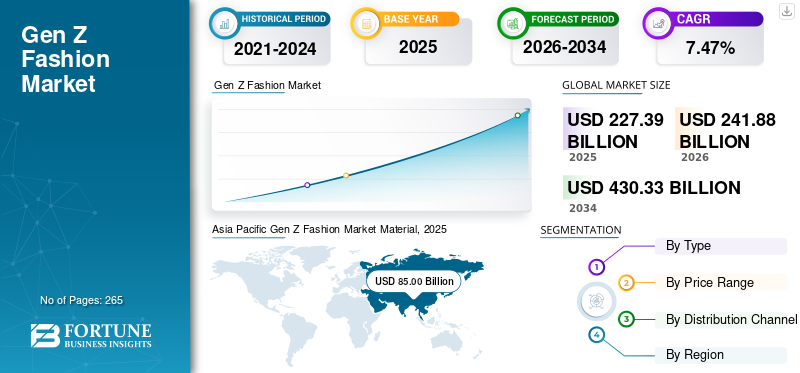
The global Gen Z fashion market size was valued at USD 227.39 billion in 2025. The market is projected to grow from USD 241.88 billion in 2026 to USD 430.33 billion by 2034, exhibiting a CAGR of 7.47% during the forecast period. Asia Pacific dominated the Gen Z fashion market with a market share of 37.80% in 2025.
Gen Z fashion is largely about trying new things and keeping up with the latest trends, driven by the strong influence of the internet and social media in their daily lives. Many Gen Zers buy clothes after discovering them on TikTok. In fact, 55% of Gen Z consumers report buying fashion items after seeing them on the platform, indicating the significant impact of influencers on purchasing behavior. Companies such as Shein constantly add new clothes to their websites. They add up to 6,000 styles every day, driven by Gen Z's demand for constant novelty. At the time, Gen Z is increasingly conscious of environmental concerns. Around 62% of shoppers check thrift stores before purchasing new items, contributing to the rapid growth of the resale market, which is expected to reach USD 82 billion by 2026.
Despite this environmental awareness, Gen Z does not always stick with the brands. Only about 29% of their clothes typically come from a single brand, indicating a strong preference for variety and experimentation. For this generation, fashion is a key medium of self-expression and individuality.
Leading brands, including Nike, Shein, Zara, Gucci, and H&M, are adopting diverse strategies to stay relevant. Players such as Nike and Gucci are leveraging immersive storytelling and collaborating with online communities to connect with the Gen Z audience. Shein and Zara are responding to micro-trends with agility and data-driven supply chains to ensure high product turnover. H&M is reinforcing its position through sustainability initiatives and circular fashion models. Collectively, these approaches are working around the Gen Z mindset that seeks authenticity & individuality, speed, and value-driven consumption, by adopting social media commerce, influencer-led branding, and timely product launch as core strategies.
Download Free sample to learn more about this report.
Gen Z Fashion Market Key Takeaways
 Market Size & Forecast
- 2025 Market Size: USD 227.39 billion
- 2026 Market Size: USD 241.88 billion
- 2034 Forecast Market Size: USD 430.33 billion
- CAGR: 7.47% from 2026–2034
 Market Share
- Asia Pacific dominated the Gen Z fashion market with a 37.80% share in 2025.
- The accessories segment is anticipated to rise at the fastest CAGR of 8.37% over the forecast period.
- The brand stores segment is projected to grow at the second-fastest CAGR of 7.53% during the forecast period.
 Key Regional Highlights
North America
North America market valued at USD 57.33 billion in 2025.
Asia Pacific
Asia Pacific held 37.80% share in 2025, valued at USD 85.00 billion.
Europe
Europe market valued at USD 48.44 billion in 2025.
U.S.
Market valued at USD 37.47 billion in 2025.
Japan
Market valued at USD 11.29 billion in 2025.
Read More

GEN Z FASHION MARKET TRENDS
Rise of Social Commerce and Influencer-Led Fashion Boosts Industry Expansion
The widespread use of social media such as TikTok and Instagram by Zoomers has led to the increased adoption of social commerce. Users are increasingly getting fashion content from short videos and creator-driven posts, which directly influence purchasing decisions. This has led to a decrease in the need for physical stores and an increase in direct-to-customer sales. This has led to a decrease in the length of the trend cycle, allowing a style to go viral and influence purchases in just a few days. This has led to a fashion environment that responds quickly to the effects of digital interactions.
MARKET DYNAMICS
MARKET DRIVERS
Download Free sample to learn more about this report.
Increasing Demand for Personalization and Self-Expression to Accelerate Market Expansion
Younger generations are more focused on individuality and identity and tend to make expressive, personalized fashion choices. Platforms such as TikTok and Instagram fuel this trend, where individuals are highly exposed to unique styles that are gaining further traction and visibility. Consequently, fashion brands are looking to provide consumers with more customization, limited-edition, and niche product ranges to accommodate a range of consumer needs. This, in turn, has led to increased consumer engagement and faster purchasing decisions, encouraging fashion brands to invest more in data analytics. This highly targeted approach further augments the Gen Z fashion market growth.
MARKET RESTRAINTS
Decline in the Frequency of New Apparel Purchases to Limit Market Growth
The emergence of ultra-fast fashion brands, dominated by online retailers such as Shein and Zara, has heightened environmental and ethical concerns among Gen Z consumers. The modern-day consumer is becoming increasingly aware of the apparel industry’s global emissions, textile waste in landfills, and labor practices, leading individuals to become more discerning and critical of their overconsumption habits. This transition is leading to a rise in demand for second-hand and sustainable options and a decline in the frequency of new apparel purchases. Thus, reduced impulse purchases may limit the growth of the market.
MARKET OPPORTUNITIES
Increased Environmental Awareness to Create Several Growth Opportunities
There is a rise in demand for cost-effective, sustainable fashion solutions, driven by increased environmental awareness among generations. Thrift culture, i.e., the growing movement of buying second-hand, vintage, or pre-owned clothing from platforms such as ThredUp and Depop, is gaining traction, with consumers preferring second-hand and upcycled products. This transition is prompting brands to introduce circular business models and resale programs into their offerings, enabling companies to generate new revenue streams while strengthening customer loyalty and brand image. Thus, a significant market development opportunity is emerging in the Gen Z fashion space, driven by the expansion of recommerce ecosystems.
MARKET CHALLENGES
Rapidly Changing Trends to Obstruct Market Growth
Gen Z consumers are constantly engaged with their phones, and social media platforms such as Instagram and TikTok are accelerating trend cycles in the Gen Z fashion market. Consumer choices have become highly erratic and unpredictable, as fast-fashion trends emerge and fade within weeks, creating challenging consumption patterns for businesses. This also creates a major hurdle for brands in scrutinizing demand forecasts, inventory management, and supply chain efficiency. Subsequently, brands are exposed to the risk of overproduction or stockouts, which can impact operational stability and profit margins. This constant need to adapt to ever-changing trends increases costs and complexity, making it challenging for companies to maintain consistent growth and profitability.
Segmentation Analysis
By Type
Apparel Segment Dominated due to its Large-Scale Adoption
By type, the market is segmented into apparel, footwear, accessories, and jewelry.
The apparel segment led the market due to its large-scale adoption and hefty spending. Moreover, rapid trend turnover and higher purchase frequency, driven by social media platforms such as Instagram and TikTok, provide consumers with the incentive to upgrade their wardrobes to keep up with evolving fashion. Consequently, companies also prioritize quick production cycles, accompanied by apparel innovation, to generate higher product sales volume.
The accessories segment is anticipated to rise at the fastest CAGR of 8.37% over the forecast period.
To know how our report can help streamline your business, Speak to Analyst
By Price Range
Economy/Budget Segment Led, Driven by the Scalability and Accessibility of Low-Cost Fashion
Based on price range, the market is divided into economy/budget, mid-range, and premium.
The economy/budget segment dominated the market, as Gen Z users are increasingly focused on affordability amid limited disposable income. Fashion brands, including Shein and Primark, are luring consumers with ultra-low prices and limited-edition product drops, increasing purchase frequency and impulsive buying, mainly driven by trend-conscious consumers. As a result, the segment is growing rapidly, outpacing mid-range and premium categories. The scalability and accessibility of low-cost fashion continue to drive segment growth.
The mid-range segment is anticipated to rise at the fastest CAGR of 8.34% over the forecast period.
By Distribution Channel
Offline Online/E-Commerce Segment Dominated owing to Easy Payment Gateways
Based on distribution channel, the market is segmented into online/e-commerce, brand stores, specialty stores, hypermarkets, and others.
The online/e-commerce segment held the dominant Gen Z fashion market share, driven by a seamless and one-stop mobile shopping experience. With the increase in social media usage, product discovery and in-app purchases have become much smoother, reducing the length of the purchase journey. Moreover, wide product assortments, options for comparison, easy payment gateways, and home delivery have increased consumer preference for online shopping, thereby contributing to its higher market share.
The brand stores segment is projected to grow at the second-fastest CAGR of 7.53% during the forecast period.
Gen Z Fashion Market Regional Outlook
By geography, the market is categorized into Europe, North America, Asia Pacific, South America, the Middle East, and Africa.
North America
Asia Pacific Gen Z Fashion Market Material, 2025 (USD Billion)
To get more information on the regional analysis of this market, Download Free sample
North America has emerged as a key region. It is projected to grow at a CAGR of 7.64% in the coming years, with the second-highest market share among all regions, reaching a valuation of USD 57.33 billion by 2025. The regional market growth is driven by the strong influence of social media platforms and high digital penetration, which augment product trend discovery and purchasing. In addition, high consumer spending power and the region's solid base in the fashion market, along with the presence of well-known fashion brands including Gucci, Prada, and Urban Outfitters, amplify product consumption. Moreover, a well-established e-commerce infrastructure enables a smooth e-commerce shopping experience, further strengthening market expansion.
U.S. Gen Z Fashion Market
With North America’s strong contribution and the U.S. dominance in the region, the U.S. market reached USD 37.47 billion in 2025, accounting for roughly 16.48% of global market sales.
Europe
Europe held the third-largest share in 2025, valued at USD 48.44 billion and accounting for 21.30% of the global market. Europe’s market growth is bolstered by strong demand for ethically and sustainably produced apparel, with consumers preferring eco-conscious brands such as Zara and H&M that are actively pursuing circular fashion practices. Furthermore, the region's dense retail ecosystem and well-established fast-fashion industry enable rapid trend adoption and product accessibility.
U.K. Gen Z Fashion Market
The U.K. market in 2025 reached USD 7.68 billion, representing roughly 3.38% of global market revenues.
Germany Gen Z Fashion Market
Germany’s market reached USD 9.06 billion in 2025, equivalent to around 3.99% of global market sales.
Asia Pacific
The Asia Pacific market dominated the global market. The market reached USD 85.00 billion in 2025 and is growing at a CAGR of 8.25%. In the region, India and China both reached USD 18.56 billion and USD 24.45 billion, respectively, in 2025. A large young population and rising disposable income, combined with the adoption of Western fashion culture and the rapid expansion of e-commerce platforms, increase product demand.
Japan Gen Z Fashion Market
The Japanese market in 2025 was valued at USD 11.29 billion, accounting for roughly 13.28% of global market revenues. The market is driven by a strong culture of streetwear and minimalist, high-quality apparel, with domestic brands such as Uniqlo leading the charge in a highly digital, fast-changing landscape of fashion trends.
China Gen Z Fashion Market
China’s market in 2025 was valued at USD 24.45 billion in revenues, representing roughly 10.75% of global market sales.
India Gen Z Fashion Market
The Indian market in 2025 was valued at USD 18.56 billion, accounting for roughly 8.16% of global market revenues.
South America and the Middle East & Africa
The South America and Middle East & Africa regions are expected to witness moderate growth in this market during the forecast period. The South American market reached USD 20.49 billion in 2025. The market in South America is influenced by an increase in smartphone and social media adoption, with platforms such as Instagram enabling fast uptake of trends and a rise in demand for affordable fashion from companies such as Shein. In the Middle East & Africa, the UAE reached USD 9.40 billion in 2025.
South Africa Gen Z Fashion Market
The South African market reached USD 3.14 billion in 2025, representing roughly 1.38% of global market revenues.
COMPETITIVE LANDSCAPE
Key Players
Competitive Pricing and Product Innovation to Gain a Competitive Landscape
The Gen Z fashion industry appears competitive, with many firms focusing on speed and value-driven innovation to gain a competitive edge. Firms such as Shein and Zara are focusing on speed in responding to micro-trends through their respective supply chains. On the other hand, firms such as Nike and Gucci are focusing on storytelling and engaging the Gen Z market through immersive experiences. In addition, firms are focusing on sustainability to achieve market competitiveness.
LIST OF KEY GEN Z FASHION COMPANIES PROFILED
- Shein (Singapore)
- Zara (Spain)
- H&M (Sweden)
- Gucci (Italy)
- Nike (U.S.)
- Adidas (Germany)
- Uniqlo (Japan)
- Urban Outfitters (U.S.)
- Forever 21 (U.S.)
- ASOS (U.K.)
KEY INDUSTRY DEVELOPMENTS
- March 2026: Zara announced a two-year collaboration with 65-year-old British designer John Galliano, who also has experience as Dior's creative director and as a designer for Maison Margiela. This collaboration was aimed at elevating Zara’s design positioning and competing with premium fashion players.
- March 2026: Spanish multinational fashion brand Zara, in partnership with designer Willy Chavarria, unveiled the “Vatísimo” collection, broadening its global appeal through culturally inspired apparel and accessories.
- January 2025: Singapore-based global fast-fashion e-commerce brand Shein announced a partnership with Reliance Retail to re-enter the Indian market. With this partnership, Shein strengthened its presence in high-growth emerging markets.
- September 2025: Nike collaborated with an India-based brand through Nike x NorBlack NorWhite to launch performance clothing and sneakers featuring bandhani patterns for Nike Women. The collection sets a new standard for Indian craftsmanship while integrating it with global sportswear
- December 2024: Virgio, an Indian sustainable fashion startup that integrates technology with circular design, expanded its offline retail presence through partnerships and standalone store launches across India, consolidating its omnichannel presence.
REPORT COVERAGE
The global Gen Z fashion market analysis includes a comprehensive study of the market & forecast by all the market segments included in the report. This qualitative and quantitative report includes details on the market dynamics and trends that are expected to drive the market over the forecast period. It provides information on key aspects, including technological advancements, the regulatory environment, and product launches. Additionally, it details partnerships, mergers & acquisitions, and key industry developments. The global market research report also provides a detailed competitive landscape, including market share and profiles of key players.
Request for Customization to gain extensive market insights.
Report Scope & Segmentation
| ATTRIBUTE | DETAILS |
| Study Period | 2021-2034 |
| Base Year | 2025 |
| Estimated Year | 2026 |
| Forecast Period | 2026-2034 |
| Historical Period | 2021-2024 |
| Growth Rate | CAGR of 7.47% from 2026 to 2034 |
| Unit | Value (USD Million) |
| Segmentation | By Type, Price Range, Distribution Channel, and Region |
| By Type |
|
| By Price Range |
|
| By Distribution Channel |
|
| By Region |
|
Frequently Asked Questions
According to Fortune Business Insights, the global market value stood at USD 227.39 billion in 2025 and is projected to reach USD 430.33 billion by 2034.
In 2025, the market value stood at USD 57.33 billion.
The market is expected to grow at a CAGR of 7.47% over the forecast period.
By type, the apparel segment led the market.
Rising need for self-expression and individuality is a key factor driving the market.
Nike, Shein, Zara, Gucci, and H&M are the major players in the global market.
Asia Pacific dominated the market in 2025.



- 2021-2034
- 2025
- 2021-2024
- 265
-
(Offer valid till 15th Oct 2026)
Get 30-60 hrs Free Customization
Expand Regional and Country Coverage, Segments Analysis, Company Profiles, Competitive Benchmarking, and End-user Insights.



















-
US +1 833 909 2966 ( Toll Free )
-
Get In Touch With Us