Aquafeed Additives Market Size, Share & Industry Analysis, By Additive Type (Amino Acids, Vitamins & Minerals, Enzymes, Probiotics, and Others), By Form (Dry and Liquid), By Aquatic Species (Fish, Crustaceans, Mollusks, and Others), and Regional Forecast, 2026-2034
 Download Free Sample
(Offer valid till 15th Oct 2026)

Aquafeed Additives Market Size and Future Outlook
 Listen to Audio Version
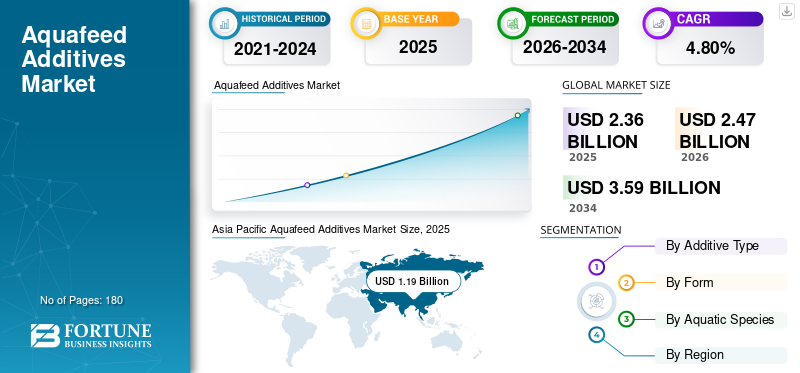
The aquafeed additives market size was valued at USD 2.36 billion in 2025 and is projected to grow from USD 2.47 billion in 2026 to USD 3.59 billion by 2034, exhibiting a CAGR of 4.80% during the forecast period. Asia Pacific dominated the aquafeed additives market with a market share of 50.42% in 2025.
Aquafeed additives are specialized components added in controlled amounts to aquatic animal's diet to enhance feed efficiency, immunity, and growth rates, without antibiotics. Unlike conventional feed components such as oils and fishmeal, which offer energy and bulk protein, additives are added to perform particular functional and metabolic roles within the animal's digestive system. A few popular additives include palatants, amino acids, vitamins, probiotics and others. Regarding target aquatic species, these additives are useful for finfish, mollusks and crustaceans. Geographically, Asia Pacific and North America are the key consumers in the global market.
Companies such as Cargill, Incorporated, Kemin Industries Inc., and Alltech, Inc., are key players in the market. New product launches are a pivotal strategy adopted by key market players to improve their position.
Download Free sample to learn more about this report.
Aquafeed Additives Market Takeaways
 Market Size & Forecast
- 2025 Market Size: USD 2.36 billion
- 2026 Market Size: USD 2.47 billion
- 2034 Forecast Market Size: USD 3.59 billion
- CAGR: 4.80% from 2026–2034
 Market Share
- Asia Pacific dominated the aquafeed additives market with a 50.42% share in 2025.
- The probiotics segment is projected to grow at a CAGR of 7.74% during the forecast period.
- The liquid segment is anticipated to expand at a CAGR of 6.09% over the forecast period.
 Key Regional Highlights
North America
North America accounted for USD 0.32 billion in 2025, supported by rising demand for high-quality aquafeed products.
Europe
Europe reached USD 0.48 billion in 2025 and is projected to grow steadily due to increasing focus on sustainable aquaculture practices.
Asia Pacific
Asia Pacific led the global market in 2025 with a valuation of USD 1.19 billion, supported by strong aquaculture production activities.
U.S.
The U.S. aquafeed additives market was valued at approximately USD 0.18 billion in 2025.
Japan
The Japan aquafeed additives market reached USD 0.20 billion in 2025, accounting for around 8.27% of global revenues.
Read More

AQUAFEED ADDITIVES MARKET TRENDS
Growing Inclination toward Plant-Centric Feed Formulations is Emerging Trend
The rising inclination toward alternative/plant based feed formulations is recognized as a key trend in the market. Traditionally, aquafeed depended substantially on fish oil/meal as the main sources of lipids and proteins. However, the restricted supply of marine resources, price variations and sustainability concerns have led producers to switch to plant-based ingredients such as rapeseed meal, soybean meal, and corn gluten meal. While these substitutes are more price-stable and sustainable, they can still pose challenges, such as nutrient imbalances and reduced digestibility. To overcome such gaps, manufacturers are adding functional components such as palatants, amino acids and enzymes that enhance digestion and improve fish and shrimp health.
MARKET DYNAMICS
MARKET DRIVERS
Download Free sample to learn more about this report.
Expansion of Aquaculture Production Fuels the Dependency on Additives
The expansion of the aquaculture sector is a major driver for aquafeed additives market growth, as most consumers depend on farmed shrimp/fish to meet their seafood demand. In the past few years, wild fish catch has remained largely stable, increasing reliance on aquaculture for seafood supply. As the majority of the crustaceans and fish are produced in farms, especially under intensive farming conditions, feed is recognized as the largest component of total operating costs. In order to enhance growth and feed efficiency, farmers use additives such as prebiotics, organic acids, and enzymes. Moreover, they are using additives to boost disease resistance, which further adds value to the growth. Looking into these advantages, companies operating in the space are aiming to introduce new feed additives for aquatic species.
MARKET RESTRAINTS
Fluctuations in Raw Component Prices Hinder the Market's Potential
One of the pivotal challenges is the variation in prices of raw materials. Globally, the aquafeed additives depend on biochemical and agricultural inputs such as amino acids, fishmeal by-products, corn, vitamins and soy derivatives. Sudden surge in petrochemical derivatives, grains, and energy poses a strong impact on the manufacturing costs of amino acids, antioxidants and enzymes. For instance, methionine and lysine are mostly influenced by fermentation costs and corn prices. These fluctuations further minimize producers' profits, further limiting the adoption of expensive additives, particularly in budget-conscious sectors. Intense competition from substitutes is another obstacle in the global market. In various developing regions, conventional feed formulas and antibiotic growth promoters are still utilized owing to established practices and cost-effectiveness. As a result, the above-mentioned fluctuations in the market hamper its growth.
MARKET OPPORTUNITIES
Technological Advancements in Additives Sector Opens Growth Opportunities
The adoption of advanced technologies in the additives industry unlocks numerous growth opportunities. To strengthen additive stability in aqueous environments, companies are using encapsulation techniques. Through this modern technology, the producers can easily protect sensitive components such as essential oils, enzymes, amino acids and probiotics. Advancements in enzyme engineering are gaining traction, as they allow the production of pH-tolerant and thermostable enzymes ideal for aquatic digestion. Moreover, insect-derived lipids and proteins are being adopted by manufacturers, as they enhance palatability and improve gut health in aquatic species. Additionally, upgradation of industrial fermentation processes helps strengthen cost control and feed efficiency for specialty bioactives, amino acids and organic acids.
Segmentation Analysis
By Additive Type
Amino Acids Segment Leads Owing to High Stability
Based on the additive type, the market is distributed into amino acids, vitamins & minerals, enzymes, probiotics and others.
The amino acids segment dominated the global market in 2025. Compared with vitamins and minerals, traditional amino acids are highly stable during pelleting and extrusion processes. Incorporation of amino acids in aqua feed improves nutrient utilization efficiency and helps in reducing nitrogen excretion. Additionally, amino acids in feed support protein synthesis and muscle development, which are key drivers of growth in shrimp and fish. Furthermore, free amino acids are quickly absorbed and digestible in the digestive tract than minerals and vitamins. As a result, the above factors propel the global aquafeed additives market share.
The probiotics are projected to grow at a high CAGR of 7.74% over the forecast period.
By Form
Dry Segment Dominated the Market Due to Prolonged Shelf Life
Depending on the form, the market is segmented into dry and liquid.
In 2025, the dry category led the global industry. Dry feed additives have a longer shelf life than liquid formulations and are less susceptible to chemical degradation and microbial growth. Compared to liquid forms, powdered additives can be easily handled, transported, and stored, reducing logistical challenges. Moreover, it has better compatibility with feed processing and has no additional requirement for specialized equipment. Additionally, dry additives have improved flexibility in distribution channels, further propelling the segment's potential.
The liquid segment is projected to grow at a high CAGR of 6.09% over the forecast period.
By Aquatic Species
To know how our report can help streamline your business, Speak to Analyst
Fish Species Led the Market Due to High Usage of Additives in Their Feed
Based on aquatic species, the market is distributed into fish, crustaceans, mollusks, and others.
Fish species dominated the global industry in 2025. As compared to mollusks and crustaceans, fish have highly developed enzyme-active digestive systems that allow them to easily absorb and digest supplemented organic acids and amino acids. Moreover, the addition of additives such as antioxidants, tryptophan and arginine helps fish manage stress more easily, especially during transportation and handling. Additionally, fish, particularly seabass and salmon, have established amino acid needs; thus, incorporating limited amino acids into their daily diets is known for improving feed nutritional imbalances. Thus, such factors drive the segment growth.
The crustaceans are projected to grow at a high CAGR of 6.31% over the forecast period.
Aquafeed Additives Market Regional Outlook
By geography, the market is categorized into Europe, North America, Asia Pacific, South America, and the Middle East & Africa.
Asia Pacific
Asia Pacific Aquafeed Additives Market Size, 2025 (USD Billion)
To get more information on the regional analysis of this market, Download Free sample
Asia Pacific dominated the market and reached the valuation of USD 1.19 billion in 2025. The increasing use of omega-3 fatty acids and vitamins as feed ingredients and rising inclination toward source of protein bolster the regional momentum.
India Aquafeed Additives Market
The India market in 2025 was at USD 0.18 billion, accounting for roughly 7.75% of the global market revenues.
The growing use of feed acidifiers and the rising demand for seafood are driving factors in the market.
China Aquafeed Additives Market
China's market is projected to be one of the largest worldwide, and held revenue of USD 0.48 billion in 2025, representing roughly 20.16% of the global market sales.
Japan Aquafeed Additives Market
The Japan market in 2025 was at USD 0.20 billion, accounting for approximately 8.27% of the global market revenues.
Europe
Europe reached USD 0.48 billion by 2025, recording a growth rate of 4.93% in the coming years, and secured the second position. The growth of fish farms and the surging production of raw materials for aquafeed are propelling the region's potential.
Germany Aquafeed Additives Market
The Germany market in 2025 was at USD 0.05 billion, representing roughly 1.92% of the global revenues.
U.K. Aquafeed Additives Market
The U.K. market reached USD 0.05 billion in 2025, equivalent to around 2.24% of the global sales.
North America
The North America market is valued at USD 0.32 billion in 2025 and ranks third globally. The market in North America is expected to grow due to the increasing production of aquatic animals and technological advancements. Moreover, the product innovation and improved presence of key players fuel the regional growth.
U.S. Aquafeed Additives Market
Based on North America's strong contribution and the U.S. dominance within the region, the U.S. market can be analytically approximated at around USD 0.18 billion in 2025, accounting for roughly 7.64% of global sales.
South America, the Middle East, and Africa
The South America and Middle East & Africa regions are expected to witness moderate growth in this market space during the forecast period. The South America market is set to reach a valuation of USD 0.20 billion in 2025. The growing number of private label players and the expanding e-commerce network are expected to drive regional growth. The Middle East and Africa market is set to reach a valuation of USD 0.17 billion in 2025.
South Africa Aquafeed Additives Market
The South Africa market was at USD 0.07 billion in 2025, representing roughly 3.05% of global aquafeed additives revenues.
COMPETITIVE LANDSCAPE
Key Industry Players
New Product Launches Help the Firms to Improve Their Market Position
The market exhibits a fragmented structure, with intense competition among market players operating in this segment. In this market, the key companies are primarily adopting new product launches as the main strategy. Via this approach, players can cater to rising consumer demands and enhance their brand image.
LIST OF KEY AQUAFEED ADDITIVES COMPANIES PROFILED
- Cargill, Incorporated (U.S.)
- Nutreco N.V. (Netherlands)
- Alltech, Inc. (U.S.)
- Evonik Industries AG (Germany)
- Kemin Industries, Inc. (U.S.)
- Novus International, Inc. (U.S.)
- BioMar Group A/S (Denmark)
- Archer Daniels Midland Company (U.S.)
- DSM-Firmenich (Switzerland)
- Biomin (Austria)
KEY INDUSTRY DEVELOPMENTS
- September 2025: Loopworm, an insect biotechnology firm in India, secured approval from the Coastal Aquaculture Authority (CAA), which allows the utilization of Loopworm's fat and protein products as palatants and additives in shrimp and fish diets.
- September 2025: DSM-Firmenich, a Swiss-based ingredients company, opened its latest state-of-the-art additive plant in Hyderabad, India.
- August 2025: Grobest Vietnam, a subsidiary of Grobest Group, an aquafeed producer in Taiwan, revealed the news of upgrading its shrimp feeds for the Vietnamese market.
- May 2024: Bluejais B.V., a feed additive distributor in the Netherlands, entered into a partnership with Procon Biotek India, a fish farming solutions company in India, to mark its debut in the aquaculture sector.
- July 2023: Phode, a French independent enterprise, expanded its line of aquafeed additives by introducing three products that improve performance and support animal welfare in aquaculture.
REPORT COVERAGE
The global aquafeed additives market provides an in-depth study of the market size & forecast by all the market segments included in the report. Aquafeed additives market forecast analysis includes details on the market dynamics and global market trends expected to drive the market during the forecast period. The global market analysis offers information on the technological advancements, new product launches, key industry developments, and details on partnerships, mergers & acquisitions. The market forecast also encompasses a detailed competitive landscape with information on the market segmentation, market share, and profiles of key operating players.
Request for Customization to gain extensive market insights.
Report Scope & Segmentation
| ATTRIBUTE | DETAILS |
| Study Period | 2021-2034 |
| Base Year | 2025 |
| Estimated Year | 2026 |
| Forecast Period | 2026-2034 |
| Historical Period | 2021-2024 |
| Growth Rate | CAGR of 4.80% from 2026-2034 |
| Unit | Value (USD Billion) |
| Segmentation | By Additive Type, Form, Aquatic Species, Region |
| By Additive Type |
|
| By Form |
|
| By Aquatic Species |
|
| By Geography |
|
Frequently Asked Questions
Fortune Business Insights says that the global market value stood at USD 2.36 billion in 2025 and is projected to reach USD 3.59 billion by 2034.
In 2026, the Asia Pacific market value stood at USD 1.25 billion.
The market is expected to exhibit a CAGR of 4.80% during the market forecast period of 2026-2034.
By form, the dry segment led the global market in 2025.
Expansion of aquaculture production fuels the dependency on additives.
Cargill, Incorporated, Kemin Industries Inc., and Alltech, Inc., are among the key players in the market.
Asia Pacific held the largest market share in 2025.
Growing inclination toward plant-centric feed formulations is the current trend.



- 2021-2034
- 2025
- 2021-2024
- 180
-
(Offer valid till 15th Oct 2026)
Get 30-60 hrs Free Customization
Expand Regional and Country Coverage, Segments Analysis, Company Profiles, Competitive Benchmarking, and End-user Insights.














Related Reports
-
US +1 833 909 2966 ( Toll Free )
-
Get In Touch With Us