Generative AI in Packaging Market Size, Share & Industry Analysis, By Technology (Machine Learning (ML), 3D Generative Design Tools, Natural Language Processing (NLP), Generative, Adversarial Networks (GANs), and Others), By Function (Structural Design, Label & Artwork Generation, Eco-efficiency Optimization, Consumer Personalization, Marketing Visualization, Simulation & Testing, and Others), By End Use (Food & Beverages, Consumer Goods, Healthcare, Personal Care & Cosmetics, Retail & E-commerce, and Others), and Regional Forecast, 2026-2034
 Download Free Sample
(Offer valid till 15th Oct 2026)

Generative AI in Packaging Market Size and Future Outlook
 Listen to Audio Version
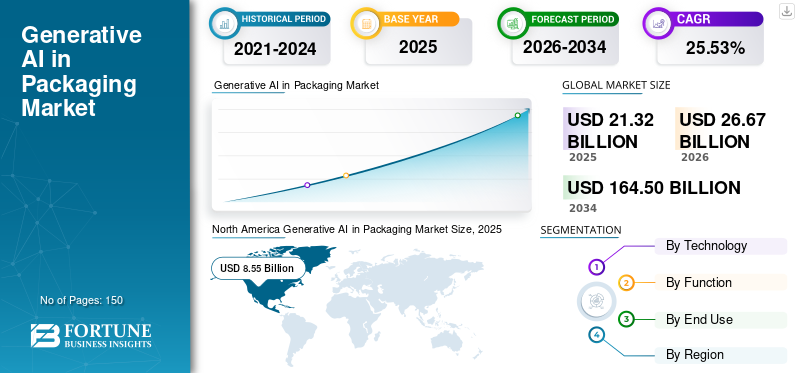
The global generative AI in packaging market size was valued at USD 21.32 billion in 2025. The market is projected to grow from USD 26.67 billion in 2026 to USD 164.50 billion by 2034, exhibiting a CAGR of 25.53% during the forecast period. North America dominated the generative AI in packaging market with a market share of 40.10% in 2025.
The global generative AI in packaging market includes AI-powered technologies that independently generate, enhance, and model packaging designs, graphics, structures, materials, and content. The increasing need for faster product introductions, mass customization, and eco-friendly packaging is driving the adoption of generative AI, as brands and converters aim to shorten design timelines, reduce material waste and costs, and boost innovation while meeting regulatory standards.
Furthermore, many key industry players, such as Adobe Inc., Dassault Systems, and Microsoft Corporation, operating in the market, are focusing on developing innovative products and conducting R&D, and contributing to the global generative market share.
Download Free sample to learn more about this report.
GENERATIVE AI IN PACKAGING MARKET KEY TAKEAWAYS
 Market Size & Forecast
- 2025 Market Size: USD 21.32 Billion
- 2026 Market Size: USD 26.67 Billion
- 2034 Forecast Market Size: USD 164.50 Billion
- CAGR: 25.53% from 2026–2034
 Market Share
- North America dominated the generative AI in packaging market with a 40.10% share in 2025.
- The machine learning (ML) segment held the largest market share in 2025.
- The structural design segment dominated the market in 2025.
 Key Regional Highlights
North America
North America reached USD 8.55 billion in 2025, maintaining its leading market position.
Asia Pacific
Asia Pacific was valued at USD 5.36 billion in 2025, ranking as the second-largest regional market.
Europe
Europe reached USD 3.77 billion in 2025 and is projected to grow at a CAGR of 25.03%.
U.S.
The market was valued at USD 6.77 billion in 2025, accounting for 31.77% of global revenue.
Japan
The market reached USD 0.95 billion in 2025, representing 4.48% of global revenue.
Read More

GENERATIVE AI IN PACKAGING MARKET TRENDS
AI-Driven Design Automation and Mass Customization is an Emerging Trend in the Market
A significant trend in the global Generative AI in Packaging market is the growing use of AI-driven design automation to enable mass-scale customization. Brand owners are increasingly using generative models to rapidly generate packaging concepts, localized graphics, and tailored designs that resonate with consumer preferences and comply with regional regulations. This trend is further bolstered by the integration of generative AI with CAD, 3D visualization, and digital printing workflows, enabling faster prototyping and virtual testing. As e-commerce and direct-to-consumer channels continue to grow, companies are harnessing generative AI to provide visually distinct, short-run, and promotional packaging without extending design time or incurring additional costs.
MARKET DYNAMICS
MARKET DRIVERS
Download Free sample to learn more about this report.
Rising Need for Speed-to-Market and Cost Optimization Is Driving Market Growth
The main catalyst for the generative AI in packaging market growth is the need to reduce packaging development timelines while managing costs. Conventional packaging design requires numerous iterations, physical prototypes, and manual adjustments, all of which are both time-intensive and costly. Generative AI expedites the creation of concepts, optimizes structures, and generates artwork, allowing brands and converters to transition from idea to production much more swiftly. By reducing human labor, minimizing mistakes, and minimizing material waste during testing phases, generative AI helps packaging stakeholders enhance operational efficiency and adapt speedily to rapidly evolving consumer trends and competitive challenges.
MARKET RESTRAINTS
Limited Trust and Explainability of AI Outputs Impede Market Growth
A significant barrier to the broader acceptance of generative AI in packaging is the lack of trust and transparency around AI-generated results. Decisions related to packaging often involve regulatory compliance, brand uniformity, and functional efficacy, areas where opaque AI models can provoke concern. Designers and brand proprietors may be reluctant to rely on generative outputs they cannot fully understand or verify. In regulated sectors such as food, pharmaceuticals, and personal care, this skepticism is even more pronounced, as any design error could lead to compliance issues, product recalls, or brand damage, thereby impeding enterprise-level implementation.
MARKET OPPORTUNITIES
Sustainability-Led Packaging Innovation Offers Impending Growth Opportunities
Sustainability offers a significant opportunity for the sector. Generative models can enhance packaging structures by minimizing material use, suggesting recyclable or mono-material designs, and predicting environmental impacts before production. With governments and brands increasingly dedicated to circular economy objectives, AI-driven tools that harmonize performance, cost, and sustainability are gaining considerable momentum. Packaging firms can set themselves apart by leveraging generative AI to swiftly create eco-friendly designs, comply with evolving regulations, and bolster brand sustainability stories, thereby generating long-term value and a competitive edge.
MARKET CHALLENGES
Integration with Legacy Packaging Systems is a Major Challenge to Market Growth
One of the primary obstacles confronting the market is its integration with legacy systems and workflows. Numerous packaging manufacturers and converters continue to depend on conventional CAD software, manual design methodologies, and isolated production systems. The implementation of generative AI necessitates substantial modifications to IT infrastructure, data standardization, and team member skill sets. Resistance to change, elevated initial integration costs, and the need for cross-functional collaboration among design, production, and compliance teams can hinder adoption, especially in small- and mid-sized packaging companies.
Segmentation Analysis
By Technology
Data-Driven Adaptability, Scalability, and Proven Performance Drive the Dominance of Machine Learning (ML)
Based on technology, the market is divided into machine learning (ML), 3D generative design tools, Natural Language Processing (NLP), Generative Adversarial Networks (GANs), and others.
The machine learning (ML) segment is expected to account for the largest generative AI in packaging market share. The Machine Learning (ML) technology sector leads the global market due to its extensive applicability, maturity, and scalability throughout packaging workflows. ML algorithms are widely utilized for design optimization, material selection, defect prediction, demand forecasting, and quality control, rendering them highly effective for practical packaging applications. In contrast to more specialized AI models, ML can be trained using existing historical production, consumer, and design data, facilitating quicker deployment and reducing integration costs. Its capacity for continuous learning and improvement over time helps packaging companies enhance efficiency, reduce waste, and ensure consistency, thereby promoting widespread adoption among both large enterprises and mid-sized converters.
The 3D generative design tools segment is expected to grow at a CAGR of 25.62% over the forecast period.
By Function
Material Efficiency, Performance Optimization, and Cost Reduction Drive the Dominance of Structural Design
Based on function, the market is segmented into structural design, label & artwork generation, eco-efficiency optimization, consumer personalization, marketing visualization, simulation & testing, and others.
In 2025, the structural design segment dominated the global market. The segment of structural design function is the leading component of the global market, as it delivers immediate, quantifiable benefits in terms of cost, performance, and sustainability goals. Enabled by Generative AI, structural design empowers packaging manufacturers to enhance shape, thickness, and material efficiency while upholding standards for strength, durability, and protection. This aspect is particularly vital for packaging in the food, beverage, and e-commerce sectors, where reducing weight and minimizing damage directly affect logistics expenses.
The label & artwork generation segment is projected to grow at a CAGR of 26.13% over the forecast period.
By End Use
To know how our report can help streamline your business, Speak to Analyst
High Volume Demand, Regulatory Pressure, and Rapid Innovation Drive the Dominance of Food & Beverages
Based on the end use, the market is segmented into food & beverages, consumer goods, healthcare, personal care & cosmetics, retail & e-commerce, and others.
The food & beverages segment is expected to hold a dominant market share over the forecast period. The food and beverages end-use segment leads the global generative AI in Packaging market, primarily due to its substantial production volumes, regular product launches, and rigorous regulatory standards. F&B brands are constantly redesigning packaging to enhance shelf appeal, ensure portion control, comply with labeling regulations, and meet sustainability objectives. Generative AI enables swift structural optimization, variations in artwork, and design iterations ready for compliance, thereby reducing time-to-market and development costs. Moreover, the sector's significant emphasis on light-weighting, recyclability, and waste reduction is well-aligned with AI-driven design optimization, positioning food and beverages as the most proactive and scalable adopters of generative AI-driven packaging solutions.
The consumer goods segment is projected to grow at a CAGR of 24.40% over the forecast period.
Generative AI in Packaging Market Regional Outlook
By region, the market is categorized into Europe, North America, Asia Pacific, Latin America, and the Middle East & Africa.
North America
North America Generative AI in Packaging Market Size, 2025 (USD Billion)
To get more information on the regional analysis of this market, Download Free sample
North America held the dominant share in 2024 at USD 6.81 billion and maintained its leading position in 2025 at USD 8.55 billion. The market within North America is propelled by robust digital infrastructure, early adoption of AI technologies, and significant investments in AI from major brands and converters. The focus on rapid market entry, customization, and intelligent packaging, combined with enhanced analytical capabilities, fosters the increased application of generative AI in design, testing, and supply chain optimization.
U.S. Generative AI in Packaging Market
Based on North America's strong contribution and the U.S. dominance within the region, the U.S. market held USD 6.77 billion in 2025, accounting for roughly 31.77% of global sales. In the U.S., the market is driven by the need for swift innovation, tailored experiences, and data-informed decision-making. Generative AI enables rapid design iterations and short-run packaging and labeling that meet compliance standards, particularly for brands in the food, beverage, and e-commerce sectors operating in fiercely competitive, trend-sensitive markets.
Europe
Europe is projected to grow at 25.03% over the coming years, the third-highest among regions, and reached a valuation of USD 3.77 billion in 2025. In Europe, market growth is mainly driven by stringent sustainability regulations and circular-economy mandates. The use of generative AI is on the rise to enhance material efficiency, boost recyclability, and ensure compliance with packaging waste directives. Robust partnerships between technology suppliers and packaging producers additionally foster innovation in eco-design driven by AI.
U.K Generative AI in Packaging Market
The U.K market in 2025 held a valuation of USD 0.64 billion, representing approximately 3.00% of global revenues.
Germany Generative AI in Packaging Market
Germany's market was valued at USD 0.83 billion in 2025, equivalent to around 3.89% of global sales.
Asia Pacific
Asia Pacific reached a valuation of USD 5.36 billion in 2025 and secure second place in the market. In the region, India and China both reached USD 1.38 billion and USD 1.66 billion, respectively, in 2025. The Asia Pacific market is driven by extensive manufacturing, rapid urbanization, and rising consumer demand. Generative AI facilitates cost-effective structural design, tailored packaging AI solutions, and expedited product launches. Nations with robust electronics, food, and e-commerce industries utilize AI to handle substantial volumes while ensuring quality and personalization.
Japan Generative AI in Packaging Market
The Japanese market in 2025 reached a value of USD 0.95 billion, accounting for roughly 4.48% of global revenues. Japan's adoption is motivated by its commitment to precision, quality, and functional efficiency. A significant focus on automation, material efficiency, and the needs of an aging population is driving AI-driven innovation across the food, pharmaceutical, and consumer packaging sectors.
China Generative AI in Packaging Market
China's market is projected to be one of the largest worldwide, with 2025 revenues valued at USD 1.66 billion, representing roughly 7.79% of global sales.
India Generative AI in Packaging Market
The Indian market in 2025 valued at USD 1.38 billion, accounting for roughly 6.49% of global markets.
Latin America
The Latin America region is expected to witness moderate growth in this market space during the forecast period. The Latin America market reached a valuation of USD 1.07 billion in 2025. In Latin America, the adoption of new practices is motivated by the necessity for cost efficiency and visual distinction in competitive consumer markets. Generative AI plays a crucial role in enhancing packaging designs, reducing material costs, and developing striking designs for food and personal care products, thereby helping brands navigate price sensitivity and changing retail formats.
Middle East & Africa
In the Middle East & Africa, and South Africa reached a valuation of USD 0.40 billion in 2025. Middle East & Africa's expansion is bolstered by a steady digital transformation, increasing demand for packaged foods, and premium branding in metropolitan areas. Generative AI is strategically employed to enhance structural design and high-end packaging, especially in the food, beverage, and cosmetics sectors, as businesses update their packaging processes and reduce reliance on imports.
Saudi Arabia Generative AI in Packaging Market
The Saudi Arabian market reached a valuation of USD 0.54 billion in 2025, accounting for roughly 2.55% of global revenues.
COMPETITIVE LANDSCAPE
Key Industry Players
Focus on Expanding Product Launch and Acquisitions by Key Players to Propel Market Progress
The global market has a semi-consolidated structure, with prominent players including Adobe Inc., Dassault Systems, and Microsoft Corporation. The significant market shares of these packaging companies are due to numerous strategic initiatives, including collaborations among operating entities to advance research.
- For instance, in September 2024, Adobe Inc. enhanced its generative AI capabilities in Adobe Firefly and Illustrator to facilitate AI-assisted packaging design. This update allows brands and packaging designers to create compliant label layouts, localized artwork variations, and 3D mock-ups using text prompts.
Other notable players in the global market include Amazon Inc., Canva, and Accenture. These companies are expected to prioritize new product launches, strategic partnerships, and collaborations to increase their global market shares during the forecast period.
LIST OF KEY GENERATIVE AI IN PACKAGING COMPANIES PROFILED
- Adobe Inc. (U.S.)
- Dassault Systems (France)
- Microsoft Corporation (U.S.)
- Amazon Inc. (U.S.)
- Canva (Australia)
- Accenture (Ireland)
- Open AI (U.S.)
- Cognex Corporation (U.S.)
- ABB Group (Switzerland)
- Neurala (U.S.)
- Clarifai (U.S.)
- PackageX Inc. (U.S.)
- NVIDIA Corporation (U.S.)
- Kebotix, Inc. (U.S.)
- Midjourney Inc. (U.S.)
KEY INDUSTRY DEVELOPMENTS
- October 2024: Accenture has announced an expansion of its generative AI services for clients in the consumer goods and packaging sectors, with an emphasis on AI-driven redesigns for packaging sustainability. This initiative integrates generative design algorithms with lifecycle assessment tools to help brands minimize material intensity while preserving functionality and visual appeal.
- August 2024: Amazon Inc. has improved its fulfillment operations by implementing AI-driven packaging optimization, utilizing generative AI models to suggest appropriately sized packaging formats for sellers. This initiative minimizes material consumption, lowers shipping costs, and reduces damage rates, demonstrating the broad commercial application of generative AI across packaging design and logistics optimization.
- July 2024: NVIDIA Corporation unveiled new generative AI simulation features on its Omniverse platform, enabling packaging engineers to develop digital twins of packaging lines and 3D packaging prototypes. This solution enables real-time structural testing and collaborative design visualization, thereby accelerating packaging innovation across both consumer goods and industrial sectors.
- June 2024: Dassault Systems has enhanced the integration of generative design AI tools into its 3DEXPERIENCE platform to facilitate AI-driven optimization of structural packaging. The company emphasized various use cases in which converters can model material reduction, assess strength performance, and evaluate pallet efficiency before physical prototyping, thereby enabling cost savings and improved sustainability outcomes for manufacturers in the food and beverage packaging sector.
- May 2024: OpenAI announced a rise in enterprise adoption of GPT-based generative models in packaging applications. This includes automating label content generation, drafting multilingual compliance texts, and visualizing concepts with AI assistance. Packaging converters and brand owners have incorporated these functionalities into their design and marketing processes to enhance speed, precision, and personalization.
REPORT COVERAGE
The market analysis includes a comprehensive study of market size & forecast across all market segments included in the market reports. It contains details on the market dynamics and market trends expected to drive the market over the forecast period. It provides information on key aspects, including technological advancements, pipeline candidates, the regulatory environment, and product launches. Additionally, it details partnerships, mergers & acquisitions, and key industry developments, along with their regional prevalence. The global market research report also provides a detailed competitive landscape, including market share and profiles of key operating players.
Request for Customization to gain extensive market insights.
Report Scope & Segmentation
| ATTRIBUTE | DETAILS |
| Study Period | 2021-2034 |
| Base Year | 2025 |
| Estimated Year | 2026 |
| Forecast Period | 2026-2034 |
| Historical Period | 2021-2024 |
| Growth Rate | CAGR of 25.53% from 2026-2034 |
| Unit | Value (USD Billion) |
| Segmentation | By Technology, Function, End Use, and Region |
| By Technology |
|
| By Function |
|
| By End Use |
|
| By Region |
|
Frequently Asked Questions
According to Fortune Business Insights, the global market value stood at USD 21.32 billion in 2025 and is projected to reach USD 164.50 billion by 2034.
In 2025, the market value of generative AI in the packaging industry stood at USD 8.55 billion.
The market is expected to grow at a CAGR of 25.53% over the forecast period.
In terms of technology, the machine learning (ML) segment is expected to lead the market.
The rising need for speed-to-market and cost optimization is driving market growth.
Adobe Inc., Dassault Systems, Microsoft Corporation, Amazon Inc., Canva, and Accenture are the major players in the global market.
North America dominated the market in 2025.



- 2021-2034
- 2025
- 2021-2024
- 150
-
(Offer valid till 15th Oct 2026)
Get 30-60 hrs Free Customization
Expand Regional and Country Coverage, Segments Analysis, Company Profiles, Competitive Benchmarking, and End-user Insights.











Related Reports
-
US +1 833 909 2966 ( Toll Free )
-
Get In Touch With Us