Next Generation Packaging Market Size, Share & Industry Analysis, By Material (Plastics, Paper & Paperboard, Bio-Derived & Compostable, and Others), By Packaging Type (Active Packaging, Modified Atmosphere Packaging (MAP), Biodegradable & Compostable Packaging, Smart & Connected Packaging, and Others), By End-use Industry (Food & Beverages, Healthcare, Personal Care & Cosmetics, Consumer Electronics, Industrial & Logistics, and Others), and Regional Forecast, 2026-2034
 Download Free Sample
(Offer valid till 30th Sep 2026)

KEY MARKET INSIGHTS
 Listen to Audio Version
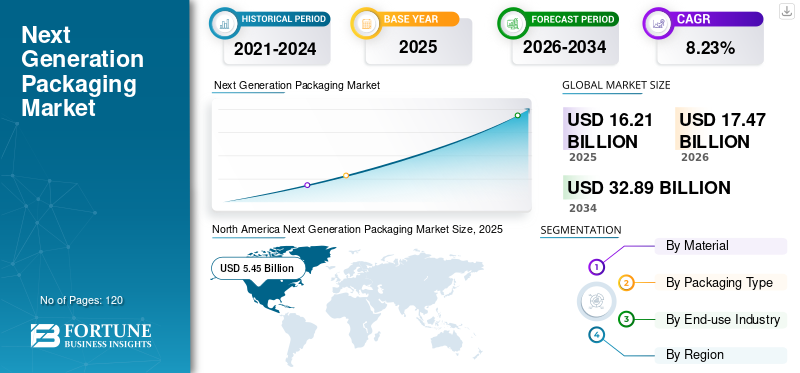
The global next generation packaging market size was valued at USD 16.21 billion in 2025. The market is projected to grow from USD 17.47 billion in 2026 to USD 32.89 billion by 2034, exhibiting a CAGR of 8.23% during the forecast period. North America dominated the global next generation packaging market with a market share of 33.62% in 2025.
Next generation packaging refers to cutting-edge, innovative solutions that surpass the conventional functions of containment and protection, actively contributing to improved product safety, extended shelf life, sustainability, enhanced functionality, and increased consumer engagement. Technological advancements are rapidly transforming packaging from a mere protective barrier into an engaging, smart system, thereby driving the market growth.
Furthermore, many key industry players, such as Amcor, CCL Industries, and Avery Dennison, operating in the market, are focusing on developing various innovative product launches and R&D activities in the market.
Download Free sample to learn more about this report.
NEXT GENERATION PACKAGING MARKET KEY TAKEAWAYS
 Market Size & Forecast
- 2025 Market Size: USD 16.21 billion
- 2026 Market Size: USD 17.47 billion
- 2034 Forecast Market Size: USD 32.89 billion
- CAGR: 8.23% from 2026–2034
 Market Share
- North America dominated the market with a 33.62% share in 2025.
- The plastics segment held the largest market share in 2025.
- The active packaging segment dominated the market in 2025.
 Key Regional Highlights
North America
North America reached USD 5.45 billion in 2025 and remained the leading regional market.
Europe
Europe generated USD 3.28 billion in 2025 and is projected to grow at a CAGR of 7.91%.
Asia Pacific
Asia Pacific reached USD 4.25 billion in 2025, driven by rapid urbanization and rising consumption of packaged food.
U.S.
The market reached USD 4.32 billion in 2025, accounting for 26.64%.
Japan
The market reached USD 0.80 billion in 2025, representing 4.93% of global revenue.
Read More

NEXT GENERATION PACKAGING MARKET TRENDS
Integration of Digital and Connected Packaging is a Prominent Trend Observed in the Market
The incorporation of digital and connected packaging signifies one of the most revolutionary trends in next generation packaging, transforming packaging from a static physical layer into a dynamic, data-driven interface among brands, products, and consumers. By integrating digital technologies, such as QR codes, NFC tags, RFID, sensors, and IoT-enabled components, packaging can now capture, store, and transmit information throughout the product lifecycle. As digital infrastructure continues to grow and the costs of adoption decrease, connected packaging is anticipated to emerge as a fundamental element of next-generation packaging strategies worldwide.
Download Free sample to learn more about this report.
MARKET DYNAMICS
MARKET DRIVERS
Rising Environmental and Sustainability Demands Are Key Factors Driving the Market Growth
A key driver of the global next generation packaging market growth is the rising worldwide focus on sustainability and environmental preservation. Authorities, regulatory organizations, and consumers are advocating for packaging solutions that minimize environmental effects through recyclability, biodegradability, and waste reduction. Regulatory measures, such as prohibitions on specific plastics and Extended Producer Responsibility (EPR) initiatives, are accelerating investments in sustainable materials and circular economy frameworks. Additionally, consumers are increasingly inclined to select brands that exhibit eco-friendly practices, thereby intensifying the demand for innovations in next generation packaging.
MARKET RESTRAINTS
High Development and Implementation Costs to Restrict Market Growth
A major limitation in the market is the high expenses associated with the development, implementation, and scaling of advanced packaging technologies. Materials such as biodegradable polymers, integrated sensors, and specialized manufacturing processes necessitate considerable investment in research and development as well as new production infrastructure. These expenses can be burdensome for Small and Medium Enterprises (SMEs) and may result in increased prices for end products, thereby restricting adoption in markets that are sensitive to price.
MARKET OPPORTUNITIES
Smart Packaging for Supply Chain and Consumer Engagement Provides Lucrative Market Growth Opportunities
The potential for smart packaging to transform product protection, supply chain efficiency, and consumer engagement is increasing. Packaging that facilitates data collection, real-time tracking, and digital interfaces offers new value propositions for companies aiming to enhance inventory management and gain deeper insights into consumer behavior. Furthermore, these technologies provide anti-counterfeiting solutions, which are especially important in the pharmaceutical sector and for high-value products.
MARKET CHALLENGES
Consumer Awareness and Acceptance Emerges as a Major Challenge to Market Growth
Despite the advantages offered by next-generation packaging, a significant number of consumers still lack awareness of its value, especially regarding digital functionalities or innovative sustainable materials. Resistance to change, coupled with a limited understanding of the benefits associated with advanced packaging, can hinder market penetration, particularly if consumers fail to recognize the direct value in their purchasing decisions.
Segmentation Analysis
By Material
Significant Properties of Plastic Material to Propel Plastics Segment Growth
Based on the material, the market is divided into plastics, paper & paperboard, bio-derived & compostable, and others.
The plastics segment is anticipated to account for the largest next generation packaging market share. The growth of this segment is driven by its unparalleled versatility, functional performance, and capacity to facilitate advanced packaging technologies on a large scale. Plastics provide a distinctive blend of lightweight strength, excellent barrier protection, adaptability in form, and cost-effectiveness. This makes them suitable for a diverse array of end-use industries, especially in food & beverages, pharmaceuticals, personal care, and e-commerce.
The paper & paperboard segment is anticipated to grow with a CAGR of 8.25% over the forecast period.
By Packaging Type
Extending Shelf Life and Reducing Product Loss Fueled the Segment Growth
Based on packaging type, the market is segmented into active packaging, Modified Atmosphere Packaging (MAP), biodegradable & compostable packaging, smart & connected packaging, and others.
In 2025, the active packaging segment dominated the global market. A key reason for its prevalence is the capacity of active packaging to prolong shelf life and maintain freshness. Technologies, such as oxygen scavengers, moisture absorbers, antimicrobial films, and ethylene absorbers help to decelerate the degradation processes in perishable goods. This capability is crucial for global supply chains, long-distance transport, and cold-chain logistics, where ensuring product integrity over prolonged durations is both a commercial and regulatory requirement.
The modified atmosphere packaging segment is projected to grow at a CAGR of 8.28% over the forecast period.
By End-use Industry
To know how our report can help streamline your business, Speak to Analyst
Volume Intensity, Safety Needs, and Shelf-Life Criticality Contribute to the Segment’s Dominance
Based on the end-use industry, the market is segmented into food & beverages, healthcare, personal care & cosmetics, consumer electronics, industrial & logistics, and others.
The food & beverages segment is anticipated to witness a dominating market share over the forecast period. The growth of this segment is driven by its status as the largest and most packaging-intensive consumer industry. This sector necessitates packaging at every phase, including processing, storage, distribution, retail, and consumption. In contrast to other industries, food & beverage items are manufactured and consumed daily, resulting in extraordinarily high volumes of packaging. Consequently, even minor enhancements in packaging performance can lead to widespread adoption of next generation solutions.
The healthcare segment is projected to grow at a CAGR of 7.04% over the forecast period.
Next Generation Packaging Market Regional Outlook
By geography, the market is categorized into Europe, North America, Asia Pacific, Latin America, and the Middle East & Africa.
North America
North America Next Generation Packaging Market Size, 2025 (USD Billion)
To get more information on the regional analysis of this market, Download Free sample
North America held the dominant share in 2024, valued at USD 5.05 billion, and maintained its leading position in 2025, with a value of USD 5.45 billion. In North America, the market is primarily driven by sustainability commitments led by brands and the digitization of supply chains, rather than solely by regulatory requirements. Major companies in the FMCG, food, and pharmaceutical sectors are making significant investments in smart, connected, and circular packaging solutions to enhance traceability, minimize waste, and improve consumer engagement.
U.S Next Generation Packaging Market
Based on North America’s strong contribution and the U.S. dominance within the region, the U.S. market can be reached a valuation of USD 4.32 billion in 2025, accounting for roughly 26.64% of global next generation packaging sales. In the U.S., the adoption of next-generation packaging is propelled by competition among brands, the growing demand for consumer transparency, and sophisticated e-commerce logistics. Businesses are utilizing smart packaging, QR-enabled labels, and interconnected solutions to provide product information, ensure traceability, and foster personalized engagement.
Europe
Europe is projected to record a growth rate of 7.91% in the coming years, which is the second highest among all regions. The region reached a valuation of USD 3.28 billion in 2025. The growth of the market in Europe is primarily influenced by strict environmental regulations and mandates related to the circular economy. Policies aimed at reducing plastic usage, enhancing recyclability, increasing recycled content, and minimizing packaging waste are transforming the selection of materials and design approaches across various industries. Consequently, the next generation of packaging in Europe is heavily focused on mono-material structures, fiber-based alternatives, compostable options, and refillable formats.
U.K Next Generation Packaging Market
The U.K. next generation packaging market reached a valuation of USD 0.62 billion in 2025, representing roughly 5.4% of global next generation packaging revenues.
Germany Next Generation Packaging Market
Germany’s next generation packaging market reached a valuation of USD 0.71 billion in 2025, equivalent to around 4.36% of global next generation packaging sales.
Asia Pacific
Asia Pacific reached a value of USD 4.25 billion in 2025 and secured the position of the third-largest region in the market. In the region, India and China reached valuations of USD 1.14 billion and USD 1.36 billion, respectively, in 2025. In the Asia Pacific region, the market is propelled by significant scale, swift urbanization, and an increase in the consumption of packaged goods, especially in the categories of food, beverages, and personal care. In contrast to Europe and North America, factors such as affordability and scalability are more influential than premium sustainability attributes, thereby driving the market development.
Japan Next Generation Packaging Market
The Japan next generation packaging market reached USD 0.80 billion in 2025, accounting for roughly 4.93% of global next generation packaging revenues. Japan's market is primarily influenced by a strong emphasis on quality, precision, and consumer safety, rather than extensive sustainability requirements.
China Next Generation Packaging Market
China’s next generation packaging market was projected to be one of the largest worldwide, with 2025 revenues estimated at around USD 1.36 billion, representing roughly 8.38% of global next generation packaging sales.
India Next Generation Packaging Market
The India next generation packaging market in 2025 was estimated at around USD 1.14 billion, accounting for roughly 7.02% of global next generation packaging revenues.
Latin America and the Middle East & Africa
The Latin America and the Middle East & Africa regions are expected to witness moderate growth in this market space during the forecast period. The Latin America market reached a valuation of USD 1.96 billion in 2025. The growth of organized retail and international trade is driving the need for improved protective and standardized packaging, especially in the food & beverage sectors.
In the Middle East & Africa, the South Africa reached a valuation of USD 0.33 billion in 2025.
Saudi Arabia Next Generation Packaging Market
The Saudi Arabia next generation packaging market reached USD 0.46 billion in 2025, representing roughly 2.81% of global next generation packaging revenues.
COMPETITIVE LANDSCAPE
Key Industry Players
Focus on Expanding Product Launch and Acquisitions by Key Players to Propel Market Progress
The global next generation packaging market holds a semi-consolidated market structure, comprising prominent players such as Amcor, CCL Industries, and Avery Dennison. The significant market share of these companies is due to numerous strategic activities, including collaboration among operating entities to advance research activities.
- For instance, in June 2025, Identiv, Inc., a worldwide frontrunner in RFID and BLE-enabled Internet of Things (IoT) solutions, showcased its latest smart packaging innovations for Digital Product Passports (DPPs) and supply chain intelligence at the AIPIA & AWA Smart Packaging World Congress 2025. These NFC- and BLE-enabled packaging solutions enable brands to track product origin, support regulatory compliance and sustainability objectives, and engage directly with consumers.
Other notable players in the global market include Identiv, Mondi, and SIG Group. These companies are expected to prioritize new product launches and collaborations to increase their global market share during the forecast period.
LIST OF KEY NEXT GENERATION PACKAGING COMPANIES PROFILED
- Amcor (Switzerland)
- CCL Industries (Canada)
- Avery Dennison (U.S.)
- Identiv (U.S.)
- Mondi (U.K.)
- SIG Group (Switzerland)
- TIPA Corp (Israel)
- ProAmpac (U.S.)
- NextGen Bioplastics, Inc. (U.S.)
- Coveris (Austria)
- Smurfit Kappa (Ireland)
- DS Smith (U.K.)
- Insignia Technologies (U.K.)
- Sealed Air (U.S.)
- Elopak (Norway)
KEY INDUSTRY DEVELOPMENTS
- October 2025: Mondi, a worldwide frontrunner in sustainable packaging and paper, will showcase its extensive range of packaging solutions tailored for the coffee industry at HOST Milano. A key feature of Mondi's presentation was the re/cycle VentPack, an advanced degassing concept designed specifically for coffee packaging. This innovative valve, pre-attached to the film, aims to streamline the packaging process for clients.
- October 2025: Amcor, a worldwide leader in the development and production of sustainable packaging solutions, announced the introduction of AmSecure thermoformed trays and rollstock, which are part of the HealthCare portfolio. AmSecure represents a next-generation packaging solution designed to fulfill the rigorous requirements of the healthcare sector.
- August 2025: Mondi broadened its selection of high-performance barrier papers with the introduction of FunctionalBarrier Paper Ultimate, a paper-based solution designed to satisfy the most stringent packaging needs. This product enables brands to achieve their circular economy objectives by allowing customers to comply with evolving regulatory standards and meet the growing demand for more sustainable packaging.
- February 2025: CCL Label declared the introduction of the next generation of shrink sleeves crafted from recycling-friendly Polyolefin (PO) material in Southeast Asia. This low-density PO material is appropriate for flotation separation during the sink/float process at PET recyclers.
- September 2023: Tipa, a global leader in compostable packaging solutions for the food and fashion industries based in Israel, partnered with Charter Next Generation (CNG), a specialty film manufacturer located in Chicago, to enhance the production and adoption of compostable packaging in the U.S. CNG will produce Tipa's innovative specialty packaging films intended for food, consumer goods, healthcare, and various other end-use markets.
REPORT COVERAGE
Request for Customization to gain extensive market insights.
Report Scope & Segmentation
|
ATTRIBUTE |
DETAILS |
|
Study Period |
2021-2034 |
|
Base Year |
2025 |
|
Estimated Year |
2026 |
|
Forecast Period |
2026-2034 |
|
Historical Period |
2021-2024 |
|
Growth Rate |
CAGR of 8.23% from 2026-2034 |
|
Unit |
Value (USD Billion) |
|
Segmentation |
By Material, Packaging Type, End-use Industry, and Region |
|
By Material |
· Plastics · Paper & Paperboard · Bio-Derived & Compostable · Others |
|
By Packaging Type |
· Active Packaging · Modified Atmosphere Packaging (MAP) · Biodegradable & Compostable Packaging · Smart & Connected Packaging · Others |
|
By End-use Industry |
· Food & Beverages · Healthcare · Personal Care & Cosmetics · Consumer Electronics · Industrial & Logistics · Others |
|
By Region |
· North America (By Material, Packaging Type, End-use Industry, and Country) o U.S. o Canada · Europe (By Material, Packaging Type, End-use Industry, and Country/Sub-region) o Germany o U.K. o France o Italy o Spain o Russia o Poland o Romania o Rest of Europe · Asia Pacific (By Material, Packaging Type, End-use Industry, and Country/Sub-region) o China o Japan o India o Australia o Southeast Asia o Rest of Asia Pacific · Latin America (By Material, Packaging Type, End-use Industry, and Country/Sub-region) o Brazil o Mexico o Argentina o Rest of Latin America · Middle East & Africa (By Material, Packaging Type, End-use Industry, and Country/Sub-region) o Saudi Arabia o UAE o Oman o South Africa o Rest of the Middle East & Africa |
Frequently Asked Questions
According to Fortune Business Insights, the global market value stood at USD 16.21 billion in 2025 and is projected to reach USD 32.89 billion by 2034.
In 2025, the market value stood at USD 5.45 billion.
The market is expected to exhibit a CAGR of 8.23% during the forecast period of 2026-2034.
By material, the plastics segment is expected to lead the market.
Rising environmental and sustainability demands are the key factors driving the market.
Amcor, CCL Industries, Avery Dennison, and Identiv are the major players in the global market.
North America dominated the market in 2025 with the largest share.


- 2021-2034
- 2025
- 2021-2024
- 120
-
(Offer valid till 30th Sep 2026)
Get 30-60 hrs Free Customization
Expand Regional and Country Coverage, Segments Analysis, Company Profiles, Competitive Benchmarking, and End-user Insights.





Related Reports
-
US +1 833 909 2966 ( Toll Free )
-
Get In Touch With Us