Ginger Beer Market Size, Share & Industry Analysis, By Product Type (Alcoholic Ginger Beer and Non-Alcoholic Ginger Beer), By Flavor (Original/Unflavored and Flavored), By Distribution Channel (Foodservice and Retail {Supermarkets/Hypermarkets, Convenience Stores, Specialty Stores, and Online Retail}) and Regional Forecast, 2026-2034
 Download Free Sample
(Offer valid till 30th Sep 2026)

Ginger Beer Market Size and Future Outlook
 Listen to Audio Version
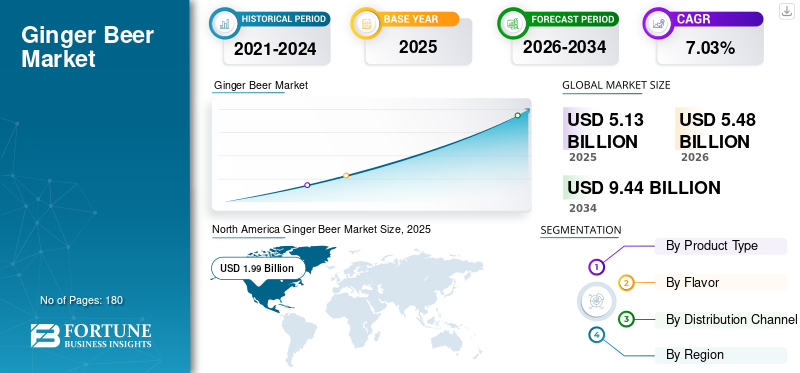
The ginger beer market size was valued at USD 5.13 billion in 2025 and is projected to grow from USD 5.48 billion in 2026 to USD 9.44 billion by 2034, exhibiting a CAGR of 7.03% during the forecast period. North America dominated the ginger beer market with a market share of 38.79% in 2025.
Ginger beer is a carbonated drink prepared using sweeteners, flavoring components, and ginger, known for its refreshing and spicy taste profile. Traditionally, it was developed through natural fermentation with a starter culture and ginger, which naturally produced carbonation and mild alcohol. Currently, ginger-flavored beer is positioned as a wellness-oriented product, a cocktail mixer, and a premium soft drink. Geographically, the U.K., North America, and Australia are well-built markets. The growing sober-curious consumption movement and the rising inclination towards botanical drinks are the main drivers of the market.
Companies such as Fever-Tree, Nestle S.A., and Reed’s Inc. are prominent players in the market. New product launches are a pivotal strategy adopted by key players to improve their position.
Download Free sample to learn more about this report.
Ginger Beer Market Key Takeaways
 Global Market Size & Forecast
- 2025 Market Size: USD 5.13 billion
- 2026 Market Size: USD 5.48 billion
- 2034 Forecast Market Size: USD 9.44 billion
- CAGR: 7.03% from 2026–2034
 Market Share
- North America dominated the ginger beer market with a 38.79% share in 2025.
- The non-alcoholic ginger beer segment led the market in 2025.
- The retail segment accounted for the largest market share in 2025.
 Key Regional Highlights
North America
North America led the global market, supported by rising demand for craft beverages and growing awareness of ginger beer's health benefits.
Europe
Europe ranked second in 2025, driven by increasing use of ginger beer as a cocktail mixer and expanding brand presence.
Asia Pacific
Asia Pacific ranked third, supported by innovative flavor launches and rising demand for natural ingredient-based beverages.
U.S.
U.S. The market reached USD 1.61 billion in 2025, representing approximately 31.46% of global revenue.
Japan
Japan The market was valued at USD 0.18 billion in 2025, accounting for approximately 3.46% of global revenue.
Read More

GINGER BEER MARKET TRENDS
Increasing Trend of Premiumization is Emerging Market Trend
Craft positioning and premiumization are recognized as key trends in the ginger beer sector. Today, the majority of consumers are looking for drinks that are flavorful and authentic, rather than basic, regular soft drinks. Ginger-based beer aligns well with this trend, as it offers a complex, spicy flavor profile. Producers are highlighting traditional brewing methods, small-batch production, real ginger content, and natural ingredients to develop a premium image. In this trend, packaging also plays a pivotal role with firms using matte-finish cans and vintage-style labels to enhance brand differentiation on retail shelves. Moreover, this trend is further reinforced by the growing cocktail culture and gourmet dining, where individuals are willing to pay extra for drinks that improve social occasions.
MARKET DYNAMICS
MARKET DRIVERS
Download Free sample to learn more about this report.
Rising Preference for Non-Alcoholic Sophisticated Beverages Propels Market’s Growth
The surging preference for non-alcoholic sophisticated drinks is a key driver supporting market expansion. In today’s era, most individuals are adopting mindful consumption lifestyles, minimizing alcohol intake for mental wellness and fitness, while still looking for drinks that are socially engaging. Ginger beer can easily cater to this demand, as its carbonation and spicy flavor offer a refined drinking experience compared to regular soft drinks. Unlike traditional sodas, which are mostly youth-oriented and over sweet, this beer is gaining recognition as an adult refreshment ideal for dining experiences and social occasions. Moreover, the augmented sober curious movement further fueled the need for drinks that mimic alcoholic beverages. Seeing this inclination, companies are trying to launch more ginger-centric alcohol-free beers for consumers.
MARKET RESTRAINTS
High Sugar Content in Beer Creates Negative Consumer Perception
One of the main obstacles in the market is the high sugar content in beer. Traditional ginger beer typically contains a high level of sugar, as sweetness is required to balance the pungent and spicy character of ginger. Ginger as a component is mostly linked with general wellness and digestive comfort, which initially creates a positive perception compared to traditional carbonated soft drinks. However, when individuals pay attention to labeling and discover high calories/sugar, the beer may be considered inconsistent and less authentic. This scenario is further exacerbated by rising public discussion around metabolic disorders, diabetes, and obesity. As a result, the high sugar content in beer production hinders the ginger beer market growth.
MARKET OPPORTUNITIES
Adoption of Modern Technologies in Beer Sector Unlocks Growth Opportunities
The incorporation of advanced technologies in the beer industry builds growth opportunities. To enhance ginger extraction, manufacturers are adopting advanced extraction techniques. Traditional extraction techniques, when used, often lead to excessive bitterness and flavor loss. Modern extraction methods, such as supercritical fluid extraction and cold extraction, enable producers to preserve freshness and aroma components effectively. Advanced sensory testing and formulation software systems are also gaining popularity in the market as they allow accurate flavor release and optimize sweetness. Moreover, companies are exploring encapsulation techniques to strengthen ingredient bioavailability and preserve sensitive components.
Segmentation Analysis
By Product Type
Non-Alcoholic Ginger Beer Dominated Market Due to Fewer Regulatory Restrictions
Depending on the product type, the market is segmented into alcoholic ginger beer and non-alcoholic ginger beer.
The non-alcoholic ginger beer sector led the market in 2025. Alcohol-free beer appeals to a wider audience as it can be consumed by individuals of all ages. The improved innovation rate in non-alcoholic formats bolsters the segment’s potential. Additionally, this type of beer faces minimal regulatory constraints on taxation and advertising, unlike alcoholic drinks, further strengthening segment growth.
The alcoholic ginger beer is projected to grow at a high CAGR of 8.71% over the forecast period.
By Flavor
Original/Unflavored Category Led the Industry Because of High Consumer Acceptance
On the basis of flavor, the market is divided into original/unflavored and flavored.
In 2025, the original/unflavored segment leads in the global market. Unflavored beer imparts the classic ginger flavor profile, which retains the beverage’s original positioning and boosts consumer trust. Traditionally, ginger-flavored beer is mostly used as a mixer, particularly because of its neutral flavor, which fuels demand for unflavored beer. Moreover, it is less dependent on seasonality than flavored beer and can be easily integrated into foodservice applications. As a result, such factors augment the sales of ginger-beer.
The flavored category is projected to grow at a high CAGR of 8.43% over the forecast period.
To know how our report can help streamline your business, Speak to Analyst
By Distribution Channel
Retail Leads in the Industry Owing to Strong At-Home Consumption
Based on distribution channel, the market is segmented into foodservice and retail.
The retail segment held largest ginger beer market share. Retail outlets, such as supermarkets/hypermarkets and specialty stores, offer wider consumer access than foodservice. The growing trend of DIY cocktail preparation has led consumers to purchase ginger beer for household use. Moreover, these channels support a broader assortment of ginger-based beers, including non-alcoholic, low-sugar, and alcoholic varieties, which might not be feasible in the HoReCa environment. Thus, such instances strengthen the segment’s momentum.
The foodservice is projected to grow at a high CAGR of 8.58% over the forecast period.
Ginger Beer Market Regional Outlook
By geography, the market is categorized into Europe, North America, Asia Pacific, South America, and the Middle East & Africa.
North America
North America Ginger Beer Market Size, 2025 (USD Billion)
To get more information on the regional analysis of this market, Download Free sample
North America dominates the market and reached valuation of USD 1.99 billion in 2025. The market in North America is expected to grow due to increasing consumer preference for craft beverages and improved awareness of the health benefits of ginger beer.
U.S. Ginger Beer Market
Based on North America's strong contribution, the U.S. market was at USD 1.61 billion in 2025, accounting for roughly 31.46% of global sales.
Europe
Europe market reached USD 1.31 billion by 2025, recording a growth rate of 6.14% in the coming years, and secured the second position. The surging use of ginger ale or ginger beer as a mixer, along with the growing number of ginger beer brands, is boosting regional potential.
Germany Ginger Beer Market
The German market in 2025 was valued at USD 0.25 billion, representing roughly 4.85% of the global market revenues.
U.K. Ginger Beer Market
The U.K. market reached USD 0.40 billion in 2025, equivalent to around 7.86% of the global market sales.
Asia Pacific
The Asia Pacific region reached USD 1.27 billion by 2025 and ranks third. Innovative flavor launches and a surging shift towards natural ingredient-infused alcoholic beverages strengthen the region's potential.
India Ginger Beer Market
The India market in 2025 was at USD 0.15 billion, accounting for roughly 2.88% of the global market revenues.
China Ginger Beer Market
China's was one of the largest market worldwide, with revenues at USD 0.45 billion in 2025, accounting for roughly 8.71% of global market sales.
Japan Ginger Beer Market
The Japan market in 2025 was at USD 0.18 billion, accounting for approximately 3.46% of the global market revenues.
South America, the Middle East & Africa
The South America and Middle East & Africa regions are expected to witness moderate growth in this market space during the forecast period. The South America market reached valuation of USD 0.35 billion in 2025. The flourishing craft beer sector and increasing youth population are expected to drive demand. The Middle East & Africa market reached USD 0.09 billion in 2025.
South Africa Ginger Beer Market
The South African market reached USD 0.07 billion in 2025, representing roughly 1.30% of global revenues.
COMPETITIVE LANDSCAPE
Key Industry Players
Novel Flavor Launches Helps the Enterprises to Capture High Market Share
The ginger beer market is considered moderately fragmented, with strong competition between regional soft drink producers, craft beverage firms, and premium mixer brands. The market is witnessing surging investment in flavor innovation and premium packaging. Moreover, brands are collaborating with retail chains and celebrity personalities to expand their business.
LIST OF KEY GINGER BEER COMPANIES PROFILED
- Fever-Tree (U.K.)
- Bundaberg Brewed Drinks (Australia)
- Q Mixers (U.S.)
- CAPI Drinks (Australia)
- Reed’s Inc. (U.S.)
- Franklin & Sons (U.K.)
- Nestle S.A. (Switzerland)
- Maine Root (U.S.)
- Fentimans (U.K.)
- East Imperial (New Zealand)
KEY INDUSTRY DEVELOPMENTS
- March 2026: Fever-Tree, a British producer of carbonated mixers, expanded its distribution of mojito and pineapple ginger beer range across the U.S. market. This drink is available in glass bottles and can be purchased from Kroger and Albertsons retailers.
- March 2026: Stoli Group, a private spirits enterprise based in the U.S., relaunched its ginger beer using a new recipe of natural components.
- May 2025: Remedy Drinks, an Australian beverage firm, announced the launch of its ginger beer, available in two flavors.
- March 2025: XXXX Brewery, a Queensland-based beer brand, unveiled its first alcoholic ginger beer. This beverage is made with ginger juice and has an ABV of 3.5%.
- May 2023: Whole Foods Market, a U.S.-based supermarket chain, entered into a partnership with Blake Lively, an American entrepreneur and actress, to introduce a non-alcoholic brand in the U.K. This Betty Buzz brand revealed five flavors of drinks, including ginger beer.
REPORT COVERAGE
The global ginger beer market provides an in-depth study of the market size & forecast by all the market segments included in the market reports. The market forecast analysis includes details on the market dynamics and trends expected to drive the market during the forecast period. The global market analysis offers information on the technological advancements, new product launches, key industry developments, and details on partnerships, mergers & acquisitions. The industry forecast also encompasses a detailed competitive landscape with information on the market segmentation, market share, and profiles of key operating players.
Request for Customization to gain extensive market insights.
Report Scope & Segmentation
| ATTRIBUTE | DETAILS |
| Study Period | 2021-2034 |
| Base Year | 2025 |
| Estimated Year | 2026 |
| Forecast Period | 2026-2034 |
| Historical Period | 2021-2024 |
| Growth Rate | CAGR of 7.03% from 2026-2034 |
| Unit | Value (USD Billion) |
| Segmentation | By Product Type, Flavor, Distribution Channel, Region |
| By Product Type |
|
| By Flavor |
|
| By Distribution Channel |
|
| By Geography |
|
Frequently Asked Questions
Fortune Business Insights says that the global market value stood at USD 5.13 billion in 2025 and is projected to reach USD 9.44 billion by 2034.
In 2025, the North America market value stood at USD 1.99 billion.
The market is expected to exhibit a CAGR of 7.03% during the forecast period of 2026-2034.
By product type, the non-alcoholic ginger beer segment led the global market.
Rising preference for non-alcoholic sophisticated beverages propels the market’s growth.
Fever Tree, Nestle S.A., and Reed’s Inc. are among the key players in the market.
North America held the largest market share.
Increasing trend of premiumization boosts the sales of ginger beer.



- 2021-2034
- 2025
- 2021-2024
- 180
-
(Offer valid till 30th Sep 2026)
Get 30-60 hrs Free Customization
Expand Regional and Country Coverage, Segments Analysis, Company Profiles, Competitive Benchmarking, and End-user Insights.




















-
US +1 833 909 2966 ( Toll Free )
-
Get In Touch With Us