 Download Free Sample



Get a Quote
Receive a tailored pricing based on your needs.
- Choose license type
- Multiple user options
- Custom scope & coverage
- Fast turnaround
"Designing Growth Strategies is in our DNA"
 Listen to Audio Version
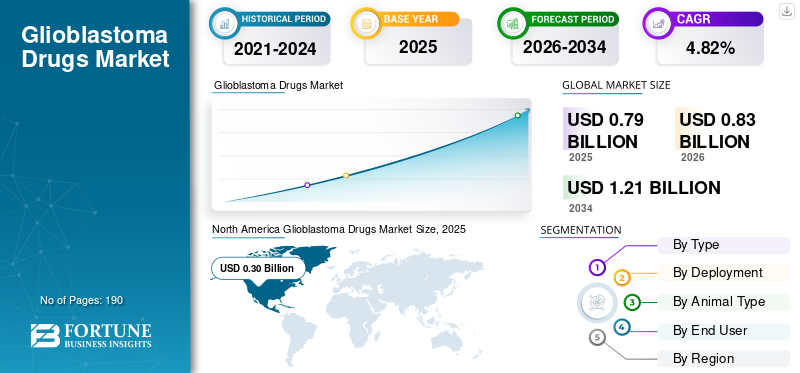
The global glioblastoma drugs market size was valued at USD 0.79 billion in 2025. The market is projected to grow from USD 0.83 billion in 2026 to USD 1.21 billion by 2034, exhibiting a CAGR of 4.82% during the forecast period. North America dominated the glioblastoma drugs market with a market share of 37.97% in 2025.
The global market is expected to witness steady growth driven by the rising prevalence of brain cancers, creating a strong need for better therapeutic options. The continued use of standard chemotherapy supports the market growth, rising research activity in targeted and immune-based therapies, and combination treatment approaches for recurrent and newly diagnosed patients. Key operating companies are investing in developing pipeline candidates to improve efficacy, extend progression-free survival, and address relapse. This continued innovation is expected to support market expansion over the coming years.
Furthermore, leading players in the industry, such as Merck & Co., Inc., Genentech, Inc. (F. Hoffmann-La Roche Ltd), and Teva Pharmaceutical Industries Ltd., are operating in the market to expand their pipeline and address unmet demand.
Download Free sample to learn more about this report.
 Global Market Size & Forecast
 Market Share
 Key Regional Highlights
North America
North America reached USD 0.30 billion in 2025, maintaining its leading regional position.
Europe
Europe is projected to reach USD 0.23 billion in 2026, driven by strong specialist treatment networks.
Asia Pacific
Asia Pacific is expected to reach USD 0.19 billion in 2026, supported by expanding advanced cancer care capacity.
U.S.
The market is projected to reach USD 0.29 billion in 2026, representing approximately 34.34% of the global market.
Japan
The market is estimated to reach USD 0.04 billion in 2026, accounting for approximately 4.82% of global revenue.
Read More

Increasing Development of Immunotherapy-Based Candidates Is Emerging as a Key Market Trend
The prominent global market trend observed is the increasing development of immunotherapy-based candidates. The treatment benefits from currently available drug options in glioblastoma remain limited, especially in recurrent disease. These factors are pushing key companies to invest in cancer vaccines, cell-based immunotherapies, checkpoint-oriented approaches, and other immune-mediated treatments that may offer better disease control and longer survival. As more developers move these candidates into mid-stage and late-stage studies, the market is witnessing a broader shift toward immune-based innovation. This trend is expected to strengthen future product differentiation and expand the commercial potential of the market.
Download Free sample to learn more about this report.
High Unmet Need for Effective Glioblastoma Therapies is Driving Market Growth
A key factor driving growth in the global glioblastoma drugs market growth is the high unmet need for effective therapies. Currently available treatment options offer limited survival benefits and do not adequately control disease recurrence. These factors are pushing drug developers to invest in new candidates that can improve efficacy, secure regulatory support, and address a patient population with very few therapeutic alternatives. As more companies advance innovative programs in glioblastoma, the market is gaining deeper pipelines and greater commercial interest, further deepening market growth.
Moreover, key companies are focusing on regulatory approval and new product launches for their glioblastoma offerings to strengthen their market position.
High Recurrence and Rapid Treatment Resistance Are Restraining Market Growth
One of the key factors restraining market growth is the rapid development of treatment resistance. This reduces the ability of existing glioblastoma drugs to deliver a durable clinical benefit. When patients relapse quickly after standard treatment, the treatment window becomes shorter, resulting in the value of current marketed therapies being more limited. Additionally, resistance to temozolomide and other treatments makes it more difficult for new drug candidates to demonstrate strong survival improvements in clinical trials. Due to this, recurrence and resistance increase the development risk, erode physician confidence in long-term benefits, and slow the pace of market expansion.
Strong and Active Pipeline Development is Creating Market Growth Opportunities
Strong and active pipeline development is creating market growth opportunities as glioblastoma remains a high-unmet-need cancer area where currently available therapies still deliver limited long-term benefit. This is encouraging companies to advance new drug candidates with different mechanisms of action, improved brain-penetration strategies, and more targeted treatment approaches. As more investigational therapies enter clinical studies, the market gains a broader pipeline of future products and greater potential for partnerships, licensing, and commercialization. It also increases the chance that new therapies may address recurrent disease more effectively, where treatment needs remain especially high. Owing to this, a deeper and more active pipeline is opening up long-term expansion opportunities for the market.
Strong Tumor Heterogeneity is Creating a Major Challenge for Market Growth
The global market continues to face significant challenges as glioblastoma is not a uniform disease and exhibits substantial variation across patients, tumor regions, and cellular states. This complexity makes treatment response less predictable and reduces the likelihood that a single drug approach will work broadly across the patient population. As a result, companies developing glioblastoma therapies face higher scientific risk, more difficult trial design, and greater pressure to identify subgroups that may respond better to treatment. This is slowing market expansion and making it more dependent on highly differentiated innovation.
Increasing Use of Temozolomide in Treatment Protocol to Lead the Segmental Growth
Based on the drug, the market is categorized into temozolomide, bevacizumab, carmustine, lomustine, procarbazine, irinotecan, and others.
Among these, the temozolomide segment accounted for the largest share in the market. Temozolomide remains one of the core drugs, used in the standard first-line glioblastoma treatment, especially in combination with radiotherapy and later as maintenance therapy. It is deeply embedded in treatment protocols; physicians are more familiar with its dosing, sequencing, and safety profile than with newer investigational options. These factors result in wider clinical use, stronger prescription continuity, and more stable revenue contribution, leading to dominance of the segment.
The others segment is expected to grow at a CAGR of 8.50% over the global glioblastoma drugs market forecast period.
To know how our report can help streamline your business, Speak to Analyst
Robust Reliance on Alkylating Agents for Glioblastoma to Boost Segmental Growth
Based on drug class, the market is segmented into alkylating agents, VEGF/angiogenesis inhibitors, nitrosoureas, platinum compounds, topoisomerase inhibitors, immune checkpoint inhibitors, and others.
In 2025, the alkylating agents accounted for the largest revenue share among drug classes. The drug class includes temozolomide, which remains the backbone chemotherapy for glioblastoma. Since current treatment standards rely heavily on temozolomide-based regimens, the alkylating class benefits directly from the broadest clinical acceptance and the highest treatment familiarity. These factors increase prescribing confidence and routine use. Additionally, novel product launches by key companies and the regulatory approvals strengthen their market position.
The immune checkpoint inhibitors segment is projected to grow at a CAGR of 11.92% during the forecast period.
Large Adult Patient Pool to Reinforce Dominance in the Segment
Based on age group, the market is segmented into pediatric and adult.
In 2025, the adult segment dominated the market. Adults dominated the market as glioblastoma primarily affects adults, naturally creating a larger treated patient base in this segment. Since the disease burden is much higher in adults than in pediatric patients, more drug demand, more clinical trial enrollment, and more commercial focus are concentrated in adult care settings. In addition, most approved and pipeline glioblastoma treatment strategies are developed primarily for adult patients, further strengthening revenue concentration in this age group. Due to this larger incidence pool and stronger treatment activity, the adult segment is likely to remain the leading contributor to the market.
In addition, the pediatric segment is projected to grow at a CAGR of 7.61% during the study period.
Greater Affordability and Access Provided by Generics to Fuel the Segment Growth
Based on type, the market is segmented into branded and generic.
Based on type, generics accounted for the largest glioblastoma drugs market share during the forecast period. Glioblastoma treatment still depends heavily on established chemotherapy molecules, especially temozolomide, where generic availability has expanded access and reduced treatment costs. As hospitals and oncology providers are highly cost-conscious in routine cancer treatment, lower-cost generic options are often preferred where clinical outcomes are already well understood. This increases prescription volume for generic products and makes them more widely available than branded therapies in many standard-use settings. In addition, the limited number of breakthrough branded drug alternatives in glioblastoma has allowed generic chemotherapy products to retain strong market relevance.
In addition, the branded segment is projected to grow at a CAGR of 3.10% during the study period.
Increasing Use of Chemotherapy as First-Line Treatment to Lead Segmental Growth
Based on the therapy, the market is segmented into targeted therapy, immunotherapy, chemotherapy, and others.
Among these, chemotherapy is likely to dominate the market as it remains the most established and routinely used drug-based treatment approach in glioblastoma, with temozolomide continuing to serve as the standard chemotherapy backbone. Since immunotherapy and targeted therapy have not yet displaced standard chemoradiation in routine care, chemotherapy continues to account for the largest share of actual treatment use. It also benefits from stronger clinical familiarity, broader treatment eligibility, and longstanding integration into frontline treatment pathways. Moreover, many experimental therapies are still being tested in combination with chemotherapy instead of replacing it. Due to this continued dependence on standard chemoradiation, chemotherapy is likely to remain the dominant therapy segment.
The immunotherapy segment is projected to grow at a CAGR of 12.72% over the study period.
Ease of Oral Medicine Dispense to Favor Growth in the Segment
Based on the route of administration, the market is segmented into oral and parenteral.
By route of administration, the oral drugs dominated the market. Oral dominated the market as temozolomide, the key chemotherapy used in glioblastoma, is widely used in capsule form, making oral administration the most established drug-delivery route in routine treatment. As oral treatment is easier to prescribe, dispense, and continue during maintenance therapy than repeated parenteral administration, it supports greater convenience for both providers and patients. This improves treatment continuity and makes oral therapy more practical within long oncology treatment cycles. In addition, several newer glioblastoma drug candidates are also being designed as oral agents, which supports the continued strength of this route. As a result, oral administration is likely to lead the market by route.
The parenteral segment is projected to grow at a CAGR of 5.86% over the study period.
Increasing Demand in Hospital Pharmacies Due to Large Patient Volumes to Lead Growth in the Segment
Based on distribution channel, the market is segmented into hospital pharmacies, drug stores & retail pharmacies, and online pharmacies.
By end user, hospital pharmacies accounted for the largest share. Glioblastoma treatment is highly specialized and usually managed within hospital-based oncology, neurosurgery, and radiation care settings. Since treatment commonly involves surgery, radiotherapy, chemotherapy, supportive medicines, and close monitoring, hospitals remain the primary point of care for drug initiation and ongoing management. This naturally drives higher dispensing through hospital pharmacies than through retail or online channels. In addition, many glioblastoma patients are treated at large cancer centers or specialty hospitals where hospital pharmacy systems are already integrated into the treatment pathway. Due to this care structure, hospital pharmacies are likely to account for the largest share of drug distribution in the market.
The online pharmacies segment is projected to grow at a CAGR of 7.96% over the study period.
By region, the market is categorized into Europe, North America, Asia Pacific, Latin America, and the Middle East & Africa.
North America Glioblastoma Drugs Market Size, 2025 (USD Billion)
To get more information on the regional analysis of this market, Download Free sample
North America held the dominant share in 2024 at USD 0.28 billion and maintained its leading position in 2025 at USD 0.30 billion. The market is growing as the region has a strong neuro-oncology infrastructure, high diagnosis and treatment intensity, and the deepest clinical-trial ecosystem for glioblastoma. It is also benefiting from continued regulatory and pipeline momentum.
Given North America's substantial contribution and the U.S. dominance in the region, the U.S. market is estimated at around USD 0.29 billion in 2026, accounting for roughly 34.34% of the global market.
Europe is projected to grow at 3.93% over the coming years, the second-highest among all regions, and reach a valuation of USD 0.23 billion by 2026. The market is growing as Europe has well-established cancer registries, broad specialist treatment networks, and increasing access to advanced glioblastoma therapies through both clinical trials and public health systems.
The U.K. market is estimated at around USD 0.05 billion in 2026, representing roughly 5.56% of the global market.
Germany's market size is projected to reach approximately USD 0.05 billion in 2026, equivalent to around 6.26% of the global market.
Asia Pacific is estimated to reach USD 0.19 billion in 2026 and secure the position of the third-largest region in the market. The market is growing as countries in the region are improving advanced cancer care capacity while also increasing local research activity in brain tumors.
The Japanese market in 2026 is estimated at around USD 0.04 billion, accounting for approximately 4.82% of the global market.
China's market is projected to be one of the largest worldwide, with 2026 revenues estimated at around USD 0.08 billion, representing approximately 9.22% of global sales.
The Indian market in 2026 is estimated at around USD 0.02 billion, accounting for roughly 2.57% of global revenue.
Latin America and the Middle East & Africa regions are expected to witness moderate growth in this market space during the forecast period. The Latin America market is set to reach a valuation of USD 0.06 billion in 2026. The market is growing as access to cancer care is gradually improving, and regional health bodies are pushing harder for greater availability of essential cancer medicines, supplies, and equipment. In the Middle East & Africa, the GCC is set to reach USD 0.02 billion in 2026.
The South African market is projected to reach approximately USD 0.01 billion by 2026, accounting for roughly 0.64% of global revenue.
New Product Launches by Key Players to Propel Market Progress
The global glioblastoma drugs market is highly consolidated, with companies such as Merck & Co., Inc., Genentech, Inc. (F. Hoffmann-La Roche Ltd), Teva Pharmaceutical Industries Ltd., Camber Pharmaceuticals, Inc., and Sun Pharmaceutical Industries Ltd. holding significant market share. Strategic partnerships, new product launches, technological advancements, and increased investments in the sector drive these companies' market share gains.
Other notable players in the global market include Accord Healthcare, Fresenius Kabi AG, and Zydus Lifesciences Ltd. These companies are expected to prioritize technological advancements, strategic collaborations, and new product launches to strengthen their positions during the global market forecast period.
The report provides a detailed global glioblastoma drugs market analysis across key segments. It offers in-depth insights into how standard therapies such as temozolomide, bevacizumab, nitrosoureas, and other treatment options are positioned within the current market landscape. The report also evaluates how treatment demand is evolving across adult and pediatric patient groups, while assessing the commercial role of branded and generic drugs in overall market development. Also, the report delivers a comprehensive outlook of the market across major regions. It examines the key factors driving market growth, major restraints and challenges, and emerging opportunities shaping future expansion. The study also covers the competitive landscape by analyzing leading companies, recent product developments, collaborations, partnerships, and pipeline progress specific to glioblastoma therapeutics. Overall, the report is designed to provide strategic insights into current market dynamics, future growth potential, and the competitive positioning of companies operating in the global market.
Request for Customization to gain extensive market insights.
| ATTRIBUTE | DETAILS |
| Study Period | 2021-2034 |
| Base Year | 2025 |
| Estimated Year | 2026 |
| Forecast Period | 2026-2034 |
| Historical Period | 2021-2024 |
| Growth Rate | CAGR of 4.82% from 2026 to 2034 |
| Unit | Value (USD Billion) |
| Segmentation | By Drug, Drug Class, Age Group, Type, Therapy, Route of Administration, Distribution Channel, and Region |
| By Drug |
|
| By Drug Class |
|
| By Age Group |
|
| By Type |
|
| By Therapy |
|
| By Route of Administration |
|
| By Distribution Channel |
|
| By Region |
|
According to Fortune Business Insights, the global market value stood at USD 0.79 billion in 2025 and is projected to reach USD 1.21 billion by 2034.
In 2025, the market value stood at USD 0.30 billion.
The market is expected to grow at a CAGR of 4.82% over the forecast period.
The temozolomide segment is expected to lead the market by drug.
The high unmet need for effective glioblastoma therapies is driving market growth.
Merck & Co., Inc., Genentech, Inc. (F. Hoffmann-La Roche Ltd), Teva Pharmaceutical Industries Ltd., and Sun Pharmaceutical Industries Ltd. are the major market players in the global market.
North America dominated the market in 2025.

Get 30-60 hrs Free Customization
Expand Regional and Country Coverage, Segments Analysis, Company Profiles, Competitive Benchmarking, and End-user Insights.













.webp)






Related Reports
Get In Touch With Us
US +1 833 909 2966 ( Toll Free )
Receive a tailored pricing based on your needs.
Discuss your questions with our industry experts.
Have questions? Get quick answers before you purchase.

