Graphics Card Market Size, Share & Industry Analysis, By Type (Discrete and Integrated), By Device (Servers/Data Center, Gaming Consoles, Desktops, Laptops, and Smartphones), By Application (Gaming, Education and Training, Multimedia Editing, and Cryptocurrency Mining), By End-User (Consumer Electronics, Industrial, Media and Entertainment, Healthcare, IT and Telecommunications, and Others), and Regional Forecast, 2026-2034
 Download Free Sample
Graphics Card Market Size & Share
 Listen to Audio Version
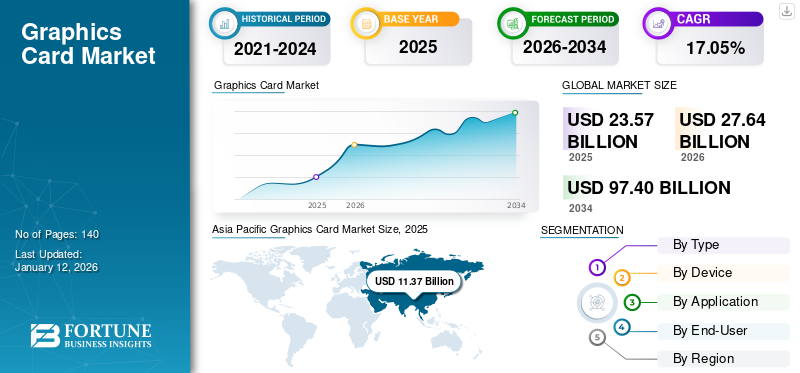
The global graphics card market size was valued at USD 23.57 billion in 2025 and is projected to grow from USD 27.64 billion in 2026 to USD 97.4 billion by 2034, exhibiting a CAGR of 17.0% during the forecast period. Asia Pacific dominated the graphics card market with a market share of 48.22% in 2025. Industry growth driven by artificial intelligence computing demand, gaming ecosystem expansion, data center acceleration, high-performance computing adoption, and advanced semiconductor manufacturing innovation
A graphics card is a piece of hardware designed to enhance a computer's video memory and improve its display quality to a higher definition. It enhances the computer's performance and enables it to handle more advanced tasks efficiently. The global graphics card market represents a critical component of the semiconductor and computing hardware ecosystem. Graphics cards, also known as graphics processing units (GPUs), enable high-performance parallel processing used across gaming systems, data centers, professional visualization environments, and artificial intelligence workloads.
Demand within the graphics card industry has evolved significantly during the past decade. Originally associated primarily with gaming applications, graphics processors now serve as foundational infrastructure for machine learning training, high-performance computing (HPC), video rendering, and cloud data center acceleration. This diversification has expanded the graphics card market size and broadened its institutional relevance.
Institutional technology buyers increasingly evaluate graphics cards as strategic computing infrastructure rather than consumer hardware. Data center operators, cloud service providers, research laboratories, and enterprise IT departments represent growing sources of demand. These buyers prioritize processing throughput, memory bandwidth, thermal efficiency, and compatibility with artificial intelligence frameworks.
Supply chain dynamics also influence the graphics card industry. Semiconductor fabrication capacity, advanced chip packaging technologies, and GPU architecture innovation determine production scalability. Manufacturing partnerships between chip designers and semiconductor foundries remain essential to sustaining supply.
Pricing patterns within the graphics card market are closely linked to semiconductor cycles and demand fluctuations across gaming, data center, and cryptocurrency sectors. Institutional buyers often evaluate long-term supply agreements to stabilize procurement costs. Regionally, North America maintains a strong influence due to leading GPU design companies and hyperscale cloud providers. Asia-Pacific plays a major role in manufacturing and consumer electronics demand. Europe contributes through advanced industrial computing applications.
The demand for graphics cards is rising due to advancements in gaming and content creation technology. The market is driven by increasing interest in immersive video games alongside Virtual Reality (VR) and Augmented Reality (AR) applications that need potent graphics performance. As 4K and 8K displays become more common, graphics cards must advance in video decoding and rendering performance to meet these demands. For instance, Exploding Topics reported that there were around 3.32 billion active video gamers worldwide in 2024. The demand for these cards continues to rise as they are increasingly used for cryptocurrency mining and machine learning tasks. Advanced GPUs with real-time ray tracing and AI features are being adopted across multiple sectors. These elements are responsible for the expansion of the graphics card market share.
The computer sector experienced a significant shortage of graphics cards due to supply and demand complexities that drove up their average price. The principal reason for this situation emerged from the closure of many factories throughout China during the COVID-19 pandemic until safety conditions allowed operations to restart. Computer chip demand rose sharply as China stopped all the major manufacturing activities. The automobile, computer, and smartphone industries experienced substantial impacts from the chip shortage.
Download Free sample to learn more about this report.
Graphics Card Market Key Takeaways
 Market Size & Forecast
- 2025 Market Size: USD 23.57 billion
- 2026 Market Size: USD 27.64 billion
- 2034 Forecast Market Size: USD 97.40 billion
- CAGR: 17.0% from 2026-2034
 Market Share
- Asia Pacific dominated the graphics card market with a 48.22% share in 2025.
- The discrete segment accounted for a 60.5% share in 2026.
- The servers/data center segment held a 31.95% share in 2026.
 Key Regional Highlights
Asia Pacific
Asia Pacific accounted for USD 11.37 billion in 2025 and is projected to reach USD 13.33 billion in 2026.
North America
North America represented USD 7.75 billion in 2025 and is expected to grow to USD 9.11 billion in 2026.
Europe
Europe generated USD 2.84 billion in 2025 and is projected to reach USD 3.35 billion in 2026.
U.S.
The graphics card market is estimated to reach USD 7.78 billion in 2026, supported by growing demand for AI, cloud computing, and gaming applications.
Japan
The market is estimated to reach USD 2.94 billion in 2026, driven by strong technology research capabilities and an advanced gaming culture.
Read More

IMPACT OF GENERATIVE AI
Integration of Generative AI with Graphics Card Enhanced the Capabilities, Further Fueling Market Growth
Generative AI creates profound and varied effects across the graphics card market. The rise in demand for advanced computing power required by AI applications drives the market for graphics cards. Graphics cards play a crucial role in powering generative AI models, allowing these systems to learn from extensive datasets and produce high-quality content.
- In January 2024, NVIDIA introduced GeForce RTX SUPER desktop graphics cards designed to deliver enhanced generative AI capabilities, along with new AI laptops from leading manufacturers and a suite of NVIDIA RTX-accelerated AI software and tools tailored for both developers and consumers. These offerings aim to improve PC experiences through generative AI: NVIDIA TensorRT acceleration for the widely-used Stable Diffusion XL model to enhance text-to-image processes, NVIDIA RTX Remix featuring generative AI texture tools, NVIDIA ACE microservices, and a growing number of games utilizing DLSS 3 technology with Frame Generation.
MARKET DYNAMICS
Graphic Card Market Trends
Integration of Ray Tracing with Graphics Card to Emerge as a Key Market Trend
Graphics cards have an essential role in the operation of ray tracing. They deliver all the processing power and specific hardware for crucial calculations. It can also offer more natural shadows, lighting, reflections, and other visual effects that were almost impossible to attain. Integrating ray tracing with graphics cards is expected to significantly improve the visual quality and frequency of video games and other graphics-heavy applications. This is immensely changing the trend into a new level of involvement and realism in gaming and other visual experiences.
The graphics card market is undergoing rapid transformation as GPU computing expands beyond traditional gaming applications. One of the most significant graphics card market trends involves the growing integration of GPUs within artificial intelligence infrastructure. Machine learning training and inference tasks require high levels of parallel processing, making GPU acceleration essential for modern data centers.
Cloud computing providers increasingly deploy graphics cards within hyperscale data centers. GPU clusters support artificial intelligence training models, large-scale data analytics, and complex scientific simulations. As enterprise adoption of artificial intelligence continues expanding, demand for GPU-accelerated computing infrastructure rises accordingly.
Another important trend involves architectural specialization within the graphics card industry. Manufacturers now design GPUs optimized for distinct workloads such as gaming, artificial intelligence inference, and professional visualization. These specialized architectures improve performance efficiency for targeted applications.
Gaming technology also continues driving innovation. High-resolution rendering, real-time ray tracing, and immersive virtual environments require increasingly powerful graphics processors. Gaming platforms now integrate advanced graphics capabilities that support 4K resolution and high refresh-rate displays.
Download Free sample to learn more about this report.
Market Drivers
Rising Competitive Gaming, Cryptocurrency Mining, and AI Fuels Market Development
The processing power assigned by graphics cards is crucial for AI and ML applications. Graphics cards with parallel tasking ability stand out in hastening the operation of AI and ML workloads. AI and ML are highly progressive and applicable in data analytics, image recognition, autonomous vehicles, and other areas; thus, the demand for graphics cards optimized for these workloads is increasing. Graphics cards are a core part of applications for developing content and videos for multimedia editing programs.
The progression of eSports and online streaming activities has led to an increased need for high-performance graphics cards. Higher refresh rates and low latency enable esports gamers to perform more competitively during gameplay. This shift provides an opportunity in the graphics card market. Also, graphics cards are essential for the processing power required for cryptocurrencies, facilitating smooth gaming experiences. While there is an increase in the value of cryptocurrency, there is a higher demand from miners looking to profit from active markets, therefore increasing the graphics card market size.
Several structural factors support sustained graphics card market growth as computational workloads become increasingly data-intensive. Artificial intelligence development represents one of the most significant drivers within the graphics card industry. Training large neural networks requires immense parallel processing capacity that GPUs provide efficiently.
Cloud computing expansion also contributes to graphics card market growth. Hyperscale cloud providers deploy GPU clusters to deliver machine learning services, data analytics capabilities, and accelerated computing resources to enterprise customers. Cloud infrastructure investment, therefore, directly increases GPU demand. Gaming remains a major consumer driver. The global gaming ecosystem continues expanding across PC, console, and mobile platforms. High-resolution displays, advanced rendering technologies, and immersive gaming environments require powerful graphics processors capable of handling complex visual workloads.
Another growth factor involves professional content creation. Multimedia editing, animation production, and video rendering rely heavily on GPU acceleration. Media production studios and digital content creators increasingly adopt high-performance graphics hardware to improve workflow efficiency.
Market Restraints
Higher Power Consumption, Heat Dissipation, Compatibility Issues, and Less Driver Support to Impede Market Development
Multimedia applications associated with high-volume treatment tend to overheat computer units. For example, when using intensive computer applications, a high-quality graphics card is supposed to work with maximum performance to maintain the video output quality. Computer cooling systems paired with relevant power management techniques help reduce overheating. Along with such issues, meeting the software and hardware compatibility requirements is also challenging, as providing enough driver support is necessary to retain a compatible multi-operating system environment.
Despite strong demand drivers, several constraints influence the graphics card market. Semiconductor manufacturing limitations represent a primary challenge. Advanced graphics processors require leading-edge fabrication nodes, which depend on limited global semiconductor foundry capacity. Supply chain disruptions may therefore affect product availability and pricing stability. Semiconductor shortages have historically led to temporary price increases and extended procurement timelines for graphics hardware.
Another challenge involves high production costs associated with advanced GPU architectures. Cutting-edge graphics processors require complex chip designs, high-bandwidth memory integration, and advanced cooling systems. These components increase manufacturing expenses and influence final product pricing.
Market volatility associated with cryptocurrency mining also affects the graphics card industry. During periods of increased cryptocurrency mining activity, demand for GPUs may surge temporarily, creating supply imbalances in consumer markets. When mining profitability declines, secondary markets may become oversupplied.
Market Opportunities
Growing Expansion of Cloud Gaming Services to Create Lucrative Market Opportunities
The expansion of cloud gaming is helping the graphics card manufacturers to create an opportunity in this market. Cloud gaming services allow users to access and play high-performance games on any device with an internet connection without costly equipment or software. Graphics cards play a crucial role in cloud games as they present graphics and provide a smooth gaming experience. The popularity of Cloud Gaming Services, such as Google Stadia, Microsoft Xbox Cloud Gaming, and Amazon Luna, is expected to create graphics card market growth opportunities in the coming years.
The graphics card market offers significant opportunities as computing infrastructure continues shifting toward accelerated processing architectures. Artificial intelligence deployment across industries creates a strong demand for GPUs capable of handling complex neural network workloads. Enterprise adoption of generative artificial intelligence technologies is expanding rapidly. Organizations require powerful computing resources to train and deploy AI models, creating substantial opportunities for graphics card manufacturers.
Edge computing also represents a promising opportunity. As artificial intelligence applications expand beyond centralized data centers, smaller GPU-enabled computing systems are being deployed at the network edge to support real-time processing. Another opportunity involves professional visualization and simulation technologies. Industries such as automotive design, aerospace engineering, and medical imaging increasingly rely on GPU-accelerated rendering to simulate complex environments.
SEGMENTATION ANALYSIS
By Type Analysis
Increased Demand for Discrete Graphic Cards from Gaming and Content Creation Places it at the Top Spot
Based on type, the market is segmented into discrete and integrated.
Discrete Graphics Cards
The discrete segment will account for 60.5% market share in 2026, due to increased demand for games, creating professional content, and applications. Discrete graphics cards offer outstanding performance and are specially designed for tasks such as play and industrial use.
Discrete graphics cards represent the most performance-oriented segment of the graphics card market. These dedicated graphics processing units (GPUs) operate independently from the central processing unit (CPU) and contain their own memory and cooling systems. Their architecture allows significantly higher processing throughput compared with integrated graphics solutions.
Demand for discrete GPUs remains particularly strong within gaming, high-performance computing, and professional visualization environments. Gaming enthusiasts and esports players typically rely on discrete graphics cards to support high frame rates, ray tracing technologies, and advanced rendering capabilities. High-end GPUs also enable immersive gaming experiences at ultra-high resolutions such as 4K and beyond.
Data centers represent another major demand source for discrete GPUs. Hyperscale cloud providers deploy GPU accelerators to support artificial intelligence training, scientific computing, and complex analytics workloads. Discrete GPUs are capable of executing thousands of parallel computing threads simultaneously, making them highly effective for machine learning applications.
Integrated Graphics
The integrated segment is expected to register the highest CAGR during the forecast period due to the demand for low-power consumption and compact computing devices. They are built into computer processors and are fit for essential tasks such as web surfing and office work.
Integrated graphics processors represent a widely deployed segment of the graphics card industry, particularly within consumer computing devices. Unlike discrete GPUs, integrated graphics are embedded directly within the CPU or system-on-chip architecture. This design reduces hardware complexity and lowers manufacturing costs.
Integrated graphics solutions are commonly used in laptops, entry-level desktops, and mobile devices where power efficiency and cost optimization are important considerations. These systems typically handle everyday graphical workloads such as web browsing, video playback, and office productivity applications.
Advancements in semiconductor technology have significantly improved the performance of integrated graphics over the past decade. Modern integrated GPUs are capable of supporting high-definition video playback, light gaming workloads, and multimedia editing tasks.
Energy efficiency represents one of the main advantages of integrated graphics systems. Because they share system resources with the CPU, integrated GPUs consume less power than discrete graphics cards. This feature is particularly valuable for portable devices where battery life remains a critical design constraint.
By Device Analysis
Surging Requirement for High-performance Calculations and Data Processing in Cloud Boosted Need for Servers/Data Centers
The market is segmented, based on device, into servers/data center, gaming consoles, desktops, laptops, and smartphones.
Servers and Data Centers
In terms of share, the servers/data center segment dominated the market in 2026, driven by the growing demand for high-performance calculations and data processing in cloud and corporate applications. Professional visualization and maintenance of industries such as engineering, design, and scientific research are a few of its crucial applications that contribute to the segment's overall growth. The servers/data center segment will account for 31.95% market share in 2026.
- In February 2025, G42, an AI technology group based in Abu Dhabi, UAE, declared a strategic investment in France in collaboration with DataOne, Europe's first-ever gigascale AI hosting infrastructure data center. Led by Core42, a subsidiary of G42 that focuses on sovereign cloud and AI infrastructure, this initiative could create an AI data center in Grenoble. This facility, equipped with AMD GPUs, provides enterprises, researchers, and innovators access to advanced AI infrastructure.
Servers and data centers represent one of the fastest-growing device categories within the graphics card market. GPU acceleration has become essential for modern data processing environments that handle artificial intelligence workloads, large-scale analytics, and scientific simulations. Cloud computing providers increasingly deploy GPU clusters within hyperscale data centers. These clusters enable enterprises to access high-performance computing resources through cloud infrastructure without investing in dedicated hardware.
Artificial intelligence development has significantly increased demand for data center GPUs. Training large neural networks requires enormous computational capacity, and GPUs provide the parallel processing architecture necessary for these workloads. Scientific research institutions also rely on GPU-enabled supercomputing environments. Applications such as climate modeling, molecular simulations, and genomic analysis benefit from GPU acceleration.
Gaming Consoles
Gaming consoles represent another important segment of the graphics card market. Console systems integrate specialized graphics processors designed to support immersive gaming environments and high-definition visual rendering. Major console manufacturers rely on custom GPU architectures optimized for gaming performance. These processors enable real-time graphics rendering, advanced shading techniques, and smooth frame rate performance during gameplay.
The gaming industry continues to expand globally, driven by digital distribution platforms, esports ecosystems, and increasing consumer engagement. Console gaming remains particularly popular due to its accessibility and standardized hardware platforms. GPU innovation within console systems also influences broader graphics card development. Technologies such as ray tracing and advanced rendering techniques often originate in high-end gaming hardware before expanding into other computing environments.
As gaming experiences become increasingly sophisticated, console GPUs will continue contributing to the evolution of graphics processing technology.
Desktops
Desktop computers represent one of the traditional markets for graphics cards. Many desktop systems rely on discrete GPUs to deliver high-performance graphical capabilities for gaming, design applications, and professional computing. Gaming desktops represent a particularly strong demand segment. Enthusiast gamers frequently upgrade graphics cards to access improved performance and new rendering technologies.
Professional workstations also rely heavily on desktop GPUs. Engineering design software, architectural visualization tools, and animation platforms require powerful graphics processing capabilities. Desktop systems provide greater hardware flexibility compared with portable devices. Users can easily upgrade graphics cards as new GPU architectures become available. Although the growth of mobile computing has reduced desktop market share in some consumer segments, high-performance desktop environments continue supporting demand for advanced graphics hardware.
Laptops
The laptop segment is anticipated to register the highest CAGR of 22.08% during the forecast period, due to rising interest in exclusive laptops equipped with enhanced features, the surging trend of cloud gaming, and the need for skilled machines in data analysis and AI tasks. In addition, a combination of advanced display technologies, smart conceptions, and improved cooling mechanisms increases the performance.
Laptop computers represent a major device segment within the graphics card industry. Modern laptops integrate either discrete GPUs or integrated graphics processors, depending on performance requirements. Gaming laptops represent one of the fastest-growing laptop categories. Manufacturers increasingly incorporate powerful discrete GPUs capable of supporting high-end gaming experiences within portable systems.
Professional laptops designed for creative professionals also rely on GPU acceleration. Video editing, graphic design, and animation applications require graphics processing power comparable to desktop systems. Energy efficiency and thermal management remain critical considerations in laptop GPU design. Manufacturers continuously improve chip efficiency to balance performance with battery life.
Smartphones
Smartphones represent an emerging segment within the broader graphics card ecosystem. Mobile GPUs integrated into smartphone system-on-chip processors enable advanced graphical capabilities for gaming, augmented reality, and multimedia applications. Mobile gaming has become a major driver of smartphone GPU development. Advanced graphics engines allow smartphones to deliver visually rich gaming experiences comparable to dedicated gaming platforms.
Augmented reality and mobile artificial intelligence applications also rely on GPU acceleration within mobile devices. Graphics processors help render complex visual environments in real time.
By Application Analysis
The growing popularity of Smartphones, Tablets, PCs, and consoles has boosted the Need for Gaming Applications.
Based on application, the market is segmented into gaming, education and training, multimedia editing, and cryptocurrency mining.
Gaming
The gaming segment dominated the market in 2026. The growing popularity of gaming smartphones, tablets, PCs, and consoles has increased the demand for advanced computer systems designed for graphics games. This growing need for professional processors that can control the complex mathematical calculations associated with the 2D and 3D graphics required for games drives the demand for graphics cards. The gaming segment is expected to account for 34.55% of the market in 2026.
Gaming remains the most visible application segment within the graphics card market. High-performance GPUs enable advanced rendering technologies, including ray tracing, realistic lighting effects, and complex graphical simulations. The global gaming ecosystem continues expanding across PC, console, and mobile platforms. Competitive esports, online multiplayer environments, and immersive open-world games require increasingly powerful graphics processing capabilities.
GPU manufacturers frequently introduce new architectures optimized specifically for gaming workloads. These innovations improve frame rate performance and graphical realism. As gaming technology continues advancing, GPUs remain a central component of the industry’s technological infrastructure.
Education and Training
Educational institutions increasingly use GPU-enabled computing systems for research, engineering education, and advanced simulations. Universities often deploy GPU clusters for computational science programs. Simulation-based training environments also rely on advanced graphics processing. Flight simulators, medical training platforms, and engineering simulations require realistic graphical rendering.
GPU acceleration allows educational institutions to conduct complex computational experiments more efficiently.
Multimedia Editing
Multimedia editing represents another significant application area for graphics cards. Video production, animation rendering, and digital design require GPU acceleration to process large graphical workloads. Content creators depend on powerful graphics processors to reduce rendering times and improve workflow efficiency. The growing digital content industry continues driving demand for professional graphics hardware.
Cryptocurrency Mining
The cryptocurrency mining segment is anticipated to register the highest CAGR of 21.34% during the forecast period. The graphics cards designed to explore cryptocurrency have the advantage of managing simple instructions on several cores simultaneously, making them more effective than other types of processors. They have many Arithmetic Logical Units (ALUs) that conduct mathematical operations, leading to better performance for cryptographic mining.
Cryptocurrency mining historically represented a volatile yet influential application segment for graphics cards. GPUs are capable of performing parallel mathematical calculations required for blockchain validation processes. Mining demand periodically increases GPU purchases during periods of high cryptocurrency prices. However, mining profitability fluctuations introduce volatility into the graphics card market.
By End-User Analysis
Consumer Electronics Segment Dominated the Market Majorly Due to Growing Innovation in the Field of Electronics
The market is categorized into consumer electronics, industrial, media and entertainment, healthcare, IT and telecommunications, and others, based on end-user.
Consumer Electronics
In 2026, the consumer electronics segment dominated by holding the largest graphics card market share. This segment growth could be linked to increased innovation in electronics. Graphics cards are the basis for visual experience and increased processing power, enhancing the need for graphics cards. Integrated graphics cards are a critical aspect of consumer electronics, including graphics cards that are highly confined in gadgets, such as laptops, tablets, smartphones, and other devices, to provide smooth and optimal graphics characteristics. The consumer electronics segment will account for 27.74% market share in 2026. Consumer electronics remain the largest end-user segment within the graphics card market. Gaming systems, personal computers, and multimedia devices rely on GPUs to deliver visual processing capabilities.
- According to an industry expert, by 2026, more than 1.1 billion households worldwide, 51% of all households, are waiting for an intelligent television. The market extends due to the growing demand for visually exciting applications and content, which includes mobile games and high-quality video transmission.
Industrial
Industrial applications include GPU-powered automation systems, robotics platforms, and manufacturing simulations.
Media and Entertainment
Media production companies rely on graphics cards for animation, visual effects, and high-resolution video editing.
Healthcare
Healthcare institutions increasingly use GPU acceleration for medical imaging, diagnostic analytics, and biomedical simulations. The healthcare segment is anticipated to depict the highest CAGR of 21.73% over the analysis period owing to the growing implementation of video cards for applications such as medical visualization, data analysis, and AI / ML, which has led to the expansion of the broader market outside traditional game applications.
To know how our report can help streamline your business, Speak to Analyst
Regional Insights
The market has been studied geographically across five main regions: Asia Pacific, South America, Europe, the Middle East & Africa, and North America.
North America Graphics Card Market Analysis
In 2025, North America represented USD 7.75 billion, accounting for 32.90% of the worldwide market, and is projected to grow to USD 9.11 billion in 2026. North America is an integral part of the global video card industry. The rising usage of streaming devices, cloud computing, gaming, and other stimulating data applications has generated demand for fast graphics cards. The U.S. stands out as a significant country in the region, demonstrating a high-level implementation of gaming, home appliances, and wearable technologies within the population. Additionally, it is expected that the coverage of innovative technologies such as artificial intelligence, virtual reality, and the Internet of Things will increase, with market revenues in the sector increasing over the next few years.
North America represents one of the most influential regions in the global graphics card market due to strong technology innovation and early adoption of accelerated computing infrastructure. The presence of leading GPU architecture developers and hyperscale cloud providers strengthens regional demand. Data center expansion, artificial intelligence development, and gaming ecosystems continue driving graphics card market growth across the United States and Canada.
United States Graphics Card Market
The United States dominates the North American graphics card market due to its leadership in semiconductor design, cloud computing infrastructure, and artificial intelligence development. Technology companies and hyperscale cloud providers deploy GPU clusters to support advanced computing workloads. The gaming industry also contributes significantly to demand. Strong research institutions and venture-backed technology startups further support graphics card industry innovation and adoption.
The increasing consumption of high-definition (HD) video, 4K/8K streaming, cloud applications, online gaming, and social media has led to a massive surge in the use of graphics cards, mainly in the U.S. The U.S. market is expanding and is estimated to hold USD 7.78 billion in 2026.
Europe Graphics Card Market Analysis
The European market generated USD 2.84 billion in 2025, representing 12.04% of the global market landscape, and is expected to reach USD 3.35 billion in 2026. The region is estimated to grow at the highest rate during the forecast period, with the latest innovations in the gaming industry, including technologies such as IoT and 3D visualization. The U.K. market continues to grow, projected to reach a value of USD 0.71 billion in 2026. Germany, France, and the U.K. are major European market countries. Germany is set to be valued at USD 0.66 billion in 2026, while France is estimated to hit USD 0.34 billion in the same year.
Europe’s graphics card market is characterized by strong demand from industrial computing, automotive simulation, and scientific research environments. Regional institutions frequently deploy GPU clusters for engineering modeling and artificial intelligence research. Regulatory frameworks supporting semiconductor innovation and digital transformation also contribute to market expansion. Gaming demand and digital content production further strengthen Europe’s role within the global graphics card industry.
Germany Graphics Card Market
Germany represents a significant contributor to the European graphics card market due to its advanced manufacturing sector and strong engineering ecosystem. Automotive simulation, industrial automation, and research computing environments frequently rely on GPU acceleration. Universities and research laboratories deploy high-performance GPU clusters for computational modeling. These factors support a stable demand for graphics processors across both industrial and academic sectors.
United Kingdom Graphics Card Market
The United Kingdom's graphics card market benefits from strong digital media production, financial technology development, and artificial intelligence research initiatives. GPU acceleration plays an important role in visual effects production, gaming development, and data analytics applications. Technology startups and academic institutions contribute to innovation in GPU computing. These factors collectively support steady graphics card market growth in the United Kingdom.
Asia-Pacific Graphics Card Market Analysis
Asia Pacific Graphics Card Market Size, 2025 (USD Billion)
To get more information on the regional analysis of this market, Download Free sample
Asia Pacific contributed 48.22% to the global market in 2025, with a valuation of USD 11.37 billion, and is projected to reach USD 13.33 billion in 2026, driven by the expanding demand for consumer electronics and the robust manufacturing environment for graphical chipsets. Fast industrial growth alongside foreign investments, the establishment of manufacturing facilities, and technological progress in India, South Korea, China, and Japan are driving the market expansion in this area. Increasing investments in the gaming and automotive sectors to improve user experiences are also expected to boost the region's industry.
Asia-Pacific represents one of the largest demand centers for the graphics card market due to strong consumer electronics production and gaming participation. The region hosts major semiconductor manufacturing ecosystems and electronics assembly operations. Rapid digitalization, expanding data center infrastructure, and increasing gaming adoption support sustained demand for graphics processors across countries, including China, Japan, South Korea, and Taiwan.
Japan Graphics Card Market
Japan is estimated to gain USD 2.94 billion in 2026. Japan’s graphics card market is supported by strong technology research capabilities and an advanced gaming culture. Domestic technology companies and research institutions frequently deploy GPU-based computing systems for robotics, simulation, and artificial intelligence applications. The country’s established gaming industry also contributes to consumer demand for graphics hardware. High standards in semiconductor engineering reinforce Japan’s influence in the graphics card ecosystem.
China Graphics Card Market
China represents a major market for graphics cards due to its large consumer electronics industry and rapidly expanding data center infrastructure. Artificial intelligence development initiatives and cloud computing expansion increase demand for GPU acceleration. Gaming also contributes significantly to consumer demand. Domestic semiconductor initiatives and technology investments continue strengthening China’s position within the global graphics card industry.
China is one of the largest and fastest-growing markets for graphics card technology. The market in China is expected to gain USD 4.98 billion in 2026. The adoption of these cards is increasing owing to their intense demand for cryptocurrency and gaming, and the rapid development of digital infrastructure. Researchers in China have attained nearly a tenfold increase in performance compared to high-performance supercomputers from the U.S., utilizing graphics processors made domestically. India is poised to hold USD 1.65 billion in 2026.
To know how our report can help streamline your business, Speak to Analyst
Latin America Graphics Card Market Analysis
The market in Latin America reached USD 0.65 billion in 2025, representing 2.77% of total market revenue, and is projected to reach USD 0.75 billion in 2026. Latin America’s graphics card market demonstrates gradual expansion supported by increasing gaming participation and digital infrastructure development. Consumer demand for gaming hardware remains the primary driver of GPU adoption in the region. Growth of digital media production and software development also contributes to demand for graphics processing hardware. Expanding internet connectivity continues to support the region’s gaming ecosystem.
The market in South America is growing steadily, owing to the recent shifts in the local economy and improved government investments in research activities. Brazil and Mexico are the leading nations in this market, with increasing gaming enthusiasts and content creators and rising demand for innovative products such as televisions and wearables.
Middle East & Africa Graphics Card Market Analysis
The Middle East & Africa market was valued at USD 0.96 billion in 2025, capturing 4.06% of global revenue, and is estimated to reach USD 1.1 billion in 2026. The region has a smaller market presence. However, the latest technological developments and funding for advanced research activities will create business opportunities in this area in the future. The GCC market is likely to gain USD 0.36 billion in 2025.
The Middle East and Africa graphics card market remains relatively smaller but shows emerging demand driven by gaming, cloud infrastructure investments, and digital transformation initiatives. Governments and enterprises increasingly deploy data centers and artificial intelligence infrastructure. Growing technology startup ecosystems and esports participation also contribute to the gradual expansion of the graphics card market demand across the region.
Competitive Landscape
Key Industry Players
Industry Leaders Focus on M&As and Collaborations to Increase Customer Base
Market players are offering graphics cards to enhance visual quality and performance in graphics-intensive tasks while improving overall system performance by offloading functions from the CPU. To extend business activities, leading firms are developing strategies and partnering with domestic companies. Additionally, M&As, collaborations, and financial aid for product development are anticipated to increase the demand and boost market growth.
The global graphics card market is highly concentrated, with a small number of semiconductor design companies controlling a large share of GPU architecture development. These companies design graphics processors that power consumer gaming systems, professional workstations, and high-performance computing infrastructure. Competition within the graphics card industry primarily revolves around performance efficiency, semiconductor design innovation, software ecosystem compatibility, and manufacturing scalability. GPU architecture development requires significant research investment, advanced chip design expertise, and access to leading-edge semiconductor fabrication technologies.
Major graphics card vendors typically operate through a vertically integrated ecosystem involving chip design, software development platforms, and partnerships with hardware manufacturers. Board partners assemble final graphics card products using GPU chips, memory modules, cooling systems, and circuit boards before distributing them to global retail markets.
Institutional buyers increasingly influence competitive dynamics within the graphics card market. Cloud computing providers, artificial intelligence research institutions, and enterprise IT departments now represent major GPU procurement customers. These organizations often require large volumes of high-performance GPUs to support accelerated computing workloads.
Strategic partnerships between GPU developers and semiconductor foundries also shape the industry’s competitive structure. Advanced fabrication processes are required to manufacture high-performance GPUs, making foundry relationships critical for product availability and innovation.
The competitive environment is also influenced by software ecosystems. GPU developers provide specialized programming frameworks that allow developers to optimize applications for parallel processing. Compatibility with artificial intelligence and high-performance computing frameworks strongly affects hardware adoption decisions. In addition to established vendors, several niche players focus on specialized GPU architectures designed for artificial intelligence inference or low-power edge computing environments. These companies target emerging segments within the graphics card industry.
List of Graphic Card Companies Profiled:
- Nvidia Corporation (U.S.)
- Advanced Micro Devices, Inc. (U.S.)
- ASUSTeK Computer Inc. (Taiwan)
- Micro-Star INT ' L CO., LTD. (Taiwan)
- GIGA-BYTE TECHNOLOGY CO., LTD. (Taiwan)
- EVGA Corporation (U.S.)
- SAPPHIRE Technology Limited (China)
- ZOTAC Technology Limited (China)
- PNY Technologies (U.S.)
- Intel Corporation (U.S.)
- XFX Inc. (U.S.)
- PowerColor (Taiwan)
- Innovision Multimedia Pte. Limited (Singapore)
- ASRock Inc (Taiwan)
- Apple Inc. (U.S.)
- Galaxy Microsystems Ltd. (China)
KEY INDUSTRY DEVELOPMENTS:
- March 2025: NVIDIA Corporation introduced an updated GPU architecture designed for large-scale artificial intelligence training environments. The platform integrates advanced tensor processing cores and high-bandwidth memory technologies to support hyperscale data center computing workloads.
- January 2025: Advanced Micro Devices (AMD) expanded its data center GPU portfolio with a new accelerator series optimized for artificial intelligence inference and high-performance computing. The architecture integrates advanced chiplet design and improved energy efficiency capabilities.
- September 2024: Intel Corporation introduced a new generation of discrete graphics processors targeting professional workstation and AI computing environments. The processors incorporate enhanced ray tracing performance and optimized parallel computing architectures.
- June 2024: NVIDIA Corporation announced expanded partnerships with major cloud service providers to deploy next-generation GPU clusters for generative artificial intelligence workloads. The initiative focuses on large-scale AI model training infrastructure.
- February 2024: AMD launched a new GPU architecture designed for gaming and high-performance computing platforms. The architecture incorporates advanced ray tracing cores, improved memory bandwidth, and enhanced AI processing capabilities for gaming and creative applications.
INVESTMENT ANALYSIS AND OPPORTUNITIES
The graphics card industry is a dominant segment of the broader graphics market. Investing in this industry could be a prominent opportunity as users expect these chips to remain strong. Companies using GPUs in their data centers and AI applications can also be essential investment opportunities. Also, investing in emerging technologies such as VR, AR, and autonomous vehicles could create new opportunities for the card manufacturers. For instance,
- In July 2023, AMD announced that it aims to invest around USD 400 million over the next five years to improve India's research, development, and engineering efforts.
REPORT COVERAGE
The report provides a detailed market analysis and focuses on key aspects, such as leading companies, product types, and leading product end-users. Besides, it offers insights into the market trends and highlights key industry developments. In addition to the abovementioned factors, the report encompasses several factors that have contributed to the market's growth in recent years.
Request for Customization to gain extensive market insights.
REPORT SCOPE & SEGMENTATION
|
ATTRIBUTE |
DETAILS |
|
Study Period |
2021-2034 |
|
Base Year |
2025 |
|
Estimated Year |
2026 |
|
Forecast Period |
2026-2034 |
|
Historical Period |
2021-2024 |
|
Growth Rate |
CAGR of 17.05% from 2026 to 2034 |
|
Unit |
Value (USD Billion) |
|
Segmentation |
Type, Device, Application, End-User, and Region |
|
Segmentation |
By Type
By Device
By Application
By End-User
By Region
|
|
Companies Profiled in the Report |
|
Frequently Asked Questions
The market is projected to reach a valuation of USD 97.4 billion by 2034.
In 2025, the market was valued at USD 23.57 billion.
The market is projected to record a CAGR of 17.05% during the forecast period.
By type, the discrete segment led the market in 2024.
Rising competitive gaming cryptocurrency mining and AI to aid market growth.
Nvidia Corporation, Advanced Micro Devices, Inc., ASUSTeK Computer Inc., Micro-Star INT'L CO., LTD., GIGA-BYTE TECHNOLOGY CO., LTD., EVGA Corporation, SAPPHIRE Technology Limited, ZOTAC Technology Limited, PNY Technologies, and Intel Corporation are the top players in the market.
Asia Pacific held the highest market share in 2026.
By end-user, the healthcare segment is expected to record the highest CAGR during the forecast period.



- 2021-2034
- 2025
- 2021-2024
- 140
Get 30-60 hrs Free Customization
Expand Regional and Country Coverage, Segments Analysis, Company Profiles, Competitive Benchmarking, and End-user Insights.




















Related Reports
-
US +1 833 909 2966 ( Toll Free )
-
Get In Touch With Us