Green Manufacturing Equipment Market Size, Share & Industry Analysis, By Equipment (Air Pollution Control, Waste Management & Recycling, Water & Wastewater Treatment, Energy Efficiency Equipment, and Others), By Technology (Filtration & Scrubbing, Recycling & Reprocessing, Clean Process Technology, and Others), By Application (Emission Reduction, Waste Reduction & Recycling, and Water Treatment), By End User (Automotive, Chemicals & Materials, Metals & Heavy Industry, Food & Beverage, and Others), and Regional Forecast, 2026 – 2034
 Download Free Sample
Green Manufacturing Equipment Market Size and Future Outlook
 Listen to Audio Version
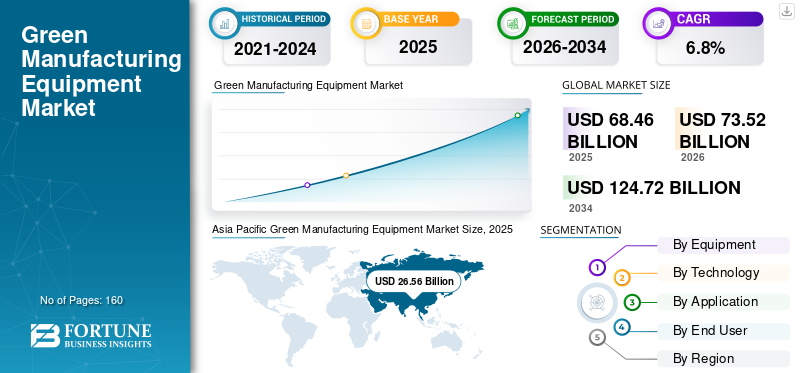
The global green manufacturing equipment market size was valued at USD 68.46 billion in 2025. The market is projected to grow from USD 73.52 billion in 2026 to USD 124.72 billion by 2034, exhibiting a CAGR of 6.8% during the forecast period. Asia Pacific dominated the green manufacturing equipment market with a market share of 38.80% in 2025.
The market is witnessing steady expansion as industries increasingly focus on reducing environmental impacts and improving production efficiency through cleaner manufacturing practices. Growth is driven by stringent environmental regulations, evolving consumer demands, and rising investments in technologies aimed at promoting sustainable industrial operations. Manufacturers are increasingly adopting sustainable solutions to optimize the use of raw materials, lower operational costs, and become more resource efficient across production processes. Green manufacturing equipment such as air pollution control systems, recycling machinery, and energy-efficient technologies are becoming essential for helping industries meet sustainability goals and reduce emissions.
Key players such as Siemens, Honeywell, and Mitsubishi Heavy Industries are actively investing in advanced environmental technologies to support sustainable manufacturing operations and strengthen their market position. Over the long term, increasing focus on carbon reduction, resource optimization, and circular economy practices is expected to support sustained market growth.
Download Free sample to learn more about this report.
Green Manufacturing Equipment Market Key Takeaways
 Global Market Size & Forecast
- 2025 Market Size: USD 68.46 billion
- 2026 Market Size: USD 73.52 billion
- 2034 Forecast Market Size: USD 124.72 billion
- CAGR: 6.8% from 2026–2034
 Market Share
- Asia Pacific dominated the green manufacturing equipment market with a 38.80% share in 2025.
- The energy efficiency equipment segment is projected to grow at a CAGR of 7.5% during the forecast period.
- The clean process technology segment is expected to grow at a CAGR of 7.4% over the forecast period.
 Key Regional Highlights
Asia Pacific
Asia Pacific led the market at USD 26.56 billion in 2025.
Europe
Europe is projected to reach USD 19.08 billion in 2026.
North America
North America is expected to reach USD 15.77 billion in 2026.
U.S
The market is estimated at USD 8.50 billion in 2026.
Japan
The market is projected to reach USD 4.37 billion in 2026, accounting for 5.9% of global revenue.
Read More

GREEN MANUFACTURING EQUIPMENT MARKET TRENDS
Increasing Adoption of Clean and Energy-Efficient Technologies is Driving Sustainable Manufacturing Transformation
The market is experiencing a growing shift toward the adoption of clean and energy-efficient technologies to reduce environmental impact and comply with regulatory standards. Manufacturers are increasingly integrating advanced filtration, scrubbing, and recycling systems to minimize emissions and optimize resource utilization. This trend is further supported by advancements in automation and digital monitoring systems that enable real-time tracking of environmental performance. As industries focus on achieving sustainability targets and reducing carbon footprint, demand for innovative green manufacturing equipment is expected to rise significantly across sectors.
- For instance, Siemens has been expanding its portfolio of environmental and energy-efficient solutions to support sustainable industrial operations globally.
MARKET DYNAMICS
MARKET DRIVERS
Download Free sample to learn more about this report.
Stringent Environmental Regulations and Growing Demand for Sustainable Industrial Practices are Driving Market Growth
The increasing implementation of environmental regulations and the need to reduce industrial emissions are key drivers of the market. Governments and regulatory bodies are enforcing strict standards for air quality, wastewater treatment, and waste management, compelling industries to adopt green manufacturing equipment. Additionally, rising awareness of environmental sustainability and corporate responsibility is encouraging companies to invest in cleaner technologies. The growing focus on reducing carbon emissions and improving energy efficiency is further driving demand for advanced manufacturing equipment designed to support sustainable production processes.
MARKET RESTRAINTS
High Capital Investment and Implementation Complexity are Limiting Adoption
Despite strong growth potential, the market faces challenges due to the high initial cost associated with green manufacturing equipment. Installation, integration, and maintenance of advanced systems such as pollution control and wastewater treatment equipment require significant investment and technical expertise. Small and mid-sized manufacturers may face financial constraints, limiting adoption. Additionally, the complexity of integrating these systems into existing production processes can pose operational challenges, slowing down implementation in certain industries.
MARKET OPPORTUNITIES
Increasing Focus on Circular Economy and Resource Optimization is Creating Growth Opportunities
The growing emphasis on circular economy practices and efficient resource utilization is creating significant opportunities for the market. Manufacturers are increasingly adopting recycling, reprocessing, and energy-efficient technologies to minimize waste and optimize resource consumption. Advances in digital monitoring, automation, and process optimization are further enabling industries to improve environmental performance. Additionally, increasing investments in sustainable infrastructure and industrial modernization are supporting the development of advanced green manufacturing solutions, driving long-term green manufacturing equipment market growth.
Segmentation Analysis
By Equipment
Air Pollution Control Segment Held Largest Share Due to High Regulatory Pressure and Emission Reduction Requirements
Based on equipment, the market is divided into air pollution control, waste management & recycling, water & wastewater treatment, energy efficiency equipment, and others.
In 2025, the air pollution control segment accounted for the highest green manufacturing equipment market share due to stringent regulations aimed at reducing industrial emissions and improving air quality. Industries such as automotive, chemicals, and heavy manufacturing are required to install advanced filtration and scrubbing systems to comply with environmental standards. The increasing focus on reducing carbon footprint and controlling pollutants is driving demand for air pollution control equipment. Additionally, advancements in filtration technologies are enhancing efficiency and performance, supporting the dominance of this segment.
- For example, industrial manufacturers are increasingly adopting advanced emission control systems to meet regulatory compliance and sustainability targets.
The energy efficiency equipment segment is anticipated to rise with a CAGR of 7.5% over the forecast period.
To know how our report can help streamline your business, Speak to Analyst
By Technology
Filtration & Scrubbing Segment Held Largest Share Due to Wide Adoption across Industrial Applications
Based on technology, the market is segmented into filtration & scrubbing, recycling & reprocessing, clean process technology, and others.
In 2025, the filtration & scrubbing segment accounted for the highest market share due to its extensive use in controlling air and water pollution across industries. These technologies are critical for removing contaminants, particulates, and harmful gases from industrial processes. The growing need for compliance with environmental standards and improving operational efficiency is driving the adoption of advanced filtration and scrubbing systems. Additionally, continuous innovation in filtration technologies is enhancing system performance and reliability, further supporting segment growth.
The clean process technology segment is expected to grow at a CAGR of 7.4% over the forecast period.
By Application
Emission Reduction Segment Held Largest Share Due to Regulatory Focus on Reducing Industrial Pollution
Based on application, the market is segmented into emission reduction, waste reduction & recycling, and water treatment.
In 2025, the emission reduction segment accounted for the highest market share as it directly addresses regulatory requirements and environmental concerns related to industrial pollution. Manufacturers are increasingly adopting equipment designed to reduce emissions and improve air quality. The rising focus on sustainability and carbon reduction is further driving demand for emission control solutions. Additionally, advancements in monitoring and control technologies are enabling more efficient emission management, supporting segment dominance.
The water treatment segment is expected to grow at a CAGR of 7.4% over the forecast period.
By End User
Automotive Segment Held Largest Share Due to High Environmental Compliance Requirements
Based on end user, the market is segmented into automotive, chemicals & materials, metals & heavy industry, food & beverage, and others.
In 2025, the automotive segment accounted for the highest market share due to stringent environmental regulations and the need to reduce emissions in manufacturing processes. Automotive manufacturers are investing in green manufacturing equipment to improve energy efficiency, reduce waste, and comply with regulatory standards. The increasing shift toward sustainable production practices and electric vehicle manufacturing is further supporting demand for advanced environmental solutions in this segment.
The chemicals & materials segment is expected to grow at a CAGR of 7.5% over the forecast period.
Green Manufacturing Equipment Market Regional Outlook
By geography, the market is categorized into Europe, North America, Asia Pacific, South America, and the Middle East & Africa.
Asia Pacific
Asia Pacific Green Manufacturing Equipment Market Size, 2025 (USD Billion)
To get more information on the regional analysis of this market, Download Free sample
Asia Pacific held a dominant position in the market in 2024 and continued to maintain its leading share in 2025, with a market valuation of USD 26.56 billion. The region’s dominance is driven by rapid industrialization, increasing environmental regulations, and growing adoption of sustainable manufacturing practices. China, India, and Japan are investing heavily in pollution control, waste management, and energy-efficient technologies, supporting strong demand for green manufacturing equipment.
Japan Green Manufacturing Equipment Market
The Japanese market is estimated at around USD 4.37 billion in 2026, accounting for roughly 5.9% of global revenue.
China Green Manufacturing Equipment Market
The Chinese market is estimated at around USD 12.07 billion in 2026, accounting for roughly 16.4% of global revenue.
India Green Manufacturing Equipment Market
The Indian market is estimated at around USD 3.01 billion in 2026, accounting for roughly 4.1% of global market.
North America
North America market is expected to reach a valuation of USD 15.77 billion in 2026. The market in this region is driven by strict environmental regulations and early adoption of advanced sustainable technologies. Industries are investing in green manufacturing equipment to improve efficiency and reduce environmental impact.
U.S. Green Manufacturing Equipment Market
The U.S. market is estimated at around USD 8.50 billion in 2026, driven by strong regulatory frameworks and increasing investments in sustainable manufacturing practices, supporting adoption of advanced environmental technologies.
Europe
Europe market is expected to reach a valuation of USD 19.08 billion in 2026. Region demonstrates steady growth supported by stringent environmental policies and strong focus on circular economy practices. Increasing adoption of sustainable manufacturing technologies is driving demand across industries.
U.K Green Manufacturing Equipment Market
The U.K. market is estimated at around USD 2.99 billion in 2026, representing roughly 4.1% of global revenues.
Germany Green Manufacturing Equipment Market
Germany’s market is projected to reach USD 5.12 billion in 2026, equivalent to around 7.0% of global sales.
South America and Middle East & Africa
The South America and Middle East & Africa regions are expected to witness moderate growth in this market during the forecast period. South America is projected to reach a market valuation of USD 4.26 billion in 2026, driven by increasing awareness of environmental sustainability and gradual adoption of green technologies. The Middle East & Africa market is expected to reach a valuation of USD 5.78 billion in 2026, supported by industrial development and increasing focus on environmental regulations and sustainability initiatives.
GCC Green Manufacturing Equipment Market
The GCC market is projected to reach around USD 2.18 billion in 2026, representing roughly 3.0% of global market.
COMPETITIVE LANDSCAPE
Key Industry Players
Key Industry Players Focus on Sustainable Technologies and Environmental Solutions to Strengthen Market Position
The green manufacturing equipment market is moderately competitive, with key players focusing on innovation, automation, and environmental technologies to strengthen their market position. Companies such as Siemens, Honeywell, Mitsubishi Heavy Industries, and GE are investing in advanced solutions for emission control, energy efficiency, and waste management. Market participants are also emphasizing digital monitoring, process optimization, and integration of sustainable technologies to improve operational performance. Strategic partnerships, product innovation, and expansion into emerging markets are enabling companies to enhance competitiveness and capture growing demand.
LIST OF KEY GREEN MANUFACTURING EQUIPMENT COMPANIES PROFILED IN REPORT
- Siemens AG (Germany)
- Honeywell International Inc. (U.S.)
- Mitsubishi Heavy Industries, Ltd. (Japan)
- General Electric Company (U.S.)
- Veolia Environnement S.A. (France)
- SUEZ Group (France)
- Hitachi, Ltd. (Japan)
- Alfa Laval AB (Sweden)
- Thermax Limited (India)
- ANDRITZ AG (Austria)
KEY INDUSTRY DEVELOPMENTS
- January 2026: Lord’s Mark Industries Ltd (LMIL) announced a multi-state investment roadmap in India focused on clean energy, healthcare, and sustainable manufacturing infrastructure development.
- December 2025: MiAlgae and Celtic Renewables announced plans to build green manufacturing plants in Scotland, backed by approximately USD 12.6 million (£10 million) in government funding to produce sustainable bio-based products.
- November 2025: TSMC launched a Zero Waste Manufacturing Center in Taiwan and signed a carbon capture agreement, advancing sustainable semiconductor manufacturing infrastructure.
- August 2025: Caterpillar partnered with Redwood Materials to enable battery recycling for electric mining equipment, creating a circular manufacturing loop for lithium-ion batteries used in zero-emission machinery.
- January 2025: Aristo India launched a 100% solar-powered manufacturing facility in Bangalore, supporting green production and reducing dependence on conventional energy sources.
REPORT COVERAGE
The global green manufacturing equipment market analysis includes a comprehensive study of the market size & forecast by all the market segments included in the report. It includes details on the market dynamics and market trends expected to drive the market over the forecast period. It provides information on key aspects, including an overview of technological advancements, pipeline candidates, the regulatory environment, and product launches. Additionally, it details partnerships, mergers & acquisitions, as well as key industry developments and prevalence by key regions. The global market research report also provides a depth competitive landscape with information on the market share and profiles of key operating players.
Request for Customization to gain extensive market insights.
Report Scope & Segmentation
| ATTRIBUTE | DETAILS |
| Study Period | 2021-2034 |
| Base Year | 2025 |
| Estimated Year | 2026 |
| Forecast Period | 2026-2034 |
| Historical Period | 2021-2024 |
| Growth Rate | CAGR of 6.8% from 2026-2034 |
| Unit | Value (USD Billion) |
| Segmentation | By Equipment, Technology, Application, End User, and Region |
| By Equipment |
|
| By Technology |
|
| By Application |
|
| By End User |
|
| By Region |
|
Frequently Asked Questions
According to Fortune Business Insights, the global market value stood at USD 68.46 billion in 2025 and is projected to reach USD 124.72 billion by 2034.
In 2026, the North America’s market value will be USD 15.77 billion.
The market is expected to exhibit a CAGR of 6.8% during the forecast period of 2026-2034.
By end user, the automotive segment is expected to lead the market.
The market is driven by increasing environmental regulations and growing demand for sustainable manufacturing practices to reduce emissions and improve resource efficiency.
Siemens, Honeywell, Mitsubishi Heavy Industries, and GE are the top players in the market.
Asia Pacific held the largest market share in 2025.


- 2021-2034
- 2025
- 2021-2024
- 160
Get 30-60 hrs Free Customization
Expand Regional and Country Coverage, Segments Analysis, Company Profiles, Competitive Benchmarking, and End-user Insights.









Related Reports
-
US +1 833 909 2966 ( Toll Free )
-
Get In Touch With Us