Greenfield Airport Market Size, Share & Industry Analysis, By Airport Size (Small, Medium, and Large Airport), By Airport Type (Commercial Passenger Airport, Cargo Airport, Mixed-Use Passenger & Cargo Airport, and Regional Airport), By Infrastructure Type (Airside Infrastructure, Terminal Infrastructure, and Cargo & Logistics Infrastructure), By Project Component (Planning, Feasibility & Design, Land Development & Site Preparation, Runway, Taxiway & Apron Construction, Terminal & Cargo Facility Construction, and Navigation, ATC & Safety Installation), and Regional Forecast, 2026-2034
 Download Free Sample
Greenfield Airport Market Size and Future Outlook
 Listen to Audio Version
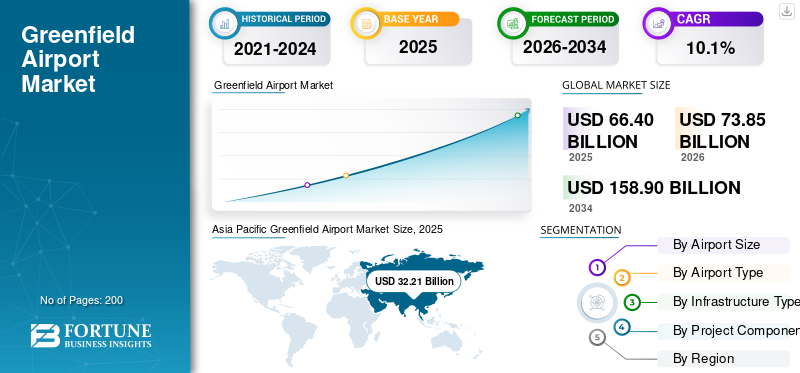
The greenfield airport market size was valued at USD 66.40 billion in 2025. The market is projected to grow from USD 73.85 billion in 2026 to USD 158.90 billion by 2034, exhibiting a CAGR of 10.1% during the forecast period. Asia Pacific dominated the greenfield airport market with a market share of 48.51% in 2025.
The market encompasses planning, design, financing, construction, and operationalization of entirely new airport facilities built on previously undeveloped land. Unlike airport expansion or brownfield development, greenfield projects enable airports to be designed from scratch with modern passenger experience standards, optimized airside-landside configurations, integrated smart technologies, and full compliance with contemporary environmental and safety regulations. Rapid urbanization, increasing air travel demand in emerging economies, and the saturation of existing airport capacity in major aviation hubs are compelling governments and private developers to pursue greenfield airport investments. The market spans across terminals, runways, cargo facilities, ground transport connectivity, and ancillary commercial infrastructure.
Key players in the market include VINCI Airports, Groupe ADP, Fraport AG, Ferrovial Airports, TAV Airports Holding, GMR Airports Limited, and Adani Airport Holdings Limited. These companies compete through expertise in airport master planning, public-private partnership structuring, integrated terminal design and construction management, smart airport technology deployment, sustainable infrastructure solutions, and long-term concession operations. Their capabilities span capacity planning, retail and commercial revenue optimization, multi-modal connectivity, cargo logistics infrastructure, and compliance with ICAO, FAA, and regional civil aviation authority standards tailored for diverse geopolitical and economic environments.
Download Free sample to learn more about this report.
greenfield airport market KEY TAKEAWAYS
 Global Market Size & Forecast
- 2025 Market Size: USD 66.40 Billion
- 2026 Market Size: USD 73.85 Billion
- 2034 Forecast Market Size: USD 158.90 Billion
- CAGR: 10.1% from 2026-2034
 Market Share
- Asia Pacific dominated the market with a 48.51% share in 2025.
- Large airport segment held the leading market share in 2025.
- Commercial passenger airport segment dominated the market in 2025.
 Key Regional Highlights
North America
North America is projected to reach USD 6.93 Billion in 2026.
Europe
Europe is estimated to reach USD 7.26 Billion in 2026.
Asia Pacific
Asia Pacific led the market with USD 32.21 Billion in 2025.
U.S.
The market is estimated at USD 5.71 Billion in 2026.
Japan
The market is estimated at USD 2.29 Billion in 2026.
Read More

greenfield airport market TRENDS
Smart Airport Technologies and Sustainable Design Standards Are Prominent Market Trends
A prominent trend shaping the market is the integration of smart infrastructure technologies including biometric passenger processing, AI-driven baggage handling, IoT-enabled building management, and digital twin-based airport operations from the earliest design stages. Unlike brownfield upgrades constrained by legacy systems, greenfield projects offer a clean-slate opportunity to embed these capabilities comprehensively. Simultaneously, environmental sustainability requirements are becoming central to greenfield airport master planning, with net-zero terminal designs, solar-powered ground infrastructure, rainwater harvesting systems, and green building certifications increasingly mandatory for project approval. These trends are redefining competitive differentiation among airport developers and operators globally.
MARKET DYNAMICS
MARKET DRIVERS
Download Free sample to learn more about this report.
Surging Air Passenger Volumes and Capacity Constraints at Existing Airports Drives Market Growth
The primary driver of the greenfield airport market growth is the sustained global growth in air passenger traffic outpacing the capacity of existing airport infrastructure in key emerging and developed markets. With major international hubs in Asia, South Asia, and Africa operating near or beyond their designed throughput limits, governments and aviation authorities are committing to entirely new airport developments to relieve congestion, improve connectivity, and accommodate future traffic growth. National aviation master plans, economic competitiveness strategies, and cargo logistics needs are reinforcing greenfield development as a strategic infrastructure priority, unlocking large capital allocations from sovereign wealth funds, development banks, and private infrastructure investors.
MARKET RESTRAINTS
High Capital Requirements and Extended Development Timelines Constraining Market Expansion
Greenfield airport development is among the most capital-intensive infrastructure undertakings, with multi-billion-dollar investments required before revenue generation begins. Extended construction timelines spanning a decade or more and exposes projects to macroeconomic risk, traffic demand fluctuation, political transitions, and regulatory delays that can erode financial returns. Land acquisition in proximity to urban centers is increasingly contentious due to community displacement and environmental impact concerns. Currency risk in emerging market projects and the complexity of structuring bankable public-private partnerships further constrain investor confidence. These factors collectively limit the pace at which viable greenfield airport projects can advance from feasibility through financial close and full construction commencement.
MARKET OPPORTUNITIES
Rapid Aviation Growth in Emerging Markets and Government Infrastructure Investment Programs Are Lucrative Growth Opportunities
The market notices compelling growth opportunities in South Asia, Southeast Asia, Africa, and the Middle East, where existing airport infrastructure is severely constrained relative to projected air travel demand growth. Government-driven infrastructure stimulus programs, foreign direct investment in aviation, and expanding middle-class populations with increasing travel aspirations are creating a robust pipeline of greenfield airport projects. Additionally, the rise of secondary city connectivity initiatives, cargo airport development for e-commerce logistics, and aviation hub strategies are generating opportunities beyond traditional metro-area airports. Public-private partnership models are enabling private developers and concessionaires to participate alongside sovereign investment, broadening the commercial opportunity landscape significantly.
MARKET CHALLENGES
Environmental Clearance Complexity and Community Opposition Challenges Market Development
Greenfield airport projects face increasing execution challenges from rigorous environmental impact assessments, wildlife habitat displacement concerns, noise pollution management requirements, and community opposition from populations affected by new airport development footprints. Obtaining multi-jurisdictional regulatory approvals across civil aviation, environmental, land use, and urban planning authorities introduces lengthy and unpredictable permitting timelines. Managing multi-stakeholder relationships involving national governments, local municipalities, airlines, concessionaires, and financing institutions adds further coordination complexity. Additionally, ensuring intermodal ground transport connectivity road, rail, and metro integration requires parallel infrastructure investment and planning alignment that frequently extends beyond the immediate airport development authority's mandate and budget.
Segmentation Analysis
By Airport Size
Increasing International Traffic Concentration and Hub Airport Saturation Are Driving Dominance of Large Airport Segment
Based on airport size, the market is segmented into small airport, medium airport, and large airport.
The large airport segment accounted for the largest market share in 2025. Demand for the large airport segment is rising as primary aviation hubs across Asia, the Middle East, and Africa reach capacity limits, necessitating new greenfield facilities capable of handling a high number of passengers annually. Governments prioritize large airport developments to sustain economic substantial growth, international connectivity, and aviation hub competitiveness on the global stage.
The small airport segment is anticipated to rise with a CAGR of 9.2% over the forecast period.
To know how our report can help streamline your business, Speak to Analyst
By Airport Type
Expanding Middle-Class Travel Demand and Low-Cost Carrier Network Growth Leads to Growth of Commercial Passenger Airport Segment
Based on airport type, the market is segmented into commercial passenger airport, cargo airport, mixed-use passenger & cargo airport, regional airport, and dual-use civil-military airport.
In 2025, the commercial passenger airport segment dominated the global market. Demand for the commercial passenger airport is rising sharply, due to surging leisure and business travel in emerging economies where existing facilities are structurally insufficient. Governments are investing in new commercial passenger airports to support national connectivity, tourism development, and economic inclusion by linking secondary cities to domestic and international aviation networks.
The mixed-use passenger & cargo airport segment is projected to grow at a CAGR of 10.7% over the forecast period.
By Infrastructure Type
Passenger Experience Expectations and Smart Infrastructure Mandates Are Driving Demand for the Terminal Infrastructure
Based on infrastructure type, the market is segmented into airside infrastructure, terminal infrastructure, cargo & logistics infrastructure, landside infrastructure, and airport IT, security & digital infrastructure.
The terminal infrastructure segment is anticipated to witness a dominating greenfield airport market share over the forecast period. Demand for the terminal infrastructure is rising as greenfield airports are required to deliver world-class passenger experience through state-of-the-art terminal designs incorporating biometric processing, automated check-in, contactless boarding, centralized baggage systems, and expansive retail and hospitality zones that maximize non-aeronautical revenue generation and operational efficiency from opening day.
The airport IT, security & digital infrastructure segment is projected to grow at a high CAGR of 11.4% over the forecast period.
By Project Component
E-Commerce Growth and Air Freight Network Expansion Are Driving Terminal & Cargo Facility Construction Segment Dominance
Based on project component, the market is segmented into planning, feasibility & design, land development & site preparation, runway, taxiway & apron construction, terminal & cargo facility construction, navigation, ATC & safety system installation, and testing, commissioning & operational handover.
The terminal & cargo facility construction segment dominated the market share in 2025. Demand for the terminal and cargo facility construction is growing as greenfield airport projects increasingly integrate dedicated cargo terminals and freight logistics zones alongside passenger infrastructure. The rapid growth of cross-border e-commerce, pharmaceutical cold-chain logistics, and time-sensitive freight is compelling airports to plan for robust cargo capacity as a core component of new airport master plans.
In addition, navigation, ATC & safety system installation segment is projected to grow at a CAGR of 11.5% during the study period.
greenfield airport market Regional Outlook
By geography, the market is categorized into North America, Europe, Asia Pacific, and Rest of the World.
Asia Pacific
Asia Pacific Greenfield Airport Market Size, 2025 (USD Billion)
To get more information on the regional analysis of this market, Download Free sample
Asia Pacific held the dominant share in 2024, valuing at USD 29.02 billion, and also maintained the leading share in 2025, with USD 32.21 billion. This is driven by India, China, ASEAN nations, and South Asian markets investing heavily in new airport capacity to accommodate some of the world's fastest-growing aviation sectors and rising passenger demand.
China Greenfield Airport Market
China’s market is projected to be one of the largest in Asia Pacific, with 2026 revenues estimated at around USD 10.61 billion. China leads global greenfield airport construction volumes, supported by state-directed aviation network expansion plans targeting tier-two and tier-three city connectivity, with CAAC oversight enabling rapid approvals and CCCC and domestic construction conglomerates delivering large-scale airport infrastructure at pace.
Japan Greenfield Airport Market
The Japan market share in 2026 is estimated at around USD 2.29 billion, accounting for roughly 8.0% of CAGR during the forecast period. Japan's market is driven by regional airport development to support tourism growth, island connectivity, and cargo logistics, with government investment programs targeting new capacity in underserved prefectural markets alongside infrastructure resilience improvement at existing facilities.
India Greenfield Airport Market
The India market in 2026 is estimated at around USD 10.93 billion. India represents one of the highest-growing markets globally, with GMR Airports, Adani Airport Holdings, and Larsen & Toubro executing an extensive pipeline of new airport projects under AAI and MOCA guidance, driven by aviation democratization and Tier-2/3 city connectivity mandates.
Europe
Europe is estimated to reach USD 7.26 billion in 2026 and secure the position of fourth largest region in the market. Europe's greenfield airport development is constrained by mature infrastructure and strict environmental regulations, with growth concentrated in Eastern European markets, regional airport network expansion, and sustainability-driven airport redevelopment programs blending greenfield and brownfield approaches.
U.K. Greenfield Airport Market
The U.K. market in 2026 is estimated at around USD 1.41 billion, representing roughly 9.5% CAGR of the forecast period. The U.K. market faces regulatory and political complexity, with demand driven by regional connectivity improvement needs and cargo facility development, as debates over additional runway capacity at major southeastern hubs continue to delay large-scale new airport projects.
Germany Greenfield Airport Market
Germany’s market is projected to reach approximately USD 0.83 billion in 2026. Germany's greenfield airport activity is focused on regional logistics hub development and airport capacity optimization, supported by Deutsche Flugsicherung oversight, with environmental and community regulatory frameworks representing the key determinants of project feasibility and timeline.
North America
North America is projected to record a CAGR of 8.6% during the forecast period and reach a valuation of USD 6.93 billion by 2026. North America's market growth is driven by urban air mobility infrastructure needs, secondary city connectivity, and cargo logistics airport development, with private developer interest increasing alongside government aviation infrastructure renewal programs targeting long-term capacity expansion.
U.S. Greenfield Airport Market
Based on North America’s strong contribution, the U.S. market can be analytically approximated at around USD 5.71 billion in 2026, representing roughly 8.4% CAGR during the forecast period. The U.S. market is driven by regional cargo airport development, urban air mobility infrastructure, and secondary metropolitan connectivity needs, with FAA regulatory frameworks and federal infrastructure funding enabling select new airport projects targeting underserved markets.
Rest of the World
The rest of the world include Middle East & Africa and Latin America. These regions are expected to witness moderate growth in this market space during the forecast period. The Middle East & Africa and Latin America market is set to reach a valuation of USD 18.66 billion and USD 5.06 billion in 2026. Rest of the World markets, particularly in Africa, the Middle East, and Latin America, represent high-growth greenfield airport opportunities driven by tourism expansion, resource economy connectivity, and strategic aviation hub ambitions backed by sovereign wealth fund investment.
COMPETITIVE LANDSCAPE
Key Industry Players
Key Players Focus on PPP-Led Airport Development, Smart Airside Systems, and Sustainable Infrastructure to Boost Market Growth
The greenfield airport market is being strengthened by key players that are shifting airport development from conventional runway-and-terminal construction toward integrated, technology-enabled, and sustainability-focused aviation ecosystems. Companies such as VINCI Airports, Groupe ADP, Fraport AG, Ferrovial Airports, TAV Airports, GMR Airports, and Adani Airport Holdings, are focusing on PPP concessions, large-scale EPC execution, smart terminal systems, baggage automation, airside safety solutions, low-carbon power infrastructure, and airport-city development. GMR Airports and Adani Airport Holdings are supporting India’s greenfield and airport modernization pipeline, while VINCI, ADP, Fraport, Ferrovial, and TAV are strengthening global airport development through concession-led investment and operational expertise. EPC players such as Larsen & Toubro, Bechtel, and CCCC are contributing through runway, terminal, cargo, utility, and landside infrastructure delivery. Meanwhile, Siemens Logistics, Honeywell, SITA, and Schneider Electric are advancing baggage handling, aircraft turnaround management, carbon tracking, microgrid power systems, and digital airport operations. These strategies are helping shift the market from basic capacity creation toward smart, resilient, passenger-centric, and commercially diversified greenfield airport infrastructure.
LIST OF KEY GREENFIELD AIRPORT COMPANIES PROFILED
- VINCI Airports (France)
- Groupe ADP (France)
- Fraport AG (Germany)
- Ferrovial Airports (Spain)
- TAV Airports Holding (Turkey)
- GMR Airports Limited (India)
- Adani Airport Holdings Limited (India)
- Larsen & Toubro Limited (India)
- Bechtel Corporation (U.S.)
- China Communications Construction Company (China)
KEY INDUSTRY DEVELOPMENTS
- August 2023: Siemens Logistics was awarded a service contract by Spanish airport operator Aena to operate and maintain the baggage handling system at Palma de Mallorca Airport in Spain. The scope covered the airport’s conveyor system, two tilt-tray sorters, 192 check-in points, and baggage reclaim carousels.
- June 2023: Honeywell International, Inc. launched an upgraded airside solutions portfolio, strengthening its gate management, aircraft turnaround, and airfield lighting capabilities. The portfolio included Navitas Smart Visual Docking, Turnaround Manager, Single Lamp Control and Monitoring System ASDv5 SVL, and Loop Sensor.
- March 2023: SITA secured a contract from Hong Kong International Airport to deploy a carbon management platform. The system was designed to help the airport monitor emissions data, track sustainability KPIs, and support its progress toward net-zero carbon targets.
- January 2023: Schneider Electric, through its AlphaStruxure joint venture, signed an agreement to develop, build, and operate integrated microgrid infrastructure for the New Terminal One at John F. Kennedy International Airport. The project included a planned 13,000-panel rooftop solar array across viable terminal roof areas.
- November 2022: Siemens Logistics received a contract from Noida International Airport in Jewar, India, to provide the VarioTray baggage handling system for Terminal One. The contract covered design, supply, installation, commissioning, and maintenance of the system.
REPORT COVERAGE
This research offers a detailed analysis of emerging trends and rapidly adopted technologies in the industry across key regions. The report outlines key drivers of market growth and challenges to expansion, delivering a detailed overview of the maritime industry landscape. The study highlights recent advancements to boost industry insights and support stakeholders in making well-informed decisions.
Request for Customization to gain extensive market insights.
Report Scope & Segmentation
| ATTRIBUTE | DETAILS |
| Study Period | 2021-2034 |
| Base Year | 2025 |
| Estimated Year | 2026 |
| Forecast Period | 2026-2034 |
| Historical Period | 2021-2024 |
| Growth Rate | CAGR of 10.1% from 2026-2034 |
| Unit | Value (USD Billion) |
| Segmentation | By Airport Size, By Airport Type, By Infrastructure Type, By Project Component, and Region |
| By Airport Size |
|
| By Airport Type |
|
| By Infrastructure Type |
|
| By Project Component |
|
| By Region |
|
Frequently Asked Questions
According to Fortune Business Insights, the global market value stood at USD 66.40 billion in 2025 and is projected to reach USD 158.90 billion by 2034.
In 2025, the Asia Pacific market value stood at USD 32.21 billion.
The market is expected to exhibit a CAGR of 10.1% during the forecast period of 2026-2034.
By airport size, large airport segment is expected to dominate the market.
Surging air passenger volumes and capacity constraints at existing airports drives market growth.
VINCI Airports, Groupe ADP, Fraport AG, Ferrovial Airports, and TAV Airports Holding are few major players in the global market.
Asia Pacific region dominated the market in 2025.



- 2021-2034
- 2025
- 2021-2024
- 200
Get 30-60 hrs Free Customization
Expand Regional and Country Coverage, Segments Analysis, Company Profiles, Competitive Benchmarking, and End-user Insights.



















Related Reports
-
US +1 833 909 2966 ( Toll Free )
-
Get In Touch With Us