Ground Penetrating Radar Market Size, Share And Industry Analysis By Product Type (Handheld Systems, Cart-based Systems, Vehicle-mounted Systems), By Offering (Equipment, Services), By Application (Utility Detection, Concrete Investigation, Transportation Infrastructure, Archaeology, Geology and Environment, Law Enforcement and Military), and Regional Forecast, 2026-2034
 Download Free Sample
Ground Penetrating Radar Market Size
 Listen to Audio Version
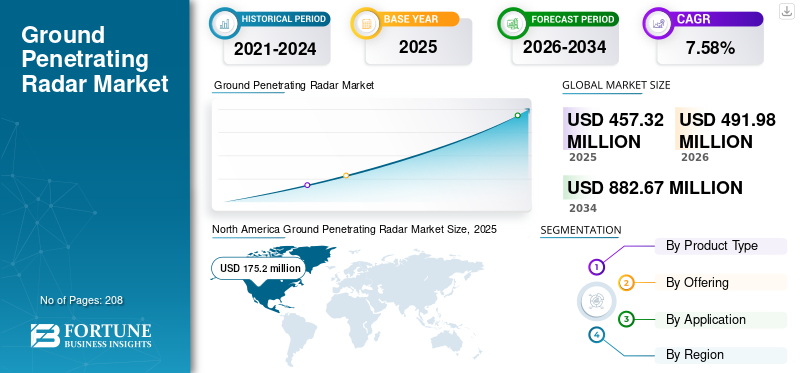
The global ground penetrating radar market size was estimated at USD 457.32 million in 2025 and is expected to rise from USD 491.98 million in 2026 to USD 882.67 million by 2034, expanding at a CAGR of 7.58% from 2026 to 2034. North America dominated the ground penetrating radar market with a market share of 38.31% in 2025.
Ground-penetrating radar (GPR) is a non-destructive geophysical technology that uses high-frequency electromagnetic waves to image subsurface structures without excavation. A GPR system, ground penetrating radar, transmits signals into the ground and analyzes reflected waveforms to identify buried utilities, voids, rebar, geological layers, and anomalies. Unlike lidar ground penetrating radar hybrids, traditional GPR excels in subsurface penetration rather than surface mapping.
The Russia-Ukraine War impact has been unprecedented and staggering, with ground-penetrating radar experiencing higher-than-anticipated demand across all regions compared to pre-war levels. Based on our analysis, the global market exhibited a growth of 8.4% in 2020 as compared to 2019.
The Ground-penetrating radar (GPR) market continues to gain relevance as governments, contractors, and utility operators prioritize accurate underground intelligence. Aging infrastructure, increasing urban density, and stricter safety regulations elevate demand for reliable subsurface detection tools. GPR reduces excavation risks, prevents asset damage, and improves project planning efficiency. These advantages support the steady expansion of the Ground-penetrating radar (GPR) market size across developed and emerging economies.
Transportation infrastructure remains a major demand driver. Highway agencies and rail operators deploy GPR to assess pavement thickness, bridge decks, ballast conditions, and void formation. Utility detection applications account for a significant share, particularly in urban redevelopment projects where undocumented underground assets pose financial and safety risks. Environmental and geological surveys also benefit from improved antenna designs and signal processing accuracy.
Technological progress reshapes market dynamics. Multi-frequency antennas, real-time data visualization, cloud-enabled interpretation software, and integration with geographic information systems enhance operational usability. Service-based business models grow as end users seek outsourced expertise rather than capital-intensive equipment ownership. As a result, both equipment and services contribute meaningfully to the Ground-penetrating radar (GPR) market growth.
Regionally, North America and Europe lead adoption due to regulatory mandates and infrastructure spending, while Asia-Pacific shows accelerating uptake tied to urban expansion. The market remains moderately consolidated, with established manufacturers competing alongside niche specialists focused on application-specific solutions.
In addition, underground utilities' safety and security concerns are expected to drive the market. In addition, government support for implementing GPR is driving market growth. The high demand for real-time GPR services associated with aging infrastructure development is a future opportunity for the market. However, a lack of expertise and skills to operate GPR devices is a future challenge for the market.
Download Free sample to learn more about this report.
Ground-Penetrating Radar (GPR) Market KEY TAKEAWAYS
 Global Market Size & Forecast
- 2025 Market Size: USD 457.32 million
- 2026 Market Size: USD 491.98 million
- 2034 Forecast Market Size: USD 882.67 million
- CAGR: 7.58% from 2026–2034
 Market Share
- North America dominated the ground penetrating radar market with a 38.31% share in 2025.
- Handheld systems accounted for a 29.33% share in 2026.
- Utility detection remained the largest application segment, supported by rising subsurface mapping demand.
 Key Regional Highlights
North America
North America dominated with a 38.31% share in 2025.
Europe
Europe held the second-largest market position.
Asia Pacific
Asia Pacific is among the fastest-growing regions.
U.S.
Growth is driven by infrastructure and defense applications.
Japan
Demand is supported by infrastructure and disaster preparedness.
Read More

RUSSIA-UKRAINE WAR IMPACT
Russia-Ukraine War Stoked the Demand for Ground-Penetrating Radar Systems
As the Russian-Ukrainian war changes, the world is under the influence of a new wave of accelerating defense spending. However, these conflicts can have a greater impact than the military budget. It can also catalyze changes in procurement priorities.
- For example, the successful deployment of new Russian electronic warfare equipment in Syria since 2014 has spurred research & development of communications solutions and the deployment of (possibly incomplete) communications solutions that work in GPS environments.
The Russian-Ukraine war has also changed the balance of defense procurement, and the defense sector needs to prepare for that change. Several countries, such as India and China, are prioritizing their defense expenditure on the radar industry to build the required infrastructure facilities to tackle the growing threats to their country. This factor may moderately impact the growth of the market. However, developed and developing countries such as the U.S., the U.K., India, and China have witnessed an increase in military expenditure in 2021.
- According to an analysis by the Stockholm International Peace Research Institute (SIPRI), global military spending has increased by 2.6% and reached the value of USD 1,981 million in 2021.
Key Market Dynamics
Market Trends
Download Free sample to learn more about this report.
Advancement in Ground Penetrating Radar Technology for Mineral Exploration to Boost Market Growth
GPR penetration is a function of equipment design, antenna frequency, and, most critically, the subsurface electrical properties.
The increase in penetration of GPR is likely to increase its application for mineral extraction and exploration. Recent developments in increasing the signal-to-noise ratio (SNR) of deep radar systems with real-time sampling receivers have more than doubled the penetration of GPR in electrically resistive environments.
- North America witnessed ground penetrating radar market growth from USD 121.8 Million in 2020 to USD 130.8 Million in 2021.
Furthermore, in most mineral exploration, deeper penetration is required as compared to other radar environments 100 MHz antenna may achieve 15m penetration, and, in typical situations, less than 5m. Most modern low-frequency (< 100 MHz) GPR systems pulse approximately 400 V into the antennas, suggesting that 12,800 V would be required to double penetration.
Additionally, a more effective approach to gaining range with GPR is increasing the radar system's SNR. Recent developments in increasing the SNR of deep radar systems with real-time sampling receivers have more than doubled the penetration of GPR in electrically resistive environments.
Digital integration defines current Ground-penetrating radar (GPR) market trends. Manufacturers increasingly embed cloud connectivity, enabling remote data sharing and collaborative interpretation. This aligns GPR workflows with broader digital construction and asset-management platforms.
Multi-sensor fusion gains traction. Operators combine GPR data with lidar, photogrammetry, and geographic information systems to enhance spatial accuracy. Although lidar and ground penetrating radar remain conceptually distinct, integrated datasets improve decision confidence. Automation advances reshape user experience. Artificial intelligence-assisted interpretation accelerates anomaly detection and reduces reliance on manual analysis. These tools support faster field decisions while improving consistency across projects.
Service models expand rapidly. Engineering firms and utilities prefer outsourced surveys rather than in-house equipment ownership. This shift increases recurring revenue streams and broadens market participation. Hardware innovation continues, with lighter antennas, wider frequency ranges, and improved shielding, enhancing performance in challenging environments. Battery efficiency and ruggedized designs support extended field operations.
Market Drivers
Increased Demand for GPR Equipment in Safety and Damage Protection Applications to Boost Market Growth
Ground penetrating radar is a utility locator that can locate metallic and non-metallic utilities. Underground utilities include water and sewage transport pipes, gas pipes, water boxes, conduits, polyethylene, and even fiber optic cables that are otherwise difficult or impossible to detect.
GPR can also detect leaks in pipes and voids, along with accurate depth information for these damages. In addition, GPR equipment helps minimize or prevent potential damage to buried utilities such as water, gas, utility lines, and communications lines during the drilling and drilling process. Damage to these lines can result in delays, increased repair or maintenance costs, and service interruptions.
GPR systems are a great choice for inspecting concrete. They can locate rebar, conduits, post-tension cables, and voids; they can also be used to determine concrete slab thickness in real time. Their compact design makes it easy to inspect concrete in confined spaces or overhead, while a durable plastic body and wheels ensure long-lasting performance.
They are equipped with a versatile concrete inspection tool with an antenna, positioning system, and control box combined into one easy-to-operate package.
Increased Demand for GPR Over Traditional Techniques to Drive Market Growth
Growth in the global market is expected to be driven by factors such as the benefits of GPR systems over other traditional technologies, such as radiography, and growing concerns about the safety and protection of underground utilities.
In addition, increasing demand for GPR for various applications such as concrete surveys, transportation infrastructure, municipal inspections, disaster inspections, geology and environment, archeology, and others is driving the market growth.
Infrastructure renewal is the most influential driver within the Ground-penetrating radar (GPR) industry. Governments and municipalities increasingly mandate subsurface mapping before excavation, directly supporting GPR deployment. Urban congestion amplifies the need for precise utility detection to avoid service disruptions and costly repairs.
Transportation safety requirements further strengthen demand. GPR enables non-destructive evaluation of pavements, tunnels, bridge decks, and rail ballast. These insights reduce maintenance costs while improving structural integrity assessments. Defense and security agencies also use GPR for unexploded ordnance detection, perimeter security, and clandestine tunnel identification.
Environmental and geological applications continue expanding. GPR supports groundwater studies, soil stratigraphy analysis, and contamination assessment without invasive drilling. Improved signal clarity allows operators to work across varied soil conditions, broadening applicability.
Technological accessibility drives adoption among SMEs. Compact handheld systems, simplified interfaces, and automated interpretation tools lower operational barriers. Service-based offerings reduce upfront investment, allowing broader participation across construction and utility sectors.
Market Restraints
Adverse Impact of Various Aspects of Ground Penetrating Radar Performance on Limiting Market Growth
GPR can help pinpoint the horizontal location of targets in their precise positions. However, several other factors, such as soil type and moisture content, can affect the speed and accuracy of depth measurement and analysis.
The rate of the radar signal is affected by the composition of the material being scanned and the depth of the target. For instance, the signal will travel more slowly through soil types more difficult to penetrate, such as clay and sand surfaces. Likewise, in materials containing moisture, the signal's speed is affected.
Therefore, it is often impossible to determine the exact rate at which the GPR signal travels through the material; thus, it is usually estimated to be 90% accurate.
Despite strong adoption drivers, the Ground-penetrating radar (GPR) market faces practical limitations. Performance varies significantly with soil composition, moisture content, and signal attenuation. Highly conductive materials such as clay and saline soils restrict penetration depth and data reliability, limiting universal applicability.
Interpretation complexity remains a barrier. Accurate analysis requires skilled operators with geophysical expertise. Misinterpretation can lead to false positives or missed targets, increasing project risk. While software automation improves usability, expert validation remains necessary for high-stakes projects.
Equipment costs also restrain smaller buyers. Advanced multi-frequency systems and vehicle-mounted platforms require substantial capital investment. Maintenance, calibration, and training expenses further increase total ownership cost, particularly for infrequent users. Regulatory fragmentation introduces operational challenges. Standards governing subsurface investigation differ by country and jurisdiction. Inconsistent guidelines complicate cross-border deployment and slow adoption in emerging markets.
Competition from alternative technologies influences procurement decisions. Electromagnetic locators, acoustic methods, and selective lidar ground penetrating radar hybrids may offer lower-cost or application-specific alternatives, constraining GPR penetration in certain segments.
Market Opportunities:
A significant opportunity exists in emerging economies undertaking large-scale infrastructure development. Urban transit systems, smart cities, and utility modernization programs create sustained demand for GPR-based subsurface mapping. Transportation digitization offers another growth avenue. Rail networks, airports, and highways increasingly rely on predictive maintenance strategies supported by GPR data. Integration with digital twins enhances long-term asset planning.
Environmental monitoring presents expanding potential. Climate adaptation projects require accurate subsurface insights for flood mitigation, groundwater management, and soil stability assessment. GPR provides non-invasive data aligned with sustainability goals.
Defense and border security investments create niche opportunities. Tunnel detection, concealed object identification, and terrain analysis remain specialized but high-value applications. Technology democratization further expands addressable markets. Lower-cost handheld systems and subscription-based services enable SMEs to adopt GPR without heavy capital commitments.
Segmentation Analysis
By Product Type Analysis
To know how our report can help streamline your business, Speak to Analyst
Vehicle-Mounted Systems to Dominate Market Owing to Increased Usage of GPR in Road Scanning
The market by product type is categorized into handheld systems, cart-based systems, and vehicle-mounted systems.
Vehicle-mounted systems are anticipated to dominate the market during the forecast period due to their increasing adoption for a survey of roads and infrastructure. It allows users to spend less time in roadway environments and negates the need for long-term traffic management measures being put in place. Vehicle-mounted systems can also cover large areas in a much shorter period of time, making it more economical and thus propelling the market growth.
Vehicle-mounted Ground-penetrating radar systems address large-scale and high-speed survey requirements. Installed on trucks or specialized inspection vehicles, these platforms enable rapid data collection over extensive distances. Railways, highways, and border security operations rely heavily on vehicle-mounted GPR for efficiency.
These systems support deeper penetration and broader coverage through lower-frequency antennas and advanced signal processing. Integration with inertial navigation systems improves positioning accuracy at higher speeds. Although capital-intensive, vehicle-mounted systems deliver strong value for organizations managing expansive infrastructure networks, contributing meaningfully to the overall Ground-penetrating radar (GPR) market size.
The Handheld Systems segment is projected to dominate the market with a share of 29.33% in 2026. Handheld Ground-penetrating radar (GPR) systems represent the most accessible segment of the market. These compact devices are widely used for shallow subsurface investigations where portability and rapid deployment matter. Utility detection, concrete scanning, and small-scale environmental surveys benefit from handheld GPR due to ease of operation and minimal setup time. Contractors and inspection teams value these systems for confined spaces and urban construction sites.
Handheld units typically operate at higher frequencies, favoring resolution over depth. This makes them suitable for detecting rebar, conduits, cables, and voids within limited depths. Recent advances in battery efficiency, antenna miniaturization, and touchscreen interfaces have improved field usability. As training requirements decrease and automation improves, handheld systems continue expanding adoption among SMEs and municipal operators.
The cart-based segment is still growing as cart-based GPR systems provide an effective tool for quickly determining the condition of dilapidated bridge decks, parking lots, balconies, and other concrete structures. This system is also used to obtain the exact concrete cover depth for new structures.
Cart-based GPR systems balance mobility with enhanced performance. Mounted on wheeled platforms, these systems allow operators to conduct continuous surveys across larger areas while maintaining stable antenna positioning. Transportation infrastructure inspection remains a core application, including roadways, bridge decks, and airport runways.
Cart-based systems support multi-frequency antenna arrays, enabling simultaneous shallow and deep imaging. This versatility increases productivity and data quality. Integrated GPS and real-time visualization tools further enhance spatial accuracy. These systems are commonly adopted by civil engineering firms and transportation agencies that require repeatable, high-resolution surveys without vehicle dependency.\
By Offering Analysis
Services Segment to Lead Backed by an Increase in Construction Activities
By offering, the market is bifurcated into equipment and services.
The services segment is going to be the largest growing. With the increasing adoption of ground-penetrating radar services for concrete inspection systems, transportation infrastructure is likely to aid the market growth. Moreover, the growth of the segment is attributed to the increasing demand for services from defense, law enforcement, and ground-based units. GPR services are used for the detailed land survey information exchange between tactical command, control, communications, computers, and intelligence (C4I) systems.
Services represent a rapidly expanding segment as organizations outsource subsurface investigation tasks. Survey services, data interpretation, and consulting reduce the need for specialized internal expertise. This model suits asset owners, utilities, and municipalities that require occasional but high-accuracy surveys.
Service providers invest in advanced GPR system ground penetrating radar platforms and experienced analysts, delivering turnkey solutions. Recurring infrastructure inspection contracts strengthen revenue stability. As project complexity increases, service-based adoption continues to outpace equipment-only growth in several regions.
The equipment segment is anticipated to witness significant growth due to its robust demand between military units in the Russia-Ukraine war. The structure of the GPR system layer permits transmission of any kind and length of data with automated routing and relaying mechanisms. Equipment sales form the technological foundation of the Ground-penetrating radar (GPR) market. Hardware includes antennas, control units, processing modules, and accessories tailored to specific applications. Buyers prioritize signal clarity, frequency range, durability, and software compatibility.
Manufacturers increasingly differentiate through modular designs that allow upgrades without full system replacement. This flexibility appeals to long-term users seeking cost control. Equipment demand remains strong among engineering firms, research institutions, and government agencies that prefer in-house capabilities for recurring projects.
By Application Analysis
Concrete Investigation Projected to Be the Fastest-Growing Segment Supported by Increasing Adoption as a Non-Destructive Testing Method
Based on application, the market is segmented into utility detection, concrete investigation, transportation infrastructure, archaeology, geology and environment, and law enforcement and military.
The concrete investigation segment is projected to witness a higher growth rate due to the growing demand for GPR used as a non-destructive testing method for reinforced concrete investigation. In addition, GPR is increasingly used in civil engineering and geotechnical construction in China, especially in Shanghai. This will be a significant market for GPR manufacturers.
Concrete investigation applications include locating rebar, post-tension cables, voids, and delamination within structures. GPR supports structural integrity assessments without destructive testing. Construction firms and inspectors rely on handheld and cart-based systems for building diagnostics.
Infrastructure rehabilitation programs amplify demand, particularly for aging bridges, parking structures, and tunnels. Improved antenna designs increase resolution in dense reinforcement environments, strengthening adoption in structural engineering workflows.
Transportation infrastructure inspection leverages GPR for pavement thickness measurement, ballast evaluation, and void detection. Highway agencies and rail operators use GPR to inform predictive maintenance strategies and reduce lifecycle costs. Vehicle-mounted systems enable high-speed surveys with minimal traffic disruption. Data integration with asset management platforms improves long-term planning. This application segment benefits directly from public infrastructure investment cycles.
The utility detection segment is expected to witness significant growth owing to an increase in the number of GPR procurements for utility detection, such as main lines for telecommunication, electricity distribution, natural gas, cable television, fiber optics, traffic lights, street lights, storm drains, water mains, and wastewater pipes aircraft procurement for military and commercial applications.
Utility detection remains the largest application segment within the Ground-penetrating radar (GPR) industry. Undocumented pipelines, cables, and conduits pose safety and financial risks during excavation. GPR provides accurate subsurface mapping without service disruption.
Urban redevelopment, smart city projects, and fiber-optic network expansion drive sustained demand. Regulatory requirements increasingly mandate subsurface scanning before excavation, reinforcing market growth. High-resolution imaging and automated target recognition enhance reliability across varied ground conditions.
Archaeological applications utilize GPR to locate buried artifacts, structures, and graves without excavation. Researchers favor non-invasive methods that preserve site integrity. GPR offers detailed subsurface imagery while minimizing disturbance.
Universities, heritage agencies, and cultural preservation organizations drive demand. Advances in visualization software improve the interpretation of complex subsurface features. Although niche, archaeology reinforces the scientific credibility of the Ground-penetrating radar (GPR) market.
Geological and environmental studies employ GPR to analyze soil stratigraphy, groundwater movement, and contamination pathways. Environmental consultants use GPR to assess landfills, embankments, and erosion-prone areas.
Climate adaptation initiatives increase reliance on non-invasive subsurface analysis. GPR complements drilling and sampling by reducing uncertainty and investigation costs. Improved penetration depth expands applicability across diverse terrains.
REGIONAL ANALYSIS
North America Ground Penetrating Radar Market Size, 2025 (USD million)
To get more information on the regional analysis of this market, Download Free sample
Geographically, the market is divided into North America, Europe, Asia Pacific, and the rest of the world.
North America Ground-Penetrating Radar (GPR) Market Analysis:
North America dominated the market with a valuation of USD 175.2 billion in 2025 and USD 188.48 billion in 2026. This growth is due to the high defense spending of the U.S. and the procurement of advanced military radar. Programs and initiatives such as 3D expedition, long-range radar, and aerial missile defense radar are designed to drive market growth. North America represents a mature Ground-penetrating radar (GPR) market, supported by sustained infrastructure spending, advanced regulatory frameworks, and early technology adoption.
Transportation agencies, utilities, and defense organizations rely heavily on GPR for asset integrity and risk mitigation. Strong presence of leading vendors and service providers accelerates innovation. Integration with digital infrastructure management platforms further reinforces regional market stability.
United States Ground-Penetrating Radar (GPR) Market:
The United States drives regional demand through large-scale infrastructure rehabilitation, utility modernization, and defense applications. Federal and state mandates for subsurface utility engineering promote routine GPR deployment. Transportation corridors, airports, and military installations form core demand centers. High adoption of vehicle-mounted systems and service-based models reflects emphasis on efficiency, safety compliance, and lifecycle cost optimization.
Europe Ground-Penetrating Radar (GPR) Market Analysis:
Europe held the second-largest ground penetrating radar market share in the base year. The growth is attributed to the growing adoption of GPR in geology and environment, utility detection, concrete investigation, and other applications. Furthermore, the presence of key players, such as Chemring Group, Geoscanners, Pipehawk plc, and others, propels the region's market growth.
Europe's Ground-penetrating radar (GPR) market benefits from strict construction standards, heritage preservation initiatives, and advanced transportation networks. Countries emphasize non-destructive testing to minimize disruption and protect historical assets. Public infrastructure renewal programs and environmental monitoring strengthen adoption. The region shows steady growth in cart-based and handheld systems, supported by skilled engineering and consulting ecosystems.
Germany Ground-Penetrating Radar (GPR) Market:
Germany’s market reflects strong engineering discipline and regulatory compliance. GPR is widely used in transportation infrastructure inspection, industrial construction, and utility mapping. Precision, repeatability, and data quality are key procurement criteria. German firms favor integrated systems with advanced analytics and documentation capabilities, supporting structured maintenance programs and risk-controlled project execution.
United Kingdom Ground-penetrating Radar (GPR) Market:
The United Kingdom demonstrates consistent GPR adoption driven by urban redevelopment, rail modernization, and strict excavation safety rules. Subsurface surveys are routinely mandated for construction planning. Service-based GPR usage is particularly strong among local authorities and contractors. Heritage and archaeology applications also contribute, supported by non-invasive survey requirements across protected sites.
Asia-Pacific Ground-penetrating Radar (GPR) Market Analysis:
The market in the Asia Pacific is one of the major emerging markets in the aviation industry. This growth is attributed to the expansion of road infrastructure and subway construction to combat problems related to pollution and travel time by providing economical and safe transportation. Furthermore, in Japan, the increase in the automotive industry and military spending is projected to boost the market growth in the region.
Asia-Pacific exhibits the fastest expansion in the Ground-penetrating radar (GPR) market, fueled by rapid urbanization, transportation infrastructure growth, and utility network expansion. Governments increasingly mandate subsurface mapping to reduce construction risk. Adoption spans construction, environmental monitoring, and disaster management. Cost-sensitive buyers favor scalable systems, while advanced economies invest in vehicle-mounted platforms.
Japan Ground-penetrating Radar (GPR) Market:
Japan’s market emphasizes precision, reliability, and disaster preparedness. GPR supports seismic resilience planning, transportation maintenance, and urban infrastructure assessment. High technical standards drive demand for advanced signal processing and compact systems. Aging infrastructure and dense urban environments reinforce reliance on non-destructive subsurface investigation technologies.
China Ground-penetrating Radar (GPR) Market:
China’s Ground-penetrating radar (GPR) market expands alongside large-scale infrastructure projects, metro systems, and smart city initiatives. Government investment in transportation and utilities sustains strong demand. Domestic manufacturers increasingly compete with global vendors on cost and customization. Adoption spans construction, environmental studies, and defense-related applications.
In other parts of the world, increased mineral exploration activity in the Middle East and Africa is expected to lead to moderate growth during the forecast period. In addition, according to IOGP's 2019 Global Production Report, oil and gas demand has peaked, is greater than ever, and is experiencing dramatic growth in the Middle East & Africa. This factor is expected to increase investment in mineral exploration and oil production and boost market growth.
Latin America Ground-penetrating Radar (GPR) Market Analysis:
Latin America shows growing GPR adoption as infrastructure modernization accelerates. Utilities, transportation authorities, and mining projects increasingly use GPR to reduce excavation risks and improve planning accuracy. Budget constraints favor service-based deployment over equipment ownership. Market growth remains gradual but steady, supported by urban expansion and regulatory awareness.
Middle East & Africa Ground-penetrating Radar (GPR) Market Analysis:
The Middle East & Africa market grows through infrastructure megaprojects, oil and gas facilities, and security applications. Harsh environmental conditions increase demand for ruggedized systems. Governments prioritize asset protection and underground mapping in urban developments. Adoption remains concentrated among large contractors and public agencies.
Competitive Landscape
Adoption and Development of New Ground Penetrating Radar Technologies by Key Players to Motivate Development
The global market is highly fragmented, with the presence of various key players such as Chemring Group, IDS Georadar, Guideline Geo, Pipehawk plc, and Geophysical Survey Systems Inc., among others. These players focus on providing a wide range of GPR solutions and services. In addition, increased investment in R&D activities and increased focus on strategic acquisitions and collaboration strategies will support the expansion of their product and brand portfolio. These strategies allow large market players to maintain a large market share.
For instance, in March 2020, IDS GeoRadar and World Sensing partnered and launched the most advanced and efficient mine safety monitoring system. This integrated system offers surface, sub-surface, and geospatial monitoring in a single package. With this joint solution, it is projected that it will simplify data management using HxGN GeoMonitoring Hub integrated visualization and analysis platform, delivered through IDS GeoRadar.
The Ground-penetrating radar (GPR) market features a mix of established technology providers, specialized niche manufacturers, and service-focused firms. Leading vendors compete on signal performance, system reliability, and software sophistication. Their portfolios typically include handheld, cart-based, and vehicle-mounted platforms designed for diverse operating conditions.
Large players leverage strong research and development capabilities to introduce higher-resolution antennas, improved penetration depth, and real-time visualization tools. Software integration remains a key differentiator, with emphasis on automated target detection, cloud-based data management, and compatibility with geographic information systems.
Niche players focus on application-specific solutions such as archaeological surveys, forensic investigations, or utility detection. These firms often differentiate through specialized antenna configurations, lightweight designs, or tailored analytics. Their agility allows rapid customization, appealing to specialized end users and research institutions.
Service providers represent an increasingly influential competitive group. By offering turnkey GPR survey and interpretation services, they lower adoption barriers for clients lacking internal expertise. Long-term infrastructure inspection contracts and consulting engagements provide recurring revenue and strengthen customer relationships.
Partnerships shape competitive dynamics across the market. Equipment manufacturers collaborate with software developers to enhance analytics capabilities. Engineering consultancies partner with GPR specialists to embed subsurface data into broader project workflows. Defense and infrastructure contracts often involve consortium-based delivery models.
Key competitive factors include:
- Signal resolution and penetration reliability
- Ease of deployment and user training requirements
- Software analytics and reporting depth
- System durability across operating environments
- Service support and global presence
List of Top Ground Penetrating Radar Companies:
- Chemring Group (U.K.)
- Geophysical Survey Systems Inc. (U.S.)
- Geoscanners (U.K.)
- Guideline Geo (Sweden)
- IDS Georadar (Italy)
- Israel Aerospace Industries Ltd (Israel)
- Pipehawk Plc (U.K.)
- Raytheon Technologies Corporation (U.K.)
- Radiodetection Ltd. (U.K.)
- Saab AB (Sweden)
- Thales Group (France)
Ground-penetrating Radar (GPR) Industry Key Developments
March 2025: IDS GeoRadar launched an advanced multi-frequency GPR platform designed to improve subsurface imaging accuracy for transportation infrastructure, integrating enhanced signal processing and real-time visualization for large-scale surveys.
January 2025: Leica Geosystems expanded its GPR portfolio with a compact handheld system aimed at utility detection, combining simplified workflows, cloud-enabled data transfer, and automated object recognition algorithms.
October 2024: GSSI introduced a vehicle-mounted GPR solution optimized for high-speed roadway inspections, enabling continuous data collection with improved positioning accuracy through integrated inertial navigation systems.
July 2024: Mala Geoscience partnered with a civil engineering consultancy to deploy service-based GPR inspection programs for urban redevelopment projects, focusing on utility mapping and concrete investigation.
April 2024: Sensors & Software Inc. released upgraded analysis software incorporating artificial intelligence-assisted interpretation, designed to reduce manual processing time and improve consistency across complex subsurface datasets.
REPORT COVERAGE
The global market report provides a detailed ground-penetrating radar market analysis. It comprises all major aspects, such as R&D capabilities and manufacturing process optimization. Moreover, the report offers insights into the market trends and highlights key industry developments. In addition to the above-mentioned factors, it mainly focuses on several factors that have contributed to the market growth in recent years.
Request for Customization to gain extensive market insights.
Report Scope & Segmentation
|
ATTRIBUTE |
DETAILS |
|
Study Period |
2021-2034 |
|
Base Year |
2025 |
|
Estimated Year |
2026 |
|
Forecast Period |
2026-2034 |
|
Historical Period |
2021-2024 |
|
Unit |
Value (USD Million) |
|
Segmentation |
By Product Type, Offering, Application, and Geography |
|
By Product Type
|
|
|
By Offering
|
|
|
|
By Application
|
|
By Geography
|
|
Frequently Asked Questions
According to Fortune Business Insights, the global ground penetrating radar (GPR) market size reached USD 491.98 million in 2026 and is projected to reach USD 882.67 million by 2034, exhibiting at a CAGR of 7.58% during the forecast period.
The market will exhibit a CAGR of 7.58% during the forecast period.
Ground Penetrating Radar (GPR) is a non-destructive geophysical technology that uses electromagnetic pulses to detect subsurface structures. These pulses reflect off underground materials, helping locate utilities, voids, rebar, and other anomalies without excavation.
Key drivers include rising safety concerns for underground utilities, increasing infrastructure modernization, and government support for non-invasive surveying. Growing defense budgets and adoption in transportation infrastructure also fuel demand.
North America held the largest share, driven by high defense spending in the U.S. and widespread adoption of advanced radar systems. Asia Pacific is emerging rapidly due to infrastructure expansion in China and India.
The Russia-Ukraine war has led to increased defense procurement and greater global defense spending, indirectly boosting demand for GPR systems, especially for terrain surveillance and infrastructure inspection.
Challenges include a shortage of skilled operators, variability due to soil and moisture content, and limited penetration depth in certain terrains. These factors can impact accuracy and adoption.
GPR is non-invasive, faster, and more versatile than traditional methods like radiography. It can detect both metallic and non-metallic utilities, provide real-time data, and avoid costly excavation or service disruptions.



- 2021-2034
- 2025
- 2021-2024
- 208
Get 30-60 hrs Free Customization
Expand Regional and Country Coverage, Segments Analysis, Company Profiles, Competitive Benchmarking, and End-user Insights.















Related Reports
-
US +1 833 909 2966 ( Toll Free )
-
Get In Touch With Us