Hazelnut Paste Market Size, Share & Industry Analysis, By Product Type (Pure Hazelnut Paste and Flavored/Compound Hazelnut Paste), By Application (Chocolate & Confectionery, Bakery & Pastry, Spreads & Fillings Manufacturing, Ice Cream & Frozen Desserts, Dairy & Desserts, and Beverages & Other Food Processing), By Nature (Conventional and Organic), By End User (Industrial Food Manufacturers, Artisanal Producers, Foodservice Operators, and Household Consumers), By Formulation (Unsweetened and Sweetened), and Regional Forecast, 2026-2034
 Download Free Sample
(Offer valid till 31st Oct 2026)

Hazelnut Paste Market Size and Future Outlook
 Listen to Audio Version
The global hazelnut paste market size was valued at USD 1,539.98 million in 2025. The market is projected to grow from USD 1,617.48 million in 2026 to USD 2,496.12 million by 2034, exhibiting a CAGR of 5.57% during the forecast period. Europe dominated the hazelnut paste market with a market share of 42.06% in 2025.
Hazelnut paste includes finely ground hazelnut pastes used for flavor, filling, texture, and as a rich ingredient in chocolate, confectionery, bakery, pastry, spreads, ice cream, desserts, and premium foodservice products. The market is expanding as more consumers prefer nut-based treats, premium chocolate fillings, clean-label bakery ingredients, and European-style confectionery products. This paste is popular for its natural roasted hazelnut flavor, creamy texture, and its ability to perfectly pair with cocoa, dairy, sugar, and bakery fats. The rise of premium spreads, artisanal pastries, pralines, filled chocolates, and plant-based desserts is another key factor boosting market growth.
Companies such as Balsu Gıda Sanayi ve Ticaret A.Ş., Olam Food Ingredients, and Barry Callebaut Group are some of the key players operating in this market. Capacity expansion and merger and expansion are the key strategies that are boosting market expansion.
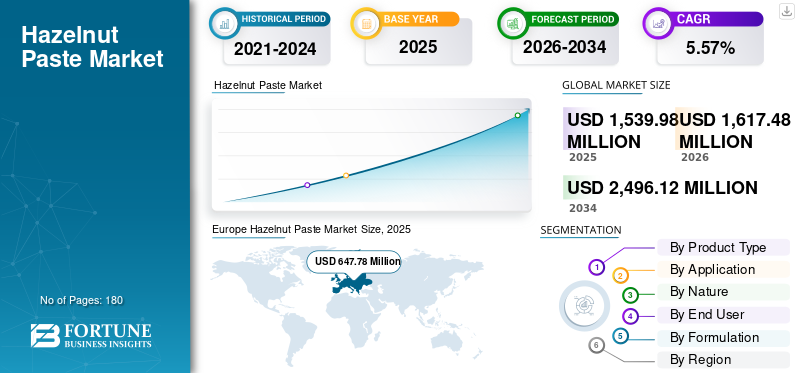
Download Free sample to learn more about this report.
Hazelnut Paste Market Key Takeways
 Global Market Size & Forecast
- 2025 Market Size: USD 1,539.98 million
- 2026 Market Size: USD 1,617.48 million
- 2034 Forecast Market Size: USD 2,496.12 million
- CAGR: 5.57% from 2026–2034
 Market Share
- Europe dominated the hazelnut paste market with a 42.06% share in 2025.
- The conventional segment accounted for the largest market share in 2025.
- The artisanal producers segment held the second-largest market share in 2025 and is projected to grow at a 6.11% CAGR during the forecast period.
 Key Regional Highlights
Europe
Europe emerged as the leading regional market, accounting for 42.06% of the global market share in 2025.
Asia Pacific
Asia Pacific market was valued at USD 401.52 million in 2025, driven by increasing demand from premium confectionery, bakery, café desserts, and spreads.
North America
North America market reached USD 235.55 million in 2025, supported by growing consumption of premium chocolate, bakery fillings, nut spreads, and clean-label desserts.
U.S.
U.S. The hazelnut paste market reached a valuation of USD 160.39 million in 2025.
Japan
Japan The hazelnut paste market reached a valuation of USD 79.56 million in 2025.
Read More

HAZELNUT PASTE MARKET TRENDS
Traceable Sourcing, Customized Roasting, and Clean-Label Formulations Reshape Hazelnut Paste Innovation
The market is shifting toward premium, traceable, and application-specific ingredient solutions. Clean-label food product demand among consumers is encouraging greater use of pure hazelnut paste instead of artificial nut flavors or highly processed compound fillings. Sustainability and origin transparency are also key criteria that consumers look for, especially for brands sourcing Turkish, Italian, or Georgian hazelnuts. Another major trend is customization, where suppliers offer light-roast, dark-roast, organic, low-sugar-compatible, or cocoa-blended paste variants for specific end uses. Growth in gluten-free premium spreads, pralines, gelato, and plant-based desserts is further pushing suppliers to deliver a consistent flavor profile and technical performance.
MARKET DYNAMICS
MARKET DRIVERS
Download Free sample to learn more about this report.
Premium Confectionery Demand and Clean-Label Nut Indulgence Boost Market Growth
Hazelnut paste is in high demand as it plays an important part in premium chocolate, pralines, spreads, bakery fillings, wafers, pastry creams, ice cream, and other desserts. Food manufacturers choose hazelnut paste for its roasted nut flavor, creamy texture, and natural fat content. As premium food brands are switching from artificial nut flavors to real nut ingredients, the demand for this paste is also increasing. Chocolate and candy makers use this paste in gianduja, truffles, filled chocolates, and nut spreads. Bakeries and pastry shops add it to croissants, cakes, cookies, creams, and layered desserts. As the lifestyle of consumers is evolving with the growing popularity of European-style treats, artisanal sweets, and plant-based desserts in the global market, the demand for this paste is also increasing.
MARKET RESTRAINTS
Hazelnut Price Volatility and Allergen Constraints Limit Wider Use across Cost-Sensitive Food Categories
The hazelnut paste market growth is restrained by raw material price volatility, crop dependency, allergen labeling, and quality variation across harvest seasons. Hazelnut supply is highly exposed to weather conditions, crop disease, regional production concentration, and currency movements, especially as Turkey remains a major global hazelnut-producing country. This makes it difficult for chocolate, bakery, and spread manufacturers to predict their costs, especially when they need stable prices for their ingredients. Allergy concerns also make it difficult to use hazelnuts in school foods, popular snacks, and shared production spaces where nut-free labels matter for business. Hence, companies that produce mass market products prefer cheaper fillings or artificial nut flavors instead of real hazelnuts to use hazelnut paste.
MARKET OPPORTUNITIES
Premium Spreads, Plant-Based Desserts, and Artisanal Confectionery Create New Growth Avenues
Artisanal bakeries, specialty chocolatiers, and premium foodservice operators are also expanding the use of hazelnut paste in pralines, pastry fillings, mousses, gelato, and gourmet desserts. In addition, rising consumer interest in European-style confectionery, rising popularity of plant-based diets, and indulgent snacking create opportunities for suppliers offering customized roasting profiles, origin-specific hazelnut varieties, and premium flavor characteristics. Food manufacturers are finding new opportunities by using hazelnut paste to add premium flavor, highlight natural ingredients, and improve texture in a range of products. Companies that provide organic, sustainably sourced, and traceable hazelnut paste are well-positioned to benefit from premium trends. Growing consumer interest in the health benefits associated with hazelnuts, including their natural content of unsaturated fats, fiber, vitamins, and antioxidants, is supporting greater adoption of hazelnut paste in premium confectionery, bakery, and nut-based spread applications.
Segmentation Analysis
By Product Type
Authentic Nut Flavor and Broad Industrial Versatility Boosted Leadership of Pure Hazelnut Paste
By product type, the market is segmented into pure hazelnut paste and flavored/compound hazelnut paste.
The pure hazelnut paste segment held the largest market share in 2025 as it offers the real flavor, aroma, texture, and fat content that manufacturers prefer for high-quality confectionery, bakery items, spreads, and desserts. Manufacturers can adjust the sweetness, cocoa, fat, and flavor of the paste to fit their needs. Food manufacturers increasingly prefer pure hazelnut paste as consumers shift toward clean-label and ingredient-transparent products.
The flavored/compound hazelnut paste segment holds the second-largest market share and is expected to grow at a CAGR of 5.73% during the forecast period. Flavored or compound gives manufacturers a standardized, ready-to-use ingredient with a consistent sweetness, texture, and spreadability. They also save time since they let manufacturers use less hazelnut, which is helpful for keeping costs down in mass-market products.
By Application
Chocolate & Confectionery Segment Led Market Due to High Hazelnut Intensity in Pralines, Spreads, and Fillings
Based on application, the market is segmented into chocolate & confectionery, bakery & pastry
spreads & fillings manufacturing, ice cream & frozen desserts, dairy & desserts, and beverages & other food processing.
The chocolate & confectionery segment accounted for the largest market share in 2025 as hazelnut paste is deeply embedded in pralines, gianduja, truffles, filled chocolates, chocolate spreads, wafers, nougat, and premium candy formulations. Hazelnut paste is used for roasted nut flavor, creamy mouthfeel, fat contribution, and compatibility with cocoa and sugar systems. Large confectionery manufacturers also use hazelnut paste on an industrial scale, creating higher recurring demand than smaller foodservice or bakery channels.
The bakery & pastry segment holds the second-largest market share and is expected to grow at a CAGR of 5.73% during the forecast period. The paste is commonly used in croissants, cakes, cookies, tart fillings, mousses, creams, biscuits, and high-end dessert bases, which helps to enhance flavor richness, texture, and indulgence. Artisanal bakeries and industrial bakery manufacturers value hazelnut paste as it pairs well with butter, cocoa, vanilla, cream, caramel, and fruit-based formulations.
To know how our report can help streamline your business, Speak to Analyst
By Nature
Conventional Segment Dominated Due to Its Cost-Efficiency and Large-Scale Supply Availability
By nature, the market is segmented into conventional and organic.
The conventional segment led the global hazelnut paste market share in 2025. It is widely available, economical, and suitable for chocolate, confectionery, bakery items, spreads, and desserts on a large scale. It is widely used in pralines, chocolate fillings, wafers, spreads, pastry creams, biscuits, and frozen desserts, especially when keeping costs down and ensuring consistency are essential. Conventional paste can be sourced from more regions that grow hazelnuts, which helps processors buy what they need more easily.
The organic segment is expected to grow at a CAGR of 6.41% during the forecast period. It fits well with premium, clean-label, and sustainability-focused products. It is mostly used in organic chocolate, premium spreads, artisanal bakery goods, specialty candies, plant-based desserts, and natural foods where people are willing to pay extra for certified ingredients.
By End User
Industrial Food Manufacturers Led Market Due to Large-Volume Formulation Demand and Standardized Processing Needs
By end user, the market is segmented into industrial food manufacturers, artisanal producers, foodservice operators, and household consumers.
Industrial food manufacturers led the global market in 2025 as they use hazelnut paste in large quantities for products including chocolate, confectionery, spreads, bakery fillings, wafers, biscuits, ice cream, and desserts. These manufacturers need consistent roasting, controlled particle size, stable viscosity, predictable oil behavior, and dependable supply contracts to keep product quality steady in large batches. Industrial buyers also purchase in bulk, leading to higher and more regular volumes than artisanal or foodservice buyers.
Artisanal producers accounted for the second largest market share in 2025 and are expected to register a CAGR of 6.11% during the forecast period. Specialty chocolatiers, pastry chefs, boutique bakeries, gelato makers, and premium dessert brands use hazelnut paste to make unique, high-value products. They prefer products with a strong roasted flavor, ingredients from specific origins, clean ingredients to adjust sweetness, cocoa, and texture.
By Formulation
Unsweetened Segment Led Market Due to Its Versatility
By formulation, the market is segmented into unsweetened and sweetened.
The unsweetened segment led the global market in 2025, as this paste gives food manufacturers the most control over recipes in chocolate, confectionery, bakery, spreads, ice cream, dairy desserts, and foodservice products. Unsweetened paste is a key ingredient in many other products, so it is more versatile than sweetened versions that are ready to use. As it can be used in so many types of food manufacturing and premium confectionery, unsweetened hazelnut paste remains the top choice in the market.
The sweetened segment is set to grow at a CAGR of 5.33% during the forecast period. Sweetened paste is the second most popular option. It gives manufacturers, bakeries, cafés, and artisanal producers a convenient ingredient with balanced sweetness, texture, and flavor. These products are often used in bakery fillings, dessert toppings, pastry creams, confectionery centers, gelato, and specialty spreads, especially when easy processing and consistent results matter. Sweetened versions cut down on the need for extra sugar and help speed up production, which appeals to smaller manufacturers and foodservice businesses.
Hazelnut Paste Market Regional Outlook
By geography, the market is categorized into Europe, North America, Asia Pacific, South America, and the Middle East & Africa.
Europe
Europe Hazelnut Paste Market Size, 2025 (USD Million)
To get more information on the regional analysis of this market, Download Free sample
The European market reached a valuation of USD 647.78 million in 2025 and is the leading region globally. Europe is the strongest regional market as hazelnut-based confectionery and bakery products are deeply embedded in food manufacturing and consumer preferences. Italy, Germany, France, Belgium, and Switzerland drive demand as there is high consumption of products such as pralines, gianduja, filled chocolates, wafers, spreads, pastries, biscuits, and gelato in this region. European manufacturers prefer pure hazelnut paste as it delivers real roasted flavor, has a clean label, and works well with cocoa and dairy products. Suppliers who provide traceable hazelnuts, custom roasting, organic choices, and reliable product standards are more likely to succeed in Europe’s premium and industrial markets.
Germany Hazelnut Paste Market
The market in Germany in 2025 reached around USD 137.23 million, representing roughly 8.91% of global revenues. In Germany, there is a strong demand for hazelnut paste from chocolate, wafer, biscuit, bakery, and premium spread makers. German health-conscious consumers prefer consistent roasting, fine particle size, controlled viscosity, and reliable allergen documentation. Hazelnut paste is often used in filled chocolates, pralines, nut creams, cookies, and bakery fillings. There is strong demand for conventional hazelnut paste in mass-market confectionery, while demand for organic or traceable paste is rising in premium retail products.
U.K. Hazelnut Paste Market
The U.K. market reached approximately USD 65.99 million in 2025, equivalent to around 4.29% of global sales.
Asia Pacific
The Asia Pacific market was valued at USD 401.52 million in 2025 due to growing hazelnut paste usage in premium confectionery, bakery chains, café desserts, ice cream, spreads, and Western-style snacks. China, Japan, South Korea, Australia, and Southeast Asia are the main growth centers in this region. However, demand is still lower than in Europe since hazelnuts are not commonly consumed in the region. The future growth of this market in the region depends on flavor localization, price management, import reliability, and partnerships with bakery and confectionery manufacturers.
India Hazelnut Paste Market
The India market in 2025 was valued at around USD 42.38 million, accounting for roughly 2.75% of global revenues.
China Hazelnut Paste Market
China’s market in 2025 was valued at around USD 126.29 million, representing roughly 8.20% of global revenues. China’s market is growing, driven by premium chocolate, bakery cafés, confectionery gifts, ice cream, and imported desserts. Demand is growing in areas with high disposable income where people link hazelnuts with European-style treats, premium spreads, filled chocolates, and bakery café items.
Japan Hazelnut Paste Market
The Japanese market in 2025 reached a valuation of around USD 79.56 million, accounting for roughly 5.17% of global revenues.
North America
The market in North America reached a valuation of USD 235.55 million in 2025. Premium chocolate, bakery fillings, nut spreads, ice cream, and new clean-label desserts all help drive North America’s market. The U.S. is the major market in the region as this country has a large number of confectionery makers, bakery chains, artisanal chocolatiers, and premium spread brands that use hazelnut paste for its roasted nut flavor and rich image. Pralines, filled chocolates, cookies, croissants, plant-based desserts, and specialty spreads are some major desserts where this paste is used in the North America market. Canada and Mexico also contribute a steady demand, mainly through bakery and premium confectionery products.
U.S. Hazelnut Paste Market
In 2025, the U.S. market reached USD 160.39 million. The U.S. market is driven by premium confectionery, nut spreads, bakery fillings, ice cream, cookies, and clean-label dessert products. Industrial chocolate and bakery manufacturers use hazelnut paste to create pralines, filled bars, wafers, pastries, and premium spreads with authentic roasted nut flavor.
South America and Middle East & Africa
Over the forecast period, South America is expected to experience significant growth in this market. South America’s market is a developing market through premium confectionery, bakery, ice cream, and imported spread categories. Brazil is one of the key markets due to its large chocolate, biscuit, bakery, and dessert manufacturing base. Argentina, Chile, and Colombia offer smaller opportunities in artisanal chocolate, café bakery, and premium retail sweets. The South America market in 2025 recorded USD 93.66 million.
The Middle East & Africa region reached a valuation of USD 161.47 million in 2025. The Middle East & Africa market is niche but growing through premium chocolate, bakery, spreads, desserts, and hospitality-led confectionery demand. The UAE and Saudi Arabia are the most relevant markets as premium supermarkets, hotels, cafés, and imported confectionery brands support demand for hazelnut-based fillings, spreads, pastries, and gelato. In South Africa, bakery, chocolate, and dessert manufacturers prefer to use this ingredient in their products. However, the region relies mostly on imported hazelnut paste, so pricing, shelf life, and reliable distributors may vary with geopolitical shifts.
Turkey Hazelnut Paste Market
The Turkish market is set to grow at a CAGR of 5.46% during the forecast period. Turkey’s dominance in global hazelnut production and export supply continues to strengthen demand for Turkish hazelnut paste among confectionery, bakery, and spread manufacturers seeking consistent raw material availability and cost efficiency.
COMPETITIVE LANDSCAPE
Key Industry Players
Premium Chocolate and Bakery Demand Strengthens Competition Among Hazelnut Paste and Nut Ingredient Suppliers
The global hazelnut paste market is a semi-fragmented market with several local manufacturers competing with multinational companies for a higher market share. Some of the prominent manufacturers include Balsu Gıda Sanayi ve Ticaret A.Ş., Olam Food Ingredients, and Barry Callebaut Group, among others. As key users of hazelnut paste such as premium confectionery and bakery brands, prefer products with a strong nut flavor and simple. Suppliers who provide traceable sourcing, custom roasting, organic options, and consistent quality are expected to grow in the future.
LIST OF HAZELNUT PASTE COMPANIES PROFILED IN REPORT
- Balsu Gıda Sanayi ve Ticaret A.Ş. (Turkey)
- Olam Food Ingredients (Singapore)
- Barry Callebaut Group (Switzerland)
- Durak Fındık (Turkey)
- Arslantürk Tarım Ürünleri (Turkey)
- Şenocak Fındık (Turkey)
- Poyraz Poyraz Fındık Entegre A.Ş. (Turkey)
- Yavuz Gıda (Turkey)
- Kanegrade Limited (U.K.)
- Babbi S.r.l. (Italy)
KEY INDUSTRY DEVELOPMENTS
- June 2026: Barry Callebaut Group, a leading manufacturer of high-quality chocolate and cocoa products, coatings, and chocolate alternatives, announced “Focus for Growth” initiatives that support nut processing and capacity expansion efforts.
- January 2026: Puratos, a global leader in bakery, patisserie, and chocolate ingredients, acquired Vör Foods, a prominent U.S.-based producer of clean-label nut pastes and nut-based filling products.
- October 2024: Bikaji Foods International Limited (Bikaji) strategically acquired Hazelnut Factory Food Products Private Limited for USD 13.86 million.
- December 2023: Ferrero International S.A. completed the acquisition of Fannie May Confections Brands, Inc. and the Harry London chocolate brands.
- December 2021: Barry Callebaut expanded its La Morella Nuts line globally, and some of its ingredients are specially formulated for use in hazelnut-flavored confections and plant-based products.
REPORT COVERAGE
The global hazelnut paste market report provides an in-depth study of the market size & forecast by all the market segments included in the report. The market analysis includes details on the market dynamics and market trends expected to drive the market during the forecast period. It offers information on the technological advancements, new product launches, key industry developments, and details on partnerships, mergers & acquisitions. The market forecast also encompasses a detailed competitive landscape with information on the market segmentation, market share, and profiles of key operating players.
Request for Customization to gain extensive market insights.
Report Scope & Segmentation
| ATTRIBUTE | DETAILS |
| Study Period | 2021-2034 |
| Base Year | 2025 |
| Estimated Year | 2026 |
| Forecast Period | 2026-2034 |
| Historical Period | 2021-2024 |
| Growth Rate | CAGR of 5.57% from 2026 to 2034 |
| Unit | Value (USD Million) |
| Segmentation | By Product Type, By Application, By Nature, By End User, By Formulation, and Region |
| By Product Type |
|
| By Application |
|
| By Nature |
|
| By End User |
|
| By Formulation |
|
| By Region |
|
Frequently Asked Questions
Fortune Business Insights says that the global market value stood at USD 1,539.98 million in 2025 and is projected to reach USD 2,496.12 million by 2034.
In 2025, Europe’s market value stood at USD 647.78 million.
The market is expected to exhibit a CAGR of 5.57% during the forecast period.
By application, the chocolate & confectionery segment led the global market.
Premium confectionery demand and clean-label nut indulgence boost market growth.
Balsu Gıda Sanayi ve Ticaret A.Ş., Olam Food Ingredients, and Barry Callebaut Group are a few of the players in the market.
Europe held the largest market share in 2025.
Traceable sourcing, customized roasting, and clean-label formulations reshape hazelnut paste innovation.



- 2021-2034
- 2025
- 2021-2024
- 180
-
(Offer valid till 31st Oct 2026)
Get 30-60 hrs Free Customization
Expand Regional and Country Coverage, Segments Analysis, Company Profiles, Competitive Benchmarking, and End-user Insights.




















Related Reports
-
US +1 833 909 2966 ( Toll Free )
-
Get In Touch With Us