Healthcare Data Storage Market Size, Share & Industry Analysis, By Delivery Model (On-Premise, Cloud, and Hybrid), By Architecture (Block Storage, File Storage, Object Storage, and Others), By Storage Type (Flash & Solid-State Storage, Magnetic Storage, and Hybrid), By Storage System (Storage Area Network (SAN), Network-Attached Storage (NAS), and Others), By Data Category (Medical Imaging & VNA Data, EHR/EMR Data, Laboratory & Diagnostic Data, and Others), By End User (Hospitals & Health Systems, Diagnostic Imaging Centers, Clinical Laboratories, and Others), and Regional Forecast, 2026-2034
 Download Free Sample
Healthcare Data Storage Market Size and Future Outlook
 Listen to Audio Version
The global healthcare data storage market size was valued at USD 8.20 billion in 2025 and is projected to grow from USD 9.20 billion in 2026 to USD 21.70 billion by 2034, exhibiting a CAGR of 11.32% during the forecast period. North America dominated the healthcare data storage market with a market share of 39.14% in 2025.
The market comprises solutions for storing, managing, protecting, and retrieving healthcare data generated across hospitals, clinics, diagnostic centers, laboratories, and other care settings. The market’s growth is supported by healthcare organizations generating larger volumes of electronic health records, medical images, pathology files, and other clinical data. Such large volumes of data are increasing the need for scalable, secure, and interoperable storage infrastructure. As a result, providers are adopting innovative models that improve data accessibility, support compliance requirements, and reduce the burden of managing complex on-premises systems.
- For instance, in April 2026, GE HealthCare Technologies Inc. announced broader access to its Genesis cloud-enabled enterprise imaging solutions through AWS Marketplace. The development has accelerated the shift to cloud-based healthcare data storage.
Furthermore, major players, such as Amazon Web Services, Inc., Microsoft Corporation, Oracle Corporation, and Dell Technologies Inc., are focusing on technological advancement.
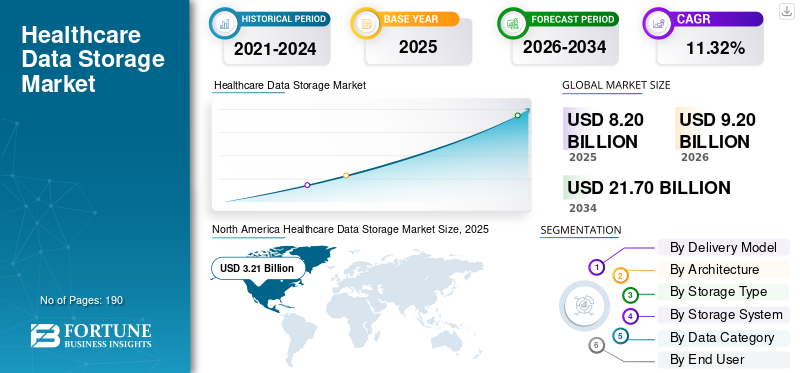
Download Free sample to learn more about this report.
HEALTHCARE DATA STORAGE MARKET Key Takeaways
 Global Market Size & Forecast
- 2025 Market Size: USD 8.20 billion
- 2026 Market Size: USD 9.20 billion
- 2034 Forecast Market Size: USD 21.70 billion
- CAGR: 11.32% from 2026–2034
 Market Share
- North America dominated the healthcare data storage market with a market share of 39.14% in 2025.
- The others segment is projected to grow at a CAGR of 12.05% during the forecast period.
- The others segment is projected to grow at a CAGR of 16.42% during the forecast period.
 Key Regional Highlights
North America
North America held the dominant share in 2024 at USD 2.91 billion and maintained its leading position in 2025 at USD 3.21 billion.
Europe
Europe is projected to grow at a CAGR of 10.40% over the coming years, the second-highest among all regions, and reach a valuation of USD 2.28 billion by 2026.
Asia Pacific
The regional market is estimated at USD 2.26 billion in 2026, fueled by rapid healthcare digitization, expanding hospital networks, and growing investments in cloud-based healthcare infrastructure.
U.S.
The U.S. healthcare data storage market is estimated at around USD 3.30 billion for 2026, accounting for roughly 35.88% of the global market.
Japan
The Japanese market is estimated at around USD 0.30 billion for 2026, accounting for approximately 3.25% of the global market.
Read More

HEALTHCARE DATA STORAGE MARKET TRENDS
Integration of AI-Ready Storage Infrastructure in Healthcare is an Emerging Trend
A prominent market trend observed is the integration of AI-Ready storage infrastructure. Healthcare organizations store large volumes of clinical, imaging, and operational data to use it further for analytics, automation, and AI models. As hospitals and health systems invest more in AI for diagnosis, workflow improvement, and clinical decision support, demand is growing for storage platforms that can securely manage data, support interoperability standards, and enable faster access to high-quality datasets. As a result, vendors are increasingly positioning healthcare storage as an AI-ready foundation rather than just a passive infrastructure layer.
- For instance, in November 2025, Intelerad collaborated with Amazon Web Services, Inc. to advance enterprise imaging in the cloud. The development would enable healthcare organizations to stream medical images directly from cloud storage with low latency, helping reduce delays and costs linked to traditional data transfers.
MARKET DYNAMICS
MARKET DRIVERS
Download Free sample to learn more about this report.
Rising Volume of Healthcare Data is Driving Demand for Advanced Storage Solutions
The global market’s growth is driven by the rising volume of healthcare data, resulting in an increased demand for advanced storage solutions. Healthcare organizations generate larger volumes of data through electronic health records, diagnostic imaging, pathology workflows, connected devices, and digital care platforms. As the volume of this data increases, hospitals and health systems demand more advanced storage infrastructure that can scale easily, protect sensitive information, and make data available across departments without slowing clinical workflows. To cater to the increasing demand, key companies are entering into strategic partnerships and collaborations to offer innovative healthcare data storage solutions.
- For instance, in March 2025, FUJIFILM Healthcare Americas Corporation partnered with Tiger Health Technology to enhance digital pathology storage and access, optimizing healthcare data management and addressing key storage-related challenges. The development highlights how growing healthcare data volumes are pushing vendors to build more specialized, scalable storage architectures that directly support market growth.
MARKET RESTRAINTS
Data Security Risks and Cyberattacks Limiting Faster Adoption of Modern Healthcare Data Storage Solutions
The global market faces major restraints, including data security risks and cyberattacks. Healthcare organizations store highly sensitive patient information across on-premises, private, and public cloud environments, which increases the complexity of protecting that data. As storage environments become more connected and more data is moved across systems, the risk of ransomware, account compromise, and large-scale breaches also increases. This makes many hospitals and providers more cautious about modernizing storage and operational systems amid new security risks. As a result, security concerns, breach recovery costs, and compliance pressure continue to slow the pace of market adoption in some healthcare settings.
- For instance, in May 2025, Kettering Health suffered a ransomware attack that knocked internal systems, phone lines, and the electronic health record system offline. Such events increase provider caution around storage migration and infrastructure change, which can restrain faster market growth even as long-term demand remains strong.
MARKET OPPORTUNITIES
Growing Shift toward Cloud and Hybrid Storage Models is Creating New Market Expansion Opportunities
The global market is experiencing robust growth opportunities, as many healthcare providers seek more flexible infrastructure that can scale with rising data volumes. Cloud and hybrid storage models are creating this opportunity by helping hospitals and diagnostic networks manage imaging files, clinical records, and other data more efficiently without relying solely on heavy on-premises investments. These factors improve remote access, support multi-site data sharing, and make it easier for organizations to modernize storage without fully disrupting existing systems. As a result, vendors that offer secure, healthcare-focused cloud and hybrid storage platforms are gaining new opportunities to expand across hospitals, imaging centers, and integrated care networks.
- For instance, in March 2025, FUJIFILM Healthcare Americas collaborated with Amazon Web Services, Inc. to expand cloud hosting capabilities for North American Synapse customers.
MARKET CHALLENGES
High Cost of Storage Infrastructure Modernization is Emerging as a Key Market Challenge
A critical challenge is the high cost of storage infrastructure. Many hospitals and healthcare networks still rely on legacy storage environments deeply integrated with EHR systems, imaging archives, backup systems, and other clinical applications. When providers try to modernize these environments, they often have to spend heavily on new hardware, software, migration services, cyber resilience, and integration with existing workflows. This increases the total cost of ownership and slows decision-making, especially for mid-sized hospitals and budget-sensitive healthcare systems. As a result, even when the need for advanced storage is rising, the high upfront and transition costs continue to delay full-scale modernization across the market.
- For instance, in April 2025, Dell Technologies Inc. introduced new infrastructure innovations designed to help organizations accelerate data center It also highlighted that customers are rethinking IT strategies to improve scalability, efficiency, and adaptability, while also emphasizing lower energy costs, lower total cost of ownership, smaller data center footprints, and reduced management complexity.
Segmentation Analysis
By Delivery Model
Stronger Control over Data Access via On-Premise Delivery Leads to its Dominance
Based on delivery model, the market is categorized into on-premise, cloud, and hybrid.
The on-premises segment dominated the market as many hospitals and health systems still prefer to keep critical patient data, imaging archives, and core clinical applications within their own controlled IT environments. The deployment gives providers stronger control over data access, system performance, latency, and internal security policies for high-volume clinical workloads. It is also widely used in large healthcare organizations where legacy systems, EHR platforms, and imaging infrastructure are already deeply integrated with in-house storage environments. As a result, on-premise storage continued to account for a significant healthcare data storage market share, especially among providers that prioritize direct control and uninterrupted access to mission-critical data.
- For instance, in April 2025, Dell Technologies Inc. announced new infrastructure innovations across its storage and data protection portfolio to help organizations modernize their data centers.
The cloud segment is expected to grow at a CAGR of 16.26% over the forecast period.
To know how our report can help streamline your business, Speak to Analyst
By Architecture
Easier Access in File Storage Support Dominance of the Segment
Based on architecture, the market is segmented into block storage, file storage, object storage, and others.
In 2025, the file storage segment accounted for the largest share of the market as healthcare organizations manage large volumes of unstructured data which is required to organize and access in file-based environments. Medical images, pathology files, scanned documents, clinical content, and administrative records are often shared across departments, which increases the importance of data storage system that support simple retrieval and multi-user access. File storage is also well-suited for workflows where hospitals need centralized access to folders, shared repositories, and large clinical datasets across distributed teams.
- For instance, in March 2026, Everpure (formerly Pure Storage) announced ActiveCluster support for file. The development enabled organizations to keep file data continuously available and movable across environments without disruption.
The object storage segment is projected to grow at a CAGR of 15.77% during the forecast period.
By Storage Type
Increasing Preference for Flash & Solid-State Storage makes it the Leading Storage Type
Based on storage type, the market is segmented into flash & solid-state storage, magnetic storage, and hybrid storage.
The flash and solid-state storage segment dominated as they help organizations improve responsiveness, reduce delays in clinical workflows, and handle growing data intensity more efficiently than traditional magnetic systems in many front-line use cases. As a result, healthcare organizations have been prioritizing flash-based platforms for performance-sensitive environments.
- For instance, in June 2025, Pure Storage, Inc. launched storage products designed to deliver performance at any scale, including new FlashArray and FlashBlade offerings.
The others segment is projected to grow at a CAGR of 12.05% during the forecast period.
By Storage System
Storage Area Network (SAN) is Mostly Used as they Support High Volume Workloads in Healthcare Organizations
Based on storage system, the market is segmented into storage area network (SAN), network-attached storage (NAS), direct-attached storage (DAS), and others.
In 2025, the storage area network segment dominated the global market, as large healthcare organizations require high-performance storage systems that support multiple servers, applications, and departments simultaneously. SAN environments are widely used in hospitals for core workloads such as EHR systems, imaging archives, and other applications that require reliable performance, strong availability, and scalable capacity. Also, they help providers manage enterprise-wide storage more efficiently while maintaining consistent access to critical data across connected clinical systems.
- For instance, in May 2025, Hewlett Packard Enterprise Company launched new guarantees for HPE Alletra Storage MP B10000 and expanded its StoreOnce portfolio to strengthen cyber resilience and data availability.
The others segment is projected to grow at a CAGR of 16.42% during the forecast period.
By Data Category
Increasing Data Volumes to Boost Medical Imaging and VNA Segmental Growth
Based on data category, the market is segmented into medical imaging & VNA data, EHR/EMR data, laboratory & diagnostic data, genomics/research data, backup, archive & disaster recovery data, patient monitoring/device-generated data, and others.
In 2025, the medical imaging & VNA data segment dominates as it generates some of the largest and fastest-growing data volumes in healthcare. Radiology, cardiology, pathology, and other image-intensive specialties produce high-resolution files that require long-term storage, secure access, and efficient sharing across departments and care sites. These advantages encourage key companies to participate in strategic collaborations.
- For instance, in March 2025, FUJIFILM Healthcare Americas Corporation partnered with Tiger Health Technology to enhance digital pathology storage and access. The partnership aims to optimize data lifecycle management and address storage-related challenges in digital pathology, where file sizes and archive requirements are expanding rapidly.
The patient monitoring/device-generated data segment is projected to grow at a CAGR of 14.84% over the forecast period.
By End User
Hospitals & Health Systems are Dominant End Users as they Generate Large Volume of Patient Data
Based on end user, the market is segmented into hospitals & health systems, diagnostic imaging centers, clinical laboratories, pharmaceutical & biotechnology companies, academic & research institutes, payers/health insurance organizations, and others.
The hospitals & health systems segment dominated the global market because these organizations generate significant and highest-volume mix of healthcare data. They rely heavily on large-scale storage infrastructure to manage EHR data, medical images, backups, archives, and data from connected devices across multiple departments and facilities. These factors encourage them to invest in storage modernization to achieve stronger interoperability, better cyber resilience, and more efficient access to patient information across complex care networks.
- For instance, in February 2025, Koninklijke Philips N.V. expanded its cloud-based HealthSuite Imaging services to Europe.
The academic & research institutes segment is projected to grow at a CAGR of 13.05% over the study period.
Healthcare Data Storage Market Regional Outlook
By geography, the market is categorized into Europe, North America, Asia Pacific, Latin America, and the Middle East & Africa.
North America
North America Healthcare Data Storage Market Size, 2025 (USD Billion)
To get more information on the regional analysis of this market, Download Free sample
North America held the dominant share in 2024 at USD 2.91 billion and maintained its leading position in 2025 at USD 3.21 billion. The regional market is growing due to high adoption of EHRs, cloud migration, and large volumes of imaging and clinical data across hospitals and health systems. Strong healthcare IT spending and rising focus on cybersecurity and backup infrastructure are further increasing demand for advanced data storage solutions.
U.S. Healthcare Data Storage Market
Given North America's substantial contribution and the U.S. dominance in the region, the U.S. market is estimated at around USD 3.30 billion in 2026, accounting for roughly 35.88% of the global market.
Europe
Europe is projected to grow at a CAGR of 10.40% over the coming years, the second-highest among all regions, and reach a valuation of USD 2.28 billion by 2026. Rising digital health investments are supporting growth, increasing the use of interoperable health records, and growing pressure to modernize legacy hospital IT systems.
U.K. Healthcare Data Storage Market
The U.K. healthcare data storage market is estimated at around USD 0.47 billion in 2026, representing roughly 5.07% of the global market.
Germany Healthcare Data Storage Market
Germany's market is projected to reach approximately USD 0.56 billion in 2026, equivalent to around 6.11% of the global market.
Asia Pacific
Asia Pacific is estimated to reach USD 2.26 billion in 2026 and secure the third position. The regional market is expanding as healthcare digitization is increasing rapidly across large patient populations, while hospital networks are generating more imaging, diagnostic, and administrative data. Growing investments in cloud infrastructure and healthcare modernization are also supporting adoption.
Japan Healthcare Data Storage Market
The Japanese market is estimated at around USD 0.30 billion for 2026, accounting for approximately 3.25% of the global market.
China Healthcare Data Storage Market
China is projected to be one of the largest worldwide, with 2026 revenues estimated at around USD 0.65 billion, representing approximately 7.04% of global sales.
India Healthcare Data Storage Market
In 2026, India’s market value is projected to reach USD 0.31 billion, accounting for roughly 3.39% of global revenue.
Latin America and the Middle East & Africa
The Latin America and the Middle East & Africa regions are expected to witness moderate growth during the forecast period. The market in Latin America is estimated to reach USD 0.63 billion driven by gradual digital transformation in hospitals and diagnostic centers, along with rising adoption of electronic medical records and connected care platforms. In the Middle East & Africa, the GCC will reach USD 0.54 billion in 2026.
South Africa Healthcare Data Storage Market
The South African market is estimated to reach approximately USD 0.17 billion in 2026, accounting for roughly 1.88% of global revenues.
COMPETITIVE LANDSCAPE
Key Industry Players
New Product Launches by Key Players to Propel Market Progress
The global healthcare data storage market is moderately consolidated, with Amazon Web Services, Inc., Microsoft Corporation, Oracle Corporation, Dell Technologies Inc., NetApp, Inc., Koninklijke Philips N.V., FUJIFILM Holdings Corporation, and Hewlett Packard Enterprise Company accounting for a significant share. These companies offer a wide range of storage solutions across cloud, hybrid, and on-premises environments, while also supporting key healthcare data types, including electronic health records, medical imaging, pathology data, and other high-volume clinical information. Their market presence is further strengthened by long-standing relationships with hospitals and health systems, broad partner ecosystems, and growing investment in secure, scalable, and interoperable storage platforms built for healthcare workloads.
- For instance, in June 2025, Pure Storage, Inc. introduced the Enterprise Data Cloud and unveiled next-generation storage products to help customers manage and unify data more efficiently across modern environments.
Other notable participants in the global market include Pure Storage, Inc., Hyland Software, Inc., Sectra AB, and GE HealthCare Technologies Inc. These companies are expected to focus on expanding enterprise imaging, modernizing vendor-neutral archives, deploying cloud-based storage, and forming platform partnerships to strengthen their market position during the forecast period.
LIST OF KEY HEALTHCARE DATA STORAGE COMPANIES PROFILED
- Amazon Web Services, Inc. (U.S.)
- Microsoft Corporation (U.S.)
- Oracle Corporation (U.S.)
- Dell Technologies Inc. (U.S.)
- NetApp, Inc. (U.S.)
- Royal Philips N.V. (Netherlands)
- Google LLC (U.S.)
- FUJIFILM Holdings Corporation (Japan)
- Hewlett-Packard Enterprise Company (U.S.)
- Pure Storage, Inc. (U.S.)
- IBM Corporation (U.S.)
KEY INDUSTRY DEVELOPMENTS
- March 2026: Hyland Software, Inc. launched Hyland Intelligent MedRecords and Hyland Intelligent Correspondence for Revenue Cycle on the Content Innovation Cloud. Both products are built on Hyland’s healthcare content platform and extend the use of stored healthcare information through AI-powered retrieval, workflow, and document operations.
- January 2026: Oracle Corporation launched the Oracle Life Sciences AI Data Platform. While broader than core hospital storage, it brings together owned and public data with Oracle Health Real-World Data, demonstrating continued product expansion in large-scale healthcare data repositories and data usability.
- November 2025: FUJIFILM Healthcare Americas Corporation launched Synapse One for outpatient imaging centers in North America. The product combines enterprise imaging and informatics workflows into a single platform, helping providers manage growing imaging data more efficiently.
- November 2025: Koninklijke Philips N.V. launched Philips Image Management 15, the next generation of Philips Vue PACS, including a zero-footprint web diagnostic viewer. It improves secure browser-based access to stored imaging data and supports more scalable cloud-enabled imaging storage environments.
- October 2025: Oracle Corporation announced the general availability of Oracle Health Connection Hub. It provides health systems with a unified console for data sharing, control, auditing, and governance, thereby strengthening the value of stored healthcare data across connected environments.
- March 2025: GE HealthCare Technologies Inc. launched its Genesis portfolio, a new cloud suite of enterprise imaging SaaS solutions. This portfolio includes cloud-native capabilities for image storage, vendor-neutral archiving, and data migration, which directly support modernization of healthcare data storage.
REPORT COVERAGE
The report provides a comprehensive global healthcare data storage market analysis. It covers a detailed market assessment across components, deployment models, storage architectures, storage types, end users, and geographies. It examines the demand for solutions used to store, manage, protect, back up, and retrieve growing volumes of healthcare data generated from electronic health records, medical imaging, laboratory systems, pathology workflows, and other digital health platforms. The study also evaluates the roles of cloud-based, on-premises, and hybrid storage systems, as well as vendor-neutral archives, disaster recovery solutions, and secure long-term data archiving platforms across healthcare settings. In addition, the report provides regional insights across key geographies, competitive landscape analysis, company profiling, recent developments, and an evaluation of the major factors driving and shaping future opportunities in the market.
Request for Customization to gain extensive market insights.
Report Scope & Segmentation
| ATTRIBUTE | DETAILS |
| Study Period | 2021-2034 |
| Base Year | 2025 |
| Estimated Year | 2026 |
| Forecast Period | 2026-2034 |
| Historical Period | 2021-2024 |
| Growth Rate | CAGR of 11.32% from 2026 to 2034 |
| Unit | Value (USD Billion) |
| Segmentation | By Delivery Model, Architecture, Storage Type, Storage System, Data Category, End User, and Region |
| By Delivery Model |
|
| By Architecture |
|
| By Storage Type |
|
| By Storage System |
|
| By Data Category |
|
| By End User |
|
| By Region |
|
Frequently Asked Questions
According to Fortune Business Insights, the global market value stood at USD 8.20 billion in 2025 and is projected to reach USD 21.70 billion by 2034.
In 2025, North America’s market value stood at USD 3.21 billion.
The market is expected to grow at a CAGR of 11.32% over the forecast period of 2026-2034.
The on-premise segment is expected to lead the market.
The rising volume of healthcare data is driving demand for advanced storage solutions.
Amazon Web Services, Inc., Microsoft Corporation, Inc., Oracle Corporation, Inc., Dell Technologies, Inc., and NetApp, Inc. are the major market players in the global market.
North America dominated the market in 2025 in terms of share.



- 2021-2034
- 2025
- 2021-2024
- 190
Get 30-60 hrs Free Customization
Expand Regional and Country Coverage, Segments Analysis, Company Profiles, Competitive Benchmarking, and End-user Insights.













.webp)






-
US +1 833 909 2966 ( Toll Free )
-
Get In Touch With Us