 Download Free Sample



Get a Quote
Receive a tailored pricing based on your needs.
- Choose license type
- Multiple user options
- Custom scope & coverage
- Fast turnaround
"Electrifying your pathway to success through in-depth market research"
 Listen to Audio Version
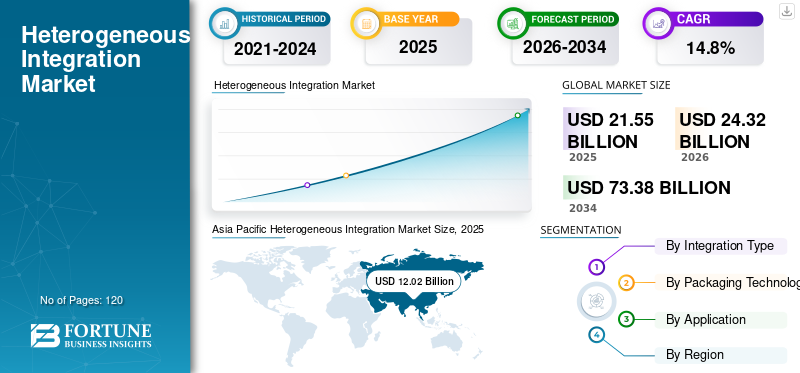
The global heterogeneous integration market size was valued at USD 21.55 billion in 2025. The market is projected to grow from USD 24.32 billion in 2026 to USD 73.38 billion by 2034, exhibiting a CAGR of 14.8% during the forecast period. Asia Pacific dominated the heterogeneous integration market with a market share of 55.77% in 2025.
The market is quite simply the semiconductor ecosystem focused on the simultaneous integration of multiple chips or dies fabricated on different process nodes, materials, or functions into an advanced package or system-level solution. Such integration utilizes technologies such as 2.5D/3D ICs and chiplet architectures, thus leading to better performance, power efficiency, and compact form factors. The market is growing rapidly, owing to the increasing responsiveness to high-performance computing demand and artificial Intelligence workloads that drive the transition from monolithic chip mastery to chiplet-based and advanced packing solutions that provide greater bandwidth while enhancing scalability and energy efficiency.
Furthermore, many key market players, such as Samsung Electronics Co., Ltd., TSMC, NVIDIA Corporation, Advanced Micro Devices, Inc., and Intel Corporation, operating in the market, are focusing on heavy investment in advanced packaging technologies. Such technologies include 2.5D/3D integration and chiplet architectures, along with ecosystem partnerships across foundries, OSATs, and fabless companies, to improve performance scalability.
Download Free sample to learn more about this report.
 Global Market Size & Forecast
 Market Share
 Key Regional Highlights
Asia Pacific
The region led the global market with USD 12.02 billion in 2025, supported by its strong semiconductor manufacturing ecosystem and rising demand from AI, HPC, automotive electronics, and consumer devices.
North America
North America is estimated to reach USD 5.56 billion in 2026 and secure the position of the second-largest region in the market, driven by strong demand from AI, data center, and high-performance computing workloads.
Europe
Europe is estimated to reach USD 3.76 billion by 2026 and is projected to grow at a CAGR of 13.9%, supported by investments through the European Chips Act.
U.S.
The U.S. heterogeneous integration market is analytically approximated at around USD 4.66 billion in 2026, accounting for roughly 19.2% of global sales.
Japan
The Japan market size in 2026 is estimated at around USD 2.62 billion, accounting for roughly 10.8% of global revenues.
Read More

Rising Generative AI Demand Driving Advanced Packaging and Chiplet-Based Integration Growth
The demand for heterogeneous integration is growing rapidly owing to the rise of generative AI and its resultant demand for high-bandwidth, low-latency, and energy efficient computing architectures for both inference and training workloads. High bandwidth can be attained by using multiple GPUs, single GPUs and AI accelerators, and High Bandwidth Memory (HBM).
These AI models are increasingly integrated using the chiplet-based and 2.5D/3D packaging solutions. This trend is pushing semiconductor companies to migrate away from monolithic-die scaling toward modular architectures that will enhance yield and scalability of performance of the chips used to support AI applications. The complexity of system design will require a closer relationship between foundries and OSATs along with fabless semiconductor suppliers. Consequently, advanced packaging technologies are an essential enabler to next-generation AI infrastructure.
Rapid Expansion of AI and High-Performance Computing Workloads Fuels Market Growth
The rapid expansion of AI and High-Performance Computing (HPC) workloads fuels the heterogeneous integration market growth. AI's computational, memory, and energy density needs cannot be met by existing monolithic chip technologies. AI has led to an increase in chiplet designs and, therefore, the adoption of advanced 2.5D/3D packaging technologies that combine multiple die types (GPU, CPU, HBM, etc.) in one package. In addition, the continued expansion of AI in both size and complexity has greatly accelerated the need for modular, high-performance semiconductor architectures. This trend is stimulating more collaboration throughout the semiconductor ecosystem for all stages, including foundries, OSATs, and fabless designer companies.
Download Free sample to learn more about this report.
Increasing Adoption of Heterogeneous Integration in Automotive Electronics and ADAS Systems Drives Market Growth
Automotive electronics and Advanced Driver Assistance Systems (ADAS) are becoming increasingly complex due to their heterogeneous nature, leading to higher costs and difficulties in integrating different computing, sensing, and communications systems into tightly constrained spaces and power budgets than were previously necessary.
For example, high-performance processors capable of performing the computations required for real-time decision-making in ADAS and autonomous driving vehicles can be enabled by the development of chiplets and the introduction of 2.5D and 3D packaging technologies. With the trend toward more software-defined and electrified vehicles, the need for scalable, energy-efficient semiconductor products has continued to expand. This is resulting in accelerated cooperation between automotive OEMs and semiconductor manufacturers to create the next generation of integrated platform solutions.
High Cost of Advanced Packaging Technologies May Hinder Market Growth
Expensive advanced packaging technologies are one of the major restraints in the market as processes such as 2.5D/3D IC integration, chiplet assembly, and TSV-based stacking require highly specialized fabrication equipment and advanced manufacturing capabilities. These new technologies typically involve complex process flows and an increased risk for low initial yields, along with higher costs related to the materials, such as silicon interposers and high-bandwidth memory interfaces, all of which lead to high overall production costs. This cost burden becomes difficult to manage, especially as users turn to mid-range and consumer applications. Adoption is thus confined to high-value segments such as AI, data centers, and high-performance computing.
Expansion of 5G and Edge Computing Infrastructure Creating New Opportunities for Market Growth
Heterogeneous integration will benefit from the growth of 5G and edge computing infrastructure. The need for compact, high-performance chips that combine processing, memory, and connectivity into a small footprint and with limited power will drive the demand for semiconductors in both edge nodes and 5G base transceiver stations. These capabilities are enabled by advanced packaging techniques such as 2.5D/3D packaging and chiplets that will allow multi-die designs to give higher bandwidths and reduced latencies. The rapid adoption of Industrial IoT, autonomous systems, and AR/VR applications creates the need for energy-efficient, high-density systems. This increased deployment of next-generation network infrastructure provides a substantial opportunity for semiconductor manufacturers looking to sell heterogeneous integration products.
Widespread Adoption of 2.5D Integration is Driving Segment Leadership
Based on the integration type, the market is divided into 2.5D integration, 3D IC integration, chiplet-based integration, and system-in-package (SiP) integration.
2.5D integration captured the largest market share in 2025 as it remained widely adopted across CPUs, GPUs, AI accelerators, network processors, and high-performance SoCs. This is due to the segment’s mature manufacturing ecosystem, better yields, and relatively lower cost compared with newer 5 nm, 4 nm, and 3 nm nodes. Its strong installed base across data centers, smartphones, telecom infrastructure, and automotive compute supported continued demand, even as leading players gradually shifted premium and AI-focused chips toward smaller process nodes.
The chiplet-based integration segment is anticipated to grow at the highest CAGR of 17.4% over the forecast period. This is owing to the fact that it allows modular, scalable, and cost-effective system designs. It enables multiple specialized dies to be combined within a single package to meet the increasing performance and energy efficiency demands of AI, HPC, and next-generation computing workloads.
Cost-Effectiveness and High-Volume Manufacturing Suitability Drives Flip-chip Packaging Segment Demand
Based on the packaging technology, the market is categorized into flip-chip packaging, fan-out wafer-level packaging, through-silicon via (TSV) based packaging, and interposer-based packaging.
Flip-chip packaging accounted for the largest market share in 2025. It is a well-established, mature packaging technology with consistent electrical performance, high input/output density, and mechanical stability across many kinds of semiconductor devices. Additionally, its cost-effectiveness and suitability for high-volume manufacturing, makes flip-chip packaging the most popular option among consumer electronics, automotive, and industrial uses.
Fan-out wafer-level packaging is anticipated to grow at the highest CAGR of 16.5% over the forecast period. This is owing to the fact that it enables ultra-thin, high-density, and cost-efficient integration of multiple dies, making it ideal for compact mobile devices, edge AI applications, and next-generation consumer electronics.
To know how our report can help streamline your business, Speak to Analyst
High-Performance Computing and Cloud Workloads Strengthens Data Centers and HPC Segment’s Leadership
Based on the application, the market is classified into consumer electronics, automotive, telecommunications (5G & Edge), data centers and HPC, and others (industrial electronics, aerospace & defense, etc.).
The data centers and HPC segment dominated the market share in 2025 and is expected to grow at the highest CAGR of 16.7% during the forecast period. This is owing to the demand for very sophisticated computing processing power, memory bandwidth, and ultra-low latency interconnections. Further, demanding heterogeneous integration solutions which have been realized with heterogeneous integration technologies such as 2.5D/3D ICs and chiplet-based architectures.
The automotive segment is anticipated to grow at a moderate CAGR of 15.6% during the forecast period. This is owing to the increasing integration of ADAS, EV platforms, and sensor fusion systems, which is driving demand for heterogeneous integration. However, adoption is tempered by cost sensitivity and longer product development cycles in the automotive industry.
By region, the market is categorized into North America, South America, Europe, the Middle East & Africa, and Asia Pacific.
Asia Pacific Heterogeneous Integration Market Size, 2025 (USD Billion)
To get more information on the regional analysis of this market, Download Free sample
Asia Pacific accounted for the largest heterogeneous integration market share in 2024, valuing at USD 10.49 billion, and also maintained the leading share in 2025, with USD 12.02 billion. The market in the Asia Pacific is expected to increase, owing to the development of a strong semiconductor manufacturing ecosystem and advanced packaging environment. Semiconductor manufacturers in Taiwan, South Korea, China, and Japan lead the region while demand for heterogeneous integration solutions increases with the high adoption of AI, High Performance Computing (HPC), automotive electronics, and consumer devices.
China’s market is projected to be one of the largest worldwide, with 2026 revenues estimated at around USD 3.22 billion, representing roughly 13.2% of global sales. This is owing to the country’s rapidly expanding semiconductor manufacturing and OSAT ecosystem, combined with increasing adoption of AI, HPC, automotive electronics, and consumer devices that rely on advanced heterogeneous integration solutions.
To know how our report can help streamline your business, Speak to Analyst
The Japan market size in 2026 is estimated at around USD 2.62 billion, accounting for roughly 10.8% of global revenues.
The Indian market size in 2026 is estimated at around USD 1.53 billion, accounting for roughly 6.3% of global revenues.
North America is estimated to reach USD 5.56 billion in 2026 and secure the position of the second-largest region in the market. This is owing to strong demand from AI, data center, and high-performance computing workloads that require advanced multi‑die and chiplet‑based packages. This support from both the industry and the government’s public funding operations, to bolster domestic supply chains, has accelerated the adoption of heterogeneous integration technologies and advanced innovations in heterogeneous integration.
Based on North America’s significant contribution and the U.S. dominance within the region, the U.S. market can be analytically approximated at around USD 4.66 billion in 2026, accounting for roughly 19.2% of global sales.
Europe is projected to grow at a CAGR of 13.9% in the coming years, which is the highest among all regions, and is estimated to reach a valuation of USD 3.76 billion by 2026. The market growth in the region relies on considerable investment from both public and private sources through the European Chips Act. It aims to strengthen regional semiconductor production, enhance advanced packaging capabilities, and foster the development of a chiplet ecosystem. These initiatives are intended to increase technological independence and provide high-performance computing solutions for automotive, industrial, and communications applications throughout the region.
The U.K. market size in 2026 is estimated at around USD 0.58 billion, representing roughly 2.4% of global revenues.
Germany’s market is projected to reach approximately USD 0.92 billion in 2026, equivalent to around 3.8% of global sales.
South America is expected to witness moderate growth in this market space during the forecast period. The South American market is set to reach a valuation of USD 0.39 billion in 2026. The growth is driven by increasing adoption of automotive electronics, industrial applications, and telecom infrastructure, which is creating demand for advanced multi-die and heterogeneous integration semiconductor solutions. In the South American region, the Brazil market is set to reach a value of USD 0.20 billion in 2026.
The Middle East & Africa market is estimated to reach USD 0.77 billion in 2026 and is expected to grow at a prominent growth rate in the coming years. The market growth in the region is driven by the increasing amount of money being invested in data center creation and infrastructure development, Artificial Intelligence (AI) implementation, and smart city projects. All of these factors require extremely efficient and effective semiconductor solutions through heterogeneous integration. Additionally, the development of the semiconductor ecosystem is occurring at an initial stage in some countries in the Middle East & Africa region, such as Israel and the GCC countries. Within the Middle East & Africa region, the GCC market is set to reach a value of USD 0.26 billion in 2026.
Focus on Expanding Advanced Packaging and Chiplet-based Integration Capabilities by Key Players to Propel Market Growth
The global heterogeneous integration market holds a semi-consolidated market structure, with prominent players such as TSMC, Samsung Electronics Co., Ltd., Intel Corporation, NVIDIA Corporation, and Advanced Micro Devices, Inc., holding significant positions. These companies are investing heavily in advanced packaging technologies including 2.5D integration, 3D IC stacking, chiplet-based architectures, fan-out wafer-level packaging, and interposer-based solutions to address increasing demand for AI, HPC, and data-intensive workloads.
Other notable players in the global market include Qualcomm Incorporated, Broadcom Inc., Apple Inc., MediaTek, Inc., and Marvell Technology, Inc. These companies are strengthening their system-level integration capabilities by adopting chiplet-based designs, high-bandwidth memory integration, and custom silicon development. Further, enabling performance scaling and power efficiency improvements for AI accelerators, premium smartphones, networking infrastructure, and next-generation computing systems.
The global heterogeneous integration market analysis includes a comprehensive study of the market size & forecast by all the market segments included in the report. It includes details on the market dynamics and market trends expected to drive the market over the forecast period. It provides information on key aspects, including an overview of technological advancements, pipeline candidates, the regulatory environment, and product launches. Additionally, it details partnerships, mergers & acquisitions, as well as key industry developments and prevalence by key regions. The global market research report also provides a detailed competitive landscape with information on the market share and profiles of key operating players.
Request for Customization to gain extensive market insights.
| ATTRIBUTE | DETAILS |
| Study Period | 2021-2034 |
| Base Year | 2025 |
| Estimated Year | 2026 |
| Forecast Period | 2026-2034 |
| Historical Period | 2021-2024 |
| Growth Rate | CAGR of 14.8% from 2026-2034 |
| Unit | Value (USD Billion) |
| Segmentation | By Integration Type, Packaging Technology, Application, and Region |
| By Integration Type |
|
| By Packaging Technology |
|
| By Application |
|
| By Region |
|
According to Fortune Business Insights, the global market value stood at USD 21.55 billion in 2025 and is projected to reach USD 73.38 billion by 2034.
The market is growing at a CAGR of 14.8% during the forecast period.
In 2025, the market value stood at USD 12.02 billion.
By application, the data centers and HPC segment is expected to lead the market.
Increasing adoption of heterogeneous integration in automotive electronics and ADAS systems drives market growth.
TSMC, Samsung Electronics Co., Ltd., Intel Corporation, NVIDIA Corporation, and Advanced Micro Devices, Inc. are the major players in the global market.
Asia Pacific dominated the market in 2025.
Get 30-60 hrs Free Customization
Expand Regional and Country Coverage, Segments Analysis, Company Profiles, Competitive Benchmarking, and End-user Insights.




















Get In Touch With Us
US +1 833 909 2966 ( Toll Free )
Receive a tailored pricing based on your needs.
Discuss your questions with our industry experts.
Have questions? Get quick answers before you purchase.

