Heterogeneous Integration Silicon Market Size, Share & Industry Analysis, By Technology (2.5D Integration, 3D Integration, Chiplet Integration, Fan-Out Integration, System-in-Package, and Others), By Application (AI & High-Performance Computing, Data Centers, Consumer Electronics, Automotive Electronics, Telecom & Networking, and Others), By End-user (Foundries, IDMs, OSATs, Fabless Semiconductor Companies, Cloud & Data Center Companies, and Others), and Regional Forecast, 2026 – 2034
 Download Free Sample
 HETEROGENEOUS INTEGRATION SILICON MARKET SIZE AND FUTURE OUTLOOK
 Listen to Audio Version
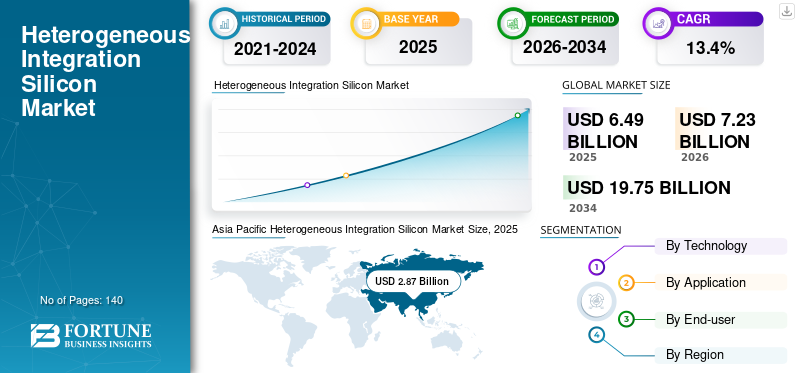
The heterogeneous integration silicon market size was valued at USD 6.49 billion in 2025. The market is projected to grow from USD 7.23 billion in 2026 to USD 19.75 billion by 2034, exhibiting a CAGR of 13.4% during the forecast period. Asia Pacific dominated the heterogeneous integration silicon market with a market share of 44.22% in 2025.
The market refers to semiconductor chips and components that combine multiple functional blocks, chip types, or materials within a single package to enhance performance, reduce power consumption, and enable compact designs. It includes 2.5D and 3D integration, chiplet integration, fan-out packaging, System-In-Package (SiP), and other emerging semiconductor technologies including hybrid bonding. The market encompasses entire semiconductor ecosystem, including foundries, Integrated Device Manufacturers (IDMs), OSATs, fabless semiconductor companies, and cloud & data center operators, delivering heterogeneous integrated solutions that support advanced computing and next-generation applications.
Taiwan Semiconductor Manufacturing Company Limited, Intel Corporation, Samsung Electronics Co., Ltd., ASE Technology Holding Co., Ltd., Amkor Technology, Inc., JCET Group Co., Ltd., GlobalFoundries Inc., United Microelectronics Corporation, Powertech Technology Inc., and Nepes Corporation are few top players in the market.
Download Free sample to learn more about this report.
HETEROGENEOUS INTEGRATION SILICON MARKET KEY TAKEAWAYS
 Global Market Size & Forecast
- 2025 Market Size: USD 6.49 billion
- 2026 Market Size: USD 7.23 billion
- 2034 Forecast Market Size: USD 19.75 billion
- CAGR: 13.4% from 2026-2034
 Market Share
- Asia Pacific dominated the heterogeneous integration silicon market with a market share of 44.22% in 2025.
- Chiplet integration is expected to grow at a maximum CAGR of 15.5% over the forecast period.
- In 2025, AI & high-performance computing held the largest share of 28.4% and is expected to grow at the highest CAGR.
 Key Regional Highlights
North America
North America held the second-largest share of the heterogeneous integration silicon market in 2025, supported by the strong presence of semiconductor innovators, AI chip developers, and advanced computing infrastructure.
Europe
Europe accounted for a significant share of the market in 2025, driven by its leadership in automotive semiconductors, industrial electronics, and advanced semiconductor research.
Asia Pacific
Asia Pacific dominated the global heterogeneous integration silicon market with a 44.22% share in 2025, reaching USD 2.87 billion, and is expected to record the fastest growth during the forecast period.
U.S.
The U.S. heterogeneous integration silicon market reached USD 1.44 billion in 2025, accounting for 22.1% of global market sales.
Japan
The Japan heterogeneous integration silicon market was valued at USD 0.59 billion in 2025, representing 9.1% of global revenues.
Read More

HETEROGENEOUS INTEGRATION SILICON MARKET TRENDS
Glass Substrates Gain Momentum in Advanced Heterogeneous Integration Packaging is Emerging Market Trend
A key trend in the market is the growing shift toward glass substrates for next-generation cutting edge packaging. Glass substrates offer better dimensional stability, improved thermal and mechanical performance, and higher interconnect density than conventional organic substrates. These benefits are significant for AI, data center, and HPC chips, where larger package sizes, dense die-to-die interconnects, and lower power loss are necessary. As chiplet architectures expand, glass substrates are expected to support more complex heterogeneous integration technologies by enabling higher-density routing and larger multi-die packages.
- In April 2026, Odisha laid the foundation stone for India’s first advanced 3D glass-based chip packaging unit with an investment of USD 200 million. The facility is expected to be operational by 2030, with a planned annual capacity of 70,000 glass panels, 50 million assembled units, and 13,200 advanced 3D heterogeneous integration modules.
Download Free sample to learn more about this report.
MARKET DYNAMICS
MARKET DRIVERS
AI and HPC Demand Accelerates Adoption of Heterogeneous Integration Silicon
The heterogeneous integration silicon market growth is driven by rising demand for high performance electronics, power-efficient chips used in AI, HPC, and data center workloads. Traditional single-die scaling is becoming costlier and more technically challenging, pushing semiconductor companies toward chiplet-based designs that integrate logic, memory, RF, and analog dies into a single package. This approach improves bandwidth, reduces latency, and allows each function to use the most suitable process node. Advanced packaging platforms such as 2.5D, 3D stacking, fan-out, and silicon interposers are therefore becoming essential for next-generation processors and accelerators.
- In October 2025, Alphawave Semi completed the tape-out of its UCIe 3D IP on TSMC’s SoIC-X technology within the 3DFabric platform. The solution delivers 10x better power efficiency and up to 5x higher signal density than traditional die-to-die interfaces.
MARKET RESTRAINTS
High Packaging Cost and Manufacturing Complexity Restrain Market Expansion
The market faces constraints due to the high cost and technical complexity of advanced packaging. Integrating multiple chiplets, memory, logic, RF, and analog dies into one package requires precise die-to-die interconnects, thermal management, advanced substrates, yield control, and complex testing. These requirements increase manufacturing cost and limit adoption among smaller semiconductor firms with restricted design and packaging budgets. In addition, defects in a single die or interconnect can affect the performance of the entire package, making testing and validation more difficult, compared to conventional single-chip packaging.
MARKET OPPORTUNITIES
AI Infrastructure Expansion Creates Growth Opportunity for Market
The market has significant growth opportunities in AI infrastructure, where chipmakers are scaling advanced packaging to support high-bandwidth, power-efficient, multi-die architectures. AI processors increasingly require chiplets, high-bandwidth memory, silicon interposers, 2.5D bridges, and 3D integrations to improve performance per watt and reduce data-transfer bottlenecks. This creates opportunities for OSATs, foundries, substrate suppliers, EDA providers, and semiconductor material companies to develop specialized solutions for AI accelerators, HPC processors, and rack-scale data center systems.
- In May 2026, AMD announced investments of over USD 10 billion in the Taiwan ecosystem to scale advanced packaging for next-generation AI infrastructure. Its EFB-based 2.5D packaging technology will support higher interconnect bandwidth and efficiency in 6th Gen AMD EPYC CPUs.
SEGMENTATION ANALYSIS
By Technology
2.5D Integration Segment Leads Due to Mature Adoption in AI, HPC, and HBM-Based Packaging
Based on technology, the market is segmented into 2.5D integration, 3D integration, chiplet integration, fan-out integration, system-in-package, and others.
In 2025, 2.5D integration held the largest share of 27.1% as it is widely adopted in AI accelerators, GPUs, HPC processors, and HBM-based packages, where high bandwidth and low latency are critical. It offers a mature, commercially proven alternative to full 3D stacking, with better thermal control, easier validation, and strong adoption by leading foundries and OSATs.
Chiplet integration is expected to grow at a maximum CAGR of 15.5% over the forecast period, as semiconductor companies shift from monolithic SoCs to modular architectures that combine multiple dies, IP blocks, and process nodes into a single package. This approach improves yield, reduces design cost, supports customization, and is increasingly used in AI, data center, automotive, and HPC chips.
By Application
AI & High-Performance Computing Dominates as Advanced Packaging Becomes Critical for High-Bandwidth Processing
Based on application, the market is divided into AI & high-performance computing, data centers, consumer electronics, automotive electronics, telecom & networking, and others.
In 2025, AI & high-performance computing held the largest share of 28.4% and is expected to grow at the highest CAGR, as these applications require very high computing power, memory bandwidth, and energy efficiency. Advanced packaging technologies such as 2.5D and 3D packages, chiplets, and HBM integration are essential for improving performance per watt in AI accelerators and HPC processors.
In 2025, data centers hold the second-largest share of 22.6%, as they are the primary deployment environment for GPUs, CPUs, AI accelerators, networking chips, and custom ASICs that use heterogeneous integration. Demand from hyperscalers and cloud service providers is increasing as they require higher compute density, better bandwidth, and lower power consumption for AI training, inference, and high-speed networking.
By End-user
To know how our report can help streamline your business, Speak to Analyst
Foundries Segment Leads Due to Strong Advanced Packaging and Wafer Fabrication Capabilities
By end-user, the market is segmented into foundries, IDMs, OSATs, fabless semiconductor companies, cloud & data center companies, and others.
In 2025, foundries held the largest share of 27.2%, as they provide the core wafer bonding and advanced packaging platforms needed for heterogeneous silicon integration. Their ability to combine process-node expertise, interposer technologies, die stacking, fan-out packaging, and volume-production support makes them the preferred partners for AI, HPC, and data-center chip customers.
Fabless semiconductor companies are projected to grow at the highest CAGR of 15.7% as they are rapidly designing AI accelerators, custom ASICs, networking chips, and chiplet-based processors without owning fabrication facilities. Their reliance on foundries and OSATs for manufacturing, combined with rising demand for customized high-performance silicon, is expected to drive faster adoption of heterogeneous integration.
Heterogeneous Integration Silicon Market Regional Outlook
By geography, the market is categorized into North America, South America, Europe, Middle East & Africa, and Asia Pacific.
Asia Pacific
Asia Pacific Heterogeneous Integration Silicon Market Size, 2025 (USD Billion)
To get more information on the regional analysis of this market, Download Free sample
Asia Pacific holds the largest heterogeneous integration silicon market share due to its strong semiconductor manufacturing base across Taiwan, South Korea, China, Japan, and Southeast Asia, supported by leading foundries, OSATs, memory suppliers, substrate manufacturers, and electronics assembly hubs. The region is also expected to grow at the highest CAGR as investments in AI chips, HBM, chiplet packaging, 2.5D/3D integration, and advanced packaging capacity continue to expand rapidly across the regional semiconductor ecosystem.
Japan Heterogeneous Integration Silicon Market
The Japan market in 2025 was at USD 0.59 billion, accounting for roughly 9.1% of global revenues.
China Heterogeneous Integration Silicon Market
China’s market is projected to be one of the largest worldwide, with 2025 revenues at USD 1.00 billion, representing roughly 15.3% of global sales.
To know how our report can help streamline your business, Speak to Analyst
India Heterogeneous Integration Silicon Market
The India market in 2025 was at USD 0.38 billion, accounting for roughly 5.9% of global revenues.
North America
North America holds the second-largest share due to the strong presence of fabless semiconductor companies, AI accelerator developers, hyperscalers, EDA providers, and semiconductor equipment suppliers. The region drives high-value demand for heterogeneous integration silicon through AI, HPC, data center, defense, automotive, and networking chip designs, while large-scale assembly and packaging capacity remains more concentrated in the Asia Pacific region.
U.S. Heterogeneous Integration Silicon Market
The U.S. market reached USD 1.44 billion in 2025, accounting for roughly 22.1% of global sales.
Europe
Europe holds a significant share due to its strong position in automotive semiconductors, industrial electronics, power devices, sensor technologies, and advanced semiconductor R&D. Demand for heterogeneous integration is supported by European automotive OEMs, Tier-1 suppliers, research institutes, and chipmakers focusing on electrification, ADAS, industrial automation, and secure edge computing applications.
U.K. Heterogeneous Integration Silicon Market
The U.K. market in 2025 was at USD 0.16 billion, representing roughly 2.4% of global revenues.
Germany Heterogeneous Integration Silicon Market
Germany’s market reached USD 0.19 billion in 2025, equivalent to around 2.9% of global sales.
Middle East & Africa
The Middle East & Africa region is projected to grow at the second-largest CAGR, driven by rising investments in digital infrastructure, AI data centers, smart cities, telecom networks, and national semiconductor initiatives. GCC countries, Israel, and parts of Africa are experiencing increasing demand for advanced computing, edge AI, cloud services, and high-speed connectivity, creating future growth opportunities for heterogeneous-integration silicon.
GCC Heterogeneous Integration Silicon Market
The GCC market was valued at USD 0.24 billion in 2025, representing roughly 3.7% of global revenues.
South America
South America is expected to grow at an average rate driven by the gradual adoption of AI, cloud computing, telecom modernization, and industrial digitalization across countries such as Brazil, Argentina, and Chile. However, limited domestic semiconductor manufacturing, lower advanced packaging capacity, and dependence on imported high-performance chips are likely to keep regional growth moderate compared to Asia Pacific, North America, and Middle East & Africa.
Brazil Heterogeneous Integration Silicon Market
The Brazil market in 2025 was at USD 0.23 billion, accounting for roughly 3.5% of global revenues.
COMPETITIVE LANDSCAPE
Key Industry Players
Key Market Players Launch New Solutions to Strengthen their Market Positioning
Players launch new solutions to enhance their market positioning by leveraging technological advancements, addressing diverse consumer needs, and staying ahead of competitors. They prioritize portfolio enhancement, strategic collaborations, and acquisitions and partnerships to strengthen their offerings. Such strategic launches enable technology companies to maintain and expand their market share amid a rapidly evolving landscape.
LIST OF KEY HETEROGENEOUS INTEGRATION SILICON COMPANIES PROFILED
- Taiwan Semiconductor Manufacturing Company Limited (Taiwan)
- Intel Corporation (U.S.)
- Samsung Electronics Co., Ltd. (South Korea)
- ASE Technology Holding Co., Ltd. (Taiwan)
- Amkor Technology, Inc. (U.S.)
- JCET Group Co., Ltd. (China)
- GlobalFoundries Inc. (U.S.)
- United Microelectronics Corporation (Taiwan)
- Powertech Technology Inc. (Taiwan)
- Nepes Corporation (South Korea)
KEY INDUSTRY DEVELOPMENTS
- May 2026: AMD announced investments of over USD 10 billion in the Taiwan ecosystem to scale advanced packaging for next-generation AI infrastructure. Its EFB-based 2.5D packaging technology will support higher interconnect bandwidth and efficiency in 6th Gen AMD EPYC CPUs.
- April 2026: TSMC began producing 5.5-reticle-size CoWoS packages to support AI demand for higher compute and memory integration. The company also plans to have a 14-reticle CoWoS platform by 2028, capable of integrating around 10 large compute dies and 20 HBM stacks.
- March 2026: Micron Technology announced high-volume production of its 36GB 12-high HBM4 for NVIDIA Vera Rubin AI platforms. The product delivers over 2.8 TB/s bandwidth and more than 20% better power efficiency.
- March 2026: Samsung Electronics announced mass production and commercial shipment of its HBM4 for AI computing. The product offers a transfer speed of 11.7 Gbps, with a maximum of 13 Gbps.
- September 2025: SK hynix completed development of its HBM4 and prepared for mass production. Its MR-MUF packaging technology improves warpage control and heat dissipation for stable HBM production.
- August 2025: Amkor Technology announced revised plans for its U.S. advanced packaging and test facility in Peoria, Arizona. The facility will support advanced packaging, wafer level packaging, and system-in-package solutions for AI, data centers, automotive, and other applications.
- July 2025: Synopsys completed its acquisition of Ansys to combine silicon design, IP, simulation, and analysis capabilities. The deal strengthens workflows for complex multi-die, chiplet, and advanced packaging architectures.
REPORT COVERAGE
The heterogeneous integration silicon market analysis provides an in-depth study of the size & forecast by all the market segments included in the report. It includes details on the market dynamics and market trends expected to drive the market in the forecast period. It offers information on the technological advancements, key developments, and details on partnerships, mergers & acquisitions. The market research report also includes a detailed competitive landscape, providing market share and profiles of key players.
Request for Customization to gain extensive market insights.
REPORT SCOPE & SEGMENTATION
| ATTRIBUTE | DETAILS |
| Study Period | 2021-2034 |
| Base Year | 2025 |
| Estimated Year | 2026 |
| Forecast Period | 2026-2034 |
| Historical Period | 2021-2024 |
| Growth Rate | CAGR of 13.4% from 2026-2034 |
| Unit | Value (USD Billion) |
| Segmentation | By Technology, By Application, By End-user, and By Region |
| By Technology |
|
| By Application |
|
| By End-user |
|
| By Region |
|
Frequently Asked Questions
Fortune Business Insights says that the global market value stood at USD 6.49 billion in 2025 and is projected to reach USD 19.75 billion by 2034.
In 2025, the Asia Pacific market value stood at USD 2.87 billion.
The market is expected to grow at a CAGR of 13.4% over the forecast period of 2026-2034.
By end-user, foundries segment was leading the market.
The key factors driving the market are rising demand for AI and high-performance computing chips, increasing adoption of chiplet-based architecture, and growing demand for compact, power-efficient semiconductor devices.
Taiwan Semiconductor Manufacturing Company Limited, Intel Corporation, and Samsung Electronics Co., Ltd. are some of the prominent players in the market.
Asia Pacific held the largest share of the market.
Major factors expected to favor product adoption include growing need for smaller, faster electronic devices and the wider adoption of advanced packaging in data centers, automotive electronics, and telecom applications.


- 2021-2034
- 2025
- 2021-2024
- 140
Get 30-60 hrs Free Customization
Expand Regional and Country Coverage, Segments Analysis, Company Profiles, Competitive Benchmarking, and End-user Insights.




















Related Reports
-
US +1 833 909 2966 ( Toll Free )
-
Get In Touch With Us