Hydrogen Blending in Natural Gas Market Size, Share & Industry Analysis, By Pipeline Type (Transmission Pipelines and Distribution Pipelines), By Hydrogen Source (Green Hydrogen, Grey Hydrogen, Blue Hydrogen, and Others), By Blend Ratio (Up to 2%, 2%-5%, 5%-10%, 10%-20%, and Above 20%), By End User (Utility, Industrial, Commercial, and Residential), and Regional Forecast, 2026-2034
 Download Free Sample
Hydrogen Blending in Natural Gas Market Size and Future Outlook
 Listen to Audio Version
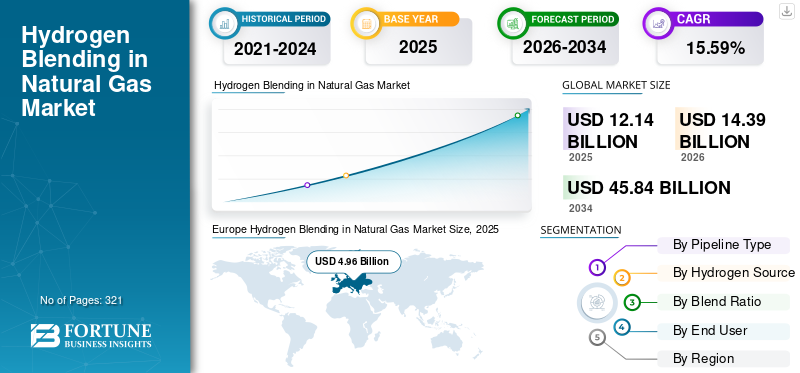
The global hydrogen blending in natural gas market size was valued at USD 12.14 billion in 2025. The market is projected to grow from USD 14.39 billion in 2026 to USD 45.84 billion by 2034, exhibiting a CAGR of 15.59% during the forecast period.
Hydrogen blending in natural gas refers to the process of injecting hydrogen into existing natural gas networks to reduce the carbon intensity of gaseous fuels without requiring immediate replacement of existing pipeline infrastructure. Hydrogen-enriched natural gas can be transported through transmission and distribution pipelines and used in residential, commercial, industrial, and power generation applications. This approach is considered a clean fuel transition pathway toward a low-carbon energy system, enabling gradual adoption of hydrogen while leveraging existing natural gas assets. Hydrogen blending supports decarbonization goals by lowering greenhouse gas emissions and facilitating the integration of renewable and low-carbon hydrogen into the energy mix.
The growth of the market is primarily driven by increasing global decarbonization initiatives and the need to reduce greenhouse gas emissions from existing gas infrastructure. Governments and regulatory bodies are promoting hydrogen blending as a cost-effective pathway to integrate low-carbon gas solutions into energy systems without requiring extensive pipeline replacement. Rising investments in green and blue hydrogen production, expanding hydrogen infrastructure projects, and growing adoption of national hydrogen strategies across Europe, North America, and Asia Pacific are further accelerating market growth. Additionally, the ability to leverage existing natural gas transmission and distribution networks makes hydrogen blending an attractive near-term solution for advancing the energy transition fuels.
Snam S.p.A., National Gas, Enagás S.A., Enbridge Inc., and Air Liquide S.A. are among the key market players driving the growth of the market. These companies are actively supporting the development of hydrogen blending infrastructure by integrating hydrogen into existing natural gas networks and advancing hydrogen-ready pipeline systems. Their efforts focus on expanding low-carbon energy solutions, improving the compatibility of gas infrastructure with hydrogen, and facilitating the transition toward cleaner energy systems. They are also investing in hydrogen production, transportation, storage, and network modernization projects to accelerate hydrogen adoption. Through strategic collaborations, technology development, and infrastructure investments, these companies are contributing to the commercialization and large-scale deployment of hydrogen within the natural gas value chain.
Download Free sample to learn more about this report.
HYDROGEN BLENDING IN NATURAL GAS MARKET KEY TAKEAWAYS
 Global Market Size & Forecast
- 2025 Market Size: USD 12.14 billion
- 2026 Market Size: USD 14.39 billion
- 2034 Forecast Market Size: USD 45.84 billion
- CAGR: 15.59% from 2026–2034
 Market Share
- Europe dominated the market with a 40.83% share in 2025.
- The Green Hydrogen segment held the largest market share 60.83% in 2025.
- The 2%–5% Blend Ratio segment held the largest market share 38.41% in 2025.
 Key Regional Highlights
Europe
Europe reached USD 4.96 billion in 2025, accounting for 40.83% of global revenue, driven by ambitious decarbonization policies and large-scale hydrogen infrastructure initiatives.
Asia Pacific
Asia Pacific reached USD 3.65 billion in 2025, accounting for 30.03% of global revenue, supported by hydrogen investments, expanding natural gas infrastructure, and national energy transition strategies.
North America
North America reached USD 2.28 billion in 2025, accounting for 18.75% of global revenue, driven by extensive natural gas infrastructure and strong government support for hydrogen development.
U.S.
The market reached USD 1.96 billion in 2025 and is estimated to reach USD 2.33 billion by 2026, supported by its extensive natural gas ecosystem and ongoing hydrogen infrastructure investments.
Japan
The market reached USD 0.72 billion in 2025 and is estimated to reach USD 0.88 billion by 2026, driven by investments in hydrogen production, transportation, storage, and utilization technologies.
Read More

Hydrogen Blending in Natural Gas Market Trends
Increasing Adoption of Hydrogen-Ready Gas Infrastructure are Amplifying Market Growth
A major trend shaping the market is the growing development of hydrogen-ready gas infrastructure and hydrogen blending technology. Gas transmission and distribution operators are increasingly modifying existing networks to accommodate hydrogen blends while preparing for future pure-hydrogen transportation. Europe is leading this trend through initiatives such as the European Hydrogen Backbone (EHB), which envisions approximately 53,000 km of hydrogen pipeline infrastructure by 2040, with a substantial portion repurposed from existing natural gas pipelines. Utilities and gas operators are conducting hydrogen blending trials at concentrations ranging from 5% to 20% to evaluate network compatibility and end-user impacts. Companies such as Snam, National Gas, and Enagás are investing heavily in pipeline modernization and hydrogen transport capabilities. The trend is further supported by government-backed hydrogen strategies across Germany, the U.K., Spain, Australia, and Japan. As hydrogen production capacity expands globally, infrastructure readiness is becoming a critical focus area, enabling a gradual transition from natural gas toward low-carbon hydrogen-based energy systems while minimizing the need for entirely new pipeline networks.
MARKET DYNAMICS
Market Drivers
Download Free sample to learn more about this report.
Global Decarbonization and Net-Zero Commitments to Push Market Growth
The primary driver for hydrogen blending in natural gas market growth is the increasing emphasis on decarbonization and net-zero emission targets. More than 150 countries have announced net-zero commitments, while major economies including the European Union, the U.K., Japan, South Korea, and Canada have adopted hydrogen strategies that recognize hydrogen blending as a transitional decarbonization pathway. According to the International Energy Agency (IEA), hydrogen demand exceeded 97 million tons globally in 2023 and is expected to grow significantly as governments seek alternatives to fossil fuels. Blending hydrogen with natural gas allows utilities and industries to reduce carbon emissions without immediately replacing existing gas infrastructure, making it one of the most practical near-term solutions for lowering emissions from gas networks. Furthermore, large-scale government funding programs, including the U.S. Regional Clean Hydrogen Hubs Program and the European Hydrogen Bank, are accelerating hydrogen production and infrastructure development. These policy initiatives are driving investments throughout the hydrogen value chain and supporting the commercialization of hydrogen blending technologies.
Market Restraints
High Cost of Low-Carbon Hydrogen Production to Limit Market Growth
One of the most significant restraints in the market is the relatively high cost of producing low-carbon hydrogen, particularly green hydrogen. While conventional natural gas remains comparatively inexpensive, green hydrogen produced through renewable-powered electrolysis often costs between USD 4–6 per kilogram in many regions, substantially higher than the cost of grey hydrogen derived from natural gas. Although costs are expected to decline over the coming decade, current economics limit large-scale deployment of hydrogen blending projects. Utilities and industrial consumers often face challenges in justifying higher fuel costs, particularly in price-sensitive markets. In addition, hydrogen blending at low concentrations typically delivers modest emissions reductions relative to the additional hydrogen production costs involved. As a result, many projects remain dependent on government incentives, subsidies, and policy support mechanisms. Until electrolyzer costs decrease further and renewable electricity becomes more affordable, hydrogen economics will continue to be a key constraint on widespread adoption of hydrogen blending technologies.
|
Rank |
Market Restraint |
Estimated Contribution to CAGR (2026-2034) |
Impact on Market Growth |
2026-2028 |
2029-2031 |
2031-2034 |
|
1 |
High production cost of green hydrogen and dependence on policy incentives for commercial viability |
High |
-1.05% |
High |
High |
Medium |
|
2 |
Technical limitations of existing pipelines, compressors, storage facilities, and end-user appliances for higher hydrogen blending ratios |
High |
-0.90% |
High |
Medium |
Medium |
|
3 |
Lack of harmonized hydrogen blending regulations, gas quality standards, and safety frameworks across countries |
Medium-High |
-0.70% |
High |
Medium |
Low |
|
4 |
Others, including limited hydrogen supply infrastructure, permitting delays, financing challenges, and public acceptance concerns |
Low |
-0.50% |
Medium |
Low |
Low |
|
|
Total Negative Growth Impact |
|
-3.15 |
|
|
|
Market Opportunities
Expansion of Green Hydrogen Production Capacity to Create New Growth Avenues
The rapid expansion of global green hydrogen production capacity presents a major opportunity for the market. According to the IEA, announced low-emission hydrogen projects globally could exceed several hundred million tons of annual production capacity by 2030 if all projects proceed as planned. Countries such as Australia, Saudi Arabia, the UAE, Spain, Chile, and India are investing billions of dollars in large-scale hydrogen production facilities supported by abundant renewable energy resources. As hydrogen availability increases and production costs decline, gas network operators will gain greater access to affordable hydrogen supplies for blending applications. Hydrogen blending offers an immediate demand outlet for newly produced hydrogen, enabling producers to commercialize hydrogen before dedicated hydrogen infrastructure becomes widespread. Furthermore, blended hydrogen fuel allows governments and utilities to utilize existing gas assets while gradually scaling hydrogen consumption. This creates a substantial opportunity for infrastructure operators, hydrogen producers, equipment suppliers, and utilities participating in the emerging hydrogen economy.
Market Challenges
Technical Compatibility and Regulatory Standardization to Limit Market Growth
A key challenge facing the market is ensuring technical compatibility across gas infrastructure and establishing harmonized regulatory standards. Hydrogen possesses different physical and chemical properties than natural gas, including lower energy density and higher diffusivity, which can affect pipeline materials, compressors, storage facilities, industrial equipment, and end-use appliances. Consequently, acceptable hydrogen blending limits vary significantly across countries, ranging from less than 2% in some jurisdictions to 20% or more in others. This lack of regulatory uniformity creates uncertainty for infrastructure operators and investors. In addition, older pipeline systems may require upgrades or material assessments before accommodating higher hydrogen concentrations. Utilities must also address appliance performance, safety requirements, gas quality specifications, and metering accuracy. Without consistent technical standards and regulatory frameworks, large-scale hydrogen blending deployment could face delays, increased compliance costs, and operational complexities, making standardization a critical prerequisite for long-term market growth.
Segmentation Analysis
By Pipeline Type
Proximity to End Users and Lower Infrastructure Modification Requirements Led to Dominance of Distribution Pipelines Segment
Based on pipeline type, the market segment covers transmission pipelines and distribution pipelines.
The distribution pipelines segment accounted for the largest hydrogen blending in natural gas market share in 2025, as most hydrogen blending projects are initially being implemented within local gas distribution networks serving residential, commercial, and small industrial consumers. Distribution systems generally operate at lower pressures and provide a practical environment for testing hydrogen compatibility and consumer acceptance. Several hydrogen blending demonstrations, including the U.K.'s HyDeploy project and North American utility pilot programs, have focused on distribution networks due to their proximity to end users and lower infrastructure modification requirements. Hydrogen injection into gas pipelines enables utilities to reduce carbon emissions from heating, cooking, and local energy consumption without requiring major changes to customer appliances at lower blend concentrations. The segment is also supported by growing investments in city gas distribution infrastructure, particularly across Europe and Asia Pacific. As governments pursue net-zero targets and utilities seek cost-effective decarbonization solutions, distribution pipelines are expected to remain the primary deployment platform for hydrogen blending during the early stages of market development.
Transmission pipelines is the fastest growing segment at a CAGR of 16.25% during the forecast period.
To know how our report can help streamline your business, Speak to Analyst
By Hydrogen Source
Global Decarbonization Goals and Favorable Government Policies Led to Green Hydrogen Segment Dominance
Based on hydrogen source, the market is segmented into green hydrogen, grey hydrogen, blue hydrogen, and others.
Green hydrogen segment accounted for approximately 60.83% of the market share in 2025. Its dominance is primarily driven by global decarbonization goals, favorable government policies, and increasing investments in renewable-powered electrolysis projects. Countries across Europe, Australia, India, and the Middle East are investing heavily in large-scale green hydrogen facilities to reduce dependence on fossil fuels and support net-zero emissions targets. Green hydrogen is particularly attractive for hydrogen blending applications because it offers near-zero carbon emissions throughout the production process when generated using renewable electricity. As utilities and gas network operators seek to lower the carbon intensity of existing gas infrastructure, green hydrogen is becoming the preferred source for blending projects. Falling renewable energy costs, advancements in electrolyzer technology, and government incentives are expected to further strengthen its position. Consequently, green hydrogen is projected to remain the dominant hydrogen source throughout the forecast period and serve as the primary driver of long-term market growth.
Blue hydrogen is the second leading segment and is expected to grow at a CAGR of 15.52% during the forecast period.
By Blend Ratio
Favorable Regulatory Acceptance and Manageable Technical Risks Propelled 2%-5% Segment Growth
Based on blend ratio, the market is segmented into Up to 2%, 2%-5%, 5%-10%, 10%-20%, and above 20%
The 2%-5% segment represented the largest market share of 38.41% in 2025. This range is widely considered the current commercial preference as it enables measurable carbon emission reductions while requiring limited modifications to existing pipeline systems and end-user equipment. Many utility-scale blending projects across Europe, North America, and Asia Pacific are operating or targeting hydrogen concentrations within this range due to favorable regulatory acceptance and manageable technical risks. Gas network operators view this blend level as a practical pathway for introducing hydrogen into existing energy systems without significantly impacting appliance performance or fuel quality standards. The segment benefits from increasing government support for gas network decarbonization and serves as a bridge between pilot-scale demonstrations and higher-concentration hydrogen integration. As hydrogen production capacity expands globally, the 2%–5% segment is expected to remain a significant market contributor throughout the forecast period, particularly in regions adopting a phased hydrogen transition strategy.
Above 20% is the fastest growing segment with a CAGR of 19.79% during the forecast period.
By End User
Requirement for Substantial Volumes of Natural Gas for Process Heating and Energy Generation Fuelled 2%-5% Segment Growth
Based on end user, the market is segmented into utility, industrial, commercial, and residential.
Industrial segment represented the largest market share of around 40.76% in 2025. Industries such as chemicals, refining, steel, cement, food processing, glass manufacturing, and heavy manufacturing consume substantial volumes of natural gas for process heating and energy generation, making them ideal end users for hydrogen blending adoption. Industrial facilities are under increasing pressure to reduce greenhouse gas emissions and comply with sustainability targets, prompting interest in low-carbon fuel alternatives. Hydrogen blending allows industrial users to lower their carbon footprint without making extensive modifications to existing combustion systems at lower blend concentrations. The segment is particularly strong in regions with significant industrial gas consumption, including China, India, Germany, the U.S., and GCC countries. As carbon pricing mechanisms, emissions regulations, and corporate sustainability commitments become more stringent, industrial users are expected to remain the dominant contributors to hydrogen blending demand throughout the forecast period.
Utility is the fastest growing segment with a CAGR of 17.71% during the forecast period.
Hydrogen Blending in Natural Gas Market Regional Outlook
By region, the market has been studied across North America, Europe, Asia Pacific, Latin America, and the Middle East & Africa.
North America
Europe Hydrogen Blending in Natural Gas Market Size, 2025 (USD Billion)
To get more information on the regional analysis of this market, Download Free sample
North America accounted for USD 2.28 billion in 2025, representing approximately 18.75% of global revenues. The growth is driven by extensive natural gas infrastructure and strong government support for hydrogen development. The United States Department of Energy's HyBlend Initiative is actively evaluating the technical feasibility of transporting hydrogen through existing natural gas pipelines, while the U.S. Regional Clean Hydrogen Hubs program has allocated billions of dollars to accelerate hydrogen deployment. Canada has also advanced hydrogen blending through projects such as Enbridge’s hydrogen injection initiative in Ontario. The region benefits from abundant natural gas resources, established pipeline networks, and growing investments in both blue and green hydrogen production, making hydrogen blending an attractive pathway for decarbonizing existing energy systems.
U.S. Hydrogen Blending in Natural Gas Market
The U.S. market was valued at USD 1.96 billion in 2025 and is estimated to reach USD 2.33 billion in 2026. The region’s growth is supported by a vast natural gas ecosystem and ongoing infrastructure investments. According to the U.S. Energy Information Administration (EIA), natural gas accounted for 43% of U.S. electricity generation in 2024, highlighting the importance of reliable gas delivery networks. Utilities are increasingly deploying advanced GIS, pipeline integrity management, and real-time monitoring solutions to improve system reliability, reduce operational risks, and support growing energy demand.
Europe
Europe is the dominant region in the market and was valued at USD 4.96 billion in 2025, accounting for approximately 40.83% of global revenues. Europe represents the most advanced region for hydrogen blending deployment due to ambitious decarbonization policies and strong regulatory support. The European Union's hydrogen strategy and the European Hydrogen Backbone initiative, which proposes approximately 53,000 km of hydrogen pipeline infrastructure by 2040, are accelerating hydrogen integration into gas networks. Germany, the U.K., Spain, France, and the Netherlands are conducting large-scale hydrogen blending trials and infrastructure modernization projects. Strong climate targets and substantial public funding continue to support market expansion across the region.
Germany Hydrogen Blending in Natural Gas Market
Germany was valued at USD 1.06 billion in 2025 and is estimated to reach USD 1.26 billion in 2026. Germany is one of the most advanced hydrogen blending markets globally, supported by its National Hydrogen Strategy and extensive investments in hydrogen-ready infrastructure. The country is developing a dedicated hydrogen core network and has positioned hydrogen as a key pillar of industrial decarbonization. Major gas transmission operators are actively assessing hydrogen blending and pipeline repurposing opportunities to support sectors such as chemicals, steel, and manufacturing.
U.K. Hydrogen Blending in Natural Gas Market
The U.K. market was valued at USD 0.86 billion in 2025 and is estimated to reach USD 1.03 billion in 2026. The U.K. has emerged as a pioneer in hydrogen blending through projects such as HyDeploy, which successfully demonstrated hydrogen blending in residential gas networks. The government views hydrogen as an important component of its net-zero strategy and is supporting multiple hydrogen production and infrastructure projects. The country's extensive residential gas heating market creates significant opportunities for blending hydrogen into existing distribution systems.
Asia Pacific
Asia Pacific’s market was valued at USD 3.65 billion in 2025, accounting for approximately 30.03% of the global market. Asia Pacific is emerging as a key growth region due to rising hydrogen investments, expanding natural gas infrastructure, and rising sustainable gas distribution demand. China, Japan, South Korea, India, and Australia have all incorporated hydrogen into their national energy transition strategies. China remains the world's largest hydrogen producer and is actively exploring hydrogen applications across industrial and energy sectors. Japan has long promoted a hydrogen-based economy and continues to invest in hydrogen transportation and utilization technologies. India's National Green Hydrogen Mission and Australia's large-scale renewable hydrogen projects are further strengthening regional momentum. Growing energy demand, industrial decarbonization efforts, and increasing renewable energy deployment are supporting the adoption of hydrogen blending across the region.
China Hydrogen Blending in Natural Gas Market
China remains the dominant contributor in Asia Pacific, valued at USD 1.33 billion in 2025, and is estimated to reach USD 1.63 billion in 2026. China is a major participant in the hydrogen economy due to its large industrial base, expanding natural gas infrastructure, and status as the world's largest hydrogen producer. Hydrogen blending is increasingly being explored as part of broader decarbonization initiatives targeting heavy industry and energy systems. Government support for clean energy technologies and industrial emissions reduction is expected to encourage greater adoption of hydrogen-based solutions across the country.
India Hydrogen Blending in Natural Gas Market
India was valued at USD 0.49 billion in 2025 and is estimated to reach USD 0.59 billion in 2026. India is rapidly emerging as a promising market for hydrogen blending, supported by the National Green Hydrogen Mission and growing investments in renewable energy. The country's expanding city gas distribution network provides a foundation for future hydrogen integration into natural gas systems. Rising industrial energy demand and government-led decarbonization efforts are creating favorable conditions for hydrogen blending deployment across multiple sectors.
Japan Hydrogen Blending in Natural Gas Market
Japan’s market was valued at USD 0.72 billion in 2025 and is estimated to reach USD 0.88 billion in 2026. Japan has been a global leader in hydrogen development for more than a decade and continues to promote the transition toward a hydrogen-based society. The country is actively investing in hydrogen production, transportation, storage, and utilization technologies while evaluating hydrogen integration into existing energy infrastructure. Limited domestic energy resources and ambitious carbon reduction goals make hydrogen blending an attractive option for supporting energy security and sustainability objectives.
Latin America
Latin America accounted for USD 0.55 billion in 2025, accounting for approximately 4.54% of global revenues. Latin America is gradually advancing hydrogen blending initiatives, supported by favorable renewable energy resources and growing interest in green hydrogen production. Brazil and Chile are positioning themselves as future hydrogen hubs due to their abundant solar and wind resources. Chile's National Green Hydrogen Strategy aims to make the country one of the world's lowest-cost green hydrogen producers, while Brazil is developing multiple hydrogen projects linked to its renewable energy sector. Although hydrogen blending remains at an early stage compared to Europe and North America, increasing investments in hydrogen production and energy transition policies are creating a foundation for future adoption across gas networks and industrial applications.
Middle East & Africa
The Middle East & Africa was valued at USD 0.71 billion in 2025. The Middle East & Africa region is gaining prominence in the market due to large-scale hydrogen investments and abundant energy resources. Saudi Arabia, the UAE, Oman, and Qatar are investing heavily in both green and blue hydrogen projects to diversify their energy economies and support decarbonization goals. The NEOM Green Hydrogen Project in Saudi Arabia is among the world's largest planned green hydrogen facilities, highlighting the region's commitment to hydrogen development. Additionally, the GCC countries possess extensive natural gas infrastructure, creating favorable conditions for future hydrogen blending applications. In Africa, South Africa, Egypt, and Morocco are also exploring hydrogen opportunities supported by renewable energy potential and international investment.
GCC Hydrogen Blending in Natural Gas Market
The GCC market was valued at USD 0.47 billion in 2025 and is estimated to reach USD 0.55 billion in 2026. The GCC region is becoming a major hub for hydrogen development due to its abundant natural gas resources, large-scale energy infrastructure, and significant investments in both green and blue hydrogen projects. Saudi Arabia, the UAE, and Oman are developing some of the world's largest hydrogen production facilities, including the landmark NEOM Green Hydrogen Project. The region's established gas pipeline networks and strong government support provide a favorable environment for future hydrogen blending adoption.
COMPETITIVE LANDSCAPE
Key Industry Players
Extensive Natural Gas Infrastructure and Huge Hydrogen Production Capabilities by Key Players to Strengthen Market Share
The hydrogen blending in natural gas market is led by companies such as Snam S.p.A., National Gas, Enagás S.A., Enbridge Inc., and Air Liquide S.A. These companies hold significant positions in the industry due to their extensive natural gas infrastructure, hydrogen production capabilities, and active involvement in hydrogen integration projects. They are investing in hydrogen-ready transmission and distribution networks, infrastructure modernization, low-carbon hydrogen production, and pipeline compatibility initiatives to support the transition toward cleaner energy systems. Their strong operational presence, strategic partnerships, and large-scale infrastructure assets enable them to play a critical role in advancing hydrogen blending adoption and accelerating the decarbonization of existing gas networks globally.
List of Key Hydrogen Blending in Natural Gas Companies Profiled in Report
- Snam S.p.A. (Italy)
- National Gas (U.K.)
- Cadent Gas (U.K.)
- Enagás S.A. (Spain)
- Fluxys Belgium SA (Belgium)
- Open Grid Europe GmbH (OGE) (Germany)
- GRTgaz S.A. (France)
- Teréga SAS (France)
- Enbridge Inc. (Canada)
- SoCalGas (U.S.)
- Kinder Morgan, Inc. (U.S.)
- Siemens Energy AG (Germany)
- Air Liquide S.A. (France)
- Linde plc (Ireland)
- ENGIE S.A. (France)
KEY INDUSTRY DEVELOPMENTS
- February 2026: Enagás reported significant progress in the H2Med project, a strategic hydrogen transportation corridor designed to connect the Iberian Peninsula with broader European hydrogen markets. The initiative supports long-term hydrogen integration and reinforces Europe's efforts to establish a large-scale hydrogen network.
- December 2025: National Gas continued advancing Project Union, the proposed hydrogen transmission network for the U.K. The initiative focuses on developing hydrogen transportation infrastructure and enabling greater hydrogen integration into the national gas system, supporting the country's broader energy transition and decarbonization goals.
- October 2025: National Gas and Centrica successfully completed the U.K.'s first real-world hydrogen blending trial by injecting a 2% blend of green hydrogen into the national gas grid and utilizing the blended gas for electricity generation. The project demonstrated the technical feasibility of integrating hydrogen into existing gas infrastructure while supporting decarbonization objectives across the energy sector.
- July 2025: Siemens Energy advanced its hydrogen infrastructure capabilities by developing solutions focused on hydrogen-compatible compressors, turbines, and pipeline systems. These efforts are intended to support gas network operators in accommodating higher hydrogen concentrations within existing natural gas infrastructure.
- January 2025: Enagás announced the expansion of Spain's Hydrogen Backbone Network through the addition of new hydrogen transportation corridors. The development aims to strengthen hydrogen infrastructure connectivity across Spain and facilitate the future transport of renewable hydrogen through existing and newly developed pipeline systems.
REPORT COVERAGE
The hydrogen blending in natural gas report provides a comprehensive analysis of the market, focusing on key aspects such as leading companies, product processes, and Porter’s Five Forces. Additionally, the report provides valuable insights into market trends and highlights key industry developments. In addition to the factors mentioned above, the report also encompasses several factors that contributed to the market's growth in recent years.
Request for Customization to gain extensive market insights.
REPORT SCOPE & SEGMENTATION
| ATTRIBUTE | DETAILS |
| Study Period | 2021-2034 |
| Base Year | 2025 |
| Estimated Year | 2026 |
| Forecast Period | 2026-2034 |
| Historical Period | 2021-2024 |
| Growth Rate | CAGR of 15.59% from 2026 to 2034 |
| Unit | Value (USD Billion) |
|
Segmentation |
By Pipeline Type
|
|
By Hydrogen Source
|
|
|
By Blend Ratio
|
|
|
By End User
|
|
|
By Region
|
Frequently Asked Questions
According to Fortune Business Insights, the global market value stood at USD 12.14 billion in 2025 and is projected to reach USD 45.84 billion by 2034.
In 2025, the Europe’s market value stood at USD 4.96 billion.
The market is expected to exhibit a CAGR of 15.59% during the forecast period.
By pipeline type, the distribution pipelines segment is expected to lead the market.
Global decarbonization and net-zero commitments are driving market expansion.
Snam S.p.A., National Gas, Enagás S.A., Enbridge Inc., and Air Liquide S.A are the major players in the global market.
Europe held the largest market share in 2025.



- 2021-2034
- 2025
- 2021-2024
- 321
Get 30-60 hrs Free Customization
Expand Regional and Country Coverage, Segments Analysis, Company Profiles, Competitive Benchmarking, and End-user Insights.



















Related Reports
-
US +1 833 909 2966 ( Toll Free )
-
Get In Touch With Us