Hydrogen Powered Heavy Machinery Market Size, Share & Industry Analysis, By Equipment Type (Forklifts, Excavators, Loaders, Haul Trucks & Dump Trucks, Backhoe Loaders, Telehandlers, and Others), By Propulsion Type (Hydrogen Fuel-Cell Electric, Hydrogen Internal Combustion Engine, and Hydrogen Hybrid Systems), By Application (Logistics & Warehousing, Construction, Mining & Quarrying, Agriculture, Waste Management & Municipal Services, and Others), By Power Rating (Below 50 kW, 50-200 kW, and Above 200 kW), and Regional Forecast, 2026 – 2034
 Download Free Sample
Hydrogen Powered Heavy Machinery Market Size and Future Outlook
 Listen to Audio Version
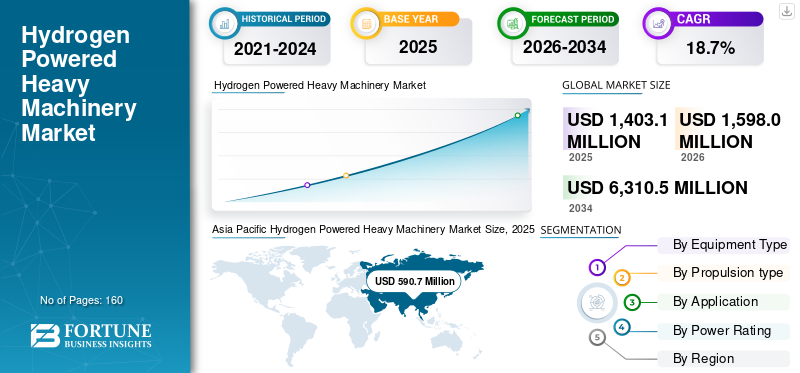
The global hydrogen powered heavy machinery market size was valued at USD 1,403.1 million in 2025. The market is projected to grow from USD 1,598.0 million in 2026 to USD 6,310.5 million by 2034, exhibiting a CAGR of 18.7% during the forecast period. Asia Pacific dominated the hydrogen powered heavy machinery market with a market share of 42.1% in 2025.
The market is experiencing consistent growth due to the growing consideration of hydrogen-powered heavy machinery by the construction industry, mining companies, logistics, warehousing industries, and municipal fleet operators to mitigate their reliance on diesel fuels, emissions, and achieve sustainability goals. Market growth is fueled by the growing need for low-emission heavy-duty machinery, the pressure to decarbonize off-highway operations, and the need for cleaner machinery in areas where environmental emissions matter, such as warehouses, ports, urban construction sites, underground mining, and industrial settings. The growing emphasis on minimizing local emissions has been a significant driver for the growth of the hydrogen-powered heavy machinery market since operators need alternatives that deliver high power outputs, long operating periods, and quick refueling capacities.
It helps to reduce on-site emissions when compared to regular diesel-powered machines. Hydrogen fuel cell machinery uses an electrochemical reaction to generate energy, producing mostly water vapor while in operation, thereby making it ideal for situations requiring clean propulsion type. While hydrogen internal combustion engine machinery is not zero-emission propulsion type as it releases nitrogen oxides during the combustion process, it significantly lowers carbon emissions when compared to diesel-powered machinery. The major companies involved, including Toyota Material Handling, JCB, XCMG, SANY Group, Liebherr, Hangcha Group, and Doosan Bobcat, are aggressively adopting hydrogen fuel cell propulsion type, hydrogen combustion engines, and hydrogen-powered heavy machinery to achieve improved sustainability outcomes and increase their competitiveness in the market. In the long run, rising availability of green hydrogen, development of refueling infrastructure, and higher usage of heavy machinery with lower emissions will drive market growth.
Download Free sample to learn more about this report.
Hydrogen Powered Heavy Machinery Market KEY TAKEAWAYS
 Global Market Size & Forecast
- 2025 Market Size: USD 1,403.1 million
- 2026 Market Size: USD 1,598.0 million
- 2034 Forecast Market Size: USD 6,310.5 million
- CAGR: 18.7% from 2026–2034
 Market Share
- Asia Pacific dominated the hydrogen powered heavy machinery market with a 42.1% share in 2025.
- The hydrogen fuel-cell electric segment is projected to grow at the fastest CAGR of 19.4% during the forecast period.
- The forklifts segment is projected to grow at the fastest CAGR of 20.2% during the forecast period.
 Key Regional Highlights
Asia Pacific
Asia Pacific reached USD 675.8 million in 2025, driven by hydrogen mobility and decarbonization initiatives.
North America
North America reached USD 466.9 million in 2026, supported by rising adoption of hydrogen fuel-cell forklifts.
Europe
Europe reached USD 349.2 million in 2026, driven by strict emission regulations and climate policies.
U.S.
U.S. reached USD 389.7 million in 2026, fueled by growing deployment of hydrogen fuel-cell forklifts.
Japan
Japan reached USD 152.0 million in 2026, driven by strong government support for hydrogen technologies.
Read More

HYDROGEN POWERED HEAVY MACHINERY MARKET TRENDS
Tightening of Emission Standards Pushing Operators to Adopt Hydrogen-Powered Equipment
The market is experiencing growing demand for advanced equipment technologies as government agencies and local governments are raising the bar on emission standards applicable in construction sites, factories, storage facilities, ports, and municipal fleet operations. Diesel engines have been under growing scrutiny for their role in generating air pollution and contributing to greenhouse gases. Hydrogen engine propulsion type offers a solution for operators who wish to meet emission reduction targets without compromising on performance levels.
- For instance, California's adoption of the Zero-Emission Forklift Regulation starting January 2025 will aid the demand for hydrogen-fueled material handling equipment. This regulation aims to motivate forklift operators to switch their use of traditional forklifts to zero-emissions vehicles, such as hydrogen fuel cell powered forklifts.
MARKET DYNAMICS
MARKET DRIVERS
Download Free sample to learn more about this report.
Shifting Focus Toward Sustainable Heavy-Duty Operations is Driving Adoption of Hydrogen-Powered Heavy Machinery
Hydrogen-powered equipment is gaining attention as it can support long operating hours, high power output, and fast refueling while helping operators meet sustainability and decarbonization goals. Hydrogen fuel cell machines operate on clean or no emissions, whereas hydrogen combustion engines can produce less direct carbon dioxide emissions than diesel machines, thereby gaining more traction. The increased demand for clean heavy-duty operations has added value to hydrogen-based machines in applications where emissions are critical, such as warehouses, ports, urban building sites, underground mines, and factories. In particular, logistics and warehousing operators are adopting hydrogen fuel-cell material-handling equipment due to its fast refueling capability, consistent power output, and suitability for multi-shift operations. To support this shift, the companies are introducing newer heavy machinery to offer better outcomes.
- In 2025, Toyota Material Handling Europe and Plug Power joined hands to bring H2 forklift and fuel cell solutions to cold storage distribution centers
MARKET RESTRAINTS
High Equipment Cost and Technological Complexity are Limiting Adoption
The high initial cost may act as a constraint on the use of hydrogen propulsion type for heavy machinery. The hydrogen fuel cells, hydrogen tank storage, hydrogen-specific engine, and safety system increase the price of such vehicles compared to diesel vehicles. Moreover, a hydrogen vehicle may require hydrogen refueling facilities that can increase the installation costs for such machinery. Therefore, the adoption may be low for small-scale fleet owners unless the machinery is affordable.
MARKET OPPORTUNITIES
Expansion of Green Hydrogen Infrastructure Is Creating Growth Opportunities
Green hydrogen infrastructure development is likely to provide potential for the hydrogen powered heavy machinery market growth. With improved propulsion type in hydrogen production, storage, and refueling, use of hydrogen fueled machines is likely to become feasible within construction sites, mining sites, warehouses, ports, and airports among other places. A centralized environment is particularly favorable since a refueling station is installed for several machines to be operated using the same source of fuel.
Segmentation Analysis
By Equipment Type
Forklifts Segment Held the Largest Share Due to High Demand for Advanced Process Monitoring
Based on the equipment type, the market is divided into excavators, loaders, backhoe loaders, telehandlers, haul trucks & dump trucks, forklifts, and others.
In 2025, the forklifts segment accounted for the highest hydrogen powered heavy machinery market share due to the growing demand of the segment across the transportation and logistics industry. Hydrogen energy is more beneficial to forklifts rather than to bigger equipment due to the fact that they are normally deployed in fixed site applications that require high utilization, such as warehouses, logistics facilities, ports, and industrial production sites. As such, it will be relatively simple and inexpensive to provide hydrogen refueling since only a single refueling station is needed to refuel all the forklifts. The difference is that forklifts require less energy compared to excavators, loaders, backhoes, telehandlers, haul trucks, and dump trucks.
The forklifts segment is anticipated to rise with a CAGR of 20.2% over the forecast period.
To know how our report can help streamline your business, Speak to Analyst
By Propulsion Type
Hydrogen Fuel-Cell Electric Systems Led the Market Due to Improved Efficiency and Cleaner Performance
Based on the propulsion type, the market is segmented into hydrogen fuel-cell electric, hydrogen internal combustion engine, and hydrogen hybrid systems.
In 2025, the hydrogen fuel-cell electric segment accounted for the highest market share and is projected to grow at fastest CAGR over the forecast period. Hydrogen fuel cell-based hydrogen power systems have an even greater edge over hydrogen-based internal combustion engines and hydrogen-based hybrid systems due to their relatively cleaner performance, improved efficiency, and regulatory compliance. Fuel cells based on hydrogen are superior to hydrogen hybrid systems since they provide a cleaner energy source and have a better track record in the commercial market in material handling equipment.
The hydrogen fuel-cell electric segment is expected to grow at a CAGR of 19.4% over the forecast period.
By Application
Logistics & Warehousing Segment Held the Largest Share Due to Growing Usage in Transportation Industry
Based on the application, the market is segmented into logistics & warehousing, construction, mining & quarrying, agriculture, waste management & municipal services, and others.
In 2025, the logistics & warehousing segment accounted for the highest market share due to wider commercial adoption of hydrogen fuel-cell forklifts and material-handling equipment. Warehouses, logistics centers, ports, and manufacturing sites have fleets of forklift trucks that are stationary in one place, thus making the installation of hydrogen refueling stations much simpler. For the purposes of multiple shifts, hydrogen forklifts refuel quickly and constantly while being more reliable than their battery-operated counterparts. Another advantage of this market is a high need for environmentally friendly conditions in enclosed spaces.
The logistics & warehousing segment is expected to grow at a CAGR of 19.8% over the forecast period.
By Power Rating
Below 50 kW Segment Held the Largest Share Due to Lower Cost
Based on the power rating, the market is segmented into below 50 kW, 50-200 kW, and above 200 kW.
Hydrogen power machines that are below 50 kW are more preferred than those above 50 kW. This is due to their relatively low costs, ease of fuel cell incorporation, and better appropriateness for light material handling applications. Such equipment includes light forklifts, pallet trucks, compact utility machines, and light-duty vehicles, and has lower hydrogen fuel capacity than the 50 kW to 200 kW, and more than 200 kW categories, and thus is easier to develop and commercialize.
The below 50 kW segment is expected to grow at a CAGR of 19.5% over the forecast period.
Hydrogen Powered Heavy Machinery Market Regional Outlook
By region, the market is categorized into Europe, North America, Asia Pacific, South America, and the Middle East & Africa.
Asia Pacific
Asia Pacific Hydrogen Powered Heavy Machinery Market Size, 2025 (USD Million)
To get more information on the regional analysis of this market, Download Free sample
Asia Pacific held the dominant position in the market in 2024 and continued to lead in 2025, with a market valuation of USD 675.8 million. The region’s dominance is driven by the presence of large equipment manufacturers in China, Japan, and South Korea, along with increasing governmental support for hydrogen mobility and decarbonization.
Japan Hydrogen Powered Heavy Machinery Market
The Japan market in 2026 is estimated at around USD 152.0 million, accounting for roughly 9.51% of global revenue.
China Hydrogen Powered Heavy Machinery Market
The China market in 2026 is estimated at around USD 205.5 million, accounting for roughly 12.86% of global revenue.
India Hydrogen Powered Heavy Machinery Market
The India market in 2026 is estimated at around USD 63.1 million, accounting for roughly 3.95% of the global market.
North America
North America’s market is projected to reach USD 466.9 million in 2026. The region holds a significant share due to rising adoption of hydrogen fuel-cell forklifts across warehouses, distribution centers, and manufacturing facilities.
U.S. Hydrogen Powered Heavy Machinery Market
The U.S. market in 2026 is estimated at around USD 389.7 million. The U.S. market is driven by strong adoption of hydrogen fuel-cell forklifts across warehouses, distribution centers, and manufacturing facilities.
Europe
Europe market in 2026 is estimated at around USD 349.2 million. Europe demonstrates steady growth supported by strict emission regulations, strong climate policies, and increasing pressure to reduce diesel use in construction, logistics, ports, and municipal operations.
U.K. Hydrogen Powered Heavy Machinery Market
The U.K. market in 2026 is estimated at around USD 76.6 million, representing roughly 4.79% of global revenues.
Germany Hydrogen Powered Heavy Machinery Market
Germany’s market is projected to reach USD 104.1 million in 2026, equivalent to around 6.52% of global sales.
South America and Middle East & Africa
South America and the Middle East & Africa regions are anticipated to experience moderate growth in this market over the forecast period. South America is projected to reach a market value of USD 44.9 million by 2026. South America is expected to witness gradual growth during the forecast period, as it is emerging as mining, agriculture, ports, and industrial operators seek cleaner alternatives to diesel-powered machinery. Meanwhile, the Middle East & Africa market is expected to attain a value of USD 38.7 million by 2026. The Middle East & Africa region is projected to grow steadily, supported by favorable cleaner operations in mining sites, industrial zones, logistics hubs, and construction projects, especially as regional hydrogen production capacity expands.
GCC Hydrogen Powered Heavy Machinery Market
The GCC market is projected to reach around USD 23.3 million in 2026, representing roughly 1.46% of the global market.
COMPETITIVE LANDSCAPE
Key Industry Players
Key Industry Players Focus on Advanced Defect Detection and AI-Driven Equipment Technologies to Strengthen Market Position
The market shows a reasonable level of consolidation, where dominant firms are concentrating on developing AI-based inspection systems, advanced defect detection systems, automated equipment platforms, and precision monitoring systems to gain competitive advantage. Major vendors have been incorporating technologies like machine vision, deep learning techniques, real-time image processing, sensor-based inspection, and automatic quality control systems in their equipment for better detection of defects and enhanced performance.
Increasing competition in the market can be attributed to technology innovations, new product offerings, collaboration initiatives, and the growing intelligent equipment portfolio of market vendors. With end-user demands for rapid inspection, higher accuracy, reduced defects, and enhanced operations visibility becoming critical, vendors are gaining a foothold in the market by offering intelligent and automated equipment products.
LIST OF KEY HYDROGEN POWERED HEAVY MACHINERY COMPANIES PROFILED
- Toyota Industries Corporation (Japan)
- Hyster-Yale Materials Handling, Inc. (U.S.)
- Linde Material Handling GmbH (Germany)
- Hangcha Group Co., Ltd. (China)
- Doosan Bobcat Inc. (South Korea)
- XCMG Group (China)
- JCB (U.K.)
- SANY Group (China)
- Liebherr Group (Germany)
- Ballard Power Systems (Canada)
KEY INDUSTRY DEVELOPMENTS
- January 2025: JCB secured approvals from licensing authorities for its hydrogen combustion engine, allowing the engine to be used commercially in construction machinery and supporting the company’s shift toward low-emission heavy equipment.
- June 2024: XCMG launched the EHSL552F hydrogen fuel-cell dump truck, equipped with a 120 kW hydrogen fuel cell and high-power battery system for large-scale transportation projects such as mining operations.
- June 2024: Liebherr unveiled the L 566 H hydrogen-powered large wheel loader, developed with a hydrogen combustion engine to support low-emission construction equipment applications.
- February 2024: Doosan Bobcat introduced its 3-ton hydrogen fuel-cell forklift and planned the supply of 30 hydrogen forklifts in 2024 to support commercialization of hydrogen-powered material-handling equipment.
- September 2022: Toyota Material Handling, Japan launched a new fuel-cell lift truck with reduced fuel-cell system cost, improved durability, and hydrogen refueling capability in around three minutes to support hydrogen adoption in logistics operations
REPORT COVERAGE
The global hydrogen powered heavy machinery market analysis includes a comprehensive study of the market size & forecast by all the market segments included in the report. It includes details on the market dynamics and market trends expected to drive the market over the forecast period. It provides information on key aspects, including an overview of technological advancements, pipeline candidates, the regulatory environment, and product launches. Additionally, it details partnerships, mergers & acquisitions, as well as key industry developments and prevalence by key regions. The global market research report also provides a depth competitive landscape with information on the market share and profiles of key operating players.
Request for Customization to gain extensive market insights.
Report Scope & Segmentation
| ATTRIBUTE | DETAILS |
| Study Period | 2021-2034 |
| Base Year | 2025 |
| Estimated Year | 2026 |
| Forecast Period | 2026-2034 |
| Historical Period | 2021-2024 |
| Growth Rate | CAGR of 18.7% from 2026-2034 |
| Unit | Value (USD Million) |
| Segmentation | By Equipment Type, Propulsion type, Application, Power Rating, and Region |
| By Equipment Type |
|
| By Propulsion Type |
|
| By Application |
|
| By Power Rating |
|
| By Region |
|
Frequently Asked Questions
According to Fortune Business Insights, the global market value stood at USD 1,403.1 million in 2025 and is projected to reach USD 6,310.5 million by 2034.
In 2026, the market is projected to reach USD 466.9 million.
The market is expected to exhibit a CAGR of 18.7% during the forecast period.
By power rating, the below 50 kW segment is expected to lead the market.
The market is driven by increasing demand for low-emission heavy-duty equipment, coupled with rising sustainability and decarbonization targets.
Toyota Industries Corporation, JCB, XCMG Group, and Doosan Bobcat Inc. are the major players in the global market.
Asia Pacific dominated the market in 2025.


- 2021-2034
- 2025
- 2021-2024
- 160
Get 30-60 hrs Free Customization
Expand Regional and Country Coverage, Segments Analysis, Company Profiles, Competitive Benchmarking, and End-user Insights.














Related Reports
-
US +1 833 909 2966 ( Toll Free )
-
Get In Touch With Us