Identification Friend or Foe Market Size, Share & Industry Analysis, By Technology (Electronic IFF, Infrared IFF, and Radio Frequency IFF), By Application (Military Platforms, Civilian Air Traffic Control, and Defense Systems), By Platform (Airborne, Land-Based, Naval, and Space-Based), By System Type (Transponders, Interrogators, and Control Panels), By Frequency Range (Low Frequency (Below 30 MHz), High Frequency (3-30 MHz), and Ultra High Frequency (300-3000 MHz), By End User (Defense Forces and Commercial Airlines), and Regional Forecast, 2026-2034
 Download Free Sample
Identification Friend or Foe Market Size
 Listen to Audio Version
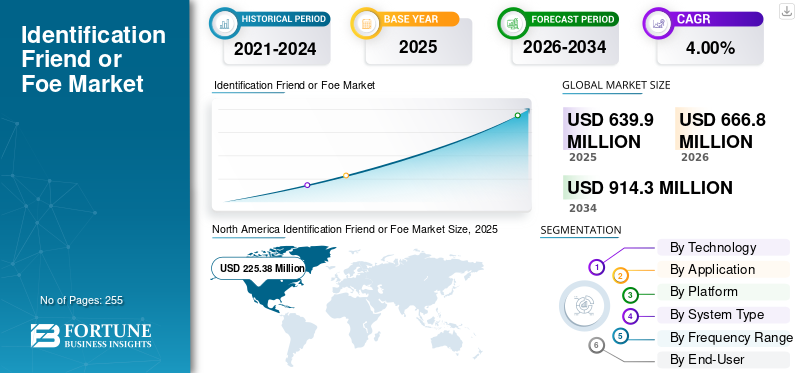
The global identification, friend or foe market size was valued at USD 639.9 million in 2025. It is projected to grow from USD 666.8 million in 2026 to USD 914.3 million by 2034, exhibiting a CAGR of 4.00%. North America dominated the identification, friend or foe market with a market share of 35.20% in 2025.
Identification Friend or Foe (IFF) systems encompass a range of technologies designed to enhance military and civilian air traffic control by positively identifying friendly forces. These systems utilize advanced technologies such as software-defined radios, which enable flexible and secure communication protocols, to improve the accuracy and reliability of identification processes. By enhancing situational awareness, IFF systems play a critical role in preventing friendly fire incidents and ensuring operational safety in complex environments.
IFF systems are typically installed on friendly aircraft, vehicles, or personnel to provide real-time identification data, distinguishing them from potential threats. These systems emit signals between manned and unmanned platforms, facilitating secure communication and identification across various domains. The use of IFF systems is essential for maintaining operational security and ensuring the safety of military and civilian assets in both national defense and air traffic control contexts.
In the broader market, IFF systems are evolving to meet the demands of modern warfare and air traffic management, with ongoing advancements in encryption, digital architectures, and interoperability standards like Mode 5. This evolution supports the integration of IFF technologies into diverse platforms, from aircraft to ground-based systems, to provide comprehensive situational awareness and enhance combat identification capabilities.
The Identification Friend or Foe (IFF) market is experiencing significant growth, fueled by the need to distinguish between friendly and hostile forces, thereby reducing the risk of friendly fire in military operations. It includes various technologies, including transponder-based systems and advanced GPS solutions, which are used in military and commercial aviation applications. With increasing global defense budgets and the growing need for improved situational awareness, the IFF market is witnessing significant growth, particularly in North America, Europe, and the Asia Pacific regions.
Additionally, technological advancements, particularly in terrestrial and aerial IFF systems, are also fueling market growth and making systems more efficient and reliable. However, the market faces challenges, such as high implementation costs and integration issues among different systems. Key players such as Raytheon Technologies and BAE Systems are focused on research and development to improve IFF technologies and actively innovate solutions to address these challenges, enhance system efficiency, and expand their global presence. These factors position the market for continued growth in the coming years.
For Instance, in January 2019, the U.S Navy Air Warfare Center Aircraft awarded Telephonics contract worth USD 15.1 million contract for a maximum of 50 AN/UPX-43(V)1 Identification Friend or Foe Interrogators, 50 IFFI mounting trays, and repairs in support of P-8A Poseidon production lots 9,10, and 11.
Download Free sample to learn more about this report.
Identification Friend or Foe Market KEY TAKEAWAYS
 Global Market Size & Forecast
- 2025 Market Size: USD 639.9 million
- 2026 Market Size: USD 666.8 million
- 2034 Forecast Market Size: USD 914.3 million
- CAGR: 4.00% from 2026–2034
 Market Share
- North America dominated the identification, friend or foe market with a 35.20% share in 2025.
- Military Platform segment accounted for the largest market share in 2026.
- Electronic IFF segment is projected to hold a 72.44% share in 2026.
 Key Regional Highlights
Asia Pacific
Asia Pacific reached USD 140.8 million in 2025, driven by defense modernization and rising military spending.
North America
North America accounted for USD 225.38 million in 2025, supported by higher defense investments and IFF adoption.
Europe
Europe captured 28.90% of the global market in 2025, driven by military modernization and surveillance upgrades.
U.S.
The market is projected to reach USD 192.07 million by 2026, fueled by next-generation defense system investments.
Japan
The market is projected to reach USD 22.54 million by 2026, supported by defense modernization initiatives.
Read More

Market Dynamics
Market Drivers
Increasing Defense Budgets and Modernization of Military Operations Programs to Propel Market Growth
Countries are focusing on modernizing their military capabilities due to increasing geopolitical tensions, leading to significant increase in defense expenditures to improve military capabilities. Ongoing conflicts are driving military modernization efforts, creating a global requirement for upgrading exciting IFF systems to counter emerging threats and operational requirements. This program includes the integration of IFF systems with unmanned aerial vehicles and other defense systems. Leading companies in the identification friend or foe systems market, such as BAE Systems Plc., Elbit Systems Ltd., General Dynamics, and others, are actively developing innovative products to improve their strategic position in the market.
For instance, in April 2019, the U.S. Air Force awarded General Dynamics a contract worth USD 20.2 million for the KIV-78 mode 4/5 cryptographic IFF system. This contract involves various units and support for U.S. and foreign military sales, improving the avionics capabilities of military aircraft with secure IFF systems.
A major trend in the identification friend or foe system market is research and development efforts to enhance the efficiency and reliability of the system. Leading companies in this sector are actively developing cutting-edge technologies to maintain their positions in the market. For instance, in September 2024, BAE Systems is working on redesigning a Mode 5-capable common IFF digital transponder as part of their efforts to modernize military identification systems. The program aims to improve performance and ensure compatibility with current military standards.
Market Restraints
Technical Challenges and Regulatory Hurdles to Restrain Market Growth
The integration of advanced technologies into existing military systems presents significant challenges, as these systems are highly complex and need specialist support. Moreover, integrating this complex IFF requires support from specialized mechanics, which adds up to more initial costs and hinders the initial program budget.
Additionally, IFF systems must comply with stringent international standards and regulations to ensure compliance among allied forces. Navigating these complex regulatory frameworks can delay deployment and increase costs, particularly for manufacturers aiming to supply systems to multiple countries, as regulatory requirements can vary country-wise.
As IFF systems become more advanced and interconnected, they are increasingly subject to cyber threats. Protecting these systems from hacking, jamming, and other forms of electronic warfare is important. However, implementing robust cyber security measures adds complexity and cost, potentially hindering the identification friend or foe market growth.
Market Opportunities
Technological Advancements and Integration with UAVs to Present Significant Growth Opportunities
Drone threats are becoming more prevalent, resulting in the increasing demand for advanced IFF systems capable of identifying unmanned aerial vehicle threats. Innovative solutions that enhance security against such threads have been a key factor in market growth. Moreover, emerging markets are increasingly investing in defense capabilities, presenting opportunities for IFF systems providers to expand their reach and develop innovative solutions to meet evolving needs.
Additionally, partnerships between defense contractors and tech companies are leading the development of next-generation IFF systems. For Instance, in July 2023, the Naval Surface Warfare Center Panama and Sagetech Avionics, Inc. entered into a cooperative research and development agreement. This partnership aims to integrate advanced IFF capabilities into unmanned aircraft systems, improving the identification process and operational safety of Unmanned Aerial System (UAS) in military applications.
The combination of AI and ML allows in IFF systems enables predictive maintenance, reduced time, and increased operational readiness. For Example, in January 2025, British startup Faculty AI is developing AI technology for military drones, focusing on applications such as subject identification and object tracking for UAVs.
Identification Friend and Foe Market Trends
Integration with Unmanned Systems to Improve Safety Drive Market Growth
There is a growing trend toward integrating IFF capabilities with unmanned platforms to improve mission efficiency and safety in complex operational environments. The integration of IFF with unmanned systems allows for better coordination between manned and unmanned during conflicts. For Instance, in February 2022, Ultra Electronics successfully deployed its Hawk IFF system during the U.S. Army Maneuver and Fires Integration Experiment at Fort Sill, Oklahoma. Integrated into a UAS in partnership with Berry Aviation Inc., the Hawk IFF demonstrated the capability to quickly identify blue force UASs, thereby enhancing the effectiveness of Counter-UAS systems.
Additionally, technological advancements in material science and data processing are driving the improvements in IFF system accuracy and digital integrations. For instance, in September 2024, the U.S. Navy awarded BAE systems contract worth USD 19 million to design and implement the UPX-24 target data processor. This upgrade aims to provide advanced digital interrogator capabilities, improving the ability to identification of friendly or hostile forces.
For Instance, in June 2024, Sweden awarded Saab a contract worth USD 246 million to deliver a third GlobalEye AEW&C aircraft. The GlobalEye system provides long-range detection and identification across air, sea, and land domains, delivering real-time intelligence to military units.
Download Free sample to learn more about this report.
Impact of Russia-Ukraine War
Rising Geopolitical Tensions are Influencing Market Growth amid the Russia-Ukraine War
The ongoing conflict between Russia and Ukraine had a significant impact on the global Identification of Friend or Foe market. This impact can be analyzed through various parameters, including its implications on global military procurement and modernization programs.
Increased Defense Spending and Demand for Substantial Investment in Advanced IFF Systems: -
The conflict has shown the importance of identification technologies to prevent friendly fire incidents and improve situation awareness. Due to this, militaries worldwide are now prioritizing upgrades to IFF systems, particularly those with advanced modes such as Mode 5, which offer encrypted identification and enhanced security. For Instance, NATO allied forces are advancing IFF modernization programs; in August 2024, NATO’s AWACS aircraft conducted operations controlling Swedish Air Force fighter jets in Swedish airspace and demonstrating improved integration and interoperability between NATO and Sweden.
Integration with Modern Warfare Technologies: -
The war has increased the pace of integrating IFF systems with advanced technologies such as UAVs, electronic warfare systems, Artificial Intelligence (AI) and machine learning. For instance, in February 2021, uAvionix launched an Identification Friend or Foe solution for small tactical UAVs. The system is designed to provide enhanced situational awareness and reduce fratricide in UAVs operations.
Challenges in Urban and Hybrid Warfare and Disturb the Supply Chain: -
The Russia-Ukraine conflict involves both conventional and hybrid warfare, where combat zones often are the civilian areas. This makes IFF systems even more important, as they identify UAS, distinguishing combatants from non-combatants, and function effectively in electronic warfare environment.
Due to sanctions on Russia and geopolitical tensions, the conflict has disrupted the global supply chain for defense equipment, including IFF components. This has resulted in disruption in production and increased spare part costs. To tackle this situation, manufacturers are taking proactive measures to reduce dependence on disrupted supply chains. For instance, in September 2024, Saab announced plans to set up production in Ukraine to support the development of the country’s independent defense capabilities.
SEGMENTATION ANALYSIS
By Technology
Electronic IFF Segment Dominated the Market Owing to Enhanced Security and Adaptability
Based on technology segment, the market is classified into Electronic IFF, Infrared IFF, and Radio Frequency IFF.
In 2026, Electronic IFF dominated the segment with a market share of 72.44%. The rising incidence of electronic attacks has increased the demand for electronic IFF systems, which have capabilities to handle and identify the attack mode, especially in high-tech and integrated warfare environments. These systems include technologies such as Mode 5 and Mode S transponders, which offer encrypted communication, enhanced security, and real-time data exchange capabilities. Additionally, modern radar systems, ground control stations, and other defense networks ensure that electronic IFF provide reliable and efficient identification systems. Moreover, electronic IFF systems are adaptable to evolving threats, making them the ideal choice for modern defense forces globally.
For instance, in September 2024, the U.S. Naval Air Systems Command awarded BAE Systems a USD 30 million contract to redesign the identification friend or foe digital transponder to address component obsolescence and improve system reliability.
The Radio Frequency IFF segment is experiencing the fastest growth, with the highest CAGR during the forecast period. The growth is propelled by its important role in integrating unmanned aerial vehicles and autonomous platforms into defense networks. Additionally, advancements in RF signal processing, such as improved range and accuracy, further propel the adoption in military applications. The increasing adoption of RF IFF systems in emerging markets and their cost-effectiveness compared to complex electronic systems result in the segment's fast growth.
For instance, in September 2024, Viasat announced its VRG-1000 Radio Frequency Generator received recertification from the Department of Defense AIMS program office. The VRG-1000 is designed to reduce IFF certification testing times from weeks to hours, streamlining the testing process for defense applications.
By Application
Military Platforms Segment Dominated the Market Owing to Continuous Technological Upgrades
By application, the market is segmented into military platforms, civilian air traffic control, and defense systems.
In 2026, Military Platform dominated the segment with a market share of 63.58%. Military platforms include combat airborne platforms, naval vessels, and ground forces platforms, which play an essential role in modern warfare. These platforms are used in different and high-threat environments where correct identification is important to prevent injuries in friendly fire incidents and ensure mission success. Airborne platforms such as fighter jets and surveillance aircraft rely on IFF systems for real-time identification during combat and inspection missions. The widespread deployment of these platforms across various regions and continuous upgrades with advanced warfare technologies further strengthen this segment dominance in the market.
For Instance, in September 2024, Indra signed a framework agreement with the Spanish Ministry of Defense to upgrade the country's ground-based air defense systems. This modernization involves integrating advanced identification friend or foe technology, improving the Spanish army's ability to identify potential threats.
The defense systems segment is experiencing the fastest growth, with the highest CAGR. Defense systems include missile defense systems and coastal surveillance applications due to increasing demand for advanced security solutions in response to rising geopolitical tensions and evolving aerial and maritime threads. The growing focus on developing integrated, automated, and AI-based defense systems to counter emerging threads, such as hypersonic missiles and drones, is further driving the adoption of IFF technologies in this segment.
By Platform
Airborne Platform Segment Showcases Highest CAGR Owing to Technological Advancements in the Demand for IFF Systems
By platform, the market is segmented into platform airborne, land-based, naval, and space-based.
In 2026, Airborne dominated the segment with a market share of 56.09%. This growth is attributed to the growing utilization of military aircraft due to their versatility and operational flexibility in missions such as ISR, troop and cargo transport, and close air support. Additionally, next-generation airborne platforms are equipped with state-of-the-art IFF technology are being developed to enhance operational competence and efficiency. Recent advancements, including better radar capabilities and integration with electronic warfare systems, further propel market growth.
For instance, in October 2024, the U.S. State Department approved a foreign military sale to Italy worth USD 680 million for the electronic attack (EA)-37B mission system. The package includes the System Control and Monitoring Systems, KIV-77 Mode 4/5 systems, AN/PYQ-10C simple key loaders, and other essential equipment.
The space-based segment is experiencing the fastest growth, with highest CAGR. As space-based military strategy gain prominence, investments in space-based IFF systems are growing rapidly. These systems provide extra coverage, enhancing situational awareness and critical data for decision-making. Rising geopolitical tensions and ongoing conflicts have driven nations to explore space-based solutions for long-range surveillance and reconnaissance purposes. Additionally, the collaboration between government bodies and private aerospace firms is fueling the advancements in space-based IFF technology. This has resulted in driving innovation, reducing costs, and improving the overall reliability and efficiency of space-based IFF systems.
To know how our report can help streamline your business, Speak to Analyst
By System Type
Transponder Segment Dominates the Market due to Technological Advancements
By system type, the market into transponders, interrogators, and control panels.
In 2026, Transponders dominated the segment with a market share of 61.26%, fueled by the increasing application of Mode 4/5 transponders and Mode S transponders in military applications. Transponders play an important role in military aviation and naval operations by ensuring accurate identification of friendly forces. The demand for advanced transponder systems that seamlessly integrate with modern aircraft and naval vessels further propels market growth. The ongoing development of transponder technologies, such as Mode 5 IFF systems, has improved data processing, increased operational range, and better resistance to jamming techniques, making transponders a vital part of the IFF systems.
For instance, in May 2024, uAvionix collaborated with R Cubed Engineering to achieve AIMS Mk XIIB certification for the RT-2087/ZPX-1, the World's first certified Mode 5 Micro-IFF combined Transponder Receiver and the first Mode 5 CTR integrated with the new KIV-79.
Control panels are experiencing rapid growth due to their ability to integrate with advanced IFF systems and other command and control technologies. The rise in global military expenditures has led to investments in extensive research and development for future systems and modernized command and control infrastructures, improving operational efficiency and decision-making processes. For Instance, in July 2022, the Norwegian armed forces awarded Hensoldt a contract worth USD 15 million to deliver upgraded Identification-Friend-or-Foe technology. Under this contract, Hensoldt delivered MSSR 2000ID secondary radars and LTR400 DNG transponders, including cryptographic and test equipment.
By Frequency Range
Ultra High-Frequency Segment Experiences Fastest Growth Propelled by its Effectiveness in Urban Environments
By frequency range, the market is divided into Low-Frequency (LF) (Below 30 MHz), High-Frequency (HF) (3-30 MHz), and Ultra-High-Frequency (UHF) (300-3000 MHz).
High-Frequency (HF) segment from three to thirty MHz dominates the market, driven by its widespread adoption across military, naval, and commercial aviation applications. High-frequency systems provide a reliable and effective solution for communication over long distances, which plays a vital role in military applications. HF systems have been widely used for a long time, making them trusted choices in identification and communication in various operations, including challenging terrains where other frequency bands may face limitations.
For instance, in February 2023, the U.S. Navy awarded a Curtiss-Wright contract worth USD 8.7 million contract to enhance identification of friends or foes capabilities. Through this contract, Curtiss-Wright would deliver a single-board computer for the AN/UPX-24(V) IFF processor sets, supporting navy operations.
The Ultra-High-Frequency (UHF) segment (300-3000 MHz) is experiencing the fastest growth, fueled by the increasing demand for advanced data transmission capabilities and enhanced identification resolution. UHF systems offer advantages such as data rate, shorter wavelengths, and the ability to operate effectively in urban areas where obstacles may disrupt signals. Additionally, the integration of modern technologies, including automated processing and advanced signal encryption, is propelling the demand for new installations and upgrades, particularly in UAS operations and other military platforms
By End User
With Increasing Defense Budgets and Rising Geopolitical Tensions, the Defense Forces Segment Dominates the Market
Based on end user, the market is divided into defense forces and commercial airlines.
The defense forces segment accounted for the largest market share in 2024, propelled by increasing defense budgets and geopolitical tensions, particularly conflicts such as the Russia-Ukraine, which have proved the importance of IFF systems in preventing friendly fire incidents. For instance, in August 2024, Ukraine lost its F-16 in combat operation. The incident highlighted the challenges of coordinating missile interception missions involving fighter jets and air defense batteries. Reports suggest that neither the fight jets nor the ground-based air defense units used IFF during the operation, leading to the loss of the F-16. This incident has reinforced the need for IFF systems in modern warfare, driving demand across various regions.
For instance, in February 2024, the U.S. approved an aerostat sale to Poland contract worth USD 1.2 billion. The contract involves four aerostat systems, airborne early warning radars with identification friend-or-for capabilities, mooring systems, and other electronic surveillance technologies to strengthen Poland’s defense infrastructure.
Supply Chain Analysis
Raw Material Suppliers
- Key Suppliers:
- BAE Systems: Supplies materials for IFF systems and components.
- Raytheon Technologies: Provides advanced materials and electronics systems for IFF solutions.
- Challenges:
- Price Fluctuations: Variations in material costs can affect overall system pricing.
- Supply Disruptions: Geopolitical tensions or natural disasters may lead to shortages.
- Regulatory Compliance: Suppliers must adhere to strict regulations, especially for dual-use materials.
Component Suppliers
- Key Suppliers:
- Elbit Systems: Offers various IFF solutions and technologies for defense applications.
- Harris Corporation: Supplies critical components for IFF systems, including transponders and receivers.
- Challenges:
- Technological Changes: Rapid advancements necessitate continuous innovation from suppliers.
- Quality Assurance: Consistent quality is crucial for system reliability.
- Intellectual Property Protection: Safeguarding proprietary technologies is challenging.
Manufacturers
- Prime Contractors:
- Lockheed Martin Corporation: Integrates IFF technologies into broader defense systems.
- Northrop Grumman Corporation: Develops advanced IFF systems for military applications.
- Challenges:
- Supplier Coordination: Managing multiple suppliers for seamless integration is complex.
- Budget Management: Large projects often overrun budgets due to unforeseen issues.
- Regulatory Adherence: Compliance with international regulations like ITAR complicates project management.
- Tier 1 / Tier 2 Suppliers:
- BAE Systems (Tier 1): Develop Identification Friend or Foe.
- General Dynamics (Tier 2): Provides associated technologies for IFF applications.
- Challenges:
- Specification Changes: Tier suppliers may struggle if prime contractors alter requirements.
- Competitive Pressure: Intense competition can squeeze margins.
- R&D Investment Needs: Continuous investment is necessary to address evolving threats.
Distributors
- Defense Procurement Agencies:
- U.S. Department of Defense (DoD): Oversees military procurement.
- Bundesamt für Ausrüstung, Informationstechnik und Nutzung der Bundeswehr (BAAINBw): Manages German military procurement.
- Direction Générale de l'Armement (DGA): Handles French defense procurement.
- Challenges:
- Procurement Delays: Lengthy processes can affect operational readiness.
- Budget Fluctuations: Changes in defense budgets impact procurement plans.
- Regulatory Navigation: Agencies face complex regulations when acquiring advanced technologies.
- Contractors & System Integrators
- Key Companies:
- L3Harris Technologies, Inc.: Integrates communication and IFF systems integration.
- Challenges:
- Technology Compatibility: Ensuring compatibility among different technologies is difficult.
- Adaptability Requirements: Flexibility is needed to meet changing military needs.
- Quality vs. Cost Balance: Meeting stringent military standards while controlling costs is essential.
- Key Companies:
End Users
- Army Aviation Forces
- Naval Aviation Forces
- Air Forces
Role of ITAR in Supply Chain
- The International Traffic in Arms Regulations (ITAR) significantly influences the supply chain for airborne countermeasures by regulating defense-related exports:
- Impacts:
- Compliance Necessity: Companies must comply with ITAR to prevent unauthorized access to sensitive technologies.
- Collaboration Complications: ITAR compliance complicates international partnerships due to export licensing requirements.
- Cost and Delay Increases: Adhering to ITAR can lead to higher administrative costs and potential delays in product delivery.
Identification Friend or Foe Market Regional Outlook
By region, the market is segmented by region into North America, Europe, Asia Pacific, Middle East & Africa, and Latin America.
North America
North America Identification Friend or Foe Market Size, 2025 (USD Million)
To get more information on the regional analysis of this market, Download Free sample
North America recorded a market size of USD 225.38 Million in 2025, capturing 35.20% of the global market share, and is projected to reach USD 235.17 Million in 2026. The region continues to dominate the market due to increasing defense budgets, military modernization programs, and strong investments in advanced identification systems. Ongoing procurement of next-generation IFF technologies across air, naval, and land-based platforms is supporting regional growth. The U.S. market is projected to reach USD 192.07 Million in 2026.
Europe
In 2025, Europe represented USD 185.0 Million, accounting for 28.90% of the worldwide market, and is projected to grow to USD 191.5 Million in 2026. Market growth is supported by increasing defense collaboration, modernization of military infrastructure, and rising focus on integrated air and missile defense capabilities. Growing investments in advanced surveillance, tracking, and identification technologies are further strengthening demand across the region. The UK market is projected to reach USD 29.22 Million in 2026, while the Germany market is projected to reach USD 33.67 Million in 2026.
Asia Pacific
The Asia Pacific market generated USD 140.8 Million in 2025, representing 22.00% of the global market landscape, and is expected to reach USD 147.8 Million in 2026. Rising military expenditures, defense modernization initiatives, and increasing geopolitical tensions are driving demand for advanced IFF systems throughout the region. Countries such as China, India, Japan, and South Korea are investing heavily in upgrading defense capabilities and strengthening battlefield situational awareness. The China market is projected to reach USD 50.28 Million in 2026, the Japan market is projected to reach USD 22.54 Million in 2026, and the India market is projected to reach USD 21.38 Million in 2026.
Middle East & Africa
Middle East & Africa accounted for USD 58.87 Million in 2025, representing 9.20% of the global market share, and is projected to reach USD 62.08 Million in 2026. Market growth is supported by ongoing military modernization efforts, particularly across GCC countries, and increasing investments in defense technologies aimed at enhancing security and operational effectiveness. Partnerships with global defense companies are also contributing to the adoption of advanced IFF systems.
Latin America
In 2025, Latin America held 4.70% of the global market, reaching a valuation of USD 29.82 Million, and is projected to grow to USD 30.20 Million in 2026. Regional growth is driven by increasing awareness of advanced identification technologies and gradual modernization of defense infrastructure. Countries such as Brazil and Argentina are investing in upgraded defense and surveillance systems, supporting the adoption of modern IFF solutions across military and security applications.
Competitive Landscape
Key Industry Players
Leading Players Are Focusing on Integrating Advanced Technologies into Unmanned Aerial Systems to Increase their Global Presence
The identification friend or foe system market is characterized by a competitive landscape featuring key players such as Lockheed Martin, Northrop Grumman, and BAE Systems. These companies are leveraging advanced technologies, including Artificial Intelligence (AI) and electronic warfare systems, to enhance the effectiveness of their identification solutions against evolving threats such as drones and unmanned aerial vehicles. The increasing geopolitical tensions and military modernization efforts are driving demand for sophisticated identification friend or foe systems across various military platforms.
For instance, in July 2024, the U.S. Navy and Japan awarded Northrop Grumman a USD 1.5 billion contract to deliver E-2D Advanced Hawkeye aircraft. It involves the fully integrated tactical cockpit, an advanced identification friend or for the system, electronic support measures, and a modernized communications and data link suite.
Regional dynamics play a significant role in shaping the competitive environment, with North America leading due to substantial defense budgets and technological advancements, followed by Europe and the Asia Pacific regions. The market is expected to grow robustly as key players continue to innovate and expand their product offerings to meet the increasing demand for effective identification solutions in military operations. Additionally, the integration of IFF technologies and enhancements in aircraft survivability against friendly and hostile fire will drive significant growth in the identification friend or foe system market over the coming years.
LIST OF KEY IDENTIFICATION FRIEND OR FOE COMPANIES PROFILED
- BAE Systems plc (U.K)
- Raytheon Technologies Corporation (the U.S.)
- Thales Group (France)
- Leonardo S.p.A. (Italy)
- ASELSAN A.Ş. (Turkey)
- Northrop Grumman Corporation (the U.S.)
- HENSOLDT AG (Germany)
- Indra Sistemas S.A. (Spain)
- General Dynamics Corporation (the U.S.)
- Elbit Systems Ltd. (Israel)
- Saab AB (Sweden)
- L3Harris Technologies Inc. (the U.S.)
- Textron Inc. (the U.S.)
- General Atomics (the U.S.)
KEY INDUSTRY DEVELOPMENTS
- June 2024- The U.S. Navy awarded BAE Systems a USD 9.1 million contract to build 18 AN/UPX-50(C) digital identification-friend-or-foe (IFF) interrogators for Navy surface warships and land-based sites. The AN/UPX-50(C) digital IFF is an upgraded U.S. Navy Mode 5 level 1 and level 2 and Mode S Interrogators, enhancing identification capabilities.
- June 2024 – Indra signed a framework agreement with the Spanish Ministry of Defence to upgrade Spain's Ground-Based Air Defence System (GBADS) with Mode 5/S IFF radar systems. These systems enhance identification of friendly aircraft and include advanced security features
- July 2023 - BAE Systems received a $15 million contract from the U.S. Navy to deliver its next-generation digital interrogator for maritime vessels. The system provides advanced capabilities with a common modular design and open-system architecture, enabling rapid integration of new technologies through software updates
- July 2022 – Hensoldt had been awarded several contracts worth USD 10.21 million from Israel Aerospace Industries’s ELTA Systems to supply its identification friend or foe products such as monopulse secondary surveillance radar MSSR 2000 ID and monopulse secondary radar (MSR) 1000I system along with test equipment.
- May 2021- The U.S. Navy awarded BAE Systems contract worth USD 18.3 million to provide hundreds of unique identification friend or foe transponders for military aircraft. The contract involves IFF transponders for jet fighter-bombers, helicopters, trainer aircraft, and transport aircraft, improving aircraft identification and combat situational awareness.
- December 2019 – Russia built a NATO Standards Identification Friend or For System for Turkeys S-400 Surface-to-air-missile systems.
REPORT COVERAGE
The report provides a detailed analysis of the market and focuses on important aspects, such as key players, products, applications, and platforms depending on various countries. Moreover, it offers deep insights into the market trends, competitive landscape, market competition, pricing of airborne countermeasures, and market status and highlights key industry developments. Additionally, it encompasses several direct and indirect factors that have contributed to the expansion of the global market in recent years.
Request for Customization to gain extensive market insights.
Report Scope & Segmentation
Report Scope & Segmentation
|
ATTRIBUTE |
DETAILS |
|
Study Period |
2021-2034 |
|
Base Year |
2025 |
|
Estimated Year |
2026 |
|
Forecast Period |
2026-2034 |
|
Historical Period |
2021-2024 |
|
Growth Rate |
CAGR of 4.00% from 2026 to 2034 |
|
Unit |
Value (USD Million) |
|
Segmentation |
By Technology
|
|
By Application
|
|
|
By Platform
|
|
|
By System Type
|
|
|
By Frequency Range
|
|
|
By End-User
|
|
|
By Region
|
Frequently Asked Questions
According to the Fortune Business Insights study, the global market was valued at USD 639.9 million in 2025 and is anticipated to be USD 914.3 million by 2034.
The identification friend or foe market is projected to grow at 4.00% over the forecast period (2026-2034).
The top ten players in the industry are BAE Systems plc, RTX Corporation, Thales Group, Leonardo S.p.A., ASELSAN A.S., HENSOLDT AG, Indra Sistemas S.A., General Dynamics Corporation, Elbit Systems Ltd., Raytheon Technologies, L3Harris Technologies, Textron Inc., General Atomics based on parameters such as Services Portfolio, Regional Presence, and Industry Experience.
North America dominated the global Identification Friend or Foe market report in 2025, with USD 225.38 million, and is anticipated to dominate the market again, estimated to reach USD 235.17 million by 2026.
U.S. dominated the global market in 2025.
Airborne has higher adoption rate among other platforms.



- 2021-2034
- 2025
- 2021-2024
- 255
Get 30-60 hrs Free Customization
Expand Regional and Country Coverage, Segments Analysis, Company Profiles, Competitive Benchmarking, and End-user Insights.




















-
US +1 833 909 2966 ( Toll Free )
-
Get In Touch With Us