India Ethanol Fuel Dispensing Infrastructure Market Size, Share & Industry Analysis, By Infrastructure (Fuel Dispensing Equipment, Storage Infrastructure, Transportation Infrastructure, Blending Infrastructure, and Monitoring & Control Systems), By Fuel Type (E10, E20, E85, and ED95), By Component (Hardware, Software, and Services), By Fuel Station Type (Public Retail, Private, and Dedicated Ethanol Stations), By Storage Capacity (Small, Medium, Large, and Very Large), By End User (Oil Marketing Companies, Private Fuel Retailers, and Transportation Fleets), and Country Forecast, 2026-2034
 Download Free Sample
India Ethanol Fuel Dispensing Infrastructure Market Size and Future Outlook
 Listen to Audio Version
The India ethanol fuel dispensing infrastructure market size was valued at USD 953.75 million in 2025. The market is projected to grow from USD 1,084.58 million in 2026 to USD 3,256.70 million by 2034, exhibiting a CAGR of 14.73% during the forecast period.
The market comprises the network of equipment, facilities, and systems used to store, transport, blend, monitor, and dispense ethanol-blended fuels such as E10 and E20 across the country. The market includes ethanol-compatible fuel dispensers, storage tanks, blending terminals, transportation infrastructure, fuel management systems, and monitoring solutions deployed at refineries, fuel depots, and retail fuel stations. It supports the implementation of India's Ethanol Blended Petrol (EBP) Programme by enabling the safe and efficient distribution of ethanol-blended fuels. The market is driven by investments from Oil Marketing Companies (OMCs), private fuel retailers, and infrastructure providers to expand the ethanol fueling stations' capability nationwide. Increasing investments in the renewable fuel supply chain and expansion of biofuel storage systems are key factors driving the Indian ethanol fuel dispensing infrastructure market share.
- In June 2021, NITI Aayog and the Ministry of Petroleum and Natural Gas (MoPNG) released the "Roadmap for Ethanol Blending in India 2020–25," advancing the target of 20% ethanol blending (E20) from 2030 to 2025–26. The initiative accelerated investments by Oil Marketing Companies (OMCs) in ethanol-compatible fuel dispensers, storage tanks, blending terminals, and transportation infrastructure. It also encouraged automobile manufacturers to develop E20-compatible vehicles, strengthening India's ethanol supply chain while reducing dependence on imported crude oil and supporting the country's energy transition objectives.
Furthermore, Indian Oil Corporation Limited (IOC), Bharat Petroleum Corporation Limited (BPCL), and Hindustan Petroleum Corporation Limited (HPCL) held the majority of the market share due to their broad portfolios and strong brand reputations. Indian Oil Corporation Limited (IOC) is India's largest integrated oil and gas company, engaged in refining, pipeline transportation, marketing of petroleum products, petrochemicals, and alternative energy solutions.
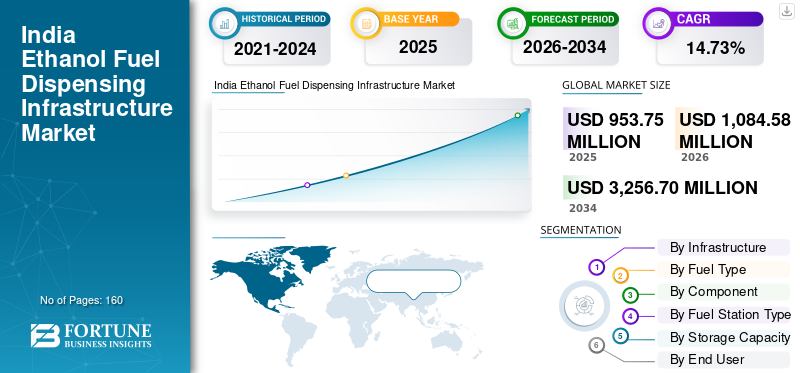
Download Free sample to learn more about this report.
INDIA ETHANOL FUEL DISPENSING INFRASTRUCTURE MARKET TRENDS:
Transition from Conventional Fuel Stations to E20-Ready Smart Fuel Infrastructure is the Key Market Trend
India's ethanol fuel dispensing infrastructure is evolving beyond conventional fuel stations toward E20-ready, digitally connected fueling networks. Oil Marketing Companies (OMCs) are upgrading retail outlets with ethanol-compatible dispensers, corrosion-resistant storage tanks, automated blending systems, and digital fuel management platforms to ensure safe handling of higher ethanol blends.
Fuel depots are increasingly adopting real-time inventory monitoring, tank gauging, and remote operational control to improve efficiency and maintain fuel quality. Simultaneously, investments are shifting toward larger blending terminals and integrated logistics infrastructure capable of supporting higher ethanol throughput.
- In March 2024, Indian Oil Corporation (IndianOil) expanded its ethanol fuel infrastructure by making E20 petrol available at around 12,000 retail outlets within a year of the national E20 rollout while simultaneously launching ETHANOL100 at 183 retail outlets. This expansion required upgrades to ethanol-compatible fuel dispensers, storage tanks, fuel handling systems, and depot infrastructure, demonstrating the industry's shift toward digitally managed, E20-ready fueling networks.
MARKET DYNAMICS
MARKET DRIVERS
Download Free sample to learn more about this report.
Accelerated Expansion of E20 Fuel Distribution Network Across India is Driving Market Growth
India's accelerated rollout of the E20 fuel distribution network is a major driver of the ethanol fuel dispensing infrastructure market. As public and private fuel retailers expand the availability of E20 petrol, substantial investments are being made in ethanol-compatible dispensers, corrosion-resistant storage tanks, blending facilities, and transportation systems. Fuel depots are being modernized with automated blending equipment and digital monitoring technologies to maintain blending accuracy and product quality. Simultaneously, the expansion of grain- and sugarcane-based ethanol production is increasing the need for larger storage capacities and stronger logistics networks. These factors are anticipated to drive the market growth during the forecast period.
- In September 2024, Bharat Petroleum Corporation Limited (BPCL) expanded its E20 petrol dispensing network to 4,279 retail outlets, representing about 18% of its total fuel station network. The expansion included upgrades to ethanol-compatible dispensing equipment and supporting infrastructure to facilitate the supply of E20 fuel. This initiative reflects the increasing investments by Oil Marketing Companies in modernizing dispensing, storage, and blending infrastructure to accelerate the nationwide rollout of ethanol-blended petrol.
|
Rank |
Market Driver |
Overall Impact Rank |
CAGR Growth Contribution |
2026-2028 |
2029-2031 |
2032-2034 |
|
1 |
Expansion of E20 fuel dispensing infrastructure across retail fuel stations |
High |
4.35% |
High |
High |
Medium |
|
2 |
Increasing investments in ethanol storage, blending terminals, and logistics infrastructure |
High |
3.25% |
High |
High |
Medium |
|
3 |
Growth in domestic ethanol production and renewable fuel supply chain |
Medium-High |
2.60% |
Medium |
High |
High |
|
4 |
Modernization of fuel stations through automation, fuel management, and digital monitoring systems |
Medium |
2.10% |
Medium |
Medium |
High |
|
5 |
Rising private sector participation and expansion of biofuel distribution infrastructure |
Medium |
1.70% |
Medium |
Medium |
High |
|
6 |
Others |
Low |
1.30% |
Low |
Medium |
Medium |
|
Total Positive Growth Contribution |
15.30% |
MARKET RESTRAINTS
Feedstock Supply Volatility and Policy-Linked Raw Material Availability to Hamper Market Demand
The market is constrained by fluctuations in the availability of ethanol feedstocks, particularly sugarcane and food grains. Variations in agricultural output, weather conditions, and government measures to balance food security with the biofuel distribution network and production can affect ethanol supply, delaying investments in dispensing stations, storage terminals, and blending infrastructure. Infrastructure developers and Oil Marketing Companies may defer capacity expansion when ethanol availability becomes uncertain, as utilization rates of new assets depend on a reliable fuel supply.
- In August 2024, the Government of India revised its ethanol feedstock policy by permitting the use of sugarcane juice and syrup again for the 2024–25 Ethanol Supply Year, after earlier restrictions imposed during the previous season due to concerns over domestic sugar availability. The policy change highlighted how feedstock availability and regulatory decisions can directly influence ethanol supply planning and infrastructure expansion.
|
Rank |
Market Restraint |
Overall Impact Rank |
CAGR Decline Contribution |
2026-2028 |
2029-2031 |
2032-2034 |
|
1 |
High capital expenditure for upgrading legacy fuel stations, storage tanks, and dispensing equipment to ethanol-compatible infrastructure |
High |
−0.25% |
High |
Medium |
Low |
|
2 |
Variability in ethanol feedstock availability and supply chain disruptions affecting infrastructure utilization |
Medium-High |
−0.18% |
High |
Medium |
Medium |
|
3 |
Technical challenges in retrofitting existing fuel handling infrastructure and ensuring material compatibility with higher ethanol blends |
Medium |
−0.09% |
Medium |
Medium |
Low |
|
4 |
Others |
Low |
−0.05% |
Low |
Low |
Low |
|
Total Negative Growth Contribution |
|
|
−0.57% |
|
|
|
MARKET OPPORTUNITIES
Expansion of Grain-Based Ethanol Corridors and Multi-Feedstock Infrastructure Create Market Opportunities
The expansion of grain-based ethanol production and multi-feedstock distilleries presents a significant opportunity for the India ethanol fuel dispensing infrastructure market growth. As ethanol manufacturing expands beyond traditional sugarcane-producing regions into grain-producing states, demand is increasing for new storage terminals, blending depots, transportation networks, and ethanol-compatible dispensing facilities. This geographical diversification requires additional fuel logistics infrastructure and regional distribution hubs to ensure uninterrupted ethanol supply across the country.
- In March 2025, the Government of India approved an Interest Subvention Scheme for cooperative sugar mills to convert existing distilleries into multi-feedstock ethanol plants capable of processing grains as well as sugar-based feedstocks. The initiative is expected to expand ethanol production capacity, create new regional supply hubs, and stimulate investments in storage, blending, transportation, and fuel dispensing infrastructure to support the growing biofuel ecosystem.
MARKET CHALLENGES
Ensuring Infrastructure Compatibility Across India's Legacy Fuel Retail Network
A key challenge for the market is upgrading the country's extensive legacy fuel retail network to safely handle higher ethanol blends. Many existing fuel stations, storage tanks, pipelines, seals, gaskets, and dispensing components were originally designed for conventional petrol and require material replacement or retrofitting to ensure compatibility with ethanol's hygroscopic and corrosive properties.
- In January 2023, Oil Marketing Companies (IOC, BPCL, and HPCL) commenced the phased rollout of E20 petrol at retail outlets, accompanied by upgrades of dispensing equipment, storage systems, and associated fuel handling infrastructure to ensure compatibility with higher ethanol blends. The phased approach reflected the technical challenge of modernizing existing fuel stations while maintaining uninterrupted fuel supply during the transition.
Segmentation Analysis
By Infrastructure
Fuel Dispensing Equipment Segment Dominated Due to Extensive Nationwide E20 Dispenser Deployment
Based on the segmentation of infrastructure, the market is classified into fuel dispensing equipment, storage infrastructure, transportation infrastructure, blending infrastructure, monitoring & control systems, and others.
In 2025, fuel dispensing equipment segment dominated the market, accounting for 31.20% of the share. Oil Marketing Companies (IOC, BPCL, and HPCL) have prioritized the installation of ethanol-compatible dispensers, nozzles, meters, hoses, and associated dispensing components across their fuel retail networks to meet the government's ethanol blending facilities targets. Every newly upgraded or commissioned E20 outlet requires compatible dispensing equipment, making this segment the largest revenue contributor.
The blending infrastructure segment is expected to grow at a CAGR of 15.72% over the forecast period.
To know how our report can help streamline your business, Speak to Analyst
By Fuel Type
E20 Segment Dominated as it is the Preferred Standard Fuel Infrastructure Investment
Based on the segmentation of the fuel type, the market is classified into E10, E20, E85, ED95, and others.
In 2025, the E20 segment dominated the global market, accounting for 66.07% of the India ethanol fuel dispensing infrastructure market share. E20 has emerged as the preferred fuel specification for new infrastructure investments across the ethanol supply chain. Equipment manufacturers are increasingly designing dispensers, seals, pumps, pipelines, and storage systems specifically for E20 compatibility, making it the benchmark for infrastructure modernization.
The E85 segment is expected to grow at the highest CAGR of 18.82% over the forecast period.
By Component
Hardware Segment Dominated Owing to High Capital Equipment Investment Requirements
On the basis of component, the market is classified into hardware, software, and services.
In 2025, the hardware segment dominated the global market, accounting for 70.47% of market share. Infrastructure deployment depends on ethanol-compatible dispensers, pumps, nozzles, piping systems, valves, storage tanks, blending equipment, flow meters, and safety components, all of which account for the largest share of project costs. Unlike software and services, these assets are mandatory for every new installation and retrofit project.
The software segment is expected to grow at a CAGR of 16.77% over the forecast period.
By Fuel Station Type
Public Retail Fuel Stations Segment Dominated as it Represents the Country's Largest and Most Extensive Fuel Distribution Network
On the basis of fuel station type, the market is classified into public retail fuel stations, private fuel stations, dedicated ethanol stations, fleet fueling stations, and others.
In 2025, the public retail fuel stations segment dominated the global market, accounting for 68.57% of market share. This segment represent the country's most extensive fuel distribution network, serving urban, semi-urban, and rural consumers. Operated primarily by public-sector oil marketing companies, these outlets handle the majority of petrol sales and therefore require continuous investments in ethanol-compatible dispensing systems, storage facilities, and fuel handling equipment.
The dedicated ethanol stations segment is expected to grow at a CAGR of 17.92% over the forecast period.
By Storage Capacity
Medium Capacity (50–200 KL) Segment Led Owing to Optimal Capacity for Depot Operations
On the basis of the segmentation of the storage capacity, the market is classified into small capacity (<50 KL), medium capacity (50–200 KL), large capacity (200–500 KL), and very large capacity (>500 KL).
In 2025, the medium capacity (50–200 KL) segment dominated the global market, accounting for 41.40% of the market share. This capacity range is widely deployed at regional fuel depots, blending facilities, and high-volume retail fuel stations where regular ethanol replenishment minimizes the need for very large storage systems. Medium-capacity tanks are easier to integrate into existing infrastructure, require less land than larger installations, and efficiently support continuous fuel distribution cycles.
The very large capacity (>500 KL) segment is expected to grow at a CAGR of 17.53% over the forecast period.
By End User
Oil Marketing Companies Segment Led Due to Extensive Infrastructure Ownership and Investments
On the basis of the segmentation of the end user, the market is classified into oil marketing companies, private fuel retailers, transportation fleets, industrial users, agricultural sector, and others.
In 2025, the oil marketing companies segment led the global market, accounting for 69.75% of market share. This is as they own and operate the majority of the country's fuel supply chain, including refineries, fuel terminals, blending depots, storage facilities, pipelines, and retail fuel stations. Their integrated operations enable large-scale planning and execution of ethanol infrastructure projects from procurement to final fuel distribution. OMCs also have established engineering capabilities, nationwide logistics networks, and centralized procurement systems, allowing faster deployment of compatible infrastructure and standardized equipment.
- In August 2022, Bharat Petroleum Corporation Limited (BPCL) announced the phased expansion of ethanol storage facilities across its depots and terminals to support the nationwide rollout of E20 petrol by 2025. BPCL also signed 131 Long-Term Offtake Agreements (LTOAs) with ethanol producers and strengthened its multimodal ethanol logistics network to ensure uninterrupted supply to its retail network.
The private fuel retailers sector is expected to grow at a CAGR of 16.18% over the forecast period.
COMPETITIVE LANDSCAPE
Key Industry Players
Partnerships, Business Expansion, and Technological Advancements to Enhance the Market Share of Key Players
In 2025, Indian Oil Corporation Limited (IOC), Bharat Petroleum Corporation Limited (BPCL), and Hindustan Petroleum Corporation Limited (HPCL) held the majority of the global market share. This share is attributed to the targeted growth strategies focused on strengthening their product portfolio, technical capability, expanding manufacturing presence, and other areas.
- In December 2023, IndianOil commissioned its first Green Hydrogen plant at the Panipat Refinery, integrating low-carbon fuel infrastructure with refinery modernization. The project is expected to support future renewable fuel handling and strengthen the company's sustainable transportation fuels infrastructure ecosystem.
Other major players in the Indian ethanol fuel dispensing infrastructure industry include Reliance BP Mobility Limited, Nayara Energy Limited, Gilbarco Veeder-Root India Pvt. Ltd. These companies are expected to prioritize new product launches and collaborations to increase their global market share during the forecast period.
LIST OF KEY INDIA ETHANOL FUEL DISPENSING INFRASTRUCTURE COMPANIES PROFILED
- Indian Oil Corporation Limited (IOC) (India)
- Bharat Petroleum Corporation Limited (BPCL) (India)
- Hindustan Petroleum Corporation Limited (HPCL) (India)
- Praj Industries Limited (India)
- Reliance BP Mobility Limited (India)
- Nayara Energy Limited (India)
- Gilbarco Veeder-Root India Pvt. Ltd. (India)
- Tatsuno India Pvt. Ltd. (India)
- Dover Fueling Solutions India (India)
- Schneider Electric India Pvt. Ltd. (India)
KEY INDUSTRY DEVELOPMENTS
- May 2026: Reliance BP Mobility was included in the Government of India's directive to prepare retail infrastructure for dispensing E20, E22, E25, and E30 fuels, marking the next phase of ethanol fuel infrastructure development. The initiative is expected to accelerate upgrades of fuel dispensers, storage systems, and forecourt infrastructure, enabling the company to support higher ethanol blends while strengthening India's expanding renewable fuel distribution network.
- February 2025: IndianOil awarded fresh ethanol supply contracts under the Ethanol Supply Year (ESY) 2024–25 programme to strengthen ethanol availability across its nationwide blending and distribution network, supporting continued expansion of downstream biofuel infrastructure. The contracts enhanced feedstock security for IndianOil's blending depots and fuel terminals, facilitating efficient operation of ethanol storage, transportation, and dispensing infrastructure while supporting the nationwide supply of ethanol-blended petrol.
- September 2024: Praj Industries introduced its Praj GenX integrated bio-manufacturing platform, enabling the production of advanced biofuels and improving process efficiency for next-generation ethanol and bio-based fuels. The platform supports flexible processing of multiple renewable feedstocks, helping ethanol producers enhance production efficiency while creating greater demand for downstream storage, blending, and fuel dispensing infrastructure across India.
- July 2024: Hindustan Petroleum Corporation Limited (HPCL) commissioned a 5 TPD Green Hydrogen plant at its Visakh Refinery, enhancing refinery decarbonization while preparing fuel infrastructure for future alternative fuel integration. The project strengthens HPCL's multi-fuel transition strategy by leveraging existing refinery and fuel distribution infrastructure, while supporting future investments in low-carbon fuel handling, storage, and dispensing systems.
- March 2024: Bharat Petroleum Corporation Limited (BPCL) commissioned a Floating Solar Power Plant at the Kochi Refinery, reducing the refinery's carbon footprint and supporting sustainable operations at one of India's major fuel processing and distribution hubs. The project improves the refinery's energy efficiency and supports cleaner fuel production while reinforcing BPCL's long-term strategy of developing sustainable infrastructure for conventional and alternative fuels, including ethanol-blended fuels.
REPORT COVERAGE
The India ethanol fuel dispensing infrastructure market analysis provides an in-depth study of the market size & forecast by all the market segments included in the report. It includes details on the market dynamics and the market trends expected to drive the market in the forecast period. It offers information on the technological advancements, new product launches, key industry developments, and details on partnerships, mergers & acquisitions. The market research report also encompasses a detailed competitive landscape with information on the market share and profiles of key operating players.
Request for Customization to gain extensive market insights.
Report Scope & Segmentation
| ATTRIBUTE | DETAILS |
| Study Period | 2021-2034 |
| Base Year | 2025 |
| Estimated Year | 2026 |
| Forecast Period | 2026-2034 |
| Historical Period | 2021-2024 |
| Growth Rate | CAGR of 14.73% from 2026 to 2034 |
| Unit | Value (USD Million) |
| Segmentation | By Infrastructure, Fuel Type, Component, Fuel Station Type, Storage Capacity, and End User |
| By Infrastructure |
|
| By Fuel Type |
|
| By Component |
|
| By Fuel Station Type |
|
| By Storage Capacity |
|
| By End User |
|
Frequently Asked Questions
Fortune Business Insights says that the India market value stood at USD 953.75 million in 2025 and is projected to reach USD 3,256.70 million by 2034.
The market is expected to exhibit a CAGR of 14.73% during the forecast period.
The fuel dispensing equipment segment led the market in terms of infrastructure.
Increasing E20 fuel adoption, expanding ethanol blending infrastructure, and rising investments by Oil Marketing Companies (OMCs) are the key factors driving the market.
Indian Oil Corporation Limited (IOC), Bharat Petroleum Corporation Limited (BPCL), Hindustan Petroleum Corporation Limited (HPCL), and Praj Industries Limited are some of the prominent players in the market.
Expansion of the renewable fuel supply chain, increasing investments in biofuel storage systems, and modernization of fuel retail infrastructure are the major factors expected to favor the market adoption.



- 2021-2034
- 2025
- 2021-2024
- 160
Get 30-60 hrs Free Customization
Expand Regional and Country Coverage, Segments Analysis, Company Profiles, Competitive Benchmarking, and End-user Insights.



















Related Reports
-
US +1 833 909 2966 ( Toll Free )
-
Get In Touch With Us