Industrial Enzymes Market Size, Share & Industry Analysis, By Type (Carbohydrases, Proteases, Lipases, Polymerases & Nucleases, and Others), By Source (Microorganisms, Plants, and Animals), By Application (Food & Beverages, Nutraceuticals & Supplements, Bioethanol, Textiles & Leather, Detergents, Paper & Pulp, Animal Feed, Water Treatment, and Others), and Regional Forecast, 2026-2034
 Download Free Sample
(Offer valid till 15th Oct 2026)

Industrial Enzymes Market Overview
 Listen to Audio Version
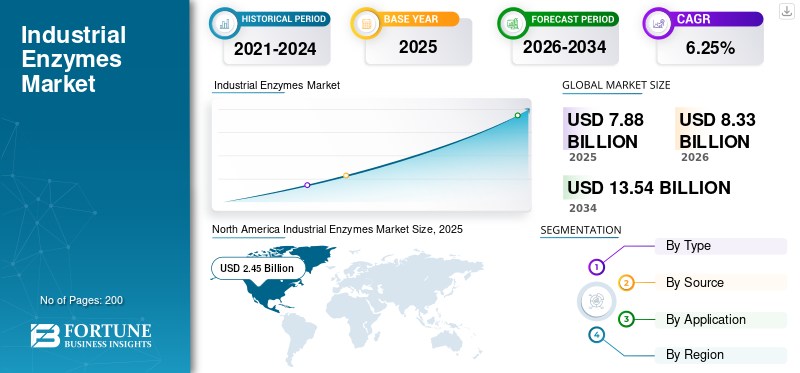
The global industrial enzymes market size was valued at USD 7.88 billion in 2025 and is projected to grow from USD 8.33 billion in 2026 to USD 13.54 billion by 2034, exhibiting a CAGR of 6.25% during the forecast period. North America dominated the Industrial Enzymes Market with a market share of 31.09% in 2025.
Industrial enzymes are biological catalysts used to accelerate chemical reactions in industrial processes. These enzymes are widely applied across food processing, biofuel production, detergents, textiles, paper manufacturing, and animal nutrition due to their efficiency, specificity, and environmentally sustainable nature. Enzymes replace harsh chemicals in detergents and textiles, enabling milder processing with reduced environmental impact.
The market sits at the intersection of biotechnology, food processing, and sustainable industrial manufacturing. The growing need for eco-friendly processing solutions is a key driver of enzyme adoption across sectors such as food & beverages, textiles, and biofuels.
Companies such as Novozymes, DSM-Firmenich, DuPont (IFF), BASF, and AB Enzymes are focusing on Leading enzyme engineering, fermentation technologies, and application-specific innovations to strengthen their global presence. Strategic partnerships in the enzyme industry are enabling companies to leverage advanced technologies and accelerate the commercialization of novel enzyme solutions.
Download Free sample to learn more about this report.
Industrial Enzymes Market Key Takeaways
 Market Size & Forecast
- 2025 Market Size: USD 7.88 billion
- 2026 Market Size: USD 8.33 billion
- 2034 Forecast Market Size: USD 13.54 billion
- CAGR: 6.25% from 2026–2034
 Market Share
- North America dominated the industrial enzymes market with a 31.09% share in 2025.
- Plant-based enzymes are expected to witness moderate growth at a CAGR of 5.42% during the forecast period.
- Nutraceuticals & supplements is projected to be the fastest-growing segment with a CAGR of 8.42%.
 Key Regional Highlights
North America
Reached USD 2.45 billion in 2025, driven by strong biotechnology infrastructure and widespread enzyme adoption.
Europe
Reached USD 2.19 billion in 2025, supported by sustainable industrial practices and environmental regulations.
Asia Pacific
Accounted for USD 2.27 billion in 2025 and is expected to grow fastest at a CAGR of 7.82%.
U.S.
Reached USD 2.08 billion in 2025, supported by biofuel production and strong food processing demand.
U.K
Reached approximately USD 0.30 billion in 2025, driven by sustainable food processing and biotech research.
Read More

Industrial Enzymes Market Trends
Shift Toward Eco-Friendly, Sustainable, and Bio-Based Industrial Processing to Support Market Growth
Industrial enzymes are increasingly replacing chemical catalysts due to their ability to operate under mild conditions, thereby reducing energy consumption and waste generation. Industries such as food processing, detergents, and biofuels are adopting enzyme-based solutions to improve efficiency while meeting sustainability targets. In addition, specialty enzymes help reduce chemical use and waste generation. Traditional chemical catalysts often require harsh acids, alkalis, or solvents, leading to hazardous by-products and complex waste treatment. In contrast, enzyme-driven processes generate biodegradable residues and improve effluent quality, helping manufacturers comply with stringent environmental standards such as REACH in Europe and EPA regulations in the U.S.
- According to the International Energy Agency (IEA), bio-based processes such as enzyme-assisted biofuel production can reduce greenhouse gas emissions by 50–70% compared to conventional fossil-based processes.
MARKET DYNAMICS
Market Drivers
Download Free sample to learn more about this report.
Strong Demand from Food Processing, Biofuel, and Detergent Industries Driving Market Growth
The global industrial enzymes market growth is significantly driven by their widespread use in food processing and biofuel production. Enzymes such as amylases, proteases, and lipases are extensively used in baking, dairy processing, brewing, and beverage clarification. These enzymes help improve product consistency, enhance processing efficiency, and reduce production time.
In the biofuel industry, enzymes play a critical role in converting starch and lignocellulosic biomass into fermentable sugars, which are then used to produce ethanol. This has become increasingly important as countries focus on renewable energy sources and reducing dependence on fossil fuels.
- According to the Renewable Fuels Association, U.S. fuel ethanol production regularly exceeds 15 billion gallons annually, with 2025 production hitting a record 16.5 billion gallons.
Market Restraints
Rising Cost Sensitivity and Operational Constraints in Enzyme Production
Despite their advantages, industrial enzymes face challenges related to production costs and operational complexity. Enzyme manufacturing involves fermentation processes that require precise control of temperature, pH, and nutrient supply, making production capital-intensive.
Raw material price fluctuations, particularly for agricultural inputs such as corn and sugar used in fermentation, can significantly impact production costs. Additionally, enzyme stability and sensitivity to environmental conditions can limit their application in certain industrial processes.
- According to the Food and Agriculture Organization (FAO) and the U.S. Department of Agriculture (USDA), corn prices have fluctuated by 20–35% annually in recent years due to climate variability and supply chain disruptions.
Market Opportunities
Technological Advancements in Enzyme Engineering to Create New Growth Avenues
The industrial enzymes market is benefiting from rapid advancements in biotechnology, particularly in enzyme engineering and synthetic biology. These technologies enable the development of enzymes with enhanced stability, higher efficiency, and improved resistance to extreme processing conditions.
The growing application of enzymes in emerging sectors such as bioplastics, wastewater treatment, and pharmaceutical manufacturing is creating new opportunities for market expansion. Enzymes are increasingly being used in environmentally sustainable processes, such as biodegradable material production and green chemistry applications.
- According to the Organisation for Economic Co-operation and Development (OECD), industrial biotechnology, including enzyme applications, is expected to contribute significantly to the global bioeconomy, potentially exceeding USD 1 trillion in value by 2030.
SEGMENTATION ANALYSIS
By Type
Carbohydrases Segment Dominated Due to Extensive Use in Food Processing and Bioethanol Production
By type, the market is segmented into carbohydrases, proteases, lipases, polymerases & nucleases, and others.
The carbohydrases segment dominated the market in 2025, reached approximately USD 2.92 billion, driven by its extensive use in starch processing, sugar conversion, and bioethanol production. These enzymes play a critical role in breaking down complex carbohydrates into simpler sugars, enabling efficient fermentation and food processing operations. Their widespread use in baking, brewing, and dairy industries further strengthens their dominance.
The polymerases & nucleases segment is expected to grow at the fastest CAGR of 8.25%, supported by increasing demand in biotechnology, diagnostics, and pharmaceutical applications. The growing importance of molecular biology techniques and genetic research is further driving demand for these specialized enzymes.
To know how our report can help streamline your business, Speak to Analyst
By Source
Microorganisms Segment Dominated Owing to High Production Efficiency and Scalability
Based on the source, the market is segmented into microorganisms, plants, and animals.
The microorganisms segment dominated the global industrial enzymes market share in 2025, reached approximately USD 7.08 billion, as microbial sources offer higher enzyme yields, cost efficiency, and ease of large-scale production. The microorganisms segment is also expected to grow at the fastest CAGR of 6.37%. Bacteria and fungi are widely used in fermentation processes, enabling consistent and scalable enzyme manufacturing. Additionally, genetic engineering techniques allow modification of microbial strains to improve enzyme performance and stability.
Plant-based enzymes are used in niche applications such as food processing and pharmaceuticals, while animal-derived enzymes are primarily used in specific medical and food applications. It is expected to grow moderately with a moderate CAGR of 5.42% during the forecast period.
By Application
Food & Beverages Segment Dominated Due to Rising Demand for Processed and Convenience Foods
By application, the market is classified into food & beverages, nutraceuticals & supplements, bioethanol, textiles & leather, detergents, paper & pulp, animal feed applications, water treatment, and others.
The food & beverages segment dominated the global market in 2025, valued at approximately USD 2.04 billion, driven by extensive enzyme usage in baking, dairy processing, brewing, and beverage clarification. Enzymes help improve texture, flavor, shelf life, and processing efficiency, making them indispensable in modern food manufacturing. The rising consumer demand for processed and convenience foods continues to support segment growth.
The nutraceuticals & supplements segment is projected to grow at the fastest CAGR of 8.42% during the forecast period, supported by increasing consumer awareness of digestive health and growing demand for enzyme-based dietary supplements.
Industrial Enzymes Market Regional Outlook
Regionally, the report covers the market analysis across North America, Europe, Asia Pacific, South America, and the Middle East & Africa.
North America
North America Industrial Enzymes Market Size, 2025 (USD Billion)
To get more information on the regional analysis of this market, Download Free sample
North America accounted for approximately USD 2.45 billion in 2025, dominating the regional market growth, and is projected to grow at a CAGR of 5.96% during forecast period, supported by a strong biotechnology infrastructure and high adoption of enzyme-based industrial processes.
U.S. Industrial Enzymes Market
The U.S. dominated the North American market, reached USD 2.08 billion in 2025, accounting for the majority share of the region. The country benefits from a well-established biofuel industry, a large-scale food processing sector, and a strong presence of key enzyme manufacturers such as IFF and DuPont.
Europe
Europe reached approximately USD 2.19 billion in 2025 and is projected to grow at a CAGR of 5.44% during the forecast period, supported by strict environmental regulations and strong adoption of sustainable industrial practices.
Germany Industrial Enzymes Market
Germany accounted for approximately USD 0.50 billion in 2025, supported by its advanced industrial biotechnology sector and strong presence in chemical, food, and pharmaceutical manufacturing industries.
U.K. Industrial Enzymes Market
The U.K. market reached approximately USD 0.30 billion in 2025, driven by increasing demand for sustainable food processing and expanding biotechnology research activities.
Asia Pacific
Asia Pacific accounted for approximately USD 2.27 billion in 2025. Asia Pacific is expected to grow at the fastest CAGR of 7.82% during the forecast period, driven by expanding food processing industries, rising biofuel production, and increasing industrialization.
China Industrial Enzymes Market
China dominated the Asia Pacific market with approximately USD 0.86 billion in 2025, supported by large-scale manufacturing, strong enzyme production capacity, and high demand from the food, textile, and bioethanol industries.
India Industrial Enzymes Market
India accounted for approximately USD 0.43 billion in 2025, driven by rapid growth in food processing, increasing adoption of enzyme-based solutions in textiles and detergents, and rising investments in biotechnology.
South America and the Middle East & Africa
South America accounted for approximately USD 0.61 billion in 2025 and is projected to grow at a CAGR of 5.02% during the forecast period, supported by expanding bioethanol production and agricultural processing industries.
The Middle East & Africa market reached approximately USD 0.35 billion in 2025 and is projected to grow at a CAGR of 4.11% during the forecast period, driven by gradual industrial development and increasing adoption of water treatment enzymes.
Brazil Industrial Enzymes Market
Brazil dominated the South American market with approximately USD 0.42 billion in 2025, supported by its strong ethanol industry, abundant sugarcane production, and increasing use of enzymes in biofuel processing.
COMPETITIVE LANDSCAPE
Key Industry Players
Leading Companies Are Focusing on Enzyme Innovation to Strengthen Market Position
The global industrial enzymes market is moderately consolidated, with a mix of multinational biotechnology firms and specialized enzyme manufacturers competing on innovation, scale, and application expertise. Market leaders are leveraging advanced fermentation technologies, protein engineering, and digital optimization tools to develop high-performance enzyme solutions tailored to specific industrial processes. Advancements in fermentation and biotechnology have enabled manufacturers to efficiently produce enzymes at scale, supporting rising industrial demand.
Companies are increasingly focusing on application-specific enzyme formulations, particularly for high-growth sectors such as food processing, biofuels, and nutraceuticals. Customized enzyme solutions allow manufacturers to improve yield efficiency, reduce processing time, and meet regulatory and sustainability requirements.
Key Players in the Industrial Enzymes Market
|
Rank |
Company Name |
|
1 |
Novozymes A/S |
|
2 |
DSM-Firmenich |
|
3 |
BASF SE |
|
4 |
International Flavors & Fragrances Inc. (IFF) |
|
5 |
AB Enzymes GmbH |
List of Key Industrial Enzymes Companies Profiled
- Novozymes A/S (Denmark)
- DSM-Firmenich (Netherlands/Switzerland)
- BASF SE (Germany)
- International Flavors & Fragrances Inc. (U.S.)
- AB Enzymes GmbH (Germany)
- Amano Enzyme Inc. (Japan)
- Advanced Enzyme Technologies Ltd. (India)
- Hansen Holding A/S (Denmark)
- Kerry Group plc (Ireland)
- Dyadic International Inc. (U.S.)
KEY INDUSTRY DEVELOPMENTS
- March 2026: International Flavors & Fragrances (IFF) expanded its Health & Biosciences operations in Latin America, transforming its Arroyito site in Argentina into the region's first full fermentation-based enzyme production hub and opening a household care application lab at its Brazil Innovation Center. This move aims to boost local enzyme production from the initial biological stage, enhancing speed, reliability, and tailored solutions for growing markets.
- March 2025: Novonesis launched Progress Beyond and Progress Go, two advanced proteases for liquid laundry detergents, targeting superior protein stain removal. These enzymes excel in cold washes and diverse conditions, offering market-leading stability, performance, and compatibility without protease inhibitors. They support clean-labeling certifications and integrate easily into formulations.
- November 2024: Synthego launched high-value in vitro transcription (IVT) enzymes, including T7 RNA Polymerase and RNase Inhibitor, to advance RNA therapeutics. These tools address key challenges in RNA synthesis, purity, and stability for mRNA applications and gene editing.
- May 2024: Biocatalysts Ltd recently launched a specialized protease platform featuring two enzymes, Promod 327L and Promod 295L, for producing high-value collagen peptides. These proteases enable efficient hydrolysis of extracted collagen from sources such as beef, pork, and fish, yielding low molecular weight, neutral-tasting peptides with improved solubility and reduced viscosity.
- June 2021: DSM-Firmenich and Novozymes (now part of Novonesis) Alliance launched ProAct 360 as their second-generation protease for poultry feed. ProAct 360™ improves feed efficiency, affordability, and sustainability by enhancing protein digestibility across amino acids, breaking down anti-nutritional factors faster, and reducing reliance on soy or major crops.
REPORT COVERAGE
The global industrial enzymes market report analyzes the market in depth and highlights crucial aspects such as global industrial enzymes market trends, market dynamics, market research, prominent companies, investment in research and development, and end-use. Besides this, the report also provides insights into the global industrial enzymes market analysis and highlights significant industry developments.
Request for Customization to gain extensive market insights.
Report Scope & Segmentation
| ATTRIBUTE | DETAILS |
| Study Period | 2021-2034 |
| Base Year | 2025 |
| Estimated Year | 2026 |
| Forecast Period | 2026-2034 |
| Historical Period | 2021-2024 |
| Growth Rate | CAGR of 6.25% from 2026 to 2034 |
| Unit | Value (USD Billion) |
|
Segmentation |
By Type
|
|
By Source
|
|
|
By Application
|
|
|
By Region
|
Frequently Asked Questions
Fortune Business Insights says that the global market was valued at USD 7.88 billion in 2025 and is anticipated to reach USD 13.54 billion by 2034.
At a CAGR of 6.25%, the global market will exhibit steady growth over the forecast period.
By source, the microorganisms segment led the market.
North America held the largest market share in 2025.
Strong demand from the food processing, biofuel, and detergent industries is driving market growth.
Novozymes, DSM-Firmenich, DuPont (IFF), BASF, and AB Enzymes are the leading companies in the market.
Shift toward sustainable and bio-based industrial processing to support market growth.



- 2021-2034
- 2025
- 2021-2024
- 200
-
(Offer valid till 15th Oct 2026)
Get 30-60 hrs Free Customization
Expand Regional and Country Coverage, Segments Analysis, Company Profiles, Competitive Benchmarking, and End-user Insights.



















Related Reports
-
US +1 833 909 2966 ( Toll Free )
-
Get In Touch With Us