Elevator and Escalator Market Size, Share & Industry Analysis, By Product (Elevators, Escalators, and Moving Walkways), By Business (New Equipment, Maintenance, and Modernization), By Application (Residential, Commercial, and Industrial), By Technology (Traction Technology, Hydraulic Technology, Machine-Room-Less (MRL) Technology, Pneumatic Technology, and Others (Screw Drive and Rack & Pinion)), and Regional Forecast, 2026-2034
 Download Free Sample
 Elevator and Escalator Market Size and Future Outlook
 Listen to Audio Version
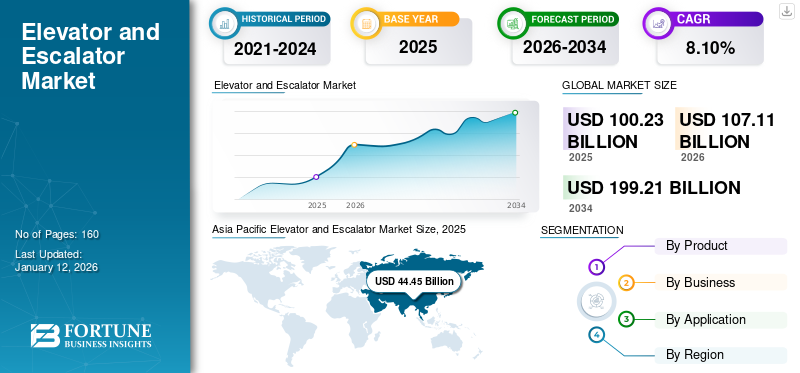
The global elevator and escalator market size was valued at USD 100.23 billion in 2025. The market is projected to grow from USD 107.11 billion in 2026 to USD 199.75 billion by 2034, exhibiting a CAGR of 8.1% during the forecast period.
Elevators, escalators, and moving walkways are essential vertical transportation systems that improve passenger mobility, building accessibility, operational efficiency, and movement across high-rise buildings, commercial complexes, transit hubs, industrial facilities, and smart building environments. The market growth is being supported by rapid urbanization, expansion of high-rise residential and commercial construction, increasing modernization of aging equipment, and rising demand for energy-efficient and digitally connected mobility systems.
The elevator and escalator industry is steadily expanding as smart elevators, destination-control systems, predictive maintenance platforms, machine-room-less technologies, and advanced safety solutions gain adoption across residential, commercial, and industrial applications. This is becoming increasingly important as cities face rising population density, growing infrastructure requirements, and the need to improve accessibility, passenger flow, and equipment reliability across high-rise buildings and public transportation facilities, further supporting market growth across global elevators and escalators.
Major companies in the market include Fujitec Co., Ltd., Hitachi, Ltd., Hyundai Elevator Co., Ltd., and KONE Corporation. These key players are progressively developing smart elevators, energy-efficient drive systems, connected maintenance platforms, destination-control technologies, advanced safety systems, and modernization solutions to improve vertical transportation efficiency and strengthen their competitiveness in the global elevator market. Rising construction of high-rise residential buildings, increasing investments in smart building infrastructure, and growing demand for maintenance and modernization services are fueling market expansion. Wider deployment of connected elevators, escalators, and moving walkways across North America, Asia Pacific, Europe, Latin America, and the Middle East & Africa will boost market growth.
Download Free sample to learn more about this report.
Elevator and Escalator Market Trends
Rising Adoption of Smart Elevators and Connected Vertical Transportation Systems is a Key Market Trend
The market is witnessing a shift toward digitally connected and intelligent vertical transportation systems, as building owners seek to improve passenger movement, equipment availability, energy efficiency, and maintenance performance. High-rise residential buildings, commercial complexes, airports, metro stations, hospitals, and smart building projects are increasingly adopting smart elevators equipped with sensors, cloud connectivity, destination-control systems, mobile access, and real-time monitoring capabilities.
Connected elevator technologies help building operators identify equipment issues, optimize traffic flow, reduce unplanned downtime, and improve passenger experience across complex building environments. These systems also enable predictive maintenance, remote diagnostics, application-based elevator calling, and integration with building management and access-control platforms. As high-rise buildings become more digitally integrated, this trend is supporting the transition from conventional elevators toward smarter, energy-efficient, and data-driven mobility systems.
- For instance, in May 2025, Otis commissioned its digitally connected SkyRise elevator system at Seattle’s Space Needle, integrating advanced controls, remote monitoring capabilities, and energy-efficient SkyMotion 800 motors to improve reliability, passenger movement, and operational performance in a high-rise building environment.
MARKET DYNAMICS
MARKET DRIVERS
Download Free sample to learn more about this report.
Rapid Urbanization and Expansion of High-Rise Construction Fuel Market Growth
Rapid urbanization, increasing population density, and continued development of high-rise residential and commercial buildings are among the major factors driving the market. Cities across Asia Pacific, North America, Europe, Latin America, and the Middle East & Africa are expanding vertically as limited urban land availability encourages developers to construct taller residential towers, office buildings, hotels, hospitals, and mixed-use complexes. Elevators, escalators, and moving walkways are essential vertical transportation systems in these buildings, helping occupants move efficiently between floors while improving accessibility and passenger flow.
Demand is particularly strong in the residential segment, where construction of high-rise residential developments is increasing across metropolitan areas. Commercial buildings, airports, metro stations, shopping centers, and other public infrastructure projects are also deploying global elevators and escalators to manage high passenger volumes. Companies such as Mitsubishi Electric Corporation, Otis Worldwide Corporation, KONE Corporation, Schindler, TK Elevator GmbH, Hyundai Elevator Co., Ltd., Fujitec Co., Ltd., and Hitachi, Ltd. are expanding their high-speed elevator, escalator, and vertical transportation portfolios to meet rising requirements from high-rise buildings and large infrastructure projects.
- For instance, in January 2026, KONE launched a residential elevator designed for villas and low-rise housing in India, expanding its product portfolio to address increasing demand for vertical transportation across the country’s growing residential construction sector.
|
Rank |
Market Drivers |
Expected Impact on Market Growth |
Estimated Gross Market Growth Contribution (USD Billion) |
Impact: 2026-2028 |
Impact: 2029-2031 |
Impact: 2032-2034 |
|
1 |
Rapid urbanization and expansion of high-rise construction are driving demand for elevators and escalators |
High |
34.50 |
High |
High |
High |
|
2 |
Increasing demand for elevator modernization and replacement of aging installed systems |
High |
27.00 |
High |
High |
High |
|
3 |
Rising adoption of smart elevators, connected technologies, and energy-efficient vertical transportation solutions |
Medium-High |
21.00 |
Medium |
High |
High |
|
4 |
Expansion of commercial infrastructure, airports, metro systems, and smart building projects |
Medium |
18.00 |
Medium |
Medium |
High |
|
5 |
Growing focus on accessibility, passenger safety, and advanced building mobility solutions |
Medium-Low |
13.50 |
Medium |
Medium |
High |
|
6 |
Others (growth of residential elevators, tourism infrastructure, industrial facilities, and replacement demand) |
Low |
6.00 |
Low |
Low |
Medium |
|
Total Gross Growth Contribution |
120 |
MARKET RESTRAINTS
High Installation Costs and Complex Maintenance Requirements are Limiting Market Growth
High installation costs remain one of the key restraints for the elevator and escalator market growth. Elevator systems require shafts, structural modifications, traction machines, control panels, doors, safety components, power systems, and specialized engineering support, resulting in substantial project expenditure. Escalators and moving walkways also involve complex civil works, customized dimensions, safety systems, and integration with building layouts. These costs can restrict adoption across low-rise residential projects, small commercial buildings, and cost-sensitive infrastructure developments, particularly in emerging markets.
Elevators and escalators require regular inspection, preventive maintenance, component replacement, safety testing, and compliance with local building and transportation regulations. Aging equipment may require expensive repairs involving motors, ropes, controllers, braking systems, doors, and electrical components. Maintenance complexity increases further in high-rise buildings, airports, metro stations, hospitals, and shopping centers where equipment downtime can disrupt passenger movement and building operations. The need for skilled technicians, original spare parts, and long-term service contracts can raise lifecycle costs and slow replacement or new installation decisions among budget-constrained building owners and developers.
|
Rank |
Market Restraints |
Expected Impact on Market Growth |
Estimated Reduction in Market Size (USD Billion) |
Impact: 2026-2028 |
Impact: 2029-2031 |
Impact: 2032-2034 |
|
1 |
High installation costs and complex maintenance requirements are limiting faster market adoption |
High |
12.00 |
High |
High |
Medium |
|
2 |
Stringent safety regulations, certification requirements, and lengthy approval processes are delaying project execution |
Medium-High |
7.50 |
Medium |
High |
Medium |
|
3 |
Limited adoption in cost-sensitive markets due to infrastructure constraints and skilled technician requirements |
Medium |
5.00 |
Medium |
Medium |
Low |
|
4 |
Others (raw material price fluctuations, supply chain challenges, replacement delays, and competition from alternative mobility solutions) |
Low |
2.86 |
Low |
Low |
Low |
|
Total Market Reduction |
27.36 |
MARKET OPPORTUNITIES
Modernization of Aging Elevator and Escalator Installations is Creating New Growth Opportunities
The growing installed base of aging elevators, escalators, and moving walkways is creating strong growth opportunities for the market. Building owners are increasingly upgrading existing vertical transportation systems with modern controllers, traction machines, door operators, safety devices, regenerative drives, destination-control systems, and energy-efficient components instead of replacing complete installations. These upgrades help improve ride quality, passenger safety, equipment reliability, energy performance, and compliance with evolving building standards.
Modernization is especially attractive across older residential buildings, office towers, hospitals, hotels, shopping centers, airports, and metro stations that operate equipment installed several decades ago. It also allows key players such as Otis, KONE, Schindler, TK Elevator, Mitsubishi Electric, and Hyundai Elevator to expand recurring revenue through retrofit packages, component replacement, lifecycle services, and phased modernization programs. As urban buildings age and property owners seek to extend equipment life while improving operational performance, modernization is expected to remain an important growth avenue for the elevator and escalator industry.
- For instance, in May 2026, KONE stated that it expected to modernize approximately 40,000-60,000 elevators annually in China by 2028 as the country’s aging installed base and government-supported replacement programs increase demand for elevator upgrades.
Segmentation Analysis
By Product
Elevators Segment Held Largest Share Due to Extensive Deployment Across Residential and Commercial Buildings
Based on product, the market is divided into elevators, escalators, and moving walkways.
The elevators segment held the largest elevator and escalator market share in 2025, driven by extensive installation across high-rise residential buildings, commercial complexes, hospitals, hotels, offices, industrial facilities, and public infrastructure. Elevators form the core of vertical transportation systems by supporting efficient passenger and freight movement between floors, improving accessibility, and enabling the development of taller buildings in densely populated urban areas. Demand is particularly strong across the residential segment, where rapid urbanization and limited land availability are encouraging the construction of high-rise residential developments. Compared with escalators and moving walkways, elevators serve a wider range of building types and are essential across both low-rise and high-rise buildings.
- In February 2026, Otis Worldwide Corporation launched its next-generation Gen3 Core elevator platform across North America and Europe, designed for mid- and high-rise residential and commercial buildings, strengthening its elevator portfolio and expanding energy-efficient and connected elevator installations.
The elevators segment is also expected to witness the highest growth rate, with a CAGR of 8.4% during the forecast period, driven by expanding urban construction, rising demand for smart elevators, increasing installation of energy-efficient systems, and growing vertical transportation requirements across residential, commercial, and industrial applications.
To know how our report can help streamline your business, Speak to Analyst
By Business
Maintenance Segment Led Market Due to Expanding Installed Base and Recurring Service Requirements
Based on business, the market is divided into new equipment, maintenance, and modernization.
The maintenance segment held the largest market share in 2025, driven by the large installed base of elevators, escalators, and moving walkways requiring regular inspection, preventive servicing, safety testing, component replacement, and operational support. Maintenance services are essential for ensuring equipment reliability, passenger safety, regulatory compliance, and uninterrupted operation across residential buildings, commercial complexes, hospitals, airports, metro stations, and industrial facilities. Compared with new equipment sales, maintenance generates recurring revenue throughout the operating life of vertical transportation systems and remains less dependent on construction cycles.
- In April 2026, KONE agreed to acquire TK Elevator, creating a combined service and modernization portfolio covering approximately 3.2 million units under maintenance and strengthening recurring lifecycle-service capabilities.
The modernization segment is expected to witness the highest growth rate, with a CAGR of 9.3% during the forecast period, driven by increasing upgrades of aging elevators and escalators with advanced controllers, energy-efficient drives, safety components, destination-control systems, and connected monitoring technologies.
By Application
Residential Segment Held Largest Share Due to Increasing High-Rise Housing Development
Based on application, the market is divided into residential, commercial, and industrial.
The residential segment held the largest market share in 2025, supported by rapid urbanization, increasing population density, and rising construction of apartments, condominiums, gated communities, and high-rise residential buildings. Elevators are increasingly considered essential in multi-story housing projects as they improve accessibility, support elderly and mobility-impaired residents, and enable efficient movement across taller buildings. Demand is particularly strong in densely populated metropolitan areas where limited land availability is encouraging vertical residential development.
- In November 2025, Fujitec Co. Ltd. completed a large-scale installation of heavy-duty freight elevators for a major industrial logistics hub in Singapore, strengthening its footprint in the industrial application segment.
The residential segment is also expected to witness the highest growth rate, with a CAGR of 8.4% during the forecast period, driven by expansion of high-rise residential construction, increasing installation of home and villa elevators, and growing demand for safe, compact, and energy-efficient vertical transportation systems.
By Technology
Traction Technology Segment Held Largest Share Due to Suitability for High-Rise and High-Capacity Buildings
Based on technology, the market segmentation is divided into traction technology, hydraulic technology, machine-room-less technology, pneumatic technology, and others (screw drive and rack & pinion). Traction technology is further segmented into geared traction and gearless traction, while hydraulic technology is further segmented into holed hydraulic, holeless hydraulic, and roped hydraulic.
The traction technology segment held the largest market share in 2025, driven by its widespread deployment across high-rise residential buildings, office towers, hotels, hospitals, and mixed-use developments. Traction elevators offer higher operating speeds, greater travel heights, improved ride quality, and better energy performance compared with conventional hydraulic systems. Gearless traction systems are particularly suitable for high-rise buildings and high-capacity applications, while geared traction systems remain widely used across mid-rise developments.
- In September 2025, SJEC Corporation introduced a new series of Machine-Room-Less (MRL) elevators specifically for the European market, utilizing space-saving technology to allow architects to maximize usable floor area in mid-rise residential developments.
The machine-room-less technology segment is expected to witness the highest growth rate, with a CAGR of 9.6% during the forecast period, driven by its compact design, lower space requirements, reduced construction complexity, and increasing adoption across residential and commercial buildings. By eliminating the need for a separate machine room, these systems help developers optimize usable building space while supporting energy-efficient and flexible elevator installation.
Elevator and Escalator Market Regional Outlook
By geography, the market is categorized into North America, Europe, Asia Pacific, Latin America, and the Middle East & Africa.
Asia Pacific
Asia Pacific Elevator and Escalator Market Size, 2025 (USD Billion)
To get more information on the regional analysis of this market, Download Free sample
Asia Pacific led the market with USD 44.20 billion in 2025 and will continue to dominate the global market. Regional growth is strongly supported by rapid urbanization, large-scale residential construction, increasing development of high-rise buildings, and expanding metro, airport, commercial, and mixed-use infrastructure across China, India, Japan, South Korea, Southeast Asia, and the rest of Asia Pacific. The region continues to witness strong demand for elevators, escalators, moving walkways, machine-room-less systems, and smart elevators that improve passenger movement, optimize building space, and support energy-efficient vertical transportation. China leads regional demand due to its extensive installed base and continued construction activity, while India is expected to grow rapidly due to urban housing development and infrastructure expansion.
China Elevator and Escalator Market
China’s market is projected to remain dominant in Asia Pacific, with 2026 revenues estimated at around USD 34.06 billion, representing roughly 31.8% of global sales.
Japan Elevator and Escalator Market
The Japanese market is estimated at around USD 4.22 billion in 2026, accounting for roughly 3.9% of global sales.
India Elevator and Escalator Market
The Indian market is estimated at around USD 2.31 billion in 2026, accounting for roughly 2.2% of global sales.
North America
North America’s market accounted for USD 20.47 billion in 2025, supported by increasing construction of high-rise residential and commercial buildings, a large installed base of aging elevators, and rising demand for maintenance and modernization services across the U.S. and Canada. Urban redevelopment, accessibility requirements, transit infrastructure expansion, and the growing adoption of smart elevators across offices, hospitals, airports, hotels, and residential buildings strongly influence regional demand. The region also benefits from increasing deployment of energy-efficient traction systems, destination-control technologies, predictive maintenance platforms, and connected vertical transportation solutions.
U.S. Elevator and Escalator Market
The U.S. is expected to dominate the North America market with an estimated revenue of around USD 17.72 billion in 2026, representing roughly 16.5% of global sales. Growth is driven by high-rise residential and commercial construction, modernization of aging elevator installations, expanding airport and metro infrastructure, and stringent accessibility and building-safety requirements. Demand remains particularly strong across residential towers, office buildings, hospitals, hotels, shopping centers, and public infrastructure requiring reliable elevators, escalators, and moving walkways.
Europe
The Europe market is expected to witness steady growth during the forecast period, driven by a large installed base of elevators, stringent safety and accessibility regulations, rising modernization requirements, and increasing adoption of energy-efficient vertical transportation systems across Germany, the U.K., France, Italy, Turkey, and the rest of Europe. Regional demand is closely associated with renovation of older residential and commercial buildings, urban redevelopment, transit infrastructure improvement, and smart building integration. Europe remains an important market as building owners increasingly upgrade controllers, drives, doors, safety systems, and digital monitoring platforms to improve equipment performance and extend service life.
U.K. Elevator and Escalator Market
The U.K. market is estimated at around USD 3.78 billion in 2026, representing roughly 3.5% of global revenues.
Germany Elevator and Escalator Market
Germany’s market is projected to reach USD 10.71 billion in 2026, equivalent to around 10.0% of global sales.
Middle East & Africa
The Middle East & Africa market is driven by increasing construction of high-rise residential towers, hotels, shopping centers, airports, metro systems, and mixed-use developments across GCC countries, South Africa, and other regional markets. Demand is closely linked to urban development, tourism infrastructure, smart city projects, and the construction of landmark high-rise buildings requiring high-speed elevators, escalators, and moving walkways. GCC countries lead regional adoption due to continued investment in large-scale real estate, transportation, hospitality, and commercial infrastructure projects.
GCC Elevator and Escalator Market
The GCC market is projected to reach around USD 3.48 billion in 2026, representing roughly 3.2% of global sales.
Latin America
The Latin America market is driven by urban redevelopment, rising residential construction, expansion of commercial infrastructure, and increasing modernization of aging elevator systems across Brazil, Mexico, and the rest of Latin America. Demand for elevators and escalators is primarily associated with apartment buildings, shopping centers, office complexes, hospitals, hotels, airports, and metro stations. Although new equipment demand remains comparatively moderate, the region offers long-term opportunities through maintenance, safety upgrades, component replacement, and modernization of existing vertical transportation systems.
Brazil Elevator and Escalator Market
The Brazil market is projected to reach around USD 1.26 billion in 2026, representing roughly 1.2% of global sales.
COMPETITIVE LANDSCAPE
Key Industry Players
Top Companies Focus on Smart Elevators and Digital Vertical Transportation Solutions to Strengthen Their Market Positions
The global elevator and escalator market is highly competitive. It continues to expand as building owners, developers, and infrastructure operators increasingly adopt advanced vertical transportation solutions across residential, commercial, and industrial applications. Elevator and escalator product portfolios, smart elevator technologies, energy efficient systems, predictive maintenance capabilities, modernization solutions, safety technologies, and integration with smart building platforms shape competition. Companies are focusing on solutions that improve passenger experience, reduce energy consumption, enhance equipment reliability, optimize maintenance operations, and support the development of connected and sustainable buildings.
Fujitec Co., Ltd., Hitachi, Ltd., Hyundai Elevator Co., Ltd., and KONE Corporation are among the major companies being tracked in this market. Several of these players are developing advanced vertical transportation solutions, ranging from elevators, escalators, and moving walkways to smart elevator platforms, destination-control systems, machine-room-less technologies, energy-efficient drive systems, digital monitoring solutions, and modernization services. As the elevator and escalator industry expands, partnerships with real estate developers, building owners, infrastructure operators, technology providers, and smart building solution companies are expected to become important competitive strategies.
List of Key Elevator and Escalator Companies Profiled
- Fujitec Co., Ltd. (Japan)
- Hitachi, Ltd. (Japan)
- Hyundai Elevator Co., Ltd. (South Korea)
- Kone Corporation (Finland)
- Mitsubishi Electric Corporation (Japan)
- Otis Worldwide Corporation (U.S.)
- Schindler (Switzerland)
- SJEC Corporation (China)
- TK Elevator GmbH (Germany)
- Toshiba Corporation (Japan)
KEY INDUSTRY DEVELOPMENTS
- June 2026: TK Elevator announced the launch of EOX Rebuild, a modernization solution designed to upgrade Europe’s aging elevator infrastructure by improving efficiency, digital connectivity, and lifecycle performance.
- May 2026: KONE Corporation launched its "Carbon-Neutral Maintenance" service globally, utilizing AI-driven predictive maintenance to reduce operational energy consumption and offset the carbon footprint of its maintained base of 1.5 million units.
- November 2025: Mitsubishi Electric completed the acquisition of AG MELCO Elevator Co. L.L.C. in Dubai to strengthen its elevator maintenance and renewal business and expand its building systems operations across the Middle East region.
- July 2025: KONE launched the KONE Renaissance program, a five-year research and development initiative focused on sustainable building renewal through digitalization, modernization, and smart elevator solutions.
- July 2025: Hyundai Elevator Co. Ltd. unveiled its "H-Port" system, featuring elevators designed to communicate with delivery robots and drones to facilitate seamless vertical logistics in smart residential complexes.
REPORT COVERAGE
The global elevator and escalator market analysis includes a comprehensive study of the market size & forecast by all the segments included in the report. It includes details on the market activities and market patterns expected to drive the market over the forecast period. It provides information on primary aspects, including an overview of elevators, escalators, moving walkways, vertical transportation systems, smart elevators, machine-room-less technologies, traction systems, hydraulic systems, energy-efficient solutions, modernization services, and digital building mobility solutions across residential, commercial, and industrial applications. Additionally, it details product launches, partnerships, mergers & acquisitions, technology developments, smart building integration, predictive maintenance solutions, connected elevator platforms, and key industry developments and regional adoption trends. The global market research report also provides an in-depth competitive landscape with information on the market share and profiles of key operating players.
Request for Customization to gain extensive market insights.
Report Scope & Segmentation
| ATTRIBUTE | DETAILS |
| Study Period | 2021-2034 |
| Base Year | 2025 |
| Estimated Year | 2026 |
| Forecast Period | 2026-2034 |
| Historical Period | 2021-2024 |
| Growth Rate | CAGR of 8.1% from 2026 to 2034 |
| Unit | Value (USD Billion) |
| Segmentation | By Product, By Business, By Application, By Technology, and By Region |
| By Product |
|
| By Business |
|
| By Application |
|
| By Technology |
|
| By Region |
|
Frequently Asked Questions
According to Fortune Business Insights, the global market size was valued at USD 100.23 billion in 2025 and is projected to reach USD 199.75 billion by 2034.
In 2025, the market in Asia Pacific was valued at USD 44.20 billion.
The market is expected to exhibit a CAGR of 8.1% during the forecast period of 2026-2034.
By product, the elevators segment led the market.
Rapid urbanization and expansion of high-rise construction fuel market growth.
Fujitec Co., Ltd., Hitachi Ltd., Hyundai Elevator Co., Ltd., KONE Corporation, Mitsubishi Electric Corporation, and Otis Worldwide Corporation are top players in the market.
Asia Pacific held the largest market share in 2025.


- 2021-2034
- 2025
- 2021-2024
- 200
Get 30-60 hrs Free Customization
Expand Regional and Country Coverage, Segments Analysis, Company Profiles, Competitive Benchmarking, and End-user Insights.














Related Reports
-
US +1 833 909 2966 ( Toll Free )
-
Get In Touch With Us