Thrombin Market Size, Share & Industry Analysis, By Product Type (Bovine Thrombin, Human Thrombin, and Recombinant Thrombin), By Dosage Form (Powder Form and Solution Form), By End User (Hospitals & ASCs, Specialty Clinics, and Others), and Regional Forecast, 2026-2034
 Download Free Sample
KEY MARKET INSIGHTS
 Listen to Audio Version
The global thrombin market size was USD 713.38 million in 2025 and is projected to grow from USD 740.96 million in 2026 to USD 1,104.62 million in 2034 at a CAGR of 5.12% during the forecast period. North America dominated the thrombin market with a market share of 43.35% in 2025.
Thrombin plays a crucial role in the coagulation cascade, enabling the conversion of fibrinogen to fibrin, which is essential for blood clot formation. It has a wide array of applications, particularly in surgical settings, to control bleeding and is crucial in trauma care, surgical procedures, and research. One of the broader applications of these products is hemostasis; thus, with the rise in complex surgeries and trauma cases, the demand for these products is escalating globally to control bleeding. This increasing demand augments the market growth.
- For instance, according to the American Academy of Orthopedic Surgeons, vertebral compression fractures resulting from osteoporosis happen approximately 1.5 million times annually in the U.S. Additionally, in 2024, over 700,000 total knee replacement surgeries were expected to be carried out nationwide. This rise in number of surgeries drives the product demand and market growth.
The market for thrombin is also being driven by continuous innovations in medical technologies and a focus on improving patient safety, with nanotechnology formulations being developed to eliminate the risks associated with bleeding defects.
- For instance, in September 2022, the research arm of the U.S. Army awarded USD 2.5 million to Case Western Reserve University bioengineer Anirban Sen Gupta to develop nanotechnology called “SanguiStop” for treating wounded soldiers and patients with bleeding defects. It allows a clot-promoting enzyme, to be intravenously delivered in a targeted manner to the site of internal injuries.
Some of the major players present in the market include Pfizer Inc., Johnson & Johnson Services, Inc., Grifols, S.A., Baxter, and MOCHIDA PHARMACEUTICAL CO., LTD. These players have robust product portfolios and are engaging in strategic initiatives, such as the expansion of manufacturing capacity, to magnify their company’s share in the market.
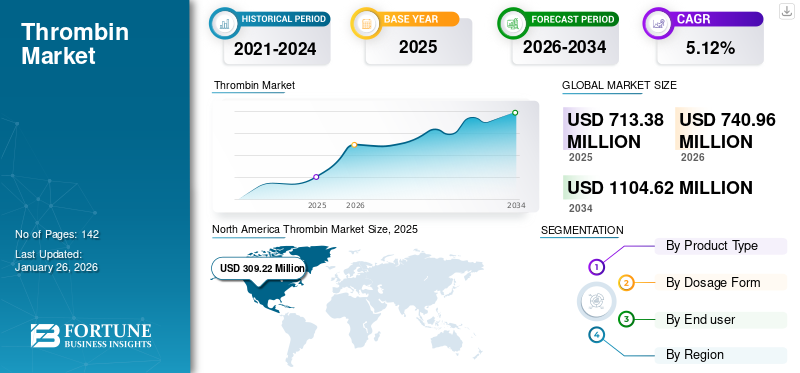
Download Free sample to learn more about this report.
Thrombin Market Takeaways
 Global Market Size & Forecast
- 2025 Market Size: USD 713.38 million
- 2026 Market Size: USD 740.96 million
- 2034 Forecast Market Size: USD 1,104.62 million
- CAGR: 5.12% from 2026–2034
 Market Share
- North America dominated the thrombin market with a 43.35% share in 2025.
- The recombinant segment is projected to account for the largest 64.60% market share in 2026, while the market is expected to grow at a 5.12% CAGR from 2026–2034.
- The powder form segment is projected to lead with a 75.98% market share in 2026.
 Key Regional Highlights
North America
North America: The market generated USD 309.22 million in 2025, accounting for 43.35% of global revenue, and is projected to reach USD 321.24 million in 2026.
Europe
The region accounted for USD 163.89 million in 2025, representing 22.97% of the global market, and is projected to reach USD 169.83 million in 2026.
Asia Pacific
The market reached USD 160.76 million in 2025, capturing 22.54% of the global market share, and is expected to grow to USD 168.69 million in 2026.
U.S.
The thrombin market is projected to reach USD 303.51 million by 2026, supported by advanced surgical infrastructure and high procedural volumes.
Japan
The thrombin market is projected to reach USD 40.03 million by 2026, driven by growing demand for advanced hemostatic products in surgical procedures.
Read More

MARKET DYNAMICS
MARKET DRIVERS
Increasing Incidence of Bleeding Disorders to Propel the Market Growth
The rising prevalence of bleeding disorders such as hemophilia and Von Willebrand diseases increases the demand for thrombin as a therapy during surgeries, propelling the growth of market. Additionally, thrombin-targeted therapeutic strategies are designed to correct its deficiencies and prevent bleeding episodes in individuals with hemophilia and other rare bleeding disorders.
- For instance, in October 2024, the World Federation of Hemophilia published its Annual Global Survey 2023, which covered 119 countries. The report identified approximately 390,630 individuals living with bleeding disorders worldwide. Among these, people affected by hemophilia and Von Willebrand disease were 218,804, respectively, increasing the need for effective hemostatic agents to manage bleeding during surgical procedures and ensure patient safety.
Moreover, growing research initiatives adopted, drive the demand for these products to treat diseases such as blood disorders, bolstering market growth.
MARKET RESTRAINTS
Adverse Drugs Events Associated with Different Sources to Restrict Adoption and Market Growth
Adverse drug events (ADEs) associated with sources from different origins pose significant safety concerns. The common adverse reactions associated with bovine and human sources include allergic reactions, bleeding complications, or immune responses, impacting the patient's health. Adverse effects related to the immunogenicity of bovine-derived products and the risk of transmission of disease from infected plasma substances adversely affect the adoption of the product.
- For instance, as per the prescribing information published by Pfizer Inc. for THROMBIN-JMI, the most common adverse reactions (incidence greater than or equal to 2.0%) following administration of THROMBIN-JMI were hypersensitivity, bleeding, anemia, postoperative wound infection, thromboembolic events, hypotension, pyrexia, tachycardia, and thrombocytopenia.
Overall, safety concerns and adverse effects associated with various thrombin sources hinder the growth and acceptance of these products in medical practice.
MARKET OPPORTUNITIES
Growing Emphasis on Developing Recombinant Thrombin is Offering Lucrative Growth Opportunity for the Market
Novel technologies in the development of these products, such as genetic engineering, offer recombinant products, providing lucrative growth opportunities. The consumption of recombinant thrombin (th) is rising in hospitals and surgical centers due to growing surgical volumes, enhanced awareness of blood product risks, lower risk of allergic reactions in comparison to plasma-derived thrombin, and the increasing availability of approved products such as Recothrom. This recombinant thrombin, produced through genetic engineering techniques, eliminates the risk of blood-borne pathogen transmission and reduces immunogenic reactions, making it especially suitable for surgical and hemostatic dosage forms. These advantages are fueling the adoption of recombinant thrombin in the market.
- For instance, according to the Journal of the American College of Surgeons, a randomized, double-blind trial compared recombinant human thrombin to bovine thrombin in various surgeries. Patients treated with recombinant thrombin developed lower anti-rhthrombin antibodies. Additionally, antibody development did not lead to coagulation or bleeding issues. The findings suggest that prothrombin offers comparable effectiveness and safety to bovine thrombin but with significantly lower immunogenicity.
Additionally, the recombinant DNA technology uses tools such as plasmids and enzymes to modify genetic material in cells, creating recombinant cell lines. Also, increasing adoption of different cell lines, such as CHO (Chinese Hamster Ovary), HEK293 (Human Embryonic Kidney), and NS0 (Mouse Myeloma), is expected to propel the growth of the recombinant technology for manufacturing these products and thus bolstering market growth during the forecast period.
MARKET CHALLENGES
High Cost of Thrombin Products to Impede Market Growth
The high cost of these products significantly restrains market growth. This is primarily due to complex manufacturing processes, safety requirements, and stringent regulatory approval processes restricting the accessibility and adoption by healthcare providers and patients. These characteristics may result in hospitals and clinics shifting toward alternate hemostatic agents such as matrix, flowable, and fibrin sealants or delay their use, reducing overall demand.
- For instance, as per the commercial website, the cost for thrombin-JMI (bovine 20,000 units) topical powder for reconstitution is around USD 321. Such high costs associated with the products may affect its adoption in the lower economic countries.
This financial barrier hampers the market expansion and slows the adoption of therapies.
THROMBIN MARKET TRENDS
Emphasis on Developing Novel Formulations for Delivery is a Prominent Market Trend
The rising demand for adequate hemostatic agents during complex surgical procedures has shifted the focus of key players on novel formulations for thrombin delivery, offering a prominent trend for the market during the forecast period. Recent advancements include bioengineered and sustained-release delivery systems that aim to boost the efficacy and safety of the patient and reduce postoperative complications.
- For example, in July 2021, researchers from the Department of Polymer Science and Engineering at Sungkyunkwan University in Korea developed biocompatible, crosslinked chitosan (CS) patches for managing femoral arterial puncture bleeding during stent placement procedures. The team designed a thrombin-coated chitosan (CS) patch that incorporates a hydrocolloid adhesive to seal and compress the puncture site effectively.
Such advancements can lead to increased demand for the product, thus shaping the market.
Download Free sample to learn more about this report.
IMPACT OF COVID-19
The COVID-19 negatively impacted the market. The pandemic resulted in a significant reduction in patient visits, which in turn led to a reduction in the number of surgeries. This is a crucial factor responsible for the decline of market growth.
- For instance, according to a 2021 article published by the National Institute of Health, the overall number of interventional cardiac procedures, including cardiac catheterization, percutaneous coronary interventions (PCI), electrophysiological, structural, and surgical procedures, decreased by approximately 89.0% in April and May 2020 during the lockdown.
Furthermore, the disruptions in the supply chain and manufacturing of thrombin, as plasma supply had come under pressure due to stringent COVID-19 guidelines, resulted in production challenges. However, with the resumption of COVID-19 guidelines in 2021, there was a sudden growth in patient visits and surgery volumes in hospital settings. Thus, the market witnessed strong growth during the period. Moreover, the rising prevalence of chronic diseases and increasing number of surgeries allowed the global market to resume to pre-pandemic levels in 2024, with a forecast of sustained growth throughout the 2025-2032 period.
SEGMENTATION ANALYSIS
By Product Type
Shift Towards Adoption of Technologically Advanced Recombinant Thrombin Boosted the Segment's Growth
Based on the product type, the global market is segmented into bovine thrombin, human thrombin, and recombinant thrombin.
The recombinant segment is projected to dominate the market with a share of 64.60% in 2026. This growth was driven by rising disruptions in the supply chain of human-derived products, primarily due to blood shortages. Moreover, concerns regarding contamination and transfusion related diseases are fueling the shift toward synthetic manufacturing, boosting the adoption of recombinant th. Additionally, key companies are frequently updating and showcasing their product portfolio to boost segmental growth.
The human thrombin segment is anticipated to expand at a stable CAGR during the forecast period. It captures the second-largest portion of the market. This dominance can be attributed to the increasing approval of human products. Additionally, the rising prevalence of chronic diseases and increasing number of surgical interventions also boost the demand for these products and, eventually, boost the segment’s growth.
- For instance, In March 2024, according to the data published by the National Institute of Health, more than 1.0 million transcatheter-based cardiovascular procedures across the spectrum of interventional cardiology were performed annually in the U.S. Such surgeries require human thrombin for hemostasis during surgeries.
The bovine thrombin segment held a considerable market share and is expected to grow with a slower CAGR during the forecast period. The adverse effects associated with the bovine-derived products are estimated to result in slower segmental growth.
To know how our report can help streamline your business, Speak to Analyst
By Dosage Form
Advantages Associated with the Powdered Form Augmented the Segmental Dominance
Based on dosage form, this market is classified as powder form and solution form.
The powder form segment is projected to dominate the market with a share of 75.98% in 2026. Key factors driving the segment growth include the benefits associated with the lyophilized powder including longer shelf life, ease of storage, and convenience in surgical applications. It is preferred for its stability and quick reconstitution during procedures. Additionally, the high prevalence of chronic diseases leading to an increasing number of surgical interventions associated with them tends to boost the adoption of these products and eventually lead to market growth.
- According to the data published by the U.S. Department of Health & Human Services in April 2024, around 13.0 million patients who visited physician offices were recorded with coronary atherosclerosis and other chronic ischemic heart disease. Such factors boost the segment’s growth in the market.
On the other hand, the solution dosage form held a substantial portion of the market and is expected to grow with a moderate CAGR during the forecast period. The ease of application and rapid action make it a preferred form in various surgical procedures for effective hemostasis. The liquid form allows for precise delivery and controlled dosage, enhancing its clinical utility. Also, solution forms are compatible with different application methods, such as soaking or spraying, making them versatile. Additionally, the rapid onset of action by solution helps reduce operative time and improve patient outcomes, further boosting the segment’s market share.
By End-User
Rising Surgical Procedures at Hospitals & ASCs Contributed to the Segmental Growth
Based on the end-user, the global market is classified as hospitals & ASCs, specialty clinics, and others.
Among end-users, hospitals & ASCs segment is projected to dominate the market with a share of 65.63% in 2026. The high share of the segment is due to its extensive use of hemostatic agents during various surgical procedures. The large volume of surgeries and the need for effective bleeding control drive the demand, enabling them to hold a significant share of the market. Additionally, the advanced infrastructure and facilities provided by hospitals encourage large volumes of surgeries, thus increasing the adoption of these products in the settings. Moreover, the increasing initiatives by the health authorities to launch advanced surgical centers in the developing regions to boost the growth of the segment in the market.
- For instance, in December 2024, the U.K. health experts launched the 100-4-100 Project, a global campaign to raise USD 100.0 million to equip 100 hospitals in India and the Global South with an aim to improve healthcare infrastructure and operational efficiency. This effort may increase the demand for such products used in surgical procedures.
The specialty clinics segment held the second-largest share of the market, attributed to the increasing number of specialty clinics in developing countries and the growing demand for cost-efficient and faster surgery options.
The other segment held a lower market share and is expected to grow steadily during the forecast period. The segment includes research institutes, other diagnostic center clinics, and research organizations. The increasing number of bleeding disorders leads to the demand for such products for research purposes, thus boosting the segment’s growth in the market.
THROMBIN MARKET REGIONAL OUTLOOK
On the basis of region, the global market can be segmented into North America, Europe, Asia Pacific, Latin America, and the Middle East & Africa.
North America
North America Thrombin Market Size, 2025 (USD Million)
To get more information on the regional analysis of this market, Download Free sample
The North America market generated USD 309.22 million in 2025, representing 43.35% of the global market landscape, and is expected to reach USD 321.24 million in 2026. The rising advancements in biotechnology to develop safer, recombinant alternatives along with advanced facilities and treatment for chronic diseases such as neurological, cardiovascular, gynecology, and others diseases in the region to fulfill the augmenting demand to boost the market growth, The U.S. market is projected to reach USD 303.51 million by 2026.
- For instance, according to the data published in December 2023 by the National Heart, Lung, and Blood Institute, about 20.5 million U.S. adults have coronary artery disease in 2023. Such factors lead to the increasing number of cardiology procedures in the region and, thus, the adoption of the segment in the market.
U.S.
The U.S. dominated the North America region, owing to high surgical volumes, well-established healthcare infrastructure, and the presence of major players in the pharmaceutical and biotechnology sectors.
Europe
Europe contributed 22.97% to the global market in 2025, with a valuation of USD 163.89 million, and is projected to reach USD 169.83 million in 2026. Europe held the second-largest share of the market. The increasing number of minimally invasive surgeries and the rising prevalence of inherited blood disorders are the key aspects boosting the regional growth of the market. The UK market is projected to reach USD 29.08 million by 2026, while the Germany market is projected to reach USD 42.44 million by 2026.
- For instance, according to the data published by Eurostat surgical operations and procedure statistics in 2023, approximately 229 cholecystectomy and 191 laparoscopic cholecystectomy surgeries per 100,000 inhabitants were performed in Germany in 2021.
Asia Pacific
Asia Pacific accounted for USD 160.76 million in 2025, representing 22.54% of the global market share, and is projected to reach USD 168.69 million in 2026. The growing aging population, lifestyle modifications, and increasing number of chronic diseases are expected to boost the number of patient visits to the hospital across the region. Moreover, active government and private insurance bodies providing reimbursement facilities for surgeries are expected to propel the market growth. The Japan market is projected to reach USD 40.03 million by 2026, the China market is projected to reach USD 47.65 million by 2026, and the India market is projected to reach USD 26.64 million by 2026.
- For instance, in September 2022, as per the All India Institute of Medical Sciences (AIIMS) orthopedics division, more than 2,50,000 people underwent total knee replacement surgery in India. Such a large population undergoing surgeries increases the demand for these products and boosts the market growth.
Latin America & Middle East & Africa
Latin America contributed approximately USD 41.85 million to the global market in 2025, accounting for 5.87% share, and is expected to reach USD 42.84 million in 2026. In 2025, Middle East & Africa held 5.28% of the global market, reaching a valuation of USD 37.65 million, and is projected to grow to USD 38.37 million in 2026. Latin America and the Middle East & Africa are projected to account for significant market revenue share during the forecast period. The increasing number of collaborations for advancement in surgical solutions and rising expenditures on healthcare are expected to augment the growth of the market in these regions during 2025-2032.
- For example, In January 2025, American Hospital Dubai collaborated with Mayo Clinic to advance healthcare services, medical education, and research throughout Dubai and the surrounding region. Such advancements are expected to propel the market's growth in the region.
COMPETITIVE LANDSCAPE
KEY INDUSTRY PLAYERS
Prominent Players with Focus on Capacity Expansion and Strong Strategic Activities to Maintain Dominance in the Market
This market holds a semi-fragmented structure with players such as Pfizer Inc., Johnson & Johnson Services, Inc., Grifols, S.A., and Baxter accounting for a substantial share in 2024. The top market players are focusing on the expansion of manufacturing capabilities and strategies, such as acquisitions and collaborations, to strengthen their positions globally.
Other key players with an important presence in the global market include Shanghai RAAS Blood Products Co., Ltd., BIOFAC A/S, Merck KGaA, and Valiant Co., LTD. These companies are anticipated to focus on research and development and new product launches to increase their market share during the forecast period.
LIST OF KEY THROMBIN COMPANIES PROFILED
- Pfizer Inc. (U.S.)
- Johnson & Johnson Services, Inc. (U.S.)
- Grifols, S.A. (Spain)
- Baxter (U.S.)
- Mochida Pharmaceutical Co., Ltd. (Japan)
- Shanghai RAAS Blood Products Co., Ltd. (China)
- BIOFAC A/S (Denmark)
- Merck KGaA (Germany)
- Valiant Co., LTD. (MP Biomedicals) (China)
KEY INDUSTRY DEVELOPMENTS
- March 2025- Shanghai RAAs Blood Products acquired Nanyue Biopharmaceutical with a valuation of USD 584.2 million. The group's product portfolio included human albumin, immunoglobulin, and coagulation factors such as thrombin and fibrinogen. The acquisition expanded the company's supply chain and enhanced efficiency in operations.
- April 2022: Grifols, S.A. acquired Biotest AG, a European healthcare company specializing in innovative hematology and clinical immunology, to boost innovation and expand its product portfolio in plasma products.
- January 2022- Grifols, S.A. acquired their first donation center, Prometic Plasma Resources Inc. (PPR), from Kedrion in Canada. This acquisition was a part of the company’s commitment to expand the availability of lifesaving plasma medicines in the Country.
- December 2021 - Fibriant, a biotech scale-up specializing in the RECOFIB platform, received up to USD 17.9 million from the European Innovation Council Accelerator. The platform is an innovative recombinant manufacturing system based on Chinese hamster ovary cells (CHO) cells for producing human fibrinogen and thrombin. The funds were utilized for R&D to expand the platform’s therapeutic to support scaling and initial clinical trials.
- January 2018- Baxter acquired two hemostat and sealant products from Mallinckrodt. Recothrom Thrombin topical and PREVELEAK Surgical Sealant were added to the company’s product portfolio.
REPORT COVERAGE
The global market analysis focuses on key aspects, such as regulatory scenarios, technological advancement, and key industry developments. Additionally, the market research includes key industry developments such as mergers, partnerships, & acquisitions and brand analysis. Besides these, the market report offers insights into the market trends and highlights key industry developments. Furthermore, the report comprises a detailed pipeline analysis of new drugs and the impact of COVID-19 on the market.
Request for Customization to gain extensive market insights.
Report Scope & Segmentation
|
ATTRIBUTE |
DETAILS |
|
Study Period |
2021-2034 |
|
Base Year |
2025 |
|
Estimated Year |
2026 |
|
Forecast Period |
2026-2034 |
|
Historical Period |
2021-2024 |
|
Growth Rate |
CAGR of 5.12% from 2026-2034 |
|
Unit |
Value (USD million) |
|
Segmentation |
By Product Type
|
|
By Dosage Form
|
|
|
By End-User
|
|
|
By Region
|
Frequently Asked Questions
Fortune Business Insights says that the global market size was USD 713.38 million in 2025 and is projected to reach USD 1,104.62 million by 2032.
In 2025, market value in North America stood at USD 309.22 million.
Registering a CAGR of 5.12%, the market will exhibit steady growth over the forecast period (2026-2034).
Based on product type, the recombinant thrombin segment is expected to lead this market during the forecast period.
The increasing incidence of bleeding disorders and rising volume of surgical procedures are the major factors driving the growth of the market.
Baxter, Pfizer Inc., and Johnson & Johnson Services, Inc. are some of the major players in the global market.
North America dominated the market in terms of share in 2025.
The increasing number of surgical procedures that utilize thrombin for hemostasis is expected to drive the growth and adoption of the products.



- 2021-2034
- 2025
- 2021-2024
- 142
Get 30-60 hrs Free Customization
Expand Regional and Country Coverage, Segments Analysis, Company Profiles, Competitive Benchmarking, and End-user Insights.













.webp)






Related Reports
-
US +1 833 909 2966 ( Toll Free )
-
Get In Touch With Us