Integrated Marine Automation System Market Size, Share & Industry Analysis, By Product Type (Hardware, Software) By Solution (Vessel Management System, Power Management System, Safety System, Others) By End-User (Commercial, Defense) and Regional Forecast, 2026-2034
 Download Free Sample
Integrated Marine Automation System Market Size
 Listen to Audio Version
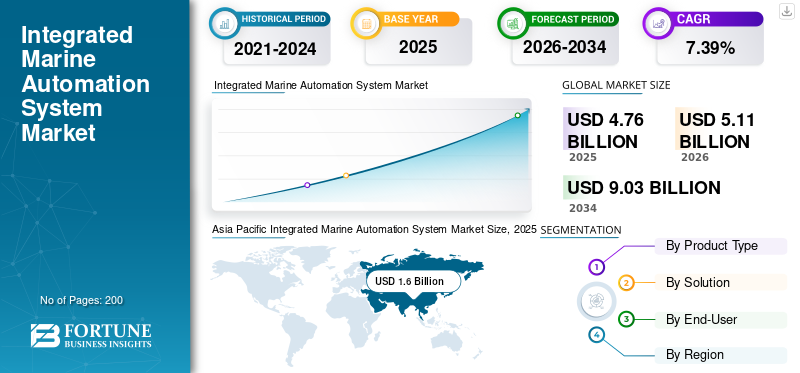
The global integrated marine automation system market size was estimated at USD 4.76 billion in 2025. The market is expected to rise from USD 5.11 billion in 2026 to USD 9.03 billion by 2034, expanding at a CAGR of 7.39% from 2026 to 2034.
Integrated marine automation is a system used to monitor and control operations on a ship. This automation system increases the operational efficiency and safety of the marine vessel. Growing demand for digitalization in the maritime sector is anticipated to increase the growth of the global integrated marine automation market. The short-term impact was observed on the market due to COVID-19 impact. However, the market is expected to recover by the end of 2022.
Download Free sample to learn more about this report.
INTEGRATED MARINE AUTOMATION SYSTEM MARKET KEY TAKEAWAYS
 Global Market Size & Forecast
- 2025 Market Size: USD 4.76 billion
- 2026 Market Size: USD 5.11 billion
- 2034 Forecast Market Size: USD 9.03 billion
- CAGR: 7.39% from 2026–2034
 Market Share
- North America dominated the data center networking market with a market share of 32.76% in 2025.
- The power management system segment is expected to hold a 21.87% share in 2021.
- The commercial is estimated to be the largest and fastest-growing segment throughout the projection period.
 Key Regional Highlights
North America
North America segment is expected to grow due to increasing research and development of marine automation systems.
Europe
The market in Europe is predicted to grow substantially owing to the growing demand for cruise ships and autonomous ships.
Asia Pacific
Asia Pacific accounts for the largest market share with a market size of USD 1.6 billion in 2025.
U.S.
The stringent government norms related to the software and the installation of the product on the advanced ship will have a short-term impact on the growth.
Japan
According to a published report, Japan account for 90% of global cargo ships.
Read More

Integrated Marine Automation System Market Trends
Emergency of Electronic Chart Display and Information System (ECDIS) to Fuel Growth
The ECDIS is a dedicated digital navigation computer. The ECDIS integrates electronic navigation software with modern navigational tools such as RADAR, GPS, ARPA, and others. It stores a set of Raster Charts or Electronic Navigation Charts (ENCs) that display all the essential geographic information to complete a voyage. There is a rise in demand for the integration of ECDI systems in ships as these charts incorporate more data than conventional navigation tools. The system also automates necessary functions such as automatic route planning and monitoring, which reduces crew tasks. The surge in the adoption of ECDI systems in new and old ships is expected to fuel the market's growth. Asia Pacific witnessed integrated marine automation system market growth from USD 1.12 Billion in 2020 to USD 1.20 Billion in 2021.
Download Free sample to learn more about this report.
Integrated Marine Automation System Market Growth Factors
Increased Development of Software Solutions to Optimize the Operational Activities to Boost Growth
Major players are focused on developing software solutions for automating ship operations. The growing development of software to ensure efficient ship operations, vessel traffic management, and ship health monitoring is anticipated to drive the market growth.
- For instance, in September 2020, a U.K.-based company, Windward launched a maritime software Maritime Artificial Intelligence Analytics (MAIA) 4.0 that can search, screen, and analyze dynamic maritime data and learn potential risks. This software is designed to determine voyage irregularities.
Hence, the rising developments in software are anticipated to propel the market growth.
Moreover, the growing adoption of technologies such as Big Data Analytics, the Internet of Things, Artificial Intelligence, and others are expected to augment the integrated marine automation system market growth during the forecast period.
Rising Investment for Incorporation of Information and Communications Technology (ICT) in Ships Expected to Fuel Market Growth
The shipbuilding and shipping companies are investing in the automation of vessels to save cost and increase efficiency of the ship operations. Moreover, increasing research and development of automated solutions by market players is expected to fuel the market growth.
- In July 2020, Sea Machines Robotics, an autonomous vessel software provider, raised USD 15 million in funding to accelerate the deployment of its technologies in an unmanned ship and naval boats.
Growing maritime trade, emerging port infrastructure, and digitalization of ships &shipyards have increased the demand for integrated marine automation systems.
Restraining Factors
Increased Risk of Cyber Threats May Restrain Growth of the Market
The risk of a cyber-attack on a ship increases due to automation. The ships travel via routes mapped by the satellites during their voyages, increasing the risk of cyber threats. The rise in demand for connected ships, autonomous ships, has increased the adoption of integrated marine automation systems. The integration of automation systems is the first step toward automating complete vessels. However, this automation is predicted to make ships vulnerable to cyber-attacks. With growing online threats and attacks worldwide, the Maritime Safety Committee (MSC) from the International Maritime Organization (IMO) has announced provisional guidelines to prevent cyber-attacks on ships’ systems.
Integrated Marine Automation System Market Segmentation Analysis
By Product Type Analysis
Software Segment to Grow at Faster Rate Owing to Increasing Software Development
Based on product type, the integrated marine automation system market is segmented into hardware and software. The hardware segment is anticipated to dominate the market due to the rise in installation of automation systems in old and new ships. The software segment is expected to grow at a higher CAGR during the forecast period due to the growing development of software to increase digitalization in the maritime sector.
By Solution Analysis
To know how our report can help streamline your business, Speak to Analyst
Vessel Management System Segment to Dominate the Market Owing to Rising Adoption to Increase Efficiency
Based on the solution, the market is classified as vessel management, power management, safety, and others. The vessel management system segment is anticipated to lead the market during the forecast period. The segment's growth is attributed to the increased adoption of vessel management systems by naval, marine, and offshore companies to increase ship efficiency by monitoring and controlling the operations. The power management system segment is expected to hold a 21.87% share in 2021.
By End-User Analysis
Commercial Segment to Grow at High CAGR Owing to Rising Shipbuilding Orders and Ship Modernization Contracts
Based on end-user, the market is segmented into commercial and defense. The commercial is estimated to be the largest and fastest-growing segment throughout the projection period. The growth is accredited to the rising shipbuilding orders and ship modernization contracts owing to the growing maritime trade and travel. The rising demand for marine automation systems from OEM and aftermarket companies for installation in new ships and old ships is predicted to augment the market growth.
Regional Analysis
Asia Pacific
Asia Pacific Integrated Marine Automation System Market Size, 2025 (USD Billion)
To get more information on the regional analysis of this market, Download Free sample
The global market is segmented based on region into North America, Europe, Asia Pacific, and Rest of the World.
Asia Pacific accounts for the largest market share with a market size of USD 1.6 billion in 2025 and is anticipated to grow at a higher compound annual growth rate through the projection period. The dominance is attributed to major shipbuilding companies such as China Shipbuilding Industry Corporation, Daewoo Shipbuilding & Marine Engineering, and others that drive the region's integrated marine automation system market.
According to a published report, Japan, South Korea, and China account for 90% of global cargo ships. Hence, the presence of shipbuilding companies supports the automation of ships in the region.
Europe
The market in Europe is predicted to grow substantially owing to the growing demand for cruise ships and autonomous ships. The ongoing ship modernization programs will facilitate the growth of the market in Europe.
North America
North America segment is expected to grow due to increasing research and development of marine automation systems by key players such Honeywell International Inc., General Electric, Emerson Electric Co., and others. The stringent government norms related to the software and the installation of the product on the advanced ship will have a short-term impact on the growth of North America.
Key Industry Players
Market Players Are Using Strategies Such as Collaboration, Investment, Partnerships, and Others to Increase Market Potential
Companies have been concentrating on the automation of ship operations over the last few years. Several companies are taking initiatives to digitalize their ships. There has been a rise in investments in the modernization of capabilities to increase efficiency and decrease costs. Key players are using collaboration and partnership strategies to increase the market potential. For instance, Hoglund signed a partnership agreement with Veracity to assist the ship owners in speeding up their digitalization initiatives.
Other key players are investing in the research and development of automation systems by adopting Artificial Intelligence, the Internet of Things, and Augmented Reality.
List of Top Integrated Marine Automation System Companies:
- ABB (Switzerland)
- Honeywell International, Inc. (U.S.)
- Rolls-Royce PLC (U.K.)
- Wartsila (Finland)
- Kongsberg (Norway)
- Siemens (Germany)
- Hyundai Heavy Industries (South Korea)
- General Electric (U.S.)
- Ingeteam (Spain)
- Emerson Electric Co. (U.S.)
Key Industry Developments:
- In October 2021 –Hoglund was awarded a contract by Sunrise Reliance LLC to supply Automation and Fuel Gas Supply System (FGSS) for retrofitting2400 TEU container ship. Hoglund and COSCO Shipyard Group will work on delivering an integrated solution that includes Power Management System (PMS), FGSS, Ship Performance Monitor (SPM), and full automation of new systems on the ship.
- In November 2021, MJR Power and Automation was awarded a contract to install its marine automation platform MAP-OE on SMS Roman tugboat.
Report Coverage
Request for Customization to gain extensive market insights.
The market report provides a detailed analysis of the industry and focuses on key aspects, such as key players, product types, solutions, and end-user of integrated marine automation systems. Moreover, the research report offers insights into market trends, competitive landscape, market competition, product pricing, control system, and market status, highlighting key industry developments, and segment of the integrated. In addition to the factors mentioned above, it encompasses several direct and indirect factors that have contributed to the sizing of the global market over recent years.
Report Scope & Segmentation
|
ATTRIBUTE |
DETAILS |
|
Study Period |
2026-2034 |
|
Base Year |
2025 |
|
Estimated Year |
2026 |
|
Forecast Period |
2026-2034 |
|
Historical Period |
2021-2024 |
|
Unit |
Value (USD Billion) |
|
Segmentation |
Product Type, Solution, End-User and Geography |
|
By Product Type
|
|
|
|
By Solution
|
|
|
By End-User
|
|
By Geography
|
Europe (By Product Type, Solution, End-User, and Country) rope (By Product Type, Solution, End-User, and Country)
|
Frequently Asked Questions
According to Fortune Business Insights, the global integrated marine automation system market was valued at USD 5.11 billion in 2026 and is projected to reach USD 9.03 billion by 2034, growing at a CAGR of 7.39% during the forecast period.
Registering a CAGR of 7.39%, the market will exhibit steady growth in the forecast period (2026-2034).
The market growth is primarily driven by the increasing digitalization of ship operations, demand for efficient vessel management, and the integration of AI, IoT, and Big Data into maritime systems. These technologies enhance operational safety, reduce manual workload, and improve cost-efficiency.
Which region dominates the integrated marine automation market?
Key technologies include Electronic Chart Display and Information Systems (ECDIS), Artificial Intelligence, Big Data Analytics, Internet of Things (IoT), and cybersecurity solutions for autonomous and connected ship operations.
The biggest challenge is the rising risk of cyber threats. Automated ships are more vulnerable to cyberattacks, prompting strict regulations and increased focus on maritime cybersecurity from bodies like the IMO’s Maritime Safety Committee.
Top market players include ABB, Honeywell International Inc., Rolls-Royce PLC, Wärtsilä, Kongsberg, Siemens, Hyundai Heavy Industries, General Electric, and Emerson Electric Co. These companies are investing in automation, AI, and digital ship technologies.
The future outlook is strong, with increasing demand for smart ships, autonomous vessels, and green shipping technologies. The integration of AI-driven systems for navigation, fuel optimization, and performance monitoring is expected to be a key trend through 2034.



- 2021-2034
- 2025
- 2021-2024
- 200
Get 30-60 hrs Free Customization
Expand Regional and Country Coverage, Segments Analysis, Company Profiles, Competitive Benchmarking, and End-user Insights.




















Related Reports
-
US +1 833 909 2966 ( Toll Free )
-
Get In Touch With Us