IO-Link Wireless Market Size, Share & Industry Analysis, By Component (Hardware and Software), By Device Type (Sensors, Actuators, and Identification Devices), By Industry (Automotive Manufacturing, Electronics & Semiconductor, Food & Beverage, Packaging, Logistics & Warehousing, Industrial Machinery, and Others), and Regional Forecast, 2026 – 2034
 Download Free Sample
IO-LINK WIRELESS MARKET SIZE AND FUTURE OUTLOOK
 Listen to Audio Version
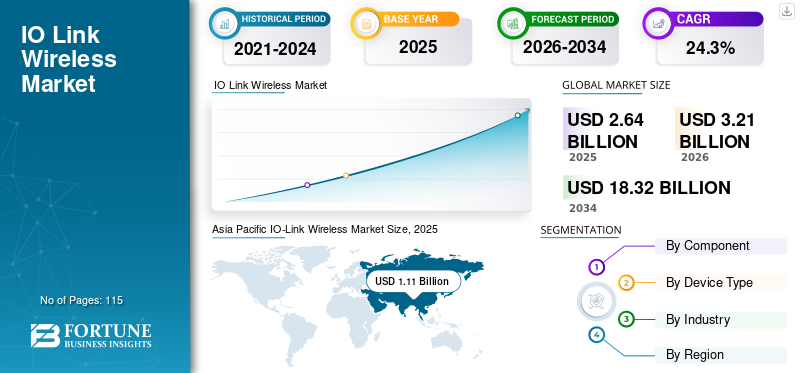
The global IO-Link wireless market size was valued at USD 2.64 billion in 2025. The market is projected to grow from USD 3.21 billion in 2026 to USD 18.32 billion by 2034, exhibiting a CAGR of 24.3% during the forecast period. Asia Pacific dominated the io link wireless market with a market share of 42.05% in 2025.
The global IO-Link wireless market refers to the ecosystem of technologies, devices, and solutions that enable bidirectional, wireless communication between sensors, actuators, and control systems using the IO-Link protocol over wireless networks. The IO-Link market scope includes wireless components and hardware, but not wired components.
IO-Link wireless eliminates the need for physical cabling by enabling low-latency, deterministic communication between field devices and industrial controllers, making it suitable for applications involving moving parts, rotating equipment, modular production lines, and hard-to-wire environments. The IO-Link market includes hardware components such as IO-Link wireless Masters, Wireless Bridges, Wireless Hubs, Wireless End Devices, Antennas, Interface modules, Power units, Gateways, and Communication modules.
Major companies include Balluff GmbH, CoreTigo Ltd., Hilscher Gesellschaft für Systemautomation mbH, ZIMMER GROUP, SMC Corporation, Phoenix Contact GmbH & Co. KG, Helmholz GmbH & Co. KG, CKD Corporation, Mitsubishi Electric Corporation, and SICK AG.
Download Free sample to learn more about this report.
IO-LINK WIRELESS MARKET KEY TAKEAWAYS
 Global Market Size & Forecast
- 2025 Market Size: USD 2.64 billion
- 2026 Market Size: USD 3.21 billion
- 2034 Forecast Market Size: USD 18.32 billion
- CAGR: 24.3% from 2026–2034
 Market Share
- Asia Pacific dominated the io link wireless market with a market share of 42.05% in 2025.
- Software is expected to grow at the highest CAGR of 25.6% over the forecast period.
- Actuators are expected to hold the second-largest share of 29.0% over the forecast period.
 Key Regional Highlights
North America
North America is witnessing a strong push toward reshoring, manufacturing, and the construction of smart factories, accelerating the adoption of IO-Link for efficient machine-level communication.
Europe
Europe is the second-largest revenue shareholder in the market, driven by strong industrial automation ecosystems in Germany, Italy, and France.
Asia Pacific
Asia Pacific was valued at USD 1.11 billion in 2025.
U.S.
The U.S. market was valued at around USD 0.44 billion in 2025, accounting for roughly 16.8% of global sales.
Japan
The Japan market in 2025 was valued at around USD 0.19 billion, accounting for roughly 7.0% of global revenues.
Read More

IO-LINK WIRELESS MARKET TRENDS
Expansion in AGVs, AMRs, and Mobile Robotics to Boost Market Growth
The increasing adoption of Autonomous Mobile Robots (AMRs) and Automated Guided Vehicles (AGVs) in manufacturing plants and warehouses is a major trend driving the IO-Link Wireless market growth.
- According to the International Federation of Robotics, mobile robot installations in logistics and manufacturing are growing rapidly, driven by e-commerce and the push for automation.
Modern industrial environments are shifting toward mobile automation systems to improve material handling, reduce reliance on labor, and enhance operational efficiency, with these systems relying on real-time communication between sensors, actuators, and control systems. IO Link wireless enables low-latency, deterministic communication for mobile robots, supporting seamless data exchange during motion and enhancing navigation, obstacle detection, and safety in dynamic environments such as warehouses and production floors, making it crucial to the growth of mobile automation ecosystems.
MARKET DYNAMICS
MARKET DRIVERS
Download Free sample to learn more about this report.
Transition Toward Sensor-Level Intelligence and Edge Connectivity in Industrial Automation to Fuel Market Expansion
The market is driven by the shift from traditional centralized control systems to decentralized, sensor-level intelligence powered by wireless connectivity. Modern industrial environments now require sensors and actuators to transmit signals and deliver real-time data such as diagnostics and device health, bypassing the limitations of physical wiring.
- According to a February 2024 report by International Data Corporation, over 50% of new industrial IoT deployments across the globe incorporate edge computing, underscoring the need for wireless communication.
IO-Link wireless enables bidirectional, cable-free communication between devices, supporting real-time diagnostics, edge-level decision-making, and flexible automation, especially in dynamic environments such as robotics and AGVs. By eliminating wiring complexities and mobility constraints, it empowers more scalable, agile, and intelligent manufacturing systems in alignment with Industry 4.0.
MARKET RESTRAINTS
Retrofitting Legacy Systems Remains a Key Barrier Restraining Market
The high initial deployment and retrofit complexity of IO-Link wireless primarily stems from the need to integrate a new communication layer into existing industrial environments. Unlike IO-Link wired or wired IO-Link, which can often be added to existing cabling systems, IO-Link wireless requires dedicated infrastructure, such as IO-Link masters, wireless masters, bridges, and network planning tools. Manufacturers must conduct site surveys to evaluate signal coverage, interference, and latency requirements, particularly in environments with heavy machinery, electromagnetic noise, and complex manufacturing processes.
Retrofitting existing control systems to accommodate IO-Link wireless requires modifications to ensure compatibility with PLCs, industrial Ethernet, and broader IO-Link systems, often requiring downtime or phased implementation, which increases both operational risk and costs. The integration of IO-Link devices is also critical for enabling reliable communication among sensors, actuators, and control systems across factory operations.
- According to Berg Insight, these integration challenges in legacy setups remain a key barrier to broader adoption, with ROI highly dependent on specific use cases, which limits large-scale deployment. Companies such as Rockwell Automation are contributing to the ecosystem through industrial automation offerings that support the rising demand for IO Link across connected manufacturing environments.
MARKET OPPORTUNITIES
Adoption of IO-Links in Harsh Industrial Environments to Create Market Opportunities
IO-Link wireless offers a significant opportunity in industrial environments where wired communication is impractical, costly, or unsafe, such as applications involving rotating machinery, moving components, hazardous areas, and remote installations. Traditional cabling in these environments faces limitations such as wear and tear, complex installations, and high maintenance costs, whereas wireless communication eliminates the need for physical connections. In rotating equipment, such as robotic arms and turntables, wired connections often require slip rings or complex cable-management systems, which are prone to failure. In contrast, IO-Link wireless simplifies communication, improving reliability and reducing downtime.
The growing deployment of IO-Link devices, IO-Link masters, and integrated IO-Link systems is further supporting flexible automation architectures by improving communication between sensors, actuators, and control systems across advanced manufacturing processes. This is expected to increase the demand for IO-Link, particularly in smart factories where IO-Link wired and IO-Link wireless technologies are used together to improve machine connectivity, reduce cabling complexity, and support scalable industrial automation.
- According to Siemens Industrial Communication Insights 2023–2024, industrial cabling can account for 20–30% of total automation system costs.
IO-Link Wireless also enables safe and efficient monitoring in harsh environments, such as oil & gas and mining, without exposing personnel to risk or adding infrastructure complexity.
SEGMENTATION ANALYSIS
By Component
Hardware Led Market Due to Its Essential Role in Physical Communication and Connection Between Industrial Devices
Based on the component, the market is divided into hardware and software.
Hardware held the largest market share in 2025 due to its fundamental role in physical communication and connection between industrial devices, forming the backbone of IO-Link wireless networks. The demand for robust and reliable hardware components, such as sensors, actuators, and communication modules, has significantly contributed to its market dominance.
Software is expected to grow at the highest CAGR of 25.6% over the forecast period, driven by advanced data processing and analytics capabilities and seamless integration with other IoT systems. As industries increasingly adopt automation and data-driven solutions, the need for sophisticated software platforms to manage, analyze, and optimize operations continues to rise.
By Device Type
Sensors Dominated Due to Their Key Role in Real-time Data Capture for Automation
Based on device type, the market is distributed into sensors, actuators, and identification devices.
Sensors held the largest market share in 2025 at 55.1%, as they are essential for capturing real-time data from industrial processes, which is crucial for automation, monitoring, and control. The growing need for data-driven decision-making and predictive maintenance across industries has driven strong demand for sensors.
Actuators are expected to hold the second-largest share of 29.0% over the forecast period, as they directly execute actions based on sensor data, enabling automation and enhancing production efficiency. Additionally, the increasing adoption of automation across industries such as manufacturing and automotive is driving strong demand for actuators in IO-Link systems.
By Industry
To know how our report can help streamline your business, Speak to Analyst
Automotive Manufacturing Dominates Due to Its Reliance on Automation and Real-time Monitoring
By industry, the market is segmented into automotive manufacturing, electronics & semiconductor, food & beverage, packaging, logistics & warehousing, industrial machinery, and others.
Automotive manufacturing dominates the market share in 2025 at 25.5%, driven by its heavy reliance on automation, real-time monitoring, and seamless system integration to improve production lines and operational efficiency. The automotive sector's focus on improving productivity, reducing downtime, and optimizing supply chains has led to widespread adoption of IO-Link wireless solutions.
The electronics and semiconductor segment is expected to record the highest CAGR of 27.3% over the forecast period, driven by advancements in smart devices, precision manufacturing, and connectivity, which are increasing demand for more sophisticated automation solutions. The ongoing trend toward miniaturization and the growing demand for higher processing speeds in electronics are expected to fuel the adoption of IO-Link wireless technology.
IO-Link Wireless Market Regional Outlook
By geography, the market is categorized into North America, South America, Europe, Middle East & Africa, and Asia Pacific.
Asia Pacific
Asia Pacific IO-Link Wireless Market Size, 2025 (USD Billion)
To get more information on the regional analysis of this market, Download Free sample
Asia Pacific was valued at USD 1.11 billion in 2025. The region dominates the global market primarily due to aggressive adoption of factory automation and increasing investment in electronics and semiconductor production. These industries require high-precision, real-time communication systems, driving demand for IO-Link-enabled smart sensors and devices for quality control and process optimization. IO-Link enables cost-effective sensor-level communication, making it highly attractive for brownfield and greenfield automation projects in these markets.
- In July 2024, China reinforced its smart manufacturing initiatives under the “Made in China” policy framework, focusing on upgrading industrial infrastructure with advanced automation and intelligent communication technologies.
Japan IO-Link Wireless Market
The Japan market in 2025 was valued at around USD 0.19 billion, accounting for roughly 7.0% of global revenues.
China IO-Link Wireless Market
China’s market is projected to be one of the largest in the world, with 2025 sales valued at around USD 0.43 billion, representing roughly 16.3% of global sales.
India IO-Link Wireless Market
The India market in 2025 was valued at around USD 0.11 billion, accounting for roughly 4.1% of global revenues.
North America
North America is witnessing a strong push toward reshoring, manufacturing, and the construction of smart factories, accelerating the adoption of IO-Link for efficient machine-level communication. Higher demand for IO-Link-enabled devices in new manufacturing facilities, owing to increased deployment of smart sensors and automation systems.
- The U.S. government’s CHIPS and Science Act (2022 ongoing implementation) is driving billions of dollars in semiconductor and advanced manufacturing investments across states such as Arizona, Texas, and Ohio.
U.S. IO-Link Wireless Market
The U.S. market was valued at around USD 0.44 billion in 2025, accounting for roughly 16.8% of global sales.
Europe
Europe is the second-largest revenue shareholder in the market, driven by strong industrial automation ecosystems in Germany, Italy, and France. The region emphasizes high-precision manufacturing and standardized communication protocols, accelerating IO-Link adoption across factory automation.
- In March 2024, the European Commission’s Industry 5.0 initiative continued to promote smart and sustainable manufacturing across member states, encouraging the adoption of digital communication technologies such as IO-Link.
U.K. IO-Link Wireless Market
The U.K. market in 2025 was valued at approximately USD 0.11 billion, accounting for roughly 4.2% of global revenues.
Germany IO-Link Wireless Market
Germany’s market was valued at USD 0.18 billion in 2025, equivalent to around 6.6% of global sales.
Middle East & Africa
The Middle East & Africa region is in the early adoption phase of IO-Link, with growth primarily driven by investments in oil & gas, energy, infrastructure, and industrial diversification projects.
The oil & gas sector plays a dominant role in the region, where IO-Link-enabled sensors are increasingly used for real-time monitoring of pressure, temperature, and flow parameters to enhance operational efficiency and safety.
- In November 2023, Saudi Arabia continued implementing Vision 2030, focusing on industrial diversification and the adoption of advanced manufacturing technologies, including smart automation systems.
GCC IO-Link Wireless Market
The GCC market was valued at USD 0.06 billion in 2025, accounting for roughly 2.2% of global revenues.
South America
South America is an emerging market, driven by gradual industrial modernization, increasing automation adoption, and investments in key sectors such as mining, agriculture, food processing, and energy.
Brazil dominates the regional market due to its strong industrial base, particularly in automotive manufacturing and food processing industries, where IO-Link is increasingly used for process monitoring and efficiency improvements.
- In May 2024, Brazil’s National Development Bank (BNDES) announced financing initiatives to support industrial digitalization and automation, encouraging the adoption of advanced communication technologies.
Brazil IO-Link Wireless Market
The Brazil market in 2025 was valued at around USD 0.05 billion, accounting for roughly 1.8% of global revenues.
COMPETITIVE LANDSCAPE
Key Industry Players
Key Players Launch New Solutions to Strengthen Market Positioning
Leading players launch new solutions to enhance their market positioning by leveraging technological advancements, addressing diverse consumer needs, and staying ahead of competitors. They prioritize portfolio enhancement, strategic collaborations, and acquisitions and partnerships to strengthen their offerings. Such strategic launches enable technology companies to maintain and expand their IO-Link Wireless market share in a rapidly evolving landscape.
LIST OF KEY IO-LINK WIRELESS COMPANIES PROFILED
- Balluff GmbH (Germany)
- CoreTigo Ltd. (Israel)
- Hilscher Gesellschaft für Systemautomation mbH (Germany)
- ZIMMER GROUP (Germany)
- SMC Corporation (Japan)
- Phoenix Contact GmbH & Co. KG (Germany)
- Helmholz GmbH & Co. KG (Germany)
- CKD Corporation (Japan)
- Mitsubishi Electric Corporation (Japan)
- SICK AG (Germany)
KEY INDUSTRY DEVELOPMENTS
- March 2026: Hilscher launched the cifX PCIE90-RE and cifX LPCIE90-RE PC cards, designed for secure, multiprotocol industrial communication via PCI Express, enabling high-performance connectivity in PC-based automation systems.
- March 2026: SMC Corporation officially commenced operations at its new Japan Technical Center (JTC) in Kashiwa City, within the Tokyo metropolitan region. This facility serves as the company’s primary global hub for research and development, aimed at accelerating innovation, strengthening advanced engineering capabilities, and reinforcing SMC’s technological leadership in industrial automation across the globe.
- January 2026: Zimmer Group expanded its portfolio within the GPP5000AL and GPD5000AL gripper series by introducing the new GPP5025AL 2-jaw parallel gripper and GPD5016AL 3-jaw centric gripper, addressing gaps in size ranges and providing enhanced flexibility for pneumatic gripper design.
- November 2025: Balluff showcased its latest industrial automation solutions at SPS 2025, highlighting innovations in sensor technology, industrial networking, and digital automation systems to improve manufacturing efficiency and machine connectivity.
- November 2025: Phoenix Contact showcased its latest industrial networking and IO-Link integration solutions at SPS 2025, highlighting advancements in smart factory connectivity, modular automation, and real-time data communication.
- May 2025: CoreTigo showcased its latest IO-Link Wireless solutions at SPS 2025, highlighting applications in robotics, AMRs, and smart manufacturing with multiple ecosystem partners.
- March 2025: CKD Corporation expanded its digital automation portfolio by introducing enhanced IO-Link compatible pneumatic control systems, aimed at improving data visibility and enabling easier integration with IO-Link wireless networks in smart factory environments.
REPORT COVERAGE
The global IO-link wireless market analysis provides an in-depth study of the size & forecast by all the market segments included in the report. It includes details on the market dynamics and market trends expected to drive the market in the forecast period. It offers information on the technological advancements, key developments, and details on partnerships, mergers & acquisitions. The market research report also includes a detailed competitive landscape, providing market share and profiles of key players.
Request for Customization to gain extensive market insights.
REPORT SCOPE & SEGMENTATION
| ATTRIBUTE | DETAILS |
| Study Period | 2021-2034 |
| Base Year | 2025 |
| Estimated Year | 2026 |
| Forecast Period | 2026-2034 |
| Historical Period | 2021-2024 |
| Growth Rate | CAGR of 24.3% from 2026 to 2034 |
| Unit | Value (USD Billion) |
| Segmentation | By Component, By Device Type, By Industry, and By Region |
| By Component |
|
| By Device Type |
|
| By Industry |
|
| By Region |
|
Frequently Asked Questions
Fortune Business Insights says that the global market value stood at USD 2.64 billion in 2025 and is projected to reach USD 18.32 billion by 2034.
In 2025, the market value in Asia Pacific stood at USD 1.11 billion.
The market is expected to grow at a CAGR of 24.3% over the forecast period.
By industry, the automotive manufacturing led the market in 2025.
The key factor driving the market is the transition toward sensor-level intelligence and edge connectivity in industrial automation.
Balluff GmbH, CoreTigo Ltd., Hilscher Gesellschaft für Systemautomation GmbH, and ZIMMER GROUP are some of the prominent players in the market.
Asia Pacific dominated the market in 2025.
The major factors expected to favor product adoption include reduced installation costs, improved system reliability, seamless integration with existing automation systems, and the growing trend of Industry 4.0 and smart manufacturing initiatives.


- 2021-2034
- 2025
- 2021-2024
- 115
Get 30-60 hrs Free Customization
Expand Regional and Country Coverage, Segments Analysis, Company Profiles, Competitive Benchmarking, and End-user Insights.




















Related Reports
-
US +1 833 909 2966 ( Toll Free )
-
Get In Touch With Us