 Download Free Sample



Get a Quote
Receive a tailored pricing based on your needs.
- Choose license type
- Multiple user options
- Custom scope & coverage
- Fast turnaround
"Designing Growth Strategies is in our DNA"

(Offer valid till 15th Nov 2026)
 Listen to Audio Version
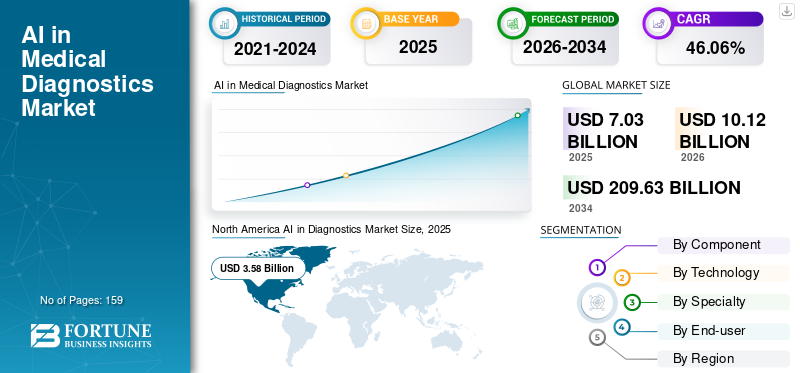
The global AI in diagnostics market size was valued at USD 7.03 billion in 2025. The market is projected to grow from USD 10.12 billion in 2026 to USD 160.54 billion by 2034, exhibiting a CAGR of 41.27% during the forecast period.
AI-based diagnostic solutions are mainly used in diagnostic imaging, pathology, cardiology, oncology, ophthalmology, and in-vitro diagnostics. The market is expected to witness exponential growth in the coming years as healthcare providers are increasingly adopting artificial intelligence in daily operations. Additionally, increasing regulatory clearances, partnerships between technology companies and healthcare providers, and the expansion of enterprise AI platforms are strengthening commercial adoption across major markets.
Major players, such as Amazon.com, Inc., Microsoft Corporation, NVIDIA Corporation, and Alphabet Inc., are actively participating in strategic collaborations and acquisitions to expand their offerings, facilitate interchangeability, enhance market access, and strengthen their market presence.
Download Free sample to learn more about this report.
Transition from Standalone AI Tools to Enterprise Diagnostic Platforms to Emerge as a Key Market Trend
One of the prominent emerging market trends is the shift toward enterprise-scale platforms capable of integrating multiple AI applications within a unified clinical workflow. Hospitals and diagnostic laboratories increasingly require solutions that can connect with existing information systems while supporting centralized case management, workflow orchestration, collaboration, and deployment of multiple AI algorithms. The transition enables healthcare providers to scale AI across departments and locations rather than implementing separate solutions for each diagnostic use case, thereby reducing integration complexity and improving operational efficiency. Major companies are introducing solutions in alignment with the trend.
Download Free sample to learn more about this report.
Pressure to Reduce Diagnostic Turnaround Times and Improve Clinical Workflow Efficiency to Drive Market Growth
Rising diagnostic volumes have resulted in increasing pressure on radiologists and pathologists, requiring healthcare systems to deliver faster clinical decisions. These factors are accelerating the adoption of AI-based diagnostic solutions, as demand for early and accurate diagnosis increases. Conventional diagnostic workflows often require specialists to manually review large volumes of imaging, pathology, and laboratory data, which can create reporting backlogs and delay treatment initiation. AI can automatically analyze diagnostic data, flag suspected abnormalities, prioritize high-risk cases, and support reporting, thereby allowing clinicians to focus attention on cases requiring immediate intervention. As hospitals increasingly seek to manage workforce constraints, the ability of AI to shorten interpretation times is becoming an important factor driving demand in the market.
Market Drivers - Impact & CAGR Contribution (2026–2034)
| Rank | Market Drivers | Expected Impact on Market Growth | Estimated Gross Market Growth Contribution (USD Billion) | Impact: 2026-2028 | Impact: 2029-2031 | Impact: 2032-2034 |
|---|---|---|---|---|---|---|
| 1 | Pressure to Reduce Diagnostic Turnaround Times and Improve Clinical Workflow Efficiency | High | 43.00 | High | High | High |
| 2 | Rapid Digitization of Medical Imaging, Pathology, and Diagnostic Workflows | High | 38.00 | Medium | High | High |
| 3 | Expansion of Enterprise-Scale AI Deployment Across Health Systems | High | 31.00 | High | High | Medium |
| 4 | Increasing Regulatory Clearances and Clinical Validation of Diagnostic AI | Medium-High | 27.00 | Medium | High | High |
| 5 | Expansion into New Diagnostic Specialties, Screening Programs, and Multimodal Diagnostics | Medium | 25.00 | Medium | Medium | High |
| 6 | Others | Low | 12.00 | Low | Low | Low |
| Total Positive Growth Contribution | 176 | |||||
Source: Fortune Business Insights
Download Free sample For In-Depth Market Restraints & Risk Analysis
High Implementation and Integration Costs Limiting Adoption Across Smaller Healthcare Facilities to Hamper Market Growth
The deployment of AI-enabled diagnostic solutions requires significant upfront and recurring investments in software licensing, computing and cloud infrastructure, among other costs. In particular, AI applications must often be integrated with existing PACS, RIS, LIS, EHR, digital pathology, and other hospital information systems, which can require customized interfaces and dedicated IT resources. While large hospitals and integrated health systems can distribute these investments across substantial diagnostic volumes, smaller hospitals, independent diagnostic centers, and laboratories may find the total cost of ownership difficult to justify.
Market Restraints - Impact & Negative CAGR Contribution (2026–2034)
| Rank | Market Restraints | Expected Impact on Market Growth | Estimated Reduction in Market Size (USD Billion) | Impact: 2026-2028 | Impact: 2029-2031 | Impact: 2032-2034 |
|---|---|---|---|---|---|---|
| 1 | High Implementation Costs, Interoperability Issues, and Legacy IT Complexity | High | 10.50 | High | High | Medium |
| 2 | Regulatory, Data Privacy, Cybersecurity, and Clinical Liability Complexity | Medium-High | 8.00 | High | Medium | Medium |
| 3 | Uncertain Reimbursement, ROI, and Clinical Adoption | Medium | 5.00 | Medium | Medium | Low |
| 4 | Others | Low | 2.08 | Low | Low | Low |
| Total Negative Growth Impact | 25.58 | |||||
Source: Fortune Business Insights
Download Free sample For In-Depth Market Restraints & Risk Analysis
Expansion of Reimbursement for Clinically Differentiated AI-Based Diagnostic Services to Offer Significant Growth Opportunities
The expansion of reimbursement represents a significant opportunity for the global AI in diagnostics market growth. Lack of dedicated payment pathways has historically limited hospitals’ ability to recover the incremental cost of adopting AI-based diagnostic technologies. As payers increasingly recognize AI services that provide measurable clinical value, AI can transition from being treated primarily as an operational expense to a separately identifiable, reimbursable diagnostic service. Dedicated reimbursement can improve the business case for hospitals and diagnostic centers, potentially improve purchasing decisions, encourage routine utilization, and enable vendors to develop sustainable per-procedure or recurring revenue models.
Limited Interoperability with Existing Hospital and Diagnostic IT Infrastructure to Remain a Significant Challenge
Limited interoperability remains an important challenge for AI-powered diagnostics solutions, as they must operate within complex healthcare IT environments comprising PACS, RIS, LIS, EHRs, imaging archives, reporting systems, and equipment from multiple vendors. Differences in data formats, interfaces, workflow configurations, and legacy infrastructure can make it difficult to exchange images, clinical information, and AI-generated results between systems. The challenge becomes more significant as hospitals attempt to deploy multiple AI algorithms from different vendors across several diagnostic departments.
Recurring Deployment and Integration Requirements Supported Software & Services Segment Leadership
Based on the component, the market is categorized into software & services and hardware.
The software & services segment dominated the AI in diagnostics market share in 2025, as it is the primary analytical functionality of AI-based diagnostic solutions. Healthcare providers can deploy these solutions over their existing imaging, pathology, laboratory, and hospital IT infrastructure, reducing the requirement to purchase dedicated AI hardware for every new application. Also, software platforms require recurring licensing, cloud hosting, algorithm updates, interoperability support, implementation, and performance monitoring, generating continued expenditure throughout the product lifecycle. Such recurring revenue generation potential drives segmental dominance, further encouraging key companies to develop innovative products.
The hardware segment is expected to grow at a CAGR of 36.06% over the forecast period.
To know how our report can help streamline your business, Speak to Analyst
Broad Diagnostic Applicability and Model Scalability Supported Machine Learning Dominance
Based on technology, the market is segmented into machine learning, natural language processing (NLP), and others.
In 2025, the machine learning segment captured the largest share in the market, as it provides the underlying pattern-recognition capability required for many high-value diagnostic applications. These technologies are particularly suited to large diagnostic datasets such as radiology images and digitized pathology slides, enabling models to recognize disease patterns that would otherwise require extensive manual interpretation. As a result, machine learning has achieved substantially broader clinical applicability across diagnostic specialties, supporting its larger market contribution.
The natural language processing (NLP) segment is projected to grow at a CAGR of 45.30% during the forecast period.
High Diagnostic Complexity and Biomarker-Driven Treatment Decisions Positioned Oncology at the Forefront
Based on application, the market is segmented into oncology, cardiology, neurology, pulmonology, infectious diseases, and others.
The oncology segment dominated the market in 2025. Cancer diagnosis involves multiple data-intensive stages, ranging from screening and lesion detection to histopathology, molecular profiling, biomarker identification, staging, prognosis, and treatment selection. These varied processes generate large volumes of data and elevate the demand for AI solutions in diagnostics to catalyze the process. AI can support tumor detection, classification, biomarker prediction, patient stratification, and treatment-response assessment, thereby extending its commercial applicability beyond initial diagnosis. Underscoring these factors, key companies are increasingly directing their resources toward new product launches.
The cardiology segment is projected to grow at a CAGR of 41.68% during the forecast period.
Large Imaging Volumes and Mature Digital Infrastructure Boosted Medical Imaging Leadership
Based on modality, the market is segmented into medical imaging, digital pathology, and others.
The medical imaging segment dominated the market in 2025, as radiology is among the earliest diagnostic specialties to generate large volumes of standardized digital data. High examination volumes and persistent radiologist workload pressures further create a measurable operational benefit from automated medical image analysis. Key companies are increasingly focusing on new product launches and their subsequent approval from regulatory bodies to capitalize on the segment’s growth potential.
The others segment is projected to grow at a CAGR of 53.89% over the forecast period.
High Patient Throughput and Enterprise-Scale AI Deployment Supported Hospital & Clinics Dominance
Based on end user, the market is segmented into hospitals & clinics, diagnostics & imaging centers, pathology & clinical laboratories, and others.
The hospitals & clinics segment dominated the market in 2025, as these facilities concentrate a substantial share of complex and acute diagnostic activity and operate multiple diagnostic departments. Large health systems also possess greater purchasing capacity, dedicated IT resources, clinical governance structures, and specialist teams needed to validate and monitor AI systems. As healthcare providers move from individual algorithms toward multi-specialty enterprise deployments, hospitals can generate considerably higher utilization and contract values than smaller standalone diagnostic facilities.
The pathology & clinical laboratories segment is projected to grow at a CAGR of 43.53% over the forecast period.
By geography, the market is categorized into Europe, North America, Asia Pacific, Latin America, and the Middle East & Africa.
North America AI in Diagnostics Market Size, 2025 (USD Billion)
To get more information on the regional analysis of this market, Download Free sample
North America was valued at USD 2.54 billion in 2024 and maintained its leading position with a value of USD 3.58 billion in 2025. Rapid hospital adoption of AI-enabled imaging and clinical decision-support solutions and strong digital health infrastructure are fueling market expansion in the region.
Given North America's substantial contribution and the U.S. dominance in the region, the U.S. market is estimated at around USD 4.66 billion in 2026, accounting for roughly 45.99% of global revenues.
Europe is projected to grow at a CAGR of 38.09% in the coming years. The region is set to reach a valuation of USD 1.99 billion in 2026, becoming the third-largest market by region. The region is witnessing growth due to wider digitization of radiology and pathology workflows, increasing implementation of AI across public healthcare systems, and strong regulatory emphasis on validated medical AI solutions.
The U.K. market is estimated at USD 0.34 billion in 2026, accounting for roughly 3.31% of global revenues.
The market in Germany is projected to reach approximately USD 0.47 billion in 2026, equivalent to around 4.69% of global revenues.
Asia Pacific is estimated to reach USD 2.30 billion in 2026 and secure the second-largest position in the market. The Asia Pacific market is expanding rapidly due to large patient populations, rising diagnostic volumes, shortages of radiologists and other specialists, and growing investment in digital healthcare infrastructure.
The Japanese market in 2026 is estimated at around USD 0.51 billion, accounting for approximately 5.06% of global revenues.
The market in China is projected to be among the largest globally, with 2026 revenues estimated at around USD 0.86 billion, accounting for approximately 8.47% of global revenues.
The Indian market in 2026 is estimated at around USD 0.35 billion, accounting for roughly 3.49% of global revenues.
Latin America is expected to witness moderate growth in this market during the forecast period. The market in Latin America is estimated to reach a valuation of USD 0.43 billion in 2026. Growth is supported by increasing modernization of hospital and diagnostic infrastructure, expansion of private healthcare networks, and rising adoption of cloud-based AI solutions that require lower upfront infrastructure investment. In the Middle East & Africa, the GCC is set to reach USD 0.13 billion in 2026.
The South African market is projected to reach approximately USD 0.04 billion in 2026, accounting for roughly 0.43% of global revenues.
Focus on AI-Enabled Product Expansion and Enterprise Deployment to Strengthen Market Position
The global AI in diagnostics market has a competitive and moderately fragmented structure, with companies such as Siemens Healthineers, Microsoft Corporation, NVIDIA Corporation, Alphabet Inc. (Google), Amazon.com, Inc., Aidoc, PathAI, and Tempus AI establishing strong positions across medical imaging, digital pathology, autonomous diagnostics, and diagnostic AI infrastructure. The competitive position of these companies is supported by continuous product innovation, regulatory clearances, integration with existing diagnostic workflows, strategic healthcare partnerships, and expansion of enterprise-scale AI platforms. Companies are increasingly focusing on moving AI solutions from individual diagnostic algorithms toward broader platforms that can support multiple clinical applications, enabling greater adoption across hospitals, laboratories, and diagnostic centers.
Other notable players in the global market include Digital Diagnostics and Qure.ai. These companies are expected to prioritize new algorithm launches, regulatory approvals, expansion into additional diagnostic indications, hospital partnerships, and integration of AI capabilities to strengthen their market presence during the forecast period for the global market.
The global AI in diagnostics market report provides market size estimates and forecasts for all key segments covered in the study. The market outlook also evaluates the key drivers, restraints, opportunities, challenges, and emerging trends expected to influence market growth during the forecast period. The report also presents a comprehensive global market analysis and a detailed competitive landscape covering estimated market shares, AI diagnostic product portfolios, platform capabilities, regulatory approvals, clinical validation strategies, strategic partnerships, collaborations, product launches, geographic presence, recent developments, and profiles of key market participants.
Request for Customization to gain extensive market insights.
| ATTRIBUTE | DETAILS |
| Study Period | 2021-2034 |
| Base Year | 2025 |
| Estimated Year | 2026 |
| Forecast Period | 2026-2034 |
| Historical Period | 2021-2024 |
| Growth Rate | CAGR of 41.27% from 2026 to 2034 |
| Unit | Value (USD Billion) |
| Segmentation | By Component, Technology, Application, Modality, End User, and Region |
| By Component |
|
| By Technology |
|
| By Application |
|
| By Modality |
|
| By End User |
|
| By Region |
|
Approach 1: Diagnostic Procedure Volume & AI-Addressable Examination Analysis
Approach 2: Installed Base & AI Attach-Rate Analysis
Approach 3: Company Revenue & Market Participation Analysis
Approach 1: Analysis of Parent & Adjacent Markets and Institutional Data
Supply Side Interviews: 60%
Demand Side Interviews: 40%
According to Fortune Business Insights, the global market value stood at USD 7.03 billion in 2025 and is projected to reach USD 160.54 billion by 2034.
In 2025, the market value stood at USD 3.58 billion in North America.
The market is expected to grow at a CAGR of 41.27% over the forecast period of 2026-2034.
The software & services segment led the market by component.
Pressure to reduce diagnostic turnaround times and improve clinical workflow efficiency is driving market growth.
Amazon.com, Inc., Microsoft Corporation, NVIDIA Corporation, and Alphabet Inc. are among the major players in the global market.
North America dominated the market in 2025.

(Offer valid till 15th Nov 2026)
Get 30-60 hrs Free Customization
Expand Regional and Country Coverage, Segments Analysis, Company Profiles, Competitive Benchmarking, and End-user Insights.













.webp)






Related Reports
Get In Touch With Us
US +1 833 909 2966 ( Toll Free )
Receive a tailored pricing based on your needs.
Discuss your questions with our industry experts.
Have questions? Get quick answers before you purchase.

