Laminated Tube Market Size, Share & Industry Analysis, By Material (Plastics, Aluminum, and Others), By Capacity (Below 50 ml, 51 to 100 ml, 101 to 150 ml, and Above 150 ml), By Application (Personal Care & Cosmetics, Consumer Goods, Pharmaceuticals, Food, and Others), and Regional Forecast, 2026-2034
 Download Free Sample
(Offer valid till 15th Oct 2026)

Laminated Tube Market Size and Future Outlook
 Listen to Audio Version
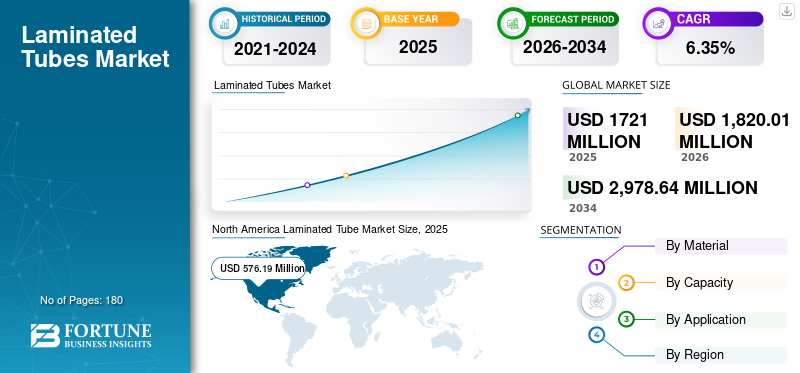
The global laminated tube market size was valued at USD 1,721.00 million in 2025. The market is projected to grow from USD 1,820.01 million in 2026 to USD 2,978.64 million by 2034, exhibiting a CAGR of 6.35% during the forecast period. North America dominated the global laminated tube market with a market share of 33.48% in 2025.
The global laminated tube market encompasses the sector involved in the manufacturing, distribution, and utilization of multi-layered tubes composed of various combinations of plastic films, aluminum foil, or mono-material laminates. They find extensive application in personal care, cosmetics, oral care, pharmaceuticals, and food industries, owing to their capability to maintain product integrity, prolong shelf life, and enhance premium branding through sophisticated printing and finishing techniques.
Furthermore, the market is dominated by several key players, including Amcor Plc, CCL Industries Inc., and Huhtamäki Oyj at the forefront. A broad portfolio, innovative product launches, and strong geographic presence expansion have supported the dominance of these companies in the global markets.
Download Free sample to learn more about this report.
Laminated Tube Market Key Takeaways
 Global Market Size & Forecast
- 2025 Market Size: USD 1,721.00 million
- 2026 Market Size: USD 1,820.01 million
- 2034 Forecast Market Size: USD 2,978.64 million
- CAGR: 6.35% from 2026–2034
 Market Share
- North America dominated the laminated tube market with a 33.48% share in 2025.
- The Plastics segment led the market with a 52.60% share in 2025.
- The Personal Care & Cosmetics segment accounted for 33.68% of the market in 2025.
 Key Regional Highlights
North America
North America reached USD 576.19 million in 2025, holding a 33.48% market share.
Asia Pacific
Asia Pacific was valued at USD 355.04 million in 2025 and is projected to grow at a 7.48% CAGR.
Europe
Europe recorded USD 450.73 million in 2025.
U.S
The laminated tube market was valued at USD 473.74 million in 2025.
Japan
The market is expected to witness steady growth, supported by demand for sustainable packaging.
Read More

MARKET DYNAMICS
MARKET DRIVERS:
Growing Demand for Barrier-Enhanced and Premium Packaging Boosts Market Growth
The global market for laminated tubes is propelled by the growing demand for high-barrier, premium, and aesthetically pleasing packaging in the personal care, cosmetics, oral care, and pharmaceutical sectors. Laminated tubes provide robust protection against oxygen, moisture, UV light, and contamination, thereby ensuring extended shelf life and product stability. Their capability to accommodate high-quality graphics, 360-degree printing, and either metallic or matte finishes boosts brand attractiveness, rendering them a favored option for premium market segments. Moreover, the rising consumption of skincare and cosmetic products in developing economies contributes to the laminated tube market growth.
MARKET RESTRAINTS:
Recycling Complexity and Raw Material Volatility Obstruct Market Growth
A significant limitation for the market is the challenge of recyclability associated with multi-layer laminates, particularly those that include aluminum barriers, which complicate sorting and recycling efforts. This situation generates compliance pressure as international regulations progressively support mono-material and recyclable packaging. Additionally, fluctuations in the prices of raw materials such as plastic resins and aluminum foil have a direct impact on production expenses. The competition posed by extruded plastic tubes, pouches, and various other flexible packaging formats further intensifies the challenges faced by the adoption of laminated tubes in specific applications.
MARKET OPPORTUNITIES:
Shift Toward Recyclable and Mono-Material Laminated Tubes Generates Lucrative Opportunities
The increasing emphasis on sustainability presents substantial opportunities for manufacturers to develop recyclable, mono-material PE and PP laminated tubes that align with global circular economy efforts. There is a growing demand for eco-friendly packaging in sectors such as cosmetics, pharmaceuticals, nutraceuticals, and food, which is paving the way for new business opportunities. The rapid expansion in emerging markets, driven by rising disposable incomes and increased personal care consumption, also presents considerable growth potential. Moreover, advancements in digital printing and short-run customization allow brands to introduce limited editions and personalized packaging, thereby generating additional revenue streams.
MARKET CHALLENGES:
Balancing Performance, Regulation, and Cost Challenge Market Growth
The laminated tube market faces challenges in balancing the demand for superior barrier performance with sustainability requirements. Achieving ideal barrier characteristics often requires multi-layer constructions, which conflict with recyclability objectives and regulatory standards promoting mono-material packaging. The rising compliance demands associated with food and pharmaceutical packaging introduce further complexity and elevate certification expenses. Moreover, the necessity for advanced lamination, printing, and forming technologies poses an entry barrier for small and medium-sized manufacturers, thereby restricting scalability within the industry.
LAMINATED TUBE MARKET TRENDS:
Sustainability, Premiumization, and Digital Printing Are Emerging as Key Trends
Significant trends influencing the market include a transition toward sustainable designs, such as reduced-aluminum, fully plastic, and PCR-integrated tubes. Brands are increasingly embracing premium finishes, including matte textures, soft-touch coatings, metallic accents, and holographic designs, to enhance their visual presence on the shelf. Digital printing is gaining popularity due to its adaptability, lower initial costs, and ability to support short production runs, personalization, and rapid market testing. Additionally, lightweighting, tamper-evident features, and the incorporation of smart packaging elements, such as QR codes, are emerging as pivotal trends that are shaping packaging strategies.
Download Free sample to learn more about this report.
Segmentation Analysis
By Material
Excellent Balance of Plastic Material Features Fuels Its Dominance
In terms of material, the market is categorized as plastics, aluminum, and others.
The plastics segment captured the largest laminated tube market share in 2025 with a 52.60% share. The segment of plastic materials leads the market primarily due to its outstanding combination of flexibility, durability, barrier performance, and cost effectiveness, which makes it ideal for large-scale production in personal care, cosmetics, oral care, and pharmaceuticals. Materials such as polyethylene (PE) and polypropylene (PP) offer robust structural integrity while facilitating lightweight designs, thereby lowering transportation and handling expenses for manufacturers and brands. Additionally, their compatibility with cutting-edge printing technologies enables high-quality graphics, premium finishes, and branding customization, all of which are crucial in competitive consumer markets.
The aluminum material segment is expected to grow at a CAGR of 6.09% over the forecast period.
By Capacity
51 to 100 ml Segment Led Market Due to Rising Utilization in Various End-use Sectors
In terms of capacity, the market is categorized into below 50 ml, 51 to 100 ml, 101 to 150 ml, and above 150 ml.
The 51 to 100 ml segment held leadership in 2025, with a 38.43% share. The segment of 51 to 100 ml leads the market due to its optimal combination of product quantity, portability, and cost-effectiveness, rendering it the favored option in essential applications such as skincare, cosmetics, oral care, and pharmaceuticals. This size category is particularly suitable for daily-use items such as face creams, gels, lotions, toothpaste, and topical treatments, offering sufficient volume for routine use while remaining compact.
The below 50 ml capacity segment is expected to grow at a CAGR of 6.98% over the forecast period.
By Application
Personal Care & Cosmetics Segment Led Market Due to High Barrier and Aesthetic Requirements
Based on application, the market is segmented into personal care & cosmetics, consumer goods, pharmaceuticals, food, and others.
In 2024, the global market was dominated by personal care and cosmetics in terms of application. Furthermore, the segment held a 33.68% share in 2025. The personal care and cosmetics sector dominates the market, as these items necessitate packaging that merges high-quality aesthetics, robust barrier characteristics, and user-friendliness, all of which laminated tubes provide efficiently. Furthermore, this sector is bolstered by the increasing global demand for skincare, beauty, and grooming personal care products, particularly fueled by urbanization, rising disposable incomes, and the impact of social media and e-commerce.
Additionally, the application of consumer goods is projected to grow at a CAGR of 6.49% during the study period.
To know how our report can help streamline your business, Speak to Analyst
Laminated Tube Market Regional Outlook
By geography, the market is categorized into Europe, North America, Asia Pacific, Latin America, and the Middle East & Africa.
North America
North America held the dominant share in 2024, valued at USD 543.72 million, and maintained its leading position in 2025, with a value of USD 576.19 million. In North America, the market is primarily driven by high-end personal care, cosmetic, and pharmaceutical products, alongside robust consumer preferences for hygiene and convenient packaging. Sustainability trends are on the rise, as brands are progressively embracing recyclable and reduced-aluminum laminated tubes to comply with regulatory standards and fulfill consumer expectations.
North America Laminated Tube Market Size, 2025 (USD Million)
To get more information on the regional analysis of this market, Download Free sample
In 2025, the U.S. market is valued at USD 473.74 million. The laminated tube market in the U.S. is experiencing significant growth, propelled by the demand for sustainability, expansion in the personal care and pharmaceutical sectors, and technological advancements. Current trends emphasize the use of eco-friendly materials such as post-consumer recycled (PCR) and ABL/PBL, high-definition digital printing, smart packaging solutions including QR codes and RFID, as well as sophisticated dispensing methods aimed at premiumization. This evolution is in response to increasingly stringent regulations and the requirements of e-commerce.
Asia Pacific
Asia Pacific reached a valuation of USD 355.04 million in 2025 and is projected to record a growth rate of 7.48%, the second-highest among all regions. The Asia Pacific region is experiencing the most rapid growth in the laminated tubes market, driven by swift urbanization, increasing disposable incomes, and a growing middle-class consumer demographic. The expansion in the personal care, beauty, and oral care sectors is particularly noteworthy, especially in countries such as China, India, and those in Southeast Asia. In the region, China and India have both reached a valuation of USD 114.29 million and USD 95.86 million, respectively, in 2025.
Europe
The European market is valued at USD 450.73 million in 2025 and has secured the position of the third-largest region in the market. The growth of the market in Europe is primarily driven by stringent environmental regulations and the demand for circular economy solutions, which is promoting the use of recyclable, mono-material laminated tubes. Additionally, the market benefits from technological advancements in printing and improvements in barrier technology, enabling brands to seamlessly integrate sustainability with high-end aesthetics.
Backed by these factors, countries including Germany are valued at USD 95.55 million, the U.K. USD 81.40 million, and France USD 71.08 million in 2025.
Latin America
The Latin America market is valued at USD 193.10 million in 2025. In Latin America, the factors propelling the market consist of the expanding cosmetics and skincare industry, the growing pharmaceutical sector, and an increasing awareness of hygiene-oriented packaging solutions.
Middle East & Africa
In the Middle East & Africa, South Africa is valued at USD 41.67 million in 2025. The market is primarily driven by the expansion of the retail and pharmaceutical industries, shifts in urban lifestyles, and an increasing awareness of international cosmetic brands.
COMPETITIVE LANDSCAPE
Key Industry Players:
A Wide Range of Product Offerings, Coupled with a Strong Distribution Network of Key Companies, supported Their Leading Positions
The global laminated tube market exhibits a semi-concentrated structure, with numerous small to mid-size companies actively operating worldwide. These players are actively involved in product innovation, strategic partnerships, and geographic expansion.
Amcor Plc, CCL Industries Inc., and Huhtamäki Oyj are among the leading players in the market. A comprehensive range of laminated tube products, a global presence through a strong distribution network, and collaborations with research and academic institutions are a few characteristics that support the dominance of these players.
Apart from this, other prominent players in the market include Albea S.A., EPL Limited, Alltub SAS, and others. These companies are undertaking various strategic initiatives, including investments in research and development (R&D) and partnerships with pharmaceutical companies, to enhance their market presence.
LIST OF KEY LAMINATED TUBE COMPANIES PROFILED:
- Amcor Plc (Switzerland)
- CCL Industries Inc. (Canada)
- Huhtamäki Oyj (Finland)
- Albea S.A. (France)
- EPL Limited (India)
- Alltub SAS (France)
- Hoffmann Neopac AG (Switzerland)
- San Ying Packaging (Jiangsu) Co., Ltd (China)
- REGO (China)
- Montebello Packaging Inc. (Canada)
- STS Pack Holding (Bulgaria)
- Perfektüp Packaging (Italy)
- Adsorbtek Solutions (Canada)
- Pirlo GmbH & Co KG (Austria)
- Antilla Propack Inc. (India)
KEY INDUSTRY DEVELOPMENTS:
- August 2025: Uflex introduced anti-counterfeiting holographic film within its multilayer laminate tubes. UFlex has announced that it is integrating its anti-counterfeiting holographic film as a fundamental component of the multi-layer laminate design of tubes. This process goes beyond merely printing a cold foil or label; it involves embedding a brand-specific custom holographic film directly into the structure of the tube, thereby rendering duplication nearly impossible, as the company asserts.
- October 2024: Berry Global Group, Inc., a global leader in packaging, declared a substantial investment aimed at expanding and improving the company’s tube manufacturing capabilities through the utilization of its newly patented DecoFusion hybrid technology process. This cutting-edge process creates a seamless construction tube that features high-impact, high-resolution graphic decoration, all while preserving a premium rebound and tactile experience.
- March 2024: Colgate-Palmolive aimed to develop a recyclable plastic laminate for toothpaste tubes. During that period, the majority of toothpaste tubes were constructed from layers of various plastics, typically encasing a thin layer of aluminum.
- April 2023: Kimpai Lamitube Company Limited, a prominent manufacturer of tube packaging, partnered with Dow Thailand Group to create a groundbreaking, recyclable laminated tube composed of mono-material plastic. This tube is intended for use with toothpaste, facial foam, hair conditioner, hand cream, serum, and lotion. Kimpai Lamitube is the first and only company in Thailand, and one of just five globally, to receive recognition from the Association of Plastic Recyclers in the tube packaging category.
- October 2019: L’Oréal unveiled the creation of the inaugural cosmetic tube that incorporates certified paper-based material, aiming to gradually replace plastic. This pioneering innovation will enable brands within the L’Oréal group to replace a significant portion of the plastic presently utilized in their tubes with a new bio-based and certified paper-like material.
REPORT COVERAGE
Request for Customization to gain extensive market insights.
Report Scope & Segmentation
|
ATTRIBUTE |
DETAILS |
|
Study Period |
2021-2034 |
|
Base Year |
2025 |
|
Forecast Period |
2026-2034 |
|
Historical Period |
2021-2024 |
|
Growth Rate |
CAGR of 6.35% from 2026-2034 |
|
Unit |
Value (USD Million) |
|
Segmentation |
By Material, Capacity, Application, and Region |
|
By Material |
|
|
By Capacity |
|
|
By Application |
|
|
By Region |
North America (By Material, Capacity, Application, and Country)
Europe (By Material, Capacity, Application, and Country/Sub-region)
Asia Pacific (By Material, Capacity, Application, and Country/Sub-region)
Latin America (By Material, Capacity, Application, and Country/Sub-region)
Middle East & Africa (By Material, Capacity, Application, and Country/Sub-region)
|
Frequently Asked Questions
Fortune Business Insights says that the global market value stood at USD 1,721.00 million in 2025 and is projected to reach USD 2,978.64 million by 2034.
In 2025, the market value stood at USD 576.19 million.
The market is expected to exhibit a CAGR of 6.35% during the forecast period of 2026-2034.
The 51 to 100 ml segment led the market by capacity.
The key factors driving the market growth are the growing demand for barrier-enhanced and premium packaging.
Amcor Plc, CCL Industries Inc., Huhtamäki Oyj, Albea S.A., EPL Limited, and Alltub SAS are some of the prominent players in the market.
North America dominated the market in 2025.
The rising demand for laminated tubes from the cosmetics industry is one factor expected to favor product adoption.



- 2021-2034
- 2025
- 2021-2024
- 180
-
(Offer valid till 15th Oct 2026)
Get 30-60 hrs Free Customization
Expand Regional and Country Coverage, Segments Analysis, Company Profiles, Competitive Benchmarking, and End-user Insights.








-
US +1 833 909 2966 ( Toll Free )
-
Get In Touch With Us