Liquid Lithium Ion Battery Market Size, Share & Industry Analysis, By Battery Chemistry (Lithium Iron Phosphate (LFP), Nickel Manganese Cobalt (NMC), Nickel Cobalt Aluminum (NCA), Lithium Cobalt Oxide (LCO), and Others), By Form (Cylindrical Batteries, Prismatic Batteries, Pouch Batteries, and Others), By Application (Electric Vehicles (EVs), Consumer Electronics, Energy Storage Systems (ESS), Industrial Equipment, and Others), and Regional Forecast, 2026-2034
 Download Free Sample
Liquid Lithium Ion Battery Market Size and Future Outlook
 Listen to Audio Version
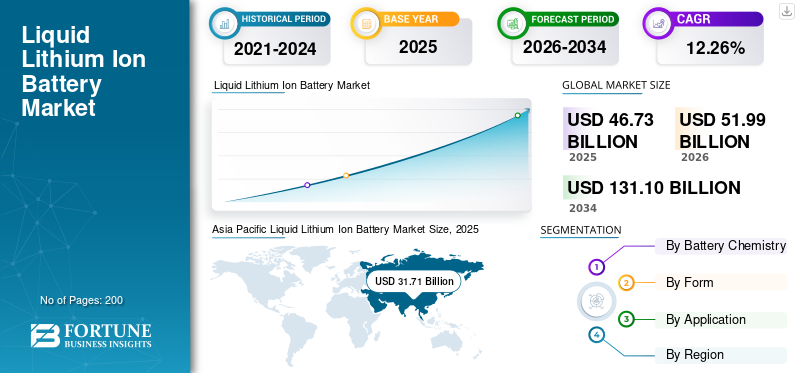
The global liquid lithium ion battery market size was valued at USD 46.73 billion in 2025. The market is projected to grow from USD 51.99 billion in 2026 to USD 131.10 billion by 2034, exhibiting a CAGR of 12.26% during the forecast period. Asia Pacific dominated the liquid lithium ion battery market with a market share of 67.86% in 2025.
A liquid lithium-ion battery is a rechargeable battery that uses a liquid electrolyte, typically composed of lithium salts dissolved in organic solvents, to facilitate the movement of lithium ions between the anode and cathode during charging and discharging. These batteries are widely used in electric vehicles, consumer electronics, energy storage systems, and industrial applications due to their high energy density, long cycle life, and mature manufacturing ecosystem.
The market share is being driven by the rapid electrification of transportation systems and the expansion of energy storage infrastructure, which are major drivers for the market. Governments worldwide are implementing stringent emission reduction targets, fuel economy regulations, and electric mobility incentives, leading to increased production capacity of electric passenger vehicles, buses, trucks, and two-wheelers. At the same time, rising investments in renewable energy projects are creating substantial demand for lithium ion batteries in battery energy storage systems to manage intermittency from solar and wind power generation.
- For instance, in April 2026, CATL, the world's largest lithium-ion battery manufacturer, unveiled six major battery innovations during its Super Technology Day in Beijing. The announcement included the third-generation Shenxing fast-charging battery, upgraded Qilin battery, new sodium-ion battery technology, and an integrated battery-swapping and supercharging network. These developments aim to improve charging speed, battery lifespan, energy density, and infrastructure integration, further strengthening the role of liquid lithium-ion batteries in electric vehicles and energy storage applications worldwide.
Some of the leading companies operating in the global liquid lithium ion battery industry include Contemporary Amperex Technology Co., Limited (CATL), BYD Company Ltd., LG Energy Solution Ltd., Samsung SDI Co., Ltd., SK On Co., Ltd., and others. BYD Company Ltd. is one of the world's leading manufacturers of liquid lithium-ion batteries, with a strong focus on Lithium Iron Phosphate (LFP) technology through its proprietary Blade Battery platform. The company leverages its vertically integrated business model, spanning battery manufacturing, electric vehicles, and energy storage systems, to supply high-performance batteries for automotive, commercial mobility, and stationary energy storage applications globally.
Download Free sample to learn more about this report.
Liquid Lithium Ion Battery Market Key Takeways
 Global Market Size & Forecast
- 2025 Market Size: USD 46.73 billion
- 2026 Market Size: USD 51.99 billion
- 2034 Forecast Market Size: USD 131.10 billion
- CAGR: 12.26% from 2026–2034
 Market Share
- Asia Pacific dominated the liquid lithium ion battery market with a 67.86% share in 2025.
- The Lithium Iron Phosphate (LFP) segment accounted for the largest market share at 41.76% in 2025.
- The cylindrical batteries segment held a leading 34.52% market share in 2025.
 Key Regional Highlights
Asia Pacific
Asia Pacific led the global market with a value of USD 31.71 billion in 2025, driven by strong battery manufacturing and EV adoption.
North America
North America was valued at USD 5.84 billion in 2025 and reached USD 6.59 billion in 2026, maintaining a significant market position.
Europe
Europe was valued at USD 6.55 billion in 2025 and is projected to expand at a 11.18% CAGR during the forecast period.
U.S.
U.S. The market was valued at USD 5.11 billion in 2025, supported by growing investments in electric mobility and energy storage.
Japan
Japan The market was estimated at USD 3.83 billion in 2025, driven by advanced battery technology development and automotive innovation.
Read More

LIQUID LITHIUM ION BATTERY MARKET TRENDS
Expansion of Battery Energy Storage Systems is the Key Market Trend
The rapid deployment of renewable energy projects is driving significant growth in Battery Energy Storage Systems (BESS), creating strong demand for liquid lithium-ion batteries. Utilities and grid operators are increasingly adopting large-scale battery storage to manage solar and wind intermittency, improve grid stability, and support peak load management. Rising investments in utility-scale, commercial, and residential energy storage projects are accelerating battery installations worldwide.
As countries pursue decarbonization targets and modernize power infrastructure, liquid lithium-ion batteries continue to dominate energy storage applications due to their high energy density, long cycle life, proven reliability, and declining manufacturing costs. This trend is further supported by government incentives, renewable energy integration policies, and growing investments in smart grids and distributed energy resources. Also, liquid lithium-ion batteries are widely used in grid scale energy storage systems and portable electronics due to their high energy density, long cycle life, and reliable performance across diverse applications.
MARKET DYNAMICS
MARKET DRIVERS
Download Free sample to learn more about this report.
Rising Electrification of Transportation and Mobility is Driving the Market Growth
The accelerating electrification of transportation is a key driver of the market. Governments across major economies are implementing stringent emission regulations, fuel efficiency standards, and EV adoption targets to reduce dependence on fossil fuels and lower carbon emissions. This has led to substantial growth in the production and sales of electric passenger cars, buses, trucks, two-wheelers, and commercial fleets, all of which rely heavily on lithium-ion battery technology.
Liquid lithium-ion batteries remain the preferred choice due to their high energy density, long cycle life, fast-charging capability, and established manufacturing ecosystem. In addition, automotive manufacturers are expanding EV portfolios and investing in battery supply chains to secure long-term battery availability. The growing need for higher driving range, improved battery performance, and cost-effective energy storage solutions continues to drive battery demand, positioning liquid lithium-ion batteries as a critical enabler of the global transportation electrification transition. These factors are anticipated to drive the liquid lithium ion battery market growth during the forecast period.
MARKET RESTRAINTS
Volatility in Critical Raw Material Supply and Pricing to Hamper the Market Demand
The market faces a significant restraint due to fluctuations in the availability and pricing of critical raw materials such as lithium, nickel, cobalt, graphite, and manganese. Growing global demand from electric vehicles, energy storage systems, and consumer electronics has intensified competition for these materials, creating supply chain uncertainties and procurement challenges for battery manufacturers.
Geopolitical tensions, mining permit delays, environmental regulations, and concentration of mineral processing capacities in a limited number of countries can further impact raw material availability and pricing stability. Sudden increases in material costs directly affect battery production expenses and can influence the affordability of electric vehicles and energy storage projects. Additionally, supply disruptions may delay manufacturing expansion plans and project deployments. As a result, battery manufacturers are increasingly pursuing material diversification, recycling initiatives, and alternative chemistries to mitigate supply risks and improve long-term supply chain resilience.
MARKET OPPORTUNITIES
Expansion of Grid-Scale Energy Storage and Renewable Energy Integration to Create New Revenue Opportunities
The increasing deployment of renewable energy projects presents a significant growth opportunity for the market. As solar and wind power installations continue to expand globally, the need for efficient energy storage solutions is becoming critical to address intermittency challenges and ensure grid reliability. Utilities, independent power producers, and commercial energy users are investing in large-scale BESS to support renewable energy integration, peak shaving, frequency regulation, and backup power applications. Liquid lithium-ion batteries are well-positioned to benefit from this trend due to their high energy density, operational flexibility, mature supply chain, and proven commercial performance. In addition, government initiatives promoting clean energy transition, grid modernization, and energy security are encouraging greater adoption of battery storage infrastructure.
MARKET CHALLENGES
Limited Battery Safety, Thermal Management, and Performance Reliability Creates Market Challenges
Ensuring battery safety and maintaining reliable performance under diverse operating conditions remain major challenges for the market. Since these batteries use flammable liquid electrolytes, they are susceptible to thermal runaway, overheating, and fire risks if exposed to mechanical damage, manufacturing defects, overcharging, or extreme temperatures. As battery capacities increase for electric vehicles and large-scale energy storage systems, manufacturers face greater complexity in designing advanced thermal management systems and Battery Management Systems (BMS) to ensure safe operation. Additionally, maintaining battery performance over extended charge-discharge cycles while minimizing degradation presents a significant technical challenge.
Segmentation Analysis
By Battery Chemistry
Lithium Iron Phosphate (LFP) Dominates Due to the Cost-Effectiveness of LFP Batteries
Based on battery chemistry, the market is classified into Lithium Iron Phosphate (LFP), Nickel Manganese Cobalt (NMC), Nickel Cobalt Aluminum (NCA), Lithium Cobalt Oxide (LCO), and others.
In 2025, Lithium Iron Phosphate (LFP) dominated the liquid lithium ion battery market share, accounting for 41.76% of the market. The LFP batteries are widely adopted in electric vehicles, buses, commercial fleets, and stationary energy storage systems where cost efficiency and operational reliability are key priorities. LFP batteries offer excellent thermal stability, minimizing the risk of overheating and improving overall battery safety. In addition, continuous advancements in cell design and manufacturing have significantly improved their energy density, making them increasingly competitive with nickel-based chemistries.
The Nickel Cobalt Aluminum (NCA) segment is expected to grow at a CAGR of 12.70% over the forecast period.
To know how our report can help streamline your business, Speak to Analyst
By Form
Cylindrical Batteries Segment Dominated Owing to Mature Manufacturing Process and Robust Mechanical Structure
Based on form, the market is classified into cylindrical batteries, prismatic batteries, pouch batteries, and others.
In 2025, the cylindrical batteries segment dominated the global market, accounting for 34.52% share. The cylindrical batteries have a standardized design that enables highly automated production, resulting in consistent quality, improved scalability, and lower manufacturing costs compared to some alternative battery formats. Cylindrical cells also offer excellent thermal management characteristics and mechanical stability, making them suitable for electric vehicles, power tools, consumer electronics, and industrial applications. Leading automotive manufacturers have extensively utilized cylindrical batteries due to their proven performance, reliability, and long operational lifespan. Continuous advancements in high-capacity cylindrical cell designs, including larger-format cells, are further improving energy density and charging performance.
The pouch batteries segment is expected to grow at the highest CAGR of 14.07% over the forecast period.
By Application
Electric Vehicles (EVs) Segment Led Due to Increased Transition Toward Sustainable Transportation
On the basis of application, the market is classified into Electric Vehicles (EVs), consumer electronics, Energy Storage Systems (ESS), industrial equipment, and others.
In 2025, the Electric Vehicles (EVs) segment dominated the global market, accounting for 62.68% share. Governments worldwide are promoting EV adoption through emission reduction targets, fuel economy regulations, tax incentives, and investments in charging infrastructure. Liquid lithium-ion batteries are the preferred energy storage technology for EVs as they offer high energy density, long driving range, fast-charging capability, and extended cycle life. Automakers are significantly expanding their electric vehicle portfolios while investing in battery manufacturing and supply chain localization to secure long-term battery availability.
The Energy Storage Systems (ESS) segment is expected to grow at a CAGR of 14.01% over the forecast period.
Liquid Lithium Ion Battery Market Regional Outlook
By region, the market is categorized into North America, Europe, Asia Pacific, Latin America, and the Middle East & Africa.
Asia Pacific
Asia Pacific Liquid Lithium Ion Battery Market Size, 2025 (USD Billion)
To get more information on the regional analysis of this market, Download Free sample
Asia Pacific was estimated to account for a dominant market share and reached USD 31.71 billion in 2025. In the region, India and China reached a valuation of USD 3.83 billion and 21.00 USD billion, respectively, in 2025.
The region’s dominance is due to its concentration of battery cell manufacturing, raw material processing, and battery component production facilities. China, South Korea, and Japan continue to expand investments in advanced battery technologies, while emerging markets such as India, Indonesia, and Thailand are attracting significant investments in battery manufacturing and EV supply chains.
India Liquid Lithium Ion Battery Market
The Indian market size accounted for roughly 8.19% of global revenues. India is emerging as a strategic market for liquid lithium-ion batteries due to the implementation of the Advanced Chemistry Cell (ACC) Production Linked Incentive (PLI) scheme and growing investments in domestic cell manufacturing.
China Liquid Lithium Ion Battery Market
In the Asia Pacific region, the China market represents roughly 44.93% of the global revenues.
Japan Liquid Lithium Ion Battery Market
The Japan market in 2025 was estimated at around USD 3.83 billion, accounting for roughly 6.10% of global revenues.
North America
The North America market in 2025 was valued at USD 5.84 billion, and also took a significant share in 2026 with USD 6.59 billion.
North America's market is being driven by unprecedented investments in domestic battery manufacturing and supply chain localization. The U.S. Department of Energy has supported multiple battery manufacturing and critical mineral processing projects. On the other hand, major companies, including LG Energy Solution, Panasonic, Samsung SDI, SK On, Ford, General Motors, and Tesla, are expanding gigafactory capacity across the U.S. and Canada.
U.S. Liquid Lithium Ion Battery Market
Based on North America’s strong contribution and the U.S. dominance within the region, the U.S. market was analytically approximated at USD 5.11 billion in 2025, accounting for roughly 10.95% of the global market size.
Europe
Europe accounted for significant market share, valuing at USD 6.55 billion in 2025, and is projected to record a growth rate of 11.18% in the coming years. Europe's market is being driven by the rapid expansion of regional battery manufacturing under the European Battery Alliance and large-scale investments in gigafactories across Germany, Sweden, France, and Hungary. Automakers, including Volkswagen, Mercedes-Benz, BMW, Stellantis, and Renault, are securing local battery supply through strategic partnerships and long-term procurement agreements.
Germany Liquid Lithium Ion Battery Market
The Germany market in 2025 was valued at around USD 2.01 billion and is estimated to reach USD 2.24 billion in 2026, representing roughly 4.31% of the global revenues. Germany is strengthening its position in the market through significant investments in battery recycling, cathode material production, and battery research initiatives. The country is also emerging as a key hub for stationary battery energy storage projects, driven by increasing renewable energy penetration and grid balancing requirements.
Latin America
Latin America is expected to witness moderate growth in this market space in the long term. The market reached a valuation of USD 1.39 billion in 2025.
Latin America is witnessing increasing demand for liquid lithium-ion batteries driven by the expansion of renewable energy storage projects and growing electrification initiatives. The region also benefits from its strategic position in the global battery supply chain, particularly through lithium resource development in countries such as Chile and Argentina. It is further encouraging investments in battery materials processing and energy storage infrastructure.
Brazil Liquid Lithium Ion Battery Market
Brazil's market value reached at around USD 0.67 billion in 2025, representing roughly 1.43% of the market.
Middle East & Africa
The Middle East & Africa region is expected to witness significant growth in this market space during the forecast period. However, the region’s market reached a valuation of USD 1.24 billion in 2025.
The Middle East & Africa market is gaining momentum through large-scale battery energy storage deployments, supporting solar and wind power projects, particularly in the GCC region.
GCC Liquid lithium ion battery Market
The GCC market was valued at around USD 0.62 billion in 2025, representing roughly 1.32% of the global market.
COMPETITIVE LANDSCAPE
Key Industry Players
Major Players are Actively Expanding Market Share via Partnerships, Business Expansion, and Technological Advancements
The global liquid lithium ion battery market holds a consolidated market structure, constituting prominent players such as contemporary amperex technology co limited (CATL), BYD Company Ltd., LG Energy Solution Ltd., and others. Market participants are focusing on growth strategies such as product portfolio expansion, technical advancements, increasing manufacturing capabilities, and other strategic initiatives to reinforce their competitive presence.
- In March 2026, CATL announced the expansion of its Shenxing fast-charging lithium-ion battery platform, designed for next-generation electric vehicles using advanced liquid electrolyte technology. The company focused on improving charging speed, energy density, and low-temperature performance while supporting large-scale EV deployment. CATL also strengthened partnerships with global automakers to integrate its high-performance liquid lithium-ion batteries into upcoming vehicle platforms.
Moreover, other key players operating in the global market include BYD Company Ltd., LG Energy Solution Ltd., and Samsung SDI Co., Ltd. During the forecast period, these companies are anticipated to prioritize new product launches and collaborations to enhance their global market share.
LIST OF KEY LIQUID LITHIUM ION BATTERY COMPANIES PROFILED
- CATL (China)
- BYD Company Ltd. (China)
- LG Energy Solution Ltd. (South Korea)
- Samsung SDI Co., Ltd. (South Korea)
- SK On Co., Ltd. (South Korea)
- Panasonic Energy Co., Ltd. (Japan)
- EVE Energy Co., Ltd. (China)
- CALB (China)
- Gotion High-Tech Co., Ltd. (China)
- Sunwoda Electronic Co., Ltd. (China)
- SVOLT Energy Technology Co., Ltd. (China)
- AESC Group Ltd. (Japan)
KEY INDUSTRY DEVELOPMENTS
- March 2026: Sunwoda expanded its liquid lithium-ion battery business through new investments in electric vehicle battery production. The initiative included manufacturing capacity additions and the development of higher-energy-density battery cells. Sunwoda also enhanced collaboration with automotive customers to accelerate battery integration into next-generation EV platforms. The company’s efforts focus on improving battery safety, charging speed, and operational efficiency while strengthening its position in the competitive global lithium-ion battery industry.
- February 2026: Gotion High-Tech announced the expansion of its lithium-ion battery manufacturing operations and accelerated commercialization of high-performance battery technologies. The company focused on improving liquid lithium-ion battery efficiency, safety, and charging performance for EV and ESS applications.
- February 2026: Panasonic Energy accelerated production expansion for advanced cylindrical liquid lithium-ion batteries used in electric vehicles. The company invested in manufacturing upgrades to improve energy density and cell reliability while reducing production costs. Panasonic also advanced the development of silicon-based anode materials to enhance battery performance and charging characteristics.
- January 2026: SK On announced plans to increase liquid lithium-ion battery manufacturing capacity through investments in North American production facilities. The initiative focused on high-nickel NCM battery technologies designed for long-range electric vehicles. SK On also expanded partnerships with leading automakers to secure long-term supply agreements and support regional battery localization efforts.
- January 2026: CALB expanded its liquid lithium-ion battery manufacturing footprint through new production investments in China. The company focused on advanced battery chemistries designed for electric vehicles and grid-scale energy storage projects. CALB also introduced technology improvements targeting higher energy density and improved thermal management performance. The initiative supports the company’s objective of increasing market share in the global battery sector while meeting the growing requirements of vehicle manufacturers and energy storage developers.
REPORT COVERAGE
The global liquid lithium ion battery market analysis provides an in-depth study of the market size & forecast by all the market segments included in the report. It includes details on the market dynamics and the market trends expected to drive the market in the forecast period. It offers information on the technological advancements, new product launches, key industry developments, and details on partnerships, mergers & acquisitions. The market research report also encompasses a detailed competitive landscape with information on the market share and profiles of key operating players.
Request for Customization to gain extensive market insights.
Report Scope & Segmentation
| ATTRIBUTE | DETAILS |
| Study Period | 2021-2034 |
| Base Year | 2025 |
| Estimated Year | 2026 |
| Forecast Period | 2026-2034 |
| Historical Period | 2021-2024 |
| Growth Rate | CAGR of 12.26% from 2026 to 2034 |
| Unit | Value (USD Billion) |
| Segmentation | By Battery Chemistry, Form, Application, and Region |
| By Battery Chemistry |
|
| By Form |
|
| By Application |
|
| By Region |
|
Frequently Asked Questions
Fortune Business Insights says that the global market value stood at USD 46.73 billion in 2025 and is projected to reach USD 131.10 billion by 2034.
In 2025, the market value stood at USD 31.71 billion.
The market is expected to exhibit a CAGR of 12.26% during the forecast period.
The Lithium Iron Phosphate (LFP) segment led the market by battery chemistry.
The market is primarily driven by accelerating electric vehicle adoption, expanding energy storage deployments, increasing demand for high-energy-density batteries, and ongoing advancements in lithium-ion battery materials and manufacturing technologies.
CATL, BYD Company Ltd., and LG Energy Solution Ltd. are some of the prominent players in the market.
Asia Pacific dominated the market in 2025.
Growing EV production, increasing renewable energy storage requirements, and declining battery costs are the major factors expected to favor adoption.


- 2021-2034
- 2025
- 2021-2024
- 200
Get 30-60 hrs Free Customization
Expand Regional and Country Coverage, Segments Analysis, Company Profiles, Competitive Benchmarking, and End-user Insights.










Related Reports
-
US +1 833 909 2966 ( Toll Free )
-
Get In Touch With Us